
Prestige, Career Paths, and Job Satisfaction Among Recent Philosophy PhDs (guest post)
Philosophy PhDs whose family backgrounds are higher in socioeconomic status are more likely to earn their doctorates from more prestigious programs. The graduates of more prestigious PhD programs are more likely to prefer academic employment to non-academic employment, and to obtain it.
Those are among the several findings shared in this guest post by Kino Zhao, assistant professor of philosophy at Simon Fraser University and one of the co-directors of the Academic Philosophy Data & Analysis (APDA) project.
The analysis is based on information in the APDA database and responses to its 2025 survey.
(A version of this post appears at The APDA Blog.)

Edgar Degas, “Portraits at the Stock Exchange” (detail)
Prestige, Career Paths, and Job Satisfaction Among Recent Philosophy PhDs
by Kino Zhao
In an earlier post, Carolyn Dicey Jennings reported some findings concerning career paths of philosophy PhDs that was based on data collected from program websites and other online sources. In this post, I discuss some findings on academic vs non-academic career paths that are based on both the APDA database and the 2025 survey.
Description of Data
I draw on two different data sources for this analysis. The first, I will call Coded Data, is a dataset we maintain by manually tracking down placement data on graduates from 150 English-speaking philosophy PhD programs (using a combination of department placement pages and internet searches, and input from program representatives and the individuals themselves). This dataset is not anonymous to APDA personnel or program representatives (names are removed for the broader public), but it only contains what is publicly available such as one’s employing institution and job title, alongside names and basic contact information (email).
Everyone from this dataset for whom we can find contact information is invited to participate in the survey we conduct every two years, resulting in what I will call Survey Data. The survey data is anonymous. It asks respondents to report things like whether they are satisfied with their current employment without providing us a way of knowing who their employers are (for obvious reasons).
For a more comprehensive overview of the methodology behind these two datasets, see this methodology paper.
For this analysis, I am only looking at people who graduated in the year 2015 or after. All incomplete entries are dropped.
| Dataset Characteristic | Count | Percentage |
|---|---|---|
| Total employment outcomes in coded data | 5,521 | 100.0% |
| Permanent academic employment | 2,236 | 40.5% |
| TT or equivalent | 1,759 | 31.9% |
| Permanent lecturer or similar | 477 | 8.6% |
| Temporary academic employment | 2,312 | 41.9% |
| Non-academic employment | 973 | 17.6% |
–
| Dataset Characteristic | Count | Percentage |
|---|---|---|
| Total individuals in survey | 703 | 100.0% |
| Individuals in academic employment | 591 | 84.1% |
| Permanent | 406 | 57.8% |
| Temporary | 179 | 25.5% |
| Not available (NA) | 6 | 0.9% |
| Individuals in non-academic employment | 91 | 12.9% |
| Unemployed individuals | 21 | 3.0% |
Prestige and Career Path
A 2018 paper by Helen De Cruz and a 2019 analysis by Jonathan Weisberg both explored the role prestige (as approximated by the Philosophical Gourmet Report ranking) plays in the academic job market. Following De Cruz, I put institutions into three categories based on the 2021 Philosophical Gourmet Report (PGR) (accessed 2026-03-20: table “in the English speaking world”): PGR 1-20, PGR 21-50, and PGR unranked.[1] [2]
| Dataset Characteristic | Coded Data | Survey Data |
|---|---|---|
| PhD Prestige | ||
| PGR Top 20 | 1152 | 398 |
| PGR 21–50 | 1015 | 226 |
| PGR Unranked | 2954 | 513 |
| Employment Type | ||
| Academic | 4,471 | 591 |
| Permanent academic | 2,194 | 406 |
| Temporary academic | 2,277 | 179 |
| Academic type unavailable | — | 6 |
| Non-ac. | 973 | 91 |
| Unemployed | — | 21 |
Academic vs. Non-Academic
Higher PGR ranking is associated with greater probability of academic employment. This is confirmed in both datasets (in the case of Coded Data, only most recent employment type is counted).
| Graduating Institution | Coded Data | Survey Data | ||
|---|---|---|---|---|
| Academic | Non-ac. | Academic | Non-ac. | |
| PGR Top 20 | 1,339 (86.3%) | 213 (13.7%) | 209 (90.9%) | 21 (9.1%) |
| PGR 21–50 | 842 (83.0%) | 173 (17.0%) | 116 (87.2%) | 17 (12.8%) |
| PGR Unranked | 2,367 (80.1%) | 587 (19.9%) | 264 (83.3%) | 53 (16.7%) |
| Pearson χ² test | χ²(2) = 26.77, p < .001 | χ²(2) = 6.67, p = .036 | ||
In the 2025 survey, we asked “what kind of employment would you prefer?” The options were “academic” (n=961 total), “no strong preference” (n=105 total), and “non-academic” (n=66 total). 88.8% of PGR 1-20 graduates and 88% of PGR 21-50 graduates prefer academic employment, while 80% of PGR unranked graduates do. Although the numbers are close, the difference is statistically significant (p<0.005). Graduates from PGR ranked institutions have a slightly higher probability of preferring academic employment.
Although the difference looks small, it does seem to account for much of the relationship between prestige and ac/non-ac job outcomes. After controlling for career preference, prestige is no longer significantly associated with ac/non-ac employment (p≈0.1). On the other hand, even after controlling for prestige, career preference is still significantly associated with employment type (p<0.0001).[4]
In addition to PGR ranking, the 2025 survey asks “how likely would you be to recommend this program to prospective PhD students?” on a scale from “definitely would not recommend” to “neither likely nor unlikely” to “definitely would recommend”. This subjective evaluation of graduating program is significantly associated with obtaining academic as opposed to non-academic employment (higher rating predicts academic, p<0.001). 91% of those rating their programs as “definitely would recommend” are in academic employment, compared to 61% of those rating “definitely would not recommend”.
Permanent vs. Temporary Academic
Restricting attention to academics, to see whether PGR ranking makes a difference to whether an academic lands a permanent job or a temporary job, we must keep in mind that more recent graduates are less likely to be in permanent employment.
In Coded Data: counting only the most recent employment type and controlling for graduation year, PGR ranking is significantly correlated with gaining permanent employment (n=4471, p<0.0001).
In Survey Data: controlling for graduation year, gender, and childhood SES, PGR ranking is significantly correlated with gaining permanent employment (n=585, p≈0.005).
Among academics, higher PGR ranking is associated with greater probability of permanent academic employment. Of all academics and after controlling for gender, socioeconomic background, and graduation year, a regression model predicts 70% probability of permanent employment in PGR unranked graduates, 76% in PGR 21-50, and 82% in PGR 1-20. Note that the difference between 70% and 82% is statistically significant (p≈0.015) but the differences between the other two pairs are not significant.
Subjective evaluation of graduating program is not significantly associated with obtaining a permanent as opposed to temporary academic job (even after controlling for gender, SES, and graduating year).
Tenure-track or Equivalent: Prestige and Year Lap
Restricting attention to people with Tenure-track or equivalent, we may ask whether prestigious jobs go to prestigious graduates. This is a new iteration of De Cruz’s 2018 analysis. Because we do not ask people’s current employment institution in our survey, this is done using Coded Data only. This means that the analysis cannot be run with subjective evaluation of graduating program. Once again, the most recent placement is counted in case of duplication.[5]
| Origin of PhD | PGR Top 20 | PGR 21–50 | Unranked | Total |
|---|---|---|---|---|
| PGR Top 20 | 93 (14.9%) | 53 (8.5%) | 477 (76.6%) | 623 (100.0%) |
| PGR 21–50 | 11 (3.3%) | 11 (3.3%) | 314 (93.5%) | 336 (100.0%) |
| PGR Unranked | 21 (2.6%) | 12 (1.5%) | 767 (95.9%) | 800 (100.0%) |
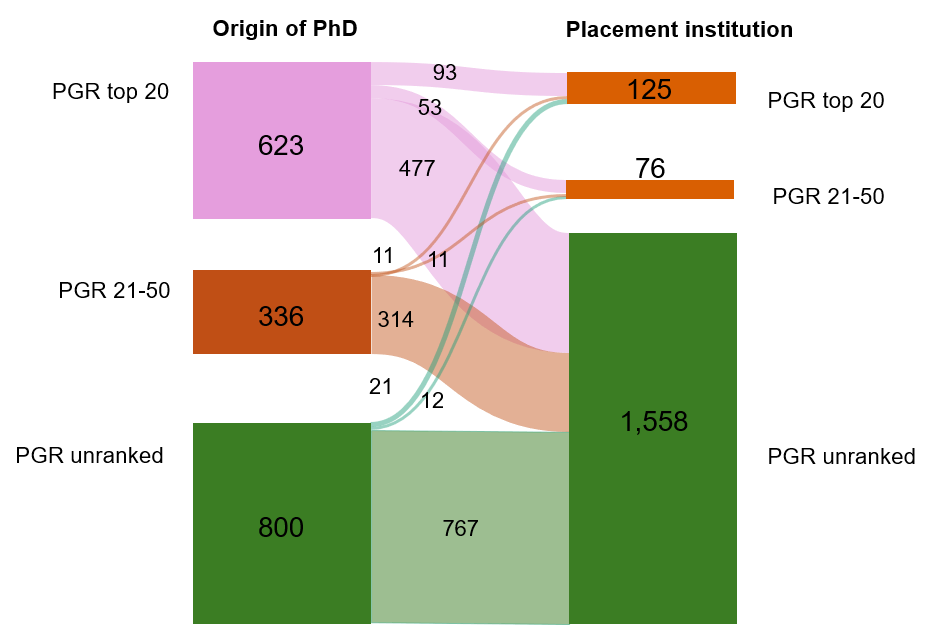
Figure 1: Sankey diagram of the effect of graduating program prestige (measured by PGR ranking) on placement program prestige.
Among those who are tenure-track or equivalent, higher PGR ranking in one’s graduating institution leads to higher PGR ranking in one’s placement institution.
Among tenure-track job holders, prestige makes no difference in the average time between graduation and first tenure-track job (with the mean at about 1.4 years and the max being 8 years in all three categories, with variance between 2.3-2.8. Note that because the dataset is restricted to 2015-2025 grads, the theoretical maximum time difference is 10 years.)
Employment Satisfaction
This analysis can only be done with Survey Data, where we ask “how satisfied are you in your current employment?” The answer is given on a 5-point scale from “very unsatisfied” to “neutral” to “very satisfied”.
There is no significant difference in satisfaction between academics as a whole and non-academics, nor is there a difference between permanent academics and non-academics.
Of academics, permanent job holders are significantly more satisfied than temporary job holders (p<0.0001). This also means that more recent graduates are likely to be less satisfied with their employment than earlier graduates.
Gender by itself does not significantly affect employment satisfaction. Childhood socioeconomic status has a marginal effect (p≈0.08). These factors will be controlled for in the following analyses.
Analyzed directly, both prestige (measured by PGR ranking) and respondent’s subjective evaluation of program (measured by the survey) are significantly positively correlated with employment satisfaction and significantly positively correlated with each other. Several regression models are run in order to disentangle the relationships.
Controlling for prestige tempers the effect of subjective evaluation on employment satisfaction and vice versa, but both associations remain statistically significant (p<0.02). This means that there are two distinct pathways that contribute to employment satisfaction.
Among academics, controlling for permanent/temporary job status makes prestige no longer significantly associated with employment satisfaction. Controlling for academic/non-academic employment makes no difference, which is not surprising since academics have similar employment satisfaction as non-academics.
On the other hand, since subjective evaluation of graduating institution is not significantly associated with obtaining a permanent academic job, controlling for permanent/temporary job status does not change the positive association between subjective evaluation of program and employment satisfaction, neither does controlling for academic vs. non-academic job.
Gender & Socioeconomic Status
This analysis is done with Survey Data only.
The 2025 survey asks respondents to report their gender. The options are “man”, “non-binary”, “woman”, and “other”. For this analysis, “non-binary” and “other” are grouped together. Empty entries are dropped. In our survey, 341 (30.3%) identify as women, 729 (64.9%) identify as men, and 54 (4.8%) identify as non-binary or other. Due to the small number of those identifying as non-binary or other, statistical testing is not always informative. I will include the numbers when the difference seems relevant.[6]
Gender has no direct effect on whether one is currently in academic or non-academic employment. In our survey, 88% of women, 82% of men, and 89% of non-binary or other are in academic employment.
Of those in academic employment, gender also has no direct effect on whether one is in permanent as opposed to temporary academic position. However, there are several caveats here, making the results difficult to interpret. Women are slightly more likely to graduate from PGR 1-20 programs than men (40% vs 33%, p≈0.083) and slightly more likely to graduate more recently. Controlling for prestige, SES, and graduation year, being women is significantly associated with being in permanent academic employment (p≈0.015) when compared to men. The predicted probabilities of obtaining permanent academic employments after controlling for those factors are 83% for women, 72% for men, 74% for non-binary or other (note that these probabilities are predicted by the regression model, rather than calculated from the dataset. In our dataset, 71% women, 69% men, and 63% non-binary/other are in permanent, as opposed to temporary, academic employment. This difference is not significant.)
Gender has no effect on employment satisfaction. There is no discernible difference in SES distribution among the three gender categories.
The 2025 survey asks respondents “what was your family’s socioeconomic status (SES) growing up?” on a 5-point scale. In our survey, 118 (10.5%) report “lower”, 262 (23.4%) “lower-middle”, 393 (35%) “middle”, 312 (27.8%) “upper-middle”, and 37 (3.3%) “upper”.
SES has no direct effect on whether one is currently in academic or non-academic employment, or permanent/temporary academic employment, or employment satisfaction. However, SES is significantly associated with graduating from prestigious programs (p<0.0001).
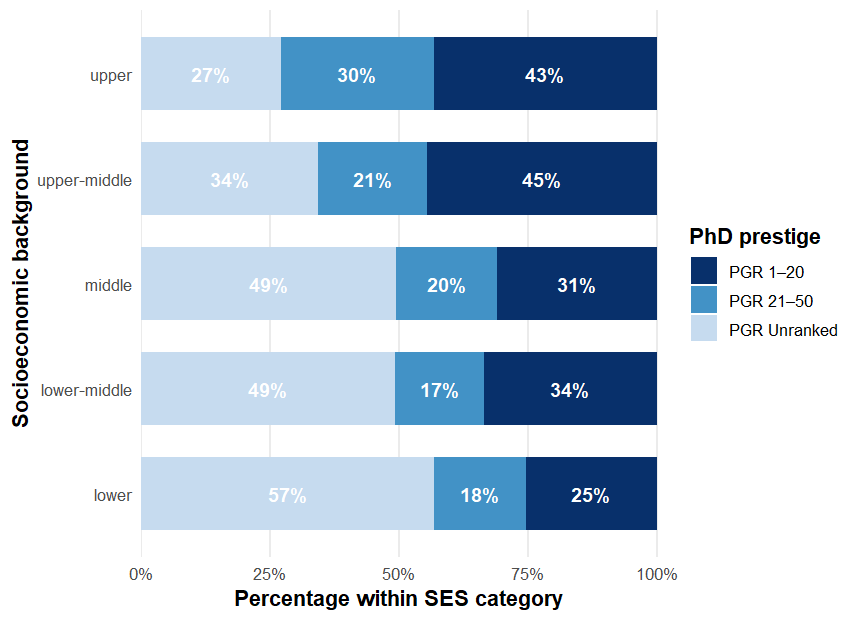
Figure 2: stacked bar chart of the effect of childhood socioeconomic status on the prestige of graduating programs (measured by PGR ranking).
Alternatively, we can visualize what percentages of people come from different SES backgrounds in the three prestige categories.
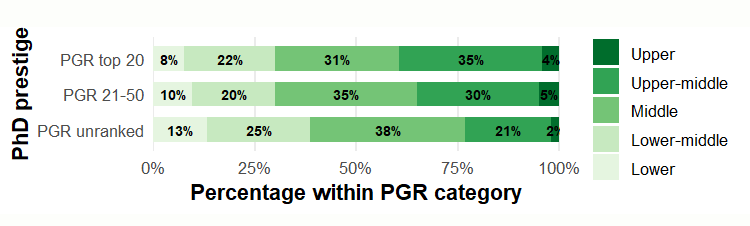
Figure 3: stacked bar chart of the SES distribution by program prestige.
Key Takeaways
- Graduates from higher PGR ranking institutions are more likely to prefer academic employment. They are also more likely to obtain academic, as opposed to non-academic, employment.
- Among academic job holders, high PGR ranking is associated with greater probability of obtaining permanent, as opposed to temporary, employment, after controlling for graduation year and gender.
- Among those who are tenure-track or equivalent, higher PGR ranking in one’s graduating institution leads to higher PGR ranking in one’s placement institution. PGR ranking makes no difference to how long it takes one to obtain one’s first tenure-track position.
- There is no significant difference in employment satisfaction between academics as a whole and non-academics, nor is there a difference between permanent academics and non-academics.
- Of academics, permanent job holders are significantly more satisfied with their employment than temporary job holders.
- Graduates from higher PGR ranked programs are happier about their current employment, though this relationship is likely explained by the fact that they are more likely to hold permanent academic positions.
- Graduates who evaluate their programs highly are more likely to be in academic, as opposed to non-academic, employment, but it makes no difference to whether they are currently in permanent or temporary employment.
- Graduates who evaluate their programs highly are more likely to be happier with their job, regardless of what job type they have. The effect persists after controlling for job type.
- Gender has no direct effect on employment satisfaction.
- Women are slightly more likely to have graduated more recently and from higher-ranked programs. After controlling for these factors, women are still slightly more likely to be in permanent, as opposed to temporary, academic employment than men.
- People with high family SES are more likely to graduate from PGR top programs, though this does not seem to affect the type of employment they obtain.
Notes:
[1] There are 24 institutions ranked as top 20. Four of these institutions have two philosophy departments that are not listed separately by the PGR. This results in 28 departments listed as top 20. For ease of understanding, I will still refer to them as PGR 1-20. Likewise, there are 31 departments in the next category, which is technically PGR 25-50, but I will refer to them as PGR 21-50.
[2] A 2022 paper by Kallens, Hicks, & Jennings measures prestige not through PGR, but through clustered hiring practices. This paper also contains analyses on variables such as AOS, which is not included in this blog post.
[3] The numbers reported in Table 3 are all of unique individuals. People with multiple job entries in the Coded Data are counted by the most recent employment. Note also that it is generally more difficult to track down graduates with non-academic employment.
[4] It is possible that people go into highly ranked programs because they prefer academic employment. However, because of the way the survey question is framed, it is also possible that respondents interpret the question to be about their current career preference, and that the result simply suggests that current academics are happy being academics, while current non-academics are happy being non-academics.
[5] There are two types of permanent academic employment in our database, “TT or equivalent” and “permanent lecturer or equivalent”. Because the role of the latter category differs greatly across institutions, this analysis only focuses on those listed as “TT or equivalent”, which also includes “Lecturers” from British and Australian institutions. Nevertheless, there is a higher error rate of misclassification of UK-style Lecturers into the “permanent lecturer” as opposed to “TT” category. Consequently, this analysis may possess a stronger US-bias beyond the base rate of overrepresentation of US institutions.
[6] In addition to gender identity, the 2025 survey also asks whether the respondent identifies as trans. The overall number of respondents identifying as trans is relatively small and greatly overlaps with those identifying as non-binary or other. Consequently, the variable of trans identity is not analyzed separately. Note that this is a different methodological decision than some of the other analyses we did with this data. In particular, trans men and trans women are grouped with cis men and cis women, respectively, in the current analysis, as opposed to a “gender nonconforming” category, as in the previous analysis.
Related:
– Gender, Publications, Teaching, and Satisfaction in the Early Stages of a Philosophy Career
– Publishing, Teaching, and the Philosophy Job Market
– Unions, Strikes, and the Financial Satisfaction of Philosophy PhD Students
– Placement, Program Ratings, Student Comments, and Keywords: an APDA Update
Thanks Kino (and everyone else) for all of the hard work that went into this! Very interesting, and very useful