
How many publications do early career job applicants in academic philosophy have? How many courses have they taught? How have the answers to these questions changed over the past decade?
These are some of the questions addressed by Travis LaCroix in the following guest post. Dr. LaCroix is assistant professor of philosophy at Durham University and co-director of Academic Philosophy Data Analysis (APDA).
The post is based on data gathered in the 2025 APDA survey.
(A version of this post also appears at the APDA blog.)

Publishing, Teaching, and the Philosophy Job Market
by Travis LaCroix
How much publication and teaching experience is “enough” to secure a stable career in academic philosophy? Is a modest record at graduation sufficient, or is there an implicit expectation that scholars substantially expand both their research and instructional portfolios during postdoctoral or contingent employment years? To explore these questions, we analyze a decade of data tracking graduates from 2014 through 2025 solicited from the 2025 APDA survey.
The synopsis: while both publication counts and teaching volume increase steadily across career stages, they follow distinct paths. Publication counts show a “more is better” signal for academic retention, with a portfolio of roughly 4–5 articles being typical by the time scholars secure their first permanent position. In contrast, teaching experience appears to reach a point of diminishing returns; those who secure permanent roles often graduate with less total teaching volume than those in contingent roles, suggesting that institutional prestige and formal pedagogical support often outweigh raw instructional quantity.
Importantly, our analysis reveals that these two metrics are statistically independent. There is no evidence of a “trade-off” between teaching and publication experience, where focusing on one detracts from the other; rather, they represent two separate pipelines shaped by departmental funding models, institutional prestige, and disciplinary norms.
Summary Statistics
We begin with a summary of statistics across key career stages.
Publications
Current students report a mean of 1.26 articles (median = 0, n = 165), indicating that most current students (across all years) have not yet published. At graduation, the mean rises to 2.01 articles (median = 1, n = 296). By the time of first permanent position, the mean increases to 5.45 articles (median = 4, n = 255).
Book publications remain comparatively rare at early stages: even among those in permanent roles, the mean number of books is 0.51 (median = 0, n = 255), with a small number of highly productive individuals raising the average.
| Career Stage | Mean (Avg.) | Median | Max | Sample (n) |
|---|---|---|---|---|
| Current Student (Articles) |
1.26 | 0 | 12 | 165 |
| At Graduation (Articles) |
2.01 | 1 | 25 | 296 |
| At Time of First Permanent Position (Articles) |
5.45 | 4 | 50 | 255 |
| At Time of First Permanent Position (Books) |
0.51 | 0 | 10 | 255 |
These figures illustrate a clear “publication pipeline”. Among current students, more than half report zero publications, reflecting early-stage enrolment. By graduation, the distribution shifts, with one publication becoming the most common outcome. At the point of permanent hire, the distribution becomes strongly right-skewed: while the median is 4 articles, a small subset of respondents reports between 10 and 50 publications, pulling the mean upward. (This skew is a recurring feature throughout the dataset.) [1]
Teaching
Considering summary statistics across key career stages for teaching experience, current students report a mean of 2.69 unique course types taught as “instructor of record” (median = 2.0, n = 264), indicating that unlike publications, most graduate students begin accumulating independent teaching experience early in their programs. At graduation, the mean rises to 4.95 course types (median = 3.0, n = 618). By the time of first permanent position, the mean increases to 7.46 course types (median = 5.0, n = 371).
The volume of teaching, measured in total course offerings (tokens), follows a similar upward trajectory steadily increasing from current student (mean = 4.40, median = 2.0, n = 205) to graduation (mean = 8.77, median = 5.0, n = 535) to first permanent hire (mean = 11.07, median = 8.0, n = 336). Even at the earliest stages, students have typically taught several distinct course offerings and several duplicate sections, and this number approximately doubles by the time a permanent hire is secured.
| Career Stage | Mean (Avg.) | Median | Min | Max | Sample Size (n) |
|---|---|---|---|---|---|
| Current Student (Type) |
2.69 | 2.0 | 0 | 27 | 264 |
| Current Student (Token) |
4.40 | 2.0 | 0 | 50 | 205 |
| At Graduation (Type) |
4.95 | 3.0 | 0 | 50 | 618 |
| At Graduation (Token) |
8.77 | 5.0 | 0 | 50 | 535 |
| At First Permanent Hire (Type) |
7.46 | 5.0 | 0 | 50 | 371 |
| At First Permanent Hire (Token) |
11.07 | 8.0 | 0 | 50 | 336 |
As with publication, these figures illustrate a steady “teaching pipeline”. Among current students, the majority have already served as instructors of record, perhaps reflecting the heavy reliance on graduate student labor in the discipline. By graduation, the distribution shifts, with three distinct course types becoming the most common threshold. At the point of permanent hire, the distribution remains right-skewed: while the median is 5 unique course types and 8 total offerings, a subset of respondents reports teaching as many as 50 courses (note that this was the maximum value allowed in the survey), pulling the mean upward. This skew suggests that while a moderate teaching load is standard, a significant portion of the candidate pool enters permanent positions with extremely high volumes of instructional experience. [2]
The Publication Pipeline
One notable pattern in the publication pipeline is the “graduation gap”: the transition from current student to graduate is associated with a substantial increase in output, with average publication counts rising by approximately 60%. (This is partly explained by the variance in time between those who count as “current students”—i.e., 1st year PhD candidates, who are less likely to have a publication, versus ABD candidates, who are more likely to have a publication.)
A second pattern is the “permanent threshold”: although there is no strict cutoff, the typical successful candidate has accumulated several additional publications after graduation, bringing their total to approximately 4–5 articles by the time of permanent hire.
Across all years, publication counts exhibit high variability. In most cohorts, the standard deviation exceeds the mean, and the range extends from 0 to as many as 30+ articles at graduation. This indicates a highly skewed distribution in which a small number of outliers significantly influence averages, while the median remains comparatively low (often between 0 and 2 publications).
Trends Across Time
Publication Rates
When we examine trends over time, publication rates at graduation remain relatively stable. The mean number of articles fluctuates between roughly 2 and 4 across cohorts from 2014 to 2025, with no significant upward or downward trend. Although there is a slight negative slope in the data, it is not statistically significant, and year-to-year variability is substantial.
In short, despite (potentially) common perceptions that publication expectations are rising, the baseline number of articles at graduation has remained broadly consistent over the past decade.
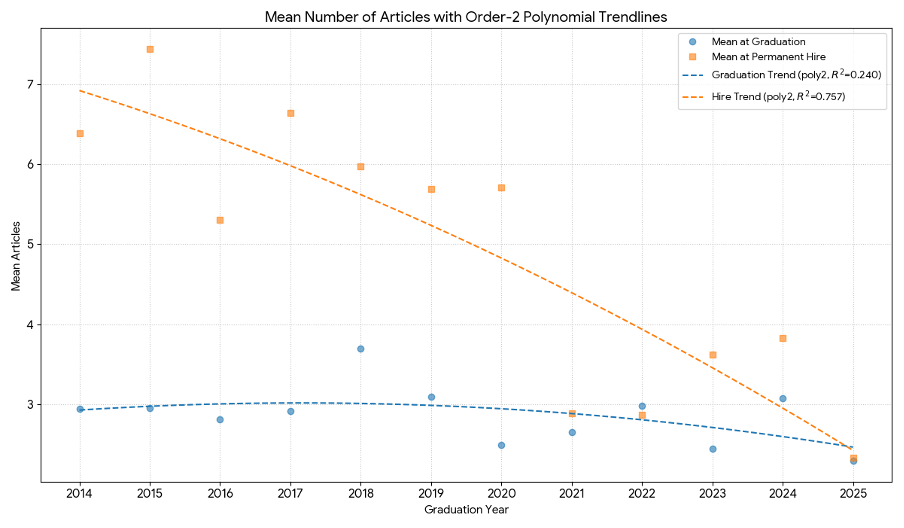
Note that the apparent decline in the average number of publications at the time of permanent hire (orange trend line) is largely an artefact of timing. Specifically, individuals who obtain permanent academic positions immediately after completing their PhD will typically have fewer publications than those who spend several years in temporary positions before being hired permanently. As a result, more recent cohorts—which include a higher proportion of immediate hires—tend to show lower publication counts at hire. Historically, candidates who do not secure immediate permanent positions tend to roughly double their publication count in the years following graduation before eventually obtaining a permanent position.
Teaching
When we examine trends over time for teaching experience, we find similar results. Teaching experience at graduation remains relatively stable. The average number of unique course types taught remains roughly between 3.5 and 6 (median, 3-4) across cohorts from 2014 to 2025, while total course offerings (tokens) fluctuate with no statistically significant upward or downward trend (p = 0.800 for types; p = 0.0725 for tokens). Although there is a slight negative slope in the token data (-0.1834 per year), it is not statistically significant, and year-to-year variability is substantial. The baseline amount of teaching experience accumulated by the time of graduation has remained broadly consistent over the past decade.
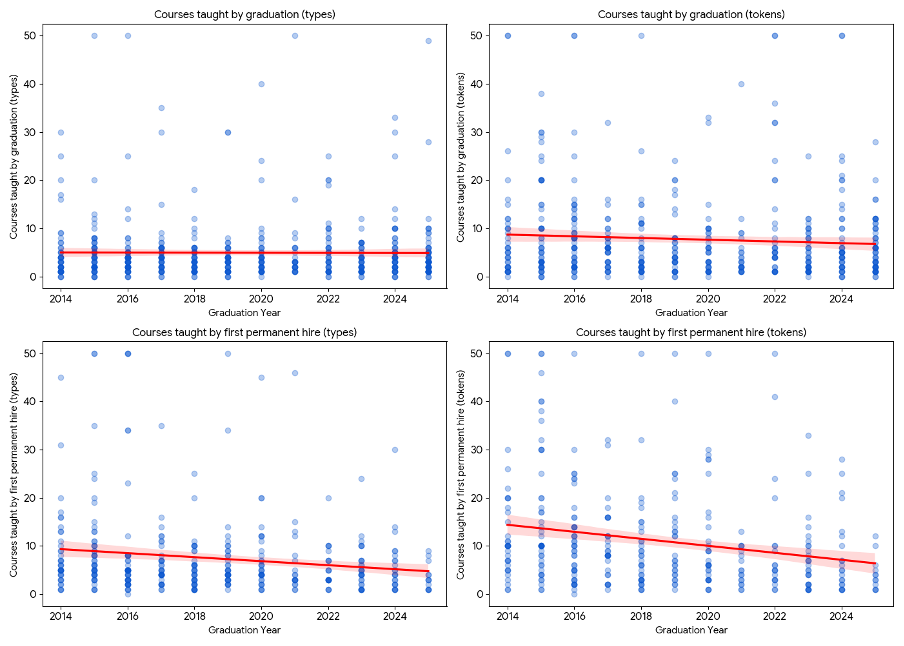
As with publications, the statistically significant downward trend in average courses taught at the time of permanent hire (p < 0.001 for tokens; p = 0.002 for types) is largely an artefact of timing. Recent graduates (2024–2025) who have already secured permanent positions are “fast hires” who moved into permanent roles immediately; as such, they have not yet had the experience of post-PhD teaching that older cohorts would have accumulated. For example, the 2015 cohort added an average of 5.02 additional course types and 7.28 additional course tokens between graduation and their first permanent position.
Career Outcomes
Publications
Turning to career outcomes, publication counts at graduation differ systematically by eventual job type. Graduates who secure permanent academic roles report higher average publication counts (mean = 2.62, median = 2) than those in contingent roles (mean = 1.48, median = 1) or non-academic careers (mean = 0.78, median = 0). Again, although there is no absolute threshold, the data suggests that having at least one or two publications at graduation is associated with a substantially higher likelihood of remaining in academia.
Books play a more limited but still meaningful role. Only a minority of permanent academics report having a book or book contract at the time of hire, and books are concentrated in specific subfields (e.g., continental philosophy and history of philosophy). There is some evidence of a substitution effect: candidates with books may require fewer articles, whereas those without books typically rely on a larger number of articles to remain competitive.
Teaching
Teaching experience at graduation does not show the same systematic upward trend for permanent academic positions that publication counts do. In fact, graduates who secure permanent academic roles tend to report slightly lower median teaching levels at graduation (mean = 4.95, median = 3.0 course types) than those in contingent academic roles (mean = 4.98, median = 4.0) or non-academic careers (mean = 5.19, median = 4.0). This suggests that while a baseline of experience is required, “more” is not necessarily better for securing a permanent position.
A similar pattern emerges for total course offerings (tokens): permanent academic hires report a median of 5.0 tokens (mean = 7.45), while those in contingent roles report a median of 5.5 (mean = 8.60) and non-academic hires report a median of 6.0 (mean = 7.98).
This suggests that while some teaching experience is standard, more is not necessarily better for securing a permanent academic position. Unlike publication counts, where there is a clear “more is better” signal, teaching experience may reach a point of diminishing returns or even reflect differences in PhD funding and programme focus, with graduates from research-intensive programmes often having lower teaching requirements but higher success rates in the permanent job market.
Note that although there is no absolute threshold, the data suggests that having roughly 3 to 5 course types at graduation is the most common range for those securing permanent academic positions. Having significantly more teaching experience (over 10 tokens) is more common among those who remain in contingent academic positions, potentially reflecting a heavier reliance on adjuncting while searching for permanent work.
The Relationship Between Research and Teaching
We also explored whether there is a “trade-off” between research and teaching to examine whether focusing on one necessarily detracts from the other. Our analysis found no statistically significant relationship between the number of publications and teaching experience across either of our primary metrics: Teaching Types (the number of unique subjects taught) and Teaching Tokens (the total volume of course offerings).
At the time of graduation, there was no significant correlation between publications and total instructional volume (Tokens, p = 0.274). By the time of a first permanent hire, the independence of these two tracks was even more pronounced, with no significant relationship found for either teaching variety (Types, p = 0.712) or total volume (Tokens, p = 0.963).
The correlation coefficients are near zero, and the R2 values indicate that publication counts explain less than 1% of the variation in teaching loads. For those navigating the job market, this is a clear signal that these two primary components of academic work operate independently. Being a high-output researcher does not statistically correlate with having more—or less—teaching experience. Candidates appear to accumulate these credentials through distinct pathways, likely influenced more by departmental funding models than by a direct tension between the two roles.
Publication Outcomes by Program
We also observe significant variation across PhD programs. Average publication counts at graduation range from fewer than 1 article in some programs to as many as 7 in others (among programs with at least five respondents).
Clustering analysis reveals three broad tiers: “low-publication” programs (average ≈ 2), “medium-publication” programs (average ≈ 3.4), and “high-publication” programs (average ≈ 6.1). This variation suggests that publication norms are not uniform across the discipline but are shaped by departmental culture, training models, and regional differences.
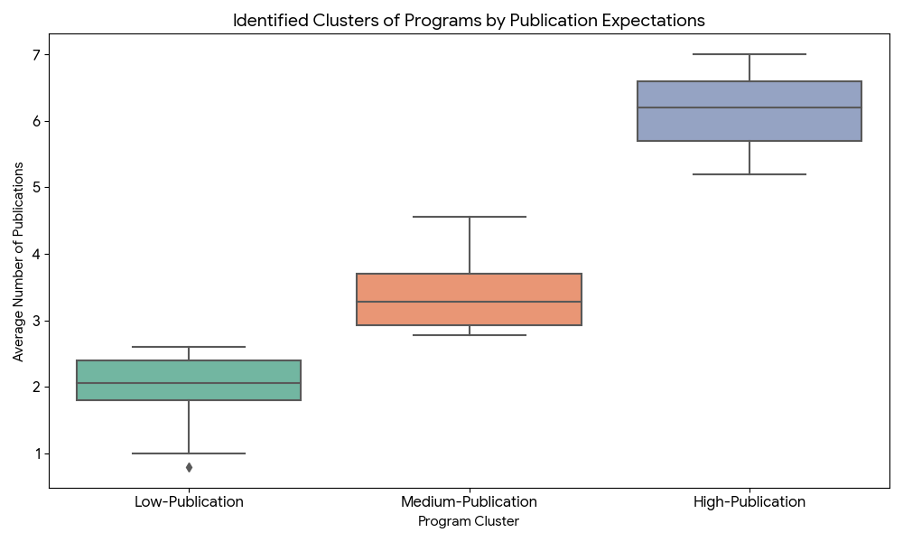
Importantly, higher publication averages do not necessarily correspond to better placement outcomes. Programs with the strongest placement records often have relatively modest publication averages at graduation (typically between 1 and 3 articles), while some high-publication programs have less consistent placement outcomes. This may suggest a “prestige–productivity” trade-off: highly ranked programs may rely more on institutional reputation and professional networks, whereas students from “less prestigious” programs may compensate by publishing more.
A related pattern emerges in program ratings. Programs with higher overall or climate ratings (according to our own data) tend to have lower average publication counts, while some of the highest-output programs report weaker climate ratings. This suggests that intensive publishing cultures may come with trade-offs in terms of student experience, though causation is difficult to establish.
Finally, publication patterns are strongly field-dependent. Subfields such as logic, philosophy of science, epistemology, and philosophy of language—where shorter, article-based research cycles and co-authorship are more common—are overrepresented in the medium- and high-publication clusters. By contrast, historically oriented or continental subfields tend to have lower publication counts at graduation, reflecting longer research timelines and different norms of scholarly output. At the same time, high-publication programs also lead in book production at later career stages, indicating that they foster a general culture of high productivity rather than a simple trade-off between books and articles.
Teaching Support vs. Labor by Program
Statistical analysis reveals a distinct split in departmental models between programs with the highest reported graduate-student teaching loads and programs where students graduate having led significantly fewer distinct courses. This variation suggests that teaching norms are not uniform but are shaped by vastly different funding models and departmental expectations.
Importantly, higher teaching volume does not correspond to better placement outcomes. Programs with the strongest records of permanent academic placement often have relatively modest teaching averages at graduation (typically between 2 and 4 unique types). In fact, candidates who secured permanent academic roles reported a slightly lower median number of course types (3.0) than those in contingent roles (4.0).
We found a weak negative correlation (r = -0.07) between the number of courses taught and program recommendation scores. This indicates that intensive teaching cultures, where students serve as instructors of record for many subjects, may come with trade-offs in student experience and perceived departmental support. Similarly, students in highly-resourced programs may be shielded from heavy teaching rotations to focus on research, while students in other programs may carry a much heavier instructional burden to secure funding.
A related pattern emerges in program ratings and reported support for teaching. We found a weak negative correlation (r = -0.077) between the number of courses taught and the level of formal teaching support (such as mentorship, observations, and pedagogical workshops) provided by the department. Programs with the highest overall satisfaction and climate ratings tend to be those that offer more formal support but fewer total classes to teach. This suggests that intensive teaching cultures—where students serve as “instructors of record” for many different subjects—may come with trade-offs in terms of student experience and perceived support.
Finally, the data suggest that the quality of preparation outweighs the quantity of the teaching load. Permanent academic hires consistently come from programs that provide higher average teaching support scores (4.05) compared to those entering non-academic careers (3.71). While having a baseline of 3 to 5 course types at graduation appears to be a standard for the market, the most successful candidates appear to be those from programs that prioritize structured pedagogical training and mentorship over raw instructional volume. [3]
Conclusion
Taken together, these findings point to several key conclusions regarding the modern academic philosophy portfolio:
- The “Threshold” Myth: There is no single “required” number of publications or courses. While a portfolio of 4–5 articles and roughly 5–8 course offerings is typical at the point of a permanent hire, these expectations vary widely. Publication counts at graduation are a stronger predictor of how quickly one gets hired rather than if they get hired.
- Quality vs. Quantity in Teaching: Permanent academic hires often come from programs that provide more formal support (mentorship and training) but fewer total classes. Graduating with an excessive teaching load (over 10 course types) is more often associated with contingent roles and lower program satisfaction than with permanent placement.
- No Evidence of Rising Expectations: Both publication and teaching levels at graduation have remained broadly stable over the past decade.
- Statistical Independence: An assumption that research and teaching are in direct tension is not supported by the data. With an R2 of less than 1%, teaching load does not explain the variation in publication output (or vice versa). Candidates accumulate these credentials through distinct pathways—research productivity is likely driven by subfield norms, while teaching loads are likely driven by departmental funding structures.
For current job seekers, the most practical takeaway is this: A modest, balanced record at graduation is typical. The path to a permanent position is not about meeting an ever-rising threshold, but about navigating a complex landscape where institutional prestige, high-quality pedagogical support, and steady post-PhD scholarly development do the heavy lifting.
Notes:
[1] Survey Note: For current students, we asked “Approximately how many peer-reviewed or invited publications (articles, chapters, or equivalent works) have you published or are accepted for publication? (Exclude book reviews, commentaries, or short pieces.)”. For those who have graduated, we asked “At the time of graduation, approximately how many peer-reviewed or invited publications (articles, chapters, or equivalent works) had you published or were accepted for publication? (Exclude book reviews, commentaries, or short pieces.)”, and for those who reported a permanent academic position, we additionally asked “At the time you were hired into your first permanent academic position, approximately how many peer-reviewed or invited publications (articles, chapters, or equivalent works) had you published or were accepted for publication? (Exclude book reviews, commentaries, or short pieces.)”. Each question included a slider [0, 50].
[2] Survey Note: For current students, we asked “Approximately how many courses have you taught as the instructor of record?”. For those who have graduated, we asked “At the time of graduation, approximately how many courses have you taught as the instructor of record?”, and for those who reported a permanent academic position, we additionally asked “At the time you were hired into your first permanent academic position, approximately how many courses have you taught as the instructor of record?”. Each question included separate sliders [0, 50] for types and tokens.
[3] Methodological Note: In our survey, respondents were asked to select all applicable types of teaching preparation they received from a list of options (e.g., “Instructor of Record”, “Formal Teaching Workshops”, “Guest Lecturing”, and “Faculty Mentorship”). To translate these qualitative selections into a format suitable for statistical analysis, we applied a count-based scoring system as follows: (1) Each distinct type of support selected by a respondent was assigned 1 point. (2) We summed these selections across both undergraduate and graduate-level preparation categories to “Support Score”. (3) The final figures represent the mathematical mean of these individual scores within each career category. By using this method, a higher score indicates that a candidate’s program provided a more diverse “menu” of formal training and mentorship, although each item selected may vary in terms of depth of training experience.
Excellent post.
Though I’m not sure about the following:
“Importantly, higher publication averages do not necessarily correspond to better placement outcomes. …This may suggest a “prestige–productivity” trade-off: highly ranked programs may rely more on institutional reputation and professional networks, whereas students from “less prestigious” programs may compensate by publishing more.”
When my dept evaluates candidates, we look to see whether they have a publication or two to make sure they can publish. So, we don’t need to see more than one or two. After one or two, it’s all about the quality of the ideas. Maybe prestige affects our judgments, but we’re at least trying to let the quality of the ideas alone guide our judgments.
In my case, it’s also really affected by career stage. I’ve hired people ABD with no publications, and I’ve been happy to do it. But if someone’s been on post-docs for 2-3 years, and they still don’t have anything out, that’s a pretty big red flag.
I totally agree with R1 Prof that quantity beyond that isn’t a huge deal. I like to see 1 for every year or two starting five years after they started grad school, but beyond that quality completely trumps quantity. (Most people start the clock on when publications are expected at PhD graduation, but I don’t really like penalising someone for actually getting the PhD done and moving to a short-term position.)
Also, as the original post indicated, it’s really affected by area as well. An ABD cog sci student with no publications (even joint publications) is going to have a much harder time than, say, an ethicist.
“I’ve hired people ABD with no publications.”
What kind of jobs were these? Please don’t say research-heavy…
Standard tenure-track positions in philosophy departments. Especially when you’ve got a fairly specific area you’re searching in, you can actually read the work of people who are clearly in the area. And sometimes the best work is part of someone’s not yet published dissertation.
The AOS of the search really matters here. If you do a search with AOS open, and you have 500-plus applications, it’s hard to read every one of them closely. So it’s almost inevitable that you’ll use filters like “Does this person have a publication” to create a manageable list. But when the AOS is fairly specialised, the first filter can be “Does this person actually work in the area we’re searching in”, and an ABD student with a promising research statement can pass that filter.
Right, an ABD without publications in a niche area can pass the *first* filter. But, in your experience, is *hiring* them—rather than a candidate with (reasonably good) publications in that area—common? I’ve heard anecdotes of this happening, and (to put things mildly) it confuses me. But I don’t have a sense of how common it is.
This is a good point, and I think what you highlight here is largely consistent with the patterns in the data, as presented.
From the survey, those in a permanent academic position had an average of 2.62 publications (median = 2) at the time of graduation. That aligns well with your description of your department’s approach to assessing applications, and we note something similar: “having at least one or two publications at graduation is associated with a substantially higher likelihood of remaining in academia”.
At the same time, the data also show that “higher publication averages do not necessarily correspond to better placement outcomes”, and that “programmes with the strongest placement records often have relatively modest publication averages at graduation”. So, more publications, in itself does not seem to straightforwardly translate to better placement.
One additional thing, though, is that those who ultimately secure permanent academic positions report, on average, 5.45 articles (median = 4) at the time that they were first hired. This suggests that although 1-2 publications may well be sufficient to establish research competence, successful candidates have often accumulated additional publications between graduating and obtaining a permanent academic position.
So one way to interpret the overall pattern is: a small number of publications may clear an initial threshold but, beyond this, other factors—like perceived quality, institutional context, letters, and networks or, indeed, 2-3 additional publications—play a larger role. The “prestige–productivity” interpretation is just one possible way of making sense of why higher publication counts do not neatly map onto better placement outcomes. That said, this interpretation is not intended to be causal or definitive.
Thanks, Travis.
I hope your analysis helps grad students stress less about the number of their publications and more about their quality.
Great data, but we should be careful about the ‘more is better’ signal. A raw count of articles treats an article in a highly selective, top-tier journal the same as one in a less competitive or specialized venue. In reality, the effort—and the market value—required to land a piece in a top-tier journal is much more significant. If we don’t distinguish between journal tiers, these stats might accidentally encourage a ‘quantity over quality’ mindset that doesn’t accurately reflect how hiring committees actually weigh a CV.
That makes a lot of sense for sure, but it’s definitely going to be hard to gather statistics on this – they’re not going to ask survey respondents to identify the journal for every article, and they’re not going to create a formalized list of journal tiers and ask survey respondents to identify how many publications were in each tier (or in a non-mentioned journal).
You’re right that the measure we use is coarse-grained (perhaps to a fault) since we ask about publication count simpliciter.
As noted in the post, the survey asked the question “Approximately how many peer-reviewed or invited publications (articles, chapters, or equivalent works) have you published or are accepted for publication? (Exclude book reviews, commentaries, or short pieces)”. So, we are not distinguishing between journal tiers—but we are also not distinguishing between publication types (e.g., journal articles vs. chapters in edited volumes). All of that is being captured under a single, fairly blunt measure.
As you suggest, there are real differences in how various venues are evaluated, both across and within categories. The co-directors spent quite a bit of time thinking about how to structure this question, and ultimately this was a trade-off between granularity and keeping the survey to a manageable length. More fine-grained data—especially tiered rankings—would have been very difficult to collect reliably at scale (as Kenny Easwaran notes in a reply).
That said, I think the results can also be read in a way that supports your underlying point. The relatively weak relationship between higher publication counts and placement outcomes suggests that simply having more papers is not, by itself, doing the work. That makes it quite plausible that other factors—such as venue quality, research impact, letters, and institutional context—are playing a significant role in how candidates are evaluated.
Jumping onto the “great post” train, but also, it seems to me that one of the main selling points in the initial framing — namely, “Publication counts show a “more is better” signal for academic retention….” — is not discussed or borne out by the results.
Or, in particular, if “more is better,” I’d expect to see (a) correlation between placement and “high publication” programs, and (b) some discussion of whether there is a correlation (and not just a threshold) between number of publications and finding a permanent position.
The anecdotal data / “received wisdom” that has been presented to me to has always suggest a threshold model and often suggested that having too many publications is actually harmful, so if “more is better” is actually how the discipline operates, that would be very interesting.
One problem is that it’s quite natural to expect a kind of Simpson’s Paradox here. Here’s a toy example – a prestigious, low publication graduate program has 5 graduates publish 1 article and not get hired, and 10 of their graduates publish 2 articles and get hired, while a less prestigious, high publication graduate program has 10 of their graduates publish 4 articles and not get hired, and 5 of their graduate publish 5 articles and get hired.
With these numbers, both the average hire and the average non-hire have precisely 3 publications, there is a strong anti-correlation between high placement and high publication, but within each program, there is a strong positive correlation between placement and publication.
Sure: the expectation that there would be a correlation is defeasible. There are lots of other reasons why it might not occur — e.g., that every publication matters a little but prestige matters a lot and swamps the signal.
My second paragraph could have been phrased better; my intention was really just to illustrate a couple ways that “Publication counts show a “more is better” signal for academic retention….” could have been borne out by the discussion / data and weren’t. I didn’t mean to imply that we should conclude that the data show that “more isn’t better” or even that “more is better” is unwarranted — just that it wasn’t supported by the analysis in the post.
A couple of questions about the data and analysis:
1. How does this data and analysis account for (or fail to) demographic difference and bias? That is to say, what’s the relationship between not only program prestige, teaching load, publication count, etc. and:
1. who gets admitted (and where),
2. who has greater carework responsibilities outside of their academic life,
3. who is doing greater amounts of service and emotional labor in departments (with students, other graduates, etc.),
4. who has added burdens to their time, energy, cognitive and emotional capacity, etc. as a result of having to navigate and endure bias, exclusion, lack of access or accommodation, and the gatekeeping built structurally and systemically into philosophy and academia as institutions (e.g. disabled students, neurodivergent students, queer and trans students, racially minoritized students, etc.), and
5. which programs have more diverse faculty representation and/or more support and mentorship for the above students?
2. The difference between subfields like logic, philosophy of science, epistemology and historical and continental subfields is named, but does this analysis take into account work done in social/political or value theory subfields? In particular, what about subfields such as philosophy of gender and sexuality, philosophy of race, and philosophy of disability where there are far fewer opportunities to publish in philosophy journals and where the writing style, methodology, and kinds of materials cited are often dismissed as “non-philosophical” and/or are published in other disciplinary journals or as public philosophy?
It may be that these distinctions are all essentially built into the difference between programs with higher “climate” ratings versus the prestige programs; however, bundling them under “climate” differences and funding models* fails to account for how these differences are causally related to bias, discrimination, gatekeeping, and exclusion as mechanisms built into the institutions of philosophy specifically and academia generally.
*The funding models difference is significant because having the time to write without teaching burdens is already an advantage, but will have outsized impact on students who have increased care and service labor attached to their teaching (due to demographic difference and the subject being taught, e.g. a female-presenting instructor for a course engaging with sexual orientation, disability, and/or neurodiversity), many of whom have greater burdens for care, service, and emotional labor at home, and who are less likely to have generational wealth or financial support from family.
With that in mind, I suggest that the most important takeaway from this analysis is not (should not be) about the relationship between publications and teaching experience to job placement, as important as that it, but about how the programs associated with those outcomes are impacted by issues of diversity, equity, and access and thus what we need to do, as individual departments and as a collective discipline, to address these. Otherwise, we’re just continually reproducing and reinforcing the structural and systemic issues that are creating hierarchies of prestige, job placement, and who gets to be a philosopher.
*I’d be similarly interested in an analysis connecting this research with Eric Schwitzgebel’s recent article on diversity in philosophy—and for both of these to be read in the context of the decades of work by minoritized philosophers such as Kristie Dotson, George Yancy, Anita Allen, and Charles Mills (among many, many others, including Sara Ahmed’s work on citational justice) critiquing and naming the systems that produce academic philosophy’s “diversity problem” that authors and commentators both of that post failed to acknowledge (and as such, reinforce and reproduce the same flaws and harms those scholars name).
I agree that these are important questions, so thanks for raising them!
Once piece of context that is not included in the DN version of the post—but is in the original post on the APDA blog—is that this is the first in a short series (two or three) analysing the 2025 survey data on publications and teaching. I started with summary statistics and outcomes as a first step, but the intention was always to follow up with a more detailed analysis of how these patterns intersect with identity and demographics.
The original APDA blog post ends by noting:
So, the plan is to take up precisely the kinds of questions you are raising in a dedicated follow-up. Initially, this was all going to be a single entry, but because of the length of the first bit of analysis, I decided that these questions were important enough to warrant their own post / analysis.
We do not have sufficient data to answer all of the questions that you raise; however, we do have enough data to explore disparities across many of the relevant demographics that you mention. I have started on this analysis already, and there are indeed some notable differences worth mentioning.
I am hoping to share the next entry around this time next month, so please keep an eye out! I would especially welcome your thoughts once it is posted.
There are a few charts with a negative slope best fit line that is said to be an artifact of timing – people entering permanent positions who graduated recently are all people who entered permanent positions quickly, while some people who graduated earlier who entered permanent positions did so later.
In both cases, the negative slope shows up because the x axis is year of graduation.
Is it possible to redo those graphs where the x axis is year of first hire in permanent position? That would seem to undo the particular effect mentioned here, and might reveal something more meaningful about trends. (Or it might not.)
I agree that plotting by year of first permanent hire would be a natural way to address the timing effect you are pointing to. Unfortunately, we did not collect data on the year of first permanent hire in the survey—only year of graduation—so we are not able to re-plot the graphs in that way. (That’s why the figures are presented as they are, and why the “timing artifact” interpretation is inferred rather than directly tested.)
That said, this is something the co-directors can discuss for future iterations of the survey, with the next one planned for 2027!
I’d also be curious about how average number of publications interacts with years since graduation – plausibly someone with 5 pubs at 3y is ‘better’ than someone with 7 pubs at 6y. Even if the average number of pubs needed hasn’t gone up, if the average time for successful applicants to get them has gone down then this would seem like increased publishing demands.
I know it’s not news, but I still find this very depressing: the “prestige–productivity” trade-off: highly ranked programs may rely more on institutional reputation and professional networks, whereas students from “less prestigious” programs may compensate by publishing more.”
It is good to learn that in average new hires are not expected to have many publications than years ago. But it’s still “publish a lot or perish” unless you went to the right place and know the right people.
It also doesn’t make me feel great, but I think that this is only a problem if institutional prestige is not actually a strong indicator of future professional performance. If graduate students from NYU with 1 publication actually tend to be better professional philosophers than Northwest Coastal State – Downtown Campus graduate students with 6 publications, then hiring on that basis seems perfectly fine to me.
Of course, I have no idea if prestige is actually a good indicator of professional performance. But, the fact that it continues to be used as such makes me think it is unlikely to be completely orthogonal to it.
This is excellent analysis. And it’s good to see that there appear to be both publication and teaching pathways to secure employment.
Just to reiterate some of the points already raised, though, the usefulness of this data partly depends on who was answering the survey. Looking forward to any follow-up posts about that. In addition to gender, race, age, and institutional prestige factors, please also include country. As is often pointed out in conversations on DN about the job market, the norms appear to differ considerably between the US, UK, and Europe (and within Europe).
If the data allows for it, another factor that may be relevant, and is rarely discussed, is career interruption, e.g. parental leave. It would be interesting to see data on this.
This raises a question similar to the one that I had about this data. Was there any control for country of PhD and country of permanent position? For example, my (entirely personal) sense is that might be more likely to get certain sorts of tenure-track positions in the US without publications than permanent positions in the UK, but that UK PhDs are more likely to graduate without publications than US PhD students (mostly due to the difference in lengths of the course). If I’m right, this might lead to various things (UK PhDs being more likely to take on non-permanent positions and hence taking longer to secure a permanent position) but also might skew the data that is being analysed quite a lot.