
NYT: “The Revenge of the Philosophy Major”
“One of humanity’s oldest disciplines and one of its newest inventions feel distinctly made for each other.”
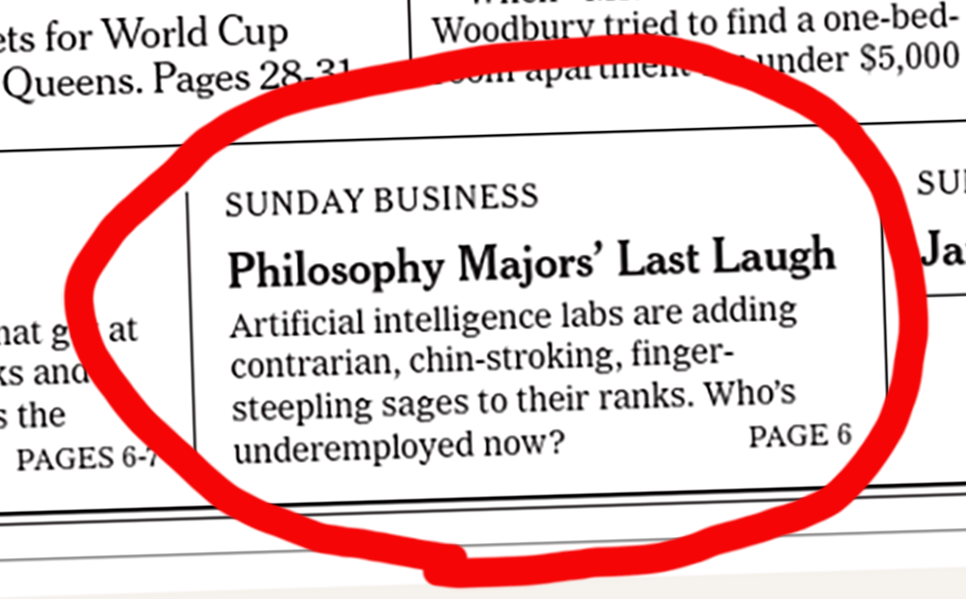
That’s a line from an article published in the New York Times today about the demand for philosophers working on artificial intelligence.
It continues:
A.I. presents a fresh way for philosophers to ask ancient questions, and its own set of new ones that they are uniquely trained to engage with: of truth and belief and knowledge (epistemologists); of reasoning (logicians); of mind and consciousness (philosophers of mind and consciousness). For ethicists, in particular, A.I. is a bonanza. How should models act toward us? How should humans interact with them? Where would purpose come from in a post-work society?
The article discusses several people trained in philosophy who are working for AI firms or AI-related organizations, including Robert Long, Geoff Keeling, Iason Gabriel, Patrick Butlin, and Amanda Askell. (See “Philosophers Working in or with AI Firms & Organizations“.)
It also covers some of the topics of interest to these philosophers, such as the nature of consciousness and AI welfare.
Unfortunately, in passing, the article says: “a plain-vanilla philosophy degree remains as hard to monetize as ever.” The implication is that philosophy majors in general fare poorly on the job market. However, as we have seen time and time again (most recently, see some of the data here) that is just not true.
Related:
– AI in the Philosophy Job Market
– The Demand for “AI & Philosophy” Hires & Expertise — and Its Precedents
– When There’s no Fun in Funding: External Research Money, Ethics-Washing, and Positive Academic Freedom
– The Demand for Philosophers
One of my concerns about the article (besides that it traffics in worn-out stereotypes) is that it doesn’t distinguish between undergrad and grad philosophy training. At first the article implies there’ll be discussion of undergrad majors, but then all the actual discussion appears to be about PhDs. (I was also wondering earlier about the “plain-vanilla” comment; I was speculating if it was supposed to mean “Philosophy PhDs who do not specialize in AI do not have extra opportunities outside of academia.”)
thanks for bringing my attn to this article i’m a digital NYT subscriber but would have overlooked it since its in the Business secion. i was a philosophy major.