
Philosophy, Brain Studies, and the Value of Curiosity
An op-ed about curiosity published in the New York Times yesterday will resonate with many philosophers.
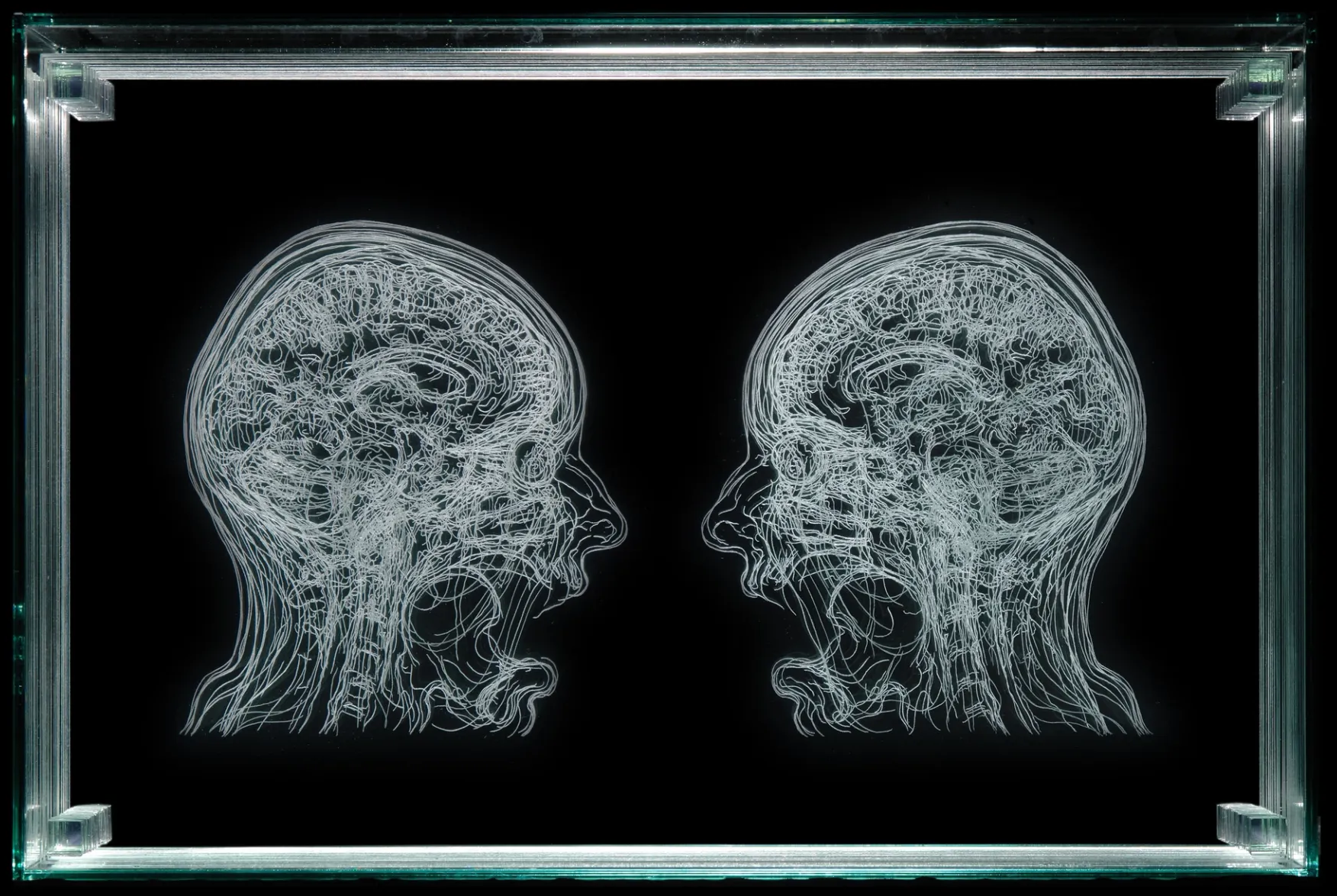
Angela Palmer, Self-Portrait (scans engraved on glass)
Written by Anne-Laure Le Cunff, a neuroscientist at King’s College London, it uses the example of AI-generated answers to internet search queries as a launch point to discuss how we learn in the time between when we form a question and find an answer to it.
Google’s AI answers are fast, even if they are often wanting in quality. But suppose its answers were better. Le Cunff asks, “Could there be anything wrong with getting a reliable answer more quickly?” She answers: “There is. By shortening the time between asking a question and getting an answer, these tools are actually undermining curiosity—and paradoxically threatening our ability to understand the world.”
She writes: “Our technology is increasingly treating the territory between the query and the answer as dead space to be eliminated, when that territory is where most of the learning actually happens.”
Researchers have found that people in a state of curiosity, while waiting for an answer to an intriguing question, remember unrelated information they encounter during that time far better than they otherwise would. In that same study, the researchers also placed those people in brain scanners. They found that waiting for an answer activates reward circuits in the brain and readies the hippocampus to help form new memories. Similar findings have been reported by other researchers in studies involving infants, older children and adults.
In short, curiosity puts the entire brain into a mode of heightened receptivity—not just for the specific thing you want to know, but also for everything around it. Curiosity opens a window, and while the window is open, learning deepens across the board.
But the window stays open only as long as the question remains unanswered…
Scientific breakthroughs, artistic leaps, technological innovation—these rarely emerge from efficient retrieval of known information. They emerge from periods of undirected exploration, when people follow questions further than they need to and find things they weren’t expecting.
There is, of course, an academic discipline that focuses on what could be described as “the territory between the query and the answer”: philosophy. Its specialty may indeed be in lengthening, rather than shortening, “the time between asking a question and getting an answer”. In part this is because we take a lot of time to work on and refine the questions, in addition to examining and reexamining what may seem to others to be a bewildering array of possible answers to them, to a bewildering degree of detail.
Curiosity is one of the virtues of philosophers. Could its development and exercise be one of the benefits of studying philosophy? Philosophers will no doubt think so, based on their own experiences and their observations of students. But it would be interesting to supplement anecdotal evidence with something more systematic. How would neurological studies similar to ones Le Cunff cites in support of curiosity describe the effects of philosophical inquiry?
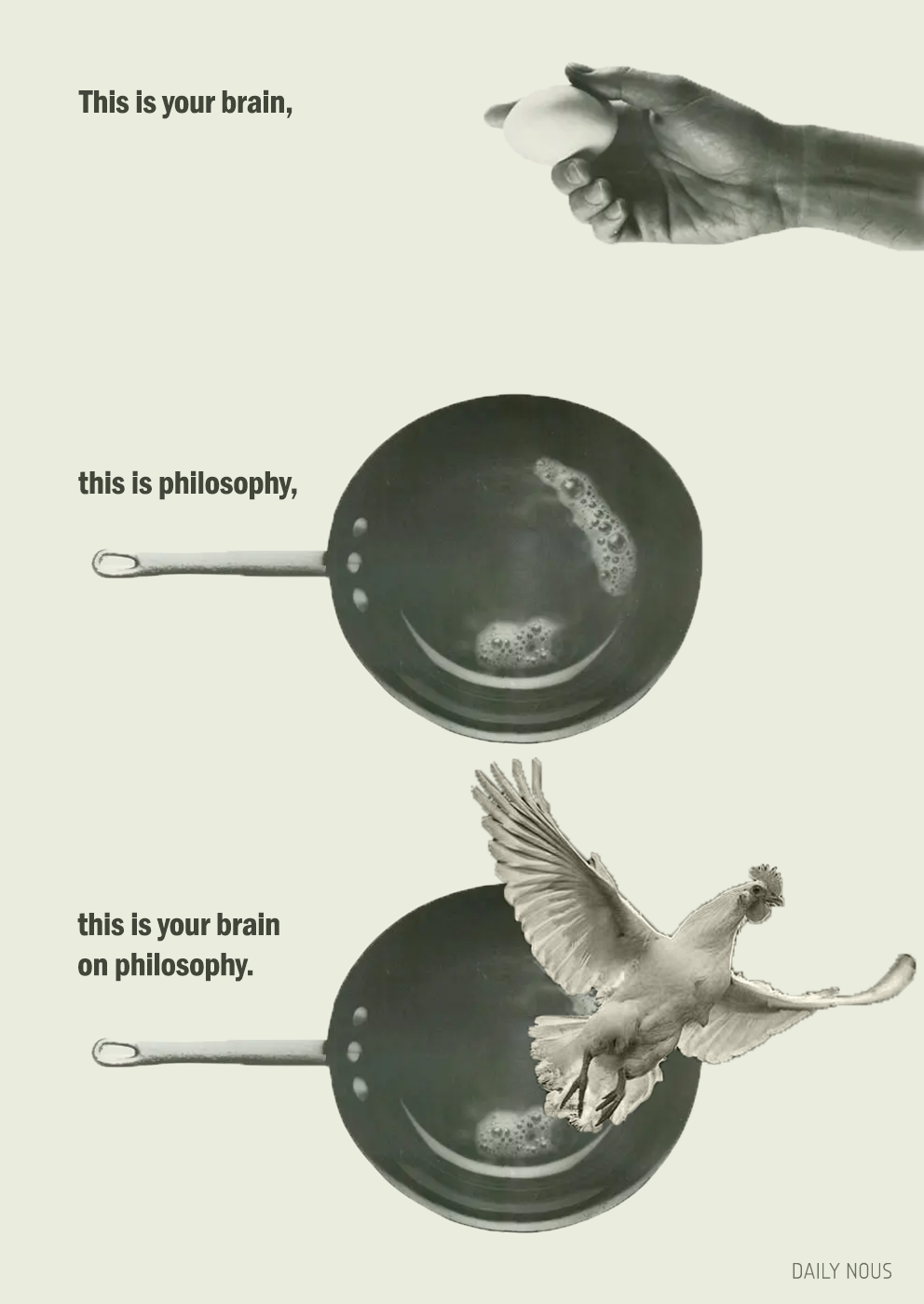
Just for fun I put that question to Google to see what its AI answer would be:
Neurological studies similar to those cited by neuroscientist Anne-Laure Le Cunff would describe philosophical inquiry as a mechanism that engages the brain’s reward networks, promotes neuroplasticity, and reframes cognitive uncertainty. It shifts the brain into an exploratory state that optimizes learning and memory retention.
Case closed—except that, despite its brief elaboration and links to sources, as far as I can tell none of the 24 mentioned sources discusses any neuroscientific study of the brains of people engaged in philosophical inquiry. Have there been such studies? If not, can we convince some people to conduct some?
Related: “How to Show that Studying Philosophy Improves Thinking Skills“
Best quote of 2026 thus far: “Our technology is increasingly treating the territory between the query and the answer as dead space to be eliminated, when that territory is where most of the learning actually happens.”
An ancient issue! “It is not reasonable for me to expect the most prestigious journal to have the best review of a widely reviewed book, but its review should come in the top 3, by my uneccentric ranking!” by me.
Interesting work, but a little confused about the argument here. It seems like, because AI gives you answers so fast, there’s no time to be curious, because it closes the gap between asking the question and getting the answer… and that’s supposed to be bad?
Let me suggest a gentle analogy. Suppose we invented a machine that, every time you’re hungry, it gives you food. Is that supposed to be bad? I mean, it eliminates the desire for food, and the time it takes to sit with that desire, just like getting rid of curiosity gets rid of needing to desire knowledge, because you already have the knowledge more or less as soon as you want it.
Bit strange. I prefer a simpler view where, for any X, if you want X, then all else equal, getting X fast is better than getting X slowly, so you can then get on with your life and get Y and get Z and all sorts of other things.
I don’t mean to sound flippant, but this analogy is terrible. Setting aside the conceptual weaknesses (food is not relevantly like knowledge), I can think of several reasons why such a machine *would be very bad*.
Many people’s lives would plausibly be made much worse by a machine that gave them food every time they were hungry. Example: someone with weakness of will struggling to maintain a strict diet for health reasons.
Perhaps you meant to deal with that sort of thing with your ‘all else equal’ in the last sentence, but still…
Right: not all else is equal. NEXT!
Was this a reply to me, or to Barnaby? Not sure…
Barnaby. Hence, “reply to Barnaby.” 😉
haha — I’m hesitant to accept the obvious in online discussions because of previous experience! 🙂
I hear that!
This is an extraordinarily odd piece of reasoning from Barnabus 2. You seem to be embracing implicitly, Barnabus, a universal principle that says things you want should be such that they (the goal associated with the wanting) are finished as fast as possible. So you must eat dinner VERY fast for example. And I suppose you want to live your own life rather than not? But if you want to live your life, then since that is an activity that proceeds in time towards an end point, you must also want the end point secured as directly and efficiently as possible? Be careful Barnabus with what you are saying, as the tentacles of its falsehood seem to skitter out in many unpleasant directions.
But heaven in the Christian Biblical view is all time at the same time so there is no fast or slow. God does not have a yesterday and tomorrow.
And you do not want the endpoint as soon as possible if that is God and He wants you here and now.
You heard it here first: God hates AI.
In Bernard Longergan’s Philosophy inquiry is the engine of all things. Same with Michael Polanyi. But curiosity as understood classically ( Studiositas and Curiositas) is the enemy of all wisdom