
The “largest and most systematic study of linguistic inequity in academic philosophy to date” was recently published.
Its authors are Neri Marsili (University of Turin) and Paul Rehren (Max Planck Institute).
In the following guest post, they share some of their findings.
Underrepresentation of Non-Native English Speakers in Analytic Philosophy: Findings from over 100,000 Papers
by Neri Marsili and Paul Rehren
It’s no secret that a good command of English is a prerequisite for a successful career in analytic philosophy. But what if English isn’t your first language? As many non-native English speakers (“non-natives”, for short) can attest, having learnt English as a second language can create friction at every stage of your academic career, from your first days as a student to tenure and beyond. Yet while obstacles tied to gender or race have long been recognised in the profession (and rightly so), disadvantages due to native language have only recently begun to attract attention and research.
So, for example, a recent survey of more than 1,600 philosophers (discussed on this very blog last year) found that non-native English speaking scholars on average need twice as long to read a paper in English and nearly twice as long to prepare a talk (even controlling for proficiency). The hurdles, however, don’t stop at manuscript preparation. Getting published isn’t easy either: non-native authors only accounted for 31% of the authors in 18 philosophy journals between 2013 and 2017—not much, considering philosophy is done all over the world. Those who are lucky enough to get published still get comparatively little attention. Among the 500 most cited works in four leading generalist journals, only 5.8% were by non-native philosophers.
While this research offers valuable insights, it has important limitations—perhaps inevitably so, given how new this area of study still is. The papers and blog posts just cited looked at relatively narrow samples, covering relatively short periods of time; they reported only raw percentages (which say little about representation) and did little to pin down what causes the gap between native and non-native speakers.
Our Study
At a workshop on corpus methods back in 2021, it struck me (Neri) that most of these limitations could be overcome by studying the problem at scale. Paul Rehren turned out to have exactly the data we needed. Our study, just published in Research Integrity and Peer Review, covers over 100,000 English-language articles published in more than 200 philosophy journals between 1975 and 2021.
Here’s how we did it. Since we obviously couldn’t check every author’s native language one by one, we used two proxies: whether the author works in an English-speaking country, and whether they got their PhD in one. This method is inexact, of course. Still, when we checked a random sample by hand, both proxies were right about nine times out of ten: imprecise, but not too bad.
Next, we needed a baseline: to quantify underrepresentation, we needed to establish the percentage of non-native philosophers in the profession. To estimate this, we turned to PhilPeople. Using the country for current academic staff as a proxy, we estimated this share at just over half (53%). We suspect, however, that the real share is substantially higher, since PhilPeople, by its own account, has “heavier coverage in Anglophone countries”. This matters for what you’re about to read: our estimates of underrepresentation are likely very conservative.
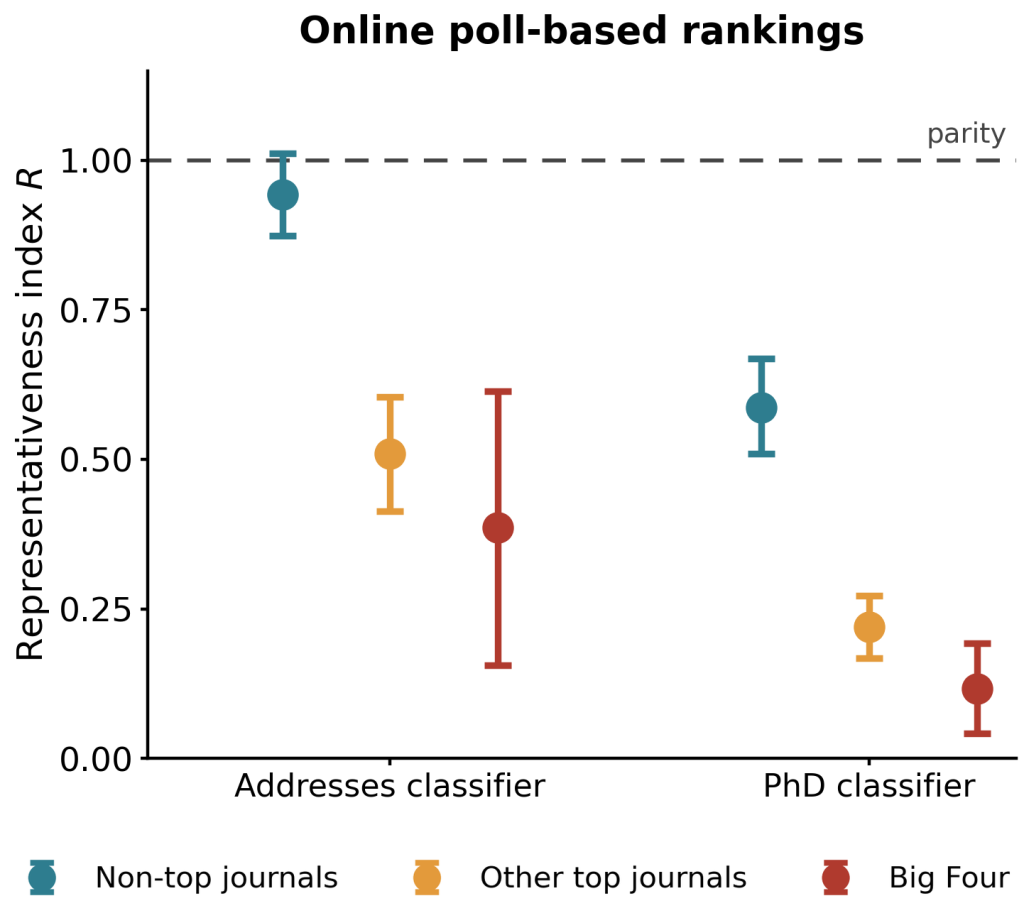
What does the data say? Overall, non-native authors come fairly close to “parity”—having a share of publications proportional to their share of the professional population—on one proxy (where they work, about 9/10 of what one would expect if they were equally well represented), and less close on the other (where they got their PhD, just over half). Before concluding that their underrepresentation is overstated, though, consider what this means. Nobody ever suggested that non-native philosophers struggle to publish anywhere. Surely you can place a paper in the least selective journal of your discipline even if your English prose doesn’t display the “flair, elegance, or vivacity” of a native speaker. What matters, by any reasonable standard, are the journals at the top: these are the publications that get you a decent readership, and that matter for hiring, funding and professional recognition.
We defined top journals in two ways: broadly, as the thirty or so journals ranked in the Leiter Reports polls, and narrowly, as the “Big Four”: Philosophical Review, Mind, Noûs and Journal of Philosophy. Once we focus on these subsets, the picture changes. In the broader group, non-native authors publish either half as much or a quarter as much as their numbers would predict (depending on the proxy, see Figure 2). In the Big Four, they publish between 12% and 38% of what you would expect. (We also looked at a third definition of top journals based on citation impact, which produced similar results).
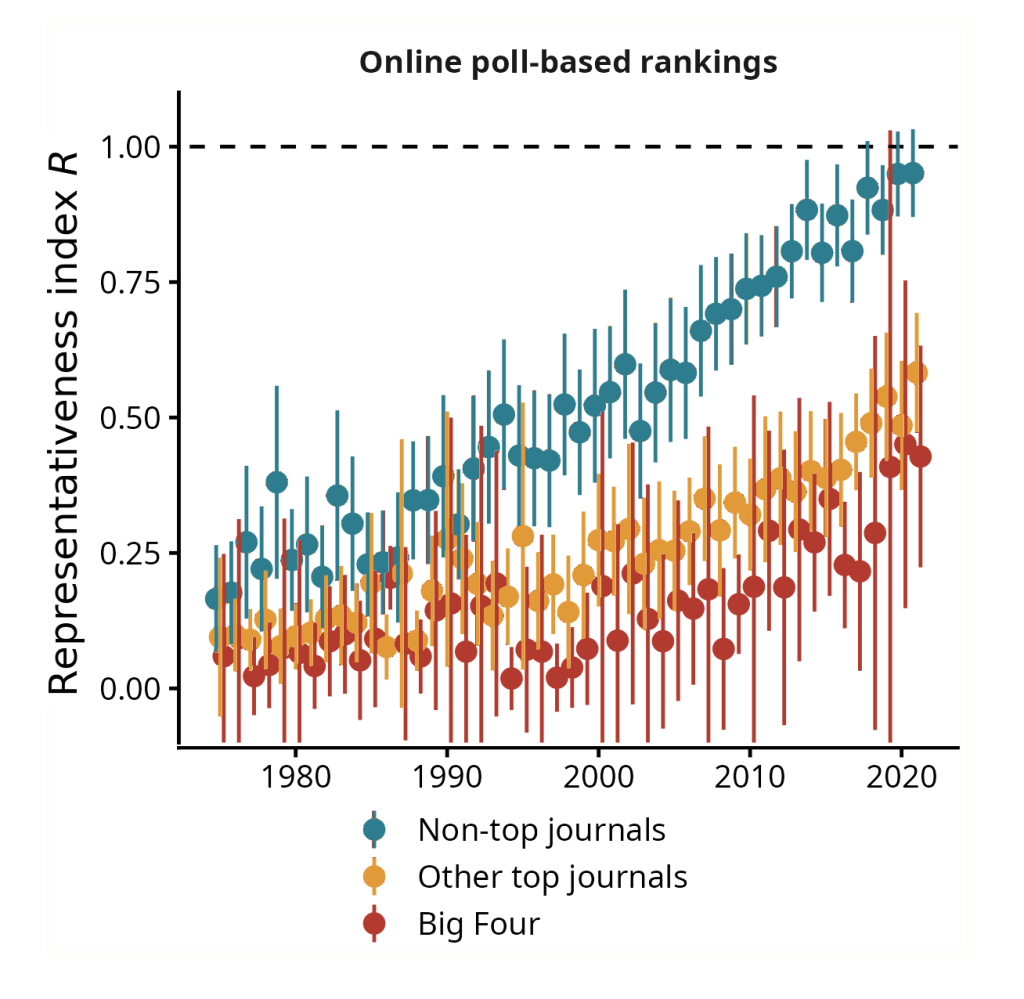
One cool feature of our dataset is that it covers almost five decades, so we can look at how differences evolve over time. Things are improving, but it doesn’t look great where it matters. Since 1975, representation in lower-ranked journals has improved a lot, to the point of near parity (classifying authors by where they work). Representation in the top journals has improved, too, but that change has been quite a bit slower. As a result, since 1975 the gap between the top and bottom journals has become much wider.
What explains the gap?
With our data, we could test three potential explanations for the gap between top journals and other journals.
The first hypothesis is a familiar story, which some readers of this blog have suggested in other discussions as an innocent explanation of the gap. Maybe non-native authors simply write less polished English, and top journals are pickier about style. If so, the gap should be larger for authors whose first language is very different from English and who consequently have a harder time learning it, such as Japanese or Korean, and smaller for closer languages like Dutch. There is a slight trend in that direction, but it is weak, and it is driven almost entirely by a few outliers closest to English (mostly Norwegian and Swedish authors). Language quality doesn’t seem to be a major driver of underrepresentation, at least by our (admittedly crude) measure of linguistic distance.
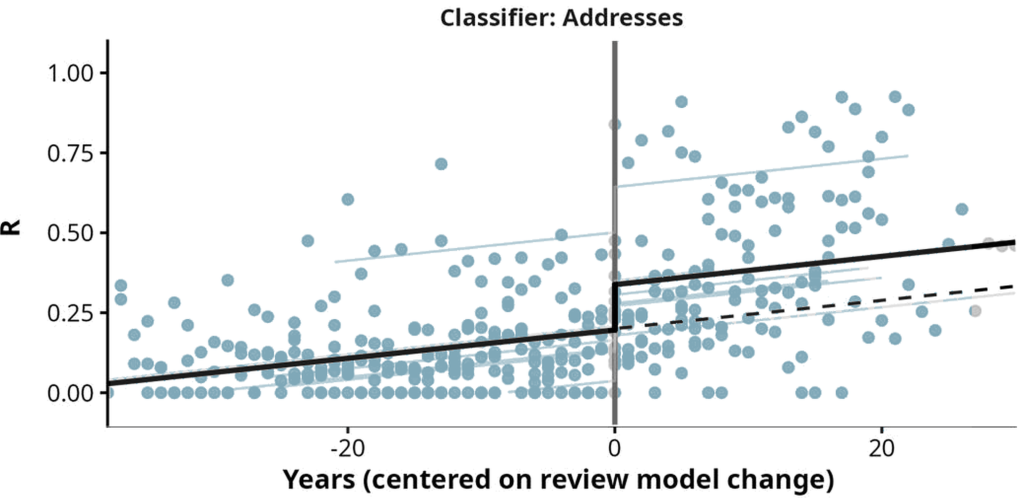
The second hypothesis is that non-native authors face active discrimination from reviewers. We tested this through a natural experiment. Over the past few decades, some top journals switched from open or single-anonymous review to double- or triple-anonymous review. If reviewers were penalizing authors for their non-native background, non-native representation should go up after the switch. Which is exactly what we found. Classified by where authors work, representation jumped from around a fifth to around a third of what parity requires. Classified by PhD institution, the change, though also positive, is much smaller and statistically uncertain. (On the assumption of active discrimination, this pattern would be somewhat unsurprising, since unblinded manuscripts show authors’ affiliations, but not where authors got their PhDs.)
Let’s keep in mind, too, that anonymous review hides a bunch of things at once: the author’s name, their institution, its prestige, the country where it’s based. To call this discrimination against non-natives (as opposed to discrimination that affects non-natives) might be a bit of a stretch, as the effect might be driven by a few compounding factors (we discuss more limitations in the paper). Still, what we detected is certainly consistent with some form of discrimination.
The third hypothesis is that non-native English speakers simply have different interests. Top journals are quite particular about the topics they deem worthy of their attention: they publish mostly metaphysics and epistemology, and very little from what PhilPapers calls “philosophical traditions” (continental and non-Western philosophy, for instance). Perhaps this mix of subfields caters better to the interests of native authors than to those of non-natives, and this contributes to the gap. According to our data, this conjecture is not far off: the work of non-native authors is comparatively more concentrated in the areas top journals publish least, and less concentrated in the areas they publish most.
It would be naive, however, to read this as an indication that non-native authors and their idiosyncratic interests are to blame for the gap. What a journal publishes is in large part an editorial choice. What seems like poor strategy from the native’s side might equally be read as self-serving topic selection by editorial boards whose interests reflect the Anglophone institutions in which they are based.
What this Shows and What Can Be Done
Our study has significant limitations. Our proxies are noisy. We have no data on books. Above all, we don’t have submission data, so we can’t measure how much of the gap comes from non-native philosophers submitting fewer papers to top journals. Even so, this is the largest and most systematic study of linguistic inequity in academic philosophy to date. With all its limitations, it confirms the picture painted by earlier work: non-native philosophers are underrepresented in the journals that matter most, and the gap is getting wider.
What can be done to improve the situation? Our data suggest that increasing anonymity on top journals that haven’t yet transitioned to triple blind could help. More anonymity would be a good idea anyway, given our profession’s problem with prestige bias. Top journals could also appoint more people from outside the English-speaking world to their editorial boards: currently, only about 4% of the editors of fifteen prominent journals work at institutions outside Anglophone countries. If boards better reflected the actual composition of the profession, there’s a chance that their editorial choices (which subfields they focus on, which level of English they deem stylistically acceptable) might too, giving non-native scholars a fairer shot at publishing. Finally, the Barcelona Principles for a Globally Inclusive Philosophy ask very little of journals and institutions: it wouldn’t hurt if more journals signed up. We’d get an extra perk, too: since the Principles recommend collecting statistics on submissions by non-native speakers, we’d finally get the data we need to settle some of the questions that our study left open.
This is very interesting work. I would add two more (overlapping) hypotheses:
(1) Non-natives also publish in their native languages/countries. Non-natives may spend some of their time writing articles in their native language, and or English-language articles for journals published in their home country which were not included in the study. (For example, “Analyse und Kritik” in Germany mainly publishes German-language articles, but it does also publishes English-language pieces.) Non-natives may publish there because they feel attached to scholarship in their native language/country, or because they want to keep the door open for an eventual return.
(2) Some non-natives may just not care as much about publishing in Top Journals. Prestige is assigned differently in different disciplinary cultures. Non-natives are more likely to be socialised at least in part outside of Anglophone academia. Elsewhere, there are other currencies of academic prestige: Books, lectures, influence on graduate students, research grants you won… Non-natives may be unconsciously less motivated to pursue publication in top journals, or they may consciously reject Anglophone philosophy’s fixation on Top Journals.