
We’ve asked before: “What is your department’s AI policy?” Perhaps you think a good academic AI policy should, to the extent possible, be sensitive to the kind of thing the AI is being used for, and by whom. So what should a department’s policy be about graduate students using AI to write a dissertation?

I ask because, according to recent analyses, some students are using AI to write at least part of their dissertations, and the number of dissertations containing AI-generated text in the United States is increasing.
According to a new working paper by Daniel P. Gross (Duke), Dror Shvadron (Toronto), and Hansen Zhang (Duke), between a quarter and a third of the dissertations that earned people their PhDs in STEM fields this year in the US contained AI writing.
They say:
We measure AI-generated writing in the dissertations of a near-census of US STEM PhD graduates from 2019 to 2026 and link graduates to their subsequent employment. [“We process all abstracts and a stratified random sample of complete dissertations (stratifying over fields and years), which we use to verify that AI-generated abstracts are a surrogate for AI-generated writing in the full text—consistent with prior research which has found the same.”]
AI writing is absent before 2023, present in 29% of dissertations filed in 2026, and rapidly growing. Use is more common among students from non-English-speaking countries and at lower-ranked programs. Among graduates in the same program and cohort, those whose dissertations contain AI writing are less likely to enter academic research careers and more likely to enter non-tenure-track roles or industry, with this pattern strongest among US-origin students. At the same time as AI may increase research productivity, it thus appears to also be displacing a potentially important portion of the work through which scientific expertise is developed.
That’s in STEM fields. What about philosophy?
I asked the team that produced the above study if they could run a similar analysis on philosophy dissertations. Very kindly, they agreed to do so.
As with the STEM fields, in philosophy the trend is an increase in the number of dissertations with AI writing (operationalized as containing at least 2% AI-written text). In 2024, 1.3% of philosophy dissertations included AI writing. That figure jumped to 7.8% in 2025, and continues to rise. Only about a quarter of the philosophy dissertations expected to be filed in 2026 were analyzed, but so far 11.1% of them contain AI writing.
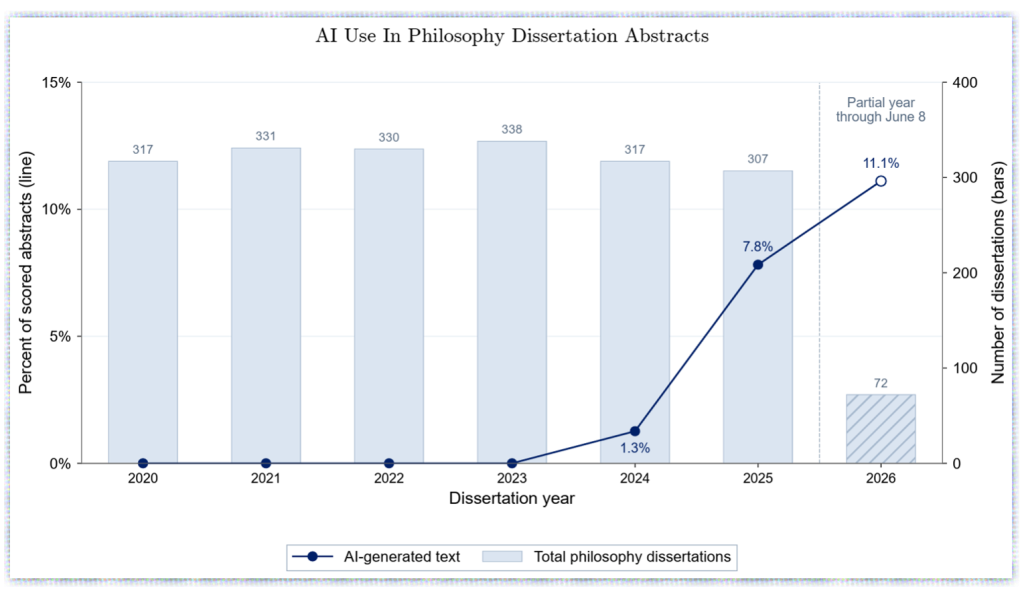
What to make of this?
One cautious point is that the numbers on that graph do not tell us how the AI was used. Perhaps not all of the types of AI use that could lead to a piece of writing having a “high” Pangram score are objectionable? Relatedly, we might ask whether policies that make fine-grained distinctions on the permissibility of AI use are feasible and whether they can be enforced?
Another thing to note is that although the rate at which AI writing shows up in philosophy dissertations is about one-third of that in STEM fields, this is not much comfort to those in philosophy who object to such writing. One reason is that shifts in academic norms are not necessarily confined by disciplinary boundaries. If the prevalence of AI-written text in dissertations becomes normal in other disciplines, the expectations we will have will be affected, as will the expectations of administrators. Number-crunching deans may want to know why they’re paying for graduate students to spend a few years writing a dissertation without AI when, with it, they could be done with their dissertations in a few months, or perhaps even weeks or days.
Relatedly, if departments aim to prohibit or strictly limit how AI is used in the writing of dissertations, best to try to do that now, while norms are in the air, rather than waiting until later, when perhaps largely unrestricted AI use by graduate students on their written work will have been normalized.
Discussion welcome.
*Note: There were some challenges determining the set of philosophy dissertation abstracts to study. Initially, the team searched available abstracts and metadata of dissertations in ProQuest that listed “philosophy” in the department or any subject search field. That overcounted philosophy dissertations by around 300% (which we noticed by comparing those figures with the number of philosophy PhDs earned each year). This is not surprising, since the word “philosophy” is used by more than just philosophers. Limiting the search to “philosophy” in the listed department and ignoring its presence elsewhere in the abstract and metadata had its problems, though, too. For one thing, some multi-disciplinary departments include philosophy; and so by this method, all of the dissertations produced by a department of “Psychology & Philosophy” would be counted as philosophy dissertations, even if the department only offers a PhD in psychology, not philosophy. So we eliminated those departments. But then we noticed a different problem: the dissertation counts of some departments were bizarrely low. For example, according to the department-only ProQuest search, Stanford University’s Department of Philosophy appears to have produced just 1 dissertation between 2016 and 2026—obviously a mistake. Several other departments had this undercounting problem. When I pointed this out, one of the researchers said the likely explanation is that “department information may be missing or recorded differently in ProQuest”. We did not search for these “missing” dissertations, and so the set of dissertations on which the study is based is not identical to the set of all philosophy dissertations filed in the US during the years studied.

This is all very troubling, and I’ve wondered about the fate of dissertations for a while now. I do want to say, as someone whose second language was English, that I greatly sympathize with those who use AI who are not native English speakers. While we rightly prize clear and concise writing, there are many brilliant philosophers who lack the ability to write with the clarity of a Harry Frankfurt, who nevertheless have valuable contributions to offer. And it is easy to dismiss a philosopher who speaks with a thick accent and is not as skilled in English as inadequate because they lack the ability to fully articulate their arguments even though they may actually be far better thinkers than those who dismiss them will ever know. This isn’t really anyone’s fault, but AI can be a corrective here. At the same time, AI is also very harmful in so many other ways. I really don’t know what the future holds anymore.