
Mark Oppenheimer, a lawyer in South Africa whom readers may know as the co-host of the popular Brain in a Vat philosophy podcast, is facing removal from his position as a member of the Council (the governing body) of the University of Cape Town (UCT) because of remarks he made while being interviewed on someone else’s podcast. An open letter defending Oppenheimer’s right to free speech is currently accepting signatures.
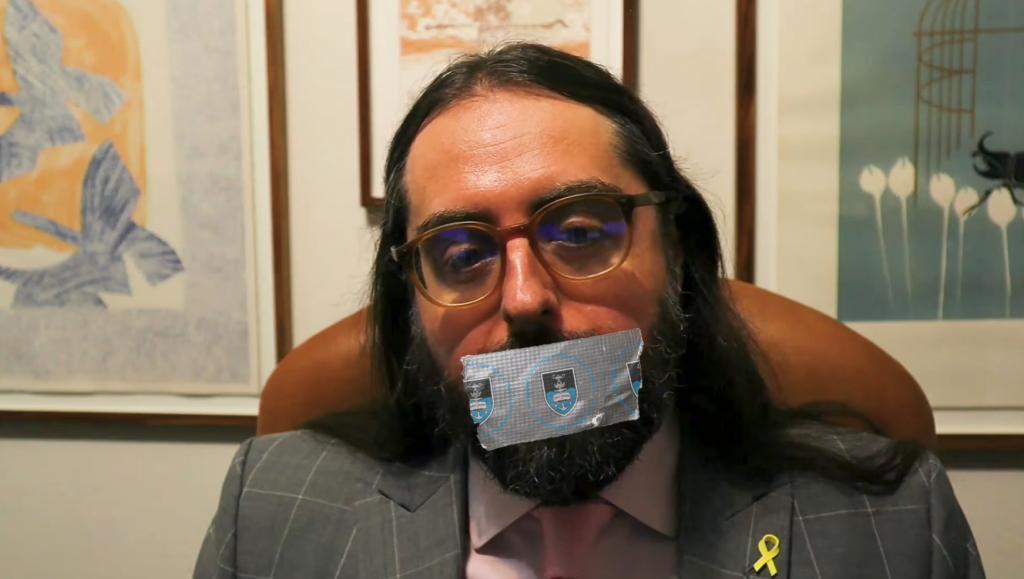
On the UCT Council website, it’s noted that Oppenheimer “has appeared in the Supreme Court of Appeal and the Constitutional Court in a series of cases that seek to determine the boundary between freedom of expression and genuine hate speech.” His role was as a lawyer in those cases, but perhaps the current situation will end up with him in the role of plaintiff.
While being interviewed by Ayaan Hirsi Ali on her podcast in March 2025, Oppenheimer made some remarks about the UCT, criticizing its boycott of Israeli academics [it is apparently a boycott of academics associated with the Israeli Defense Force], referring to “Islamist elements” that have “take[n] control” of the university, and describing some violent episodes of anti-Semitic behavior. See around the 32 minute mark of this video.
Now, says the Mail & Guardian, “The University of Cape Town is considering sanctions against two council members [Oppenheimer and David Ansara, who reposted on social media another person’s praise of Oppenheimer’s interview] after retired judge Mahomed Navsa found that claims of Islamist control at the institution, and their endorsement, breached its governing body’s code of conduct.”
Oppenheimer faces removal from the Council, and Ansara faces a six-month suspension.
The Mail & Guardian reports:
Council adopted the investigation reports [of Oppenheimer and Ansara] at a special meeting on 18 October and appointed a five-member subcommittee to hear representations before deciding on sanctions, if any…
Navsa’s report [excerpts here] places the complaints within an increasingly bitter struggle over UCT’s Gaza resolutions, describing efforts to reverse them, challenges to individual council members and retaliatory complaints that consumed university resources. The findings against Oppenheimer arose from his March 2025 interview with Ayaan Hirsi Ali. He identified himself as a council member and alleged that Islamist elements had taken control of UCT, terrorised those seeking a reasonable position and trampled on academic freedom. Navsa found no evidence that council members were Islamists or were being influenced by Islamists. Although Oppenheimer had not named individuals, the judge concluded that his statements implicated council and senate members who supported the Gaza resolutions...
Oppenheimer rejected the proposed removal in a statement published by the Daily Friend [here] on 18 October, calling it “an egregious attack on freedom of expression”. He maintained that his interview raised legitimate concerns about antisemitic intimidation and UCT’s protection of Jewish students. In submissions to the inquiry, he denied describing every supporter of the Gaza resolutions as an Islamist or identifying council or senate members as terrorists. He argued that criticism of Islamism as a political ideology did not amount to an attack on Muslims and that his reference to people being terrorised concerned intimidation on campus.
It’s worth noting that South African Constitution does protect Freedom of Expression, stating:
1. Everyone has the right to freedom of expression, which includes
a. freedom of the press and other media;
b. freedom to receive or impart information or ideas;
c. freedom of artistic creativity; and
d. academic freedom and freedom of scientific research.2. The right in subsection (1) does not extend to
a. propaganda for war;
b. incitement of imminent violence; or
c. advocacy of hatred that is based on race, ethnicity, gender or religion, and that constitutes incitement to cause harm.
I listened to the podcast and it does not appear that Oppenheimer engaged in propaganda for war, incitement to imminent violence, or advocacy of harm-inciting hatred. In other words, his speech is protected speech.
Further, UCT is a public university and is bound to respect the rights enumerated in the Constitution.
Additionally, the Code of Conduct for UCT Council Members states, among other things, that “Council members should be respectful of every individual’s right to express their opinions, whether those opinions are complimentary or critical of Council and UCT.”
An “open letter in defence of free expression at the University of Cape Town,” in support of Oppenheimer, is now circulating. Some excerpts:
Our support for Oppenheimer’s freedom of expression does not require agreement with his political views, his assessment of events at UCT, or his choice of words. These matters are open to vigorous disagreement. The principle we defend is that members of a university community must be free to question institutional policies and prevailing orthodoxies, including on subjects that provoke deep political and religious disagreement.
Criticism of political movements, religious ideas, or university decisions falls within the scope of free inquiry. Claims made in such criticism should be examined through evidence and reasoned argument. The fact that an argument causes offence, attracts accusations of prejudice, or damages an institution’s preferred public image cannot, by itself, justify punishment…
Judge Navsa writes that this case concerns good faith and respect for Council, not free speech. We disagree. The report finds against Oppenheimer because it judges his claims false and insulting: that UCT’s resolution amounts to a boycott of Israeli academics, and that Islamist elements have gained influence at the university. These are contested claims about a live public dispute. UCT received legal advice in 2019 that an academic boycott of Israel would breach the constitutional right to academic freedom, and the resolution has been challenged in court. When a governing body removes a member because it finds his public account of such a dispute untrue, it punishes speech, whatever it calls the offence. The case against Ansara is weaker still: he faces suspension for sharing another person’s praise of the interview.
Some of Oppenheimer’s claims in the interview may be overstated, and some may be wrong. Colleagues who felt maligned had every right to answer him, in public and at length. That is how a university should settle such disputes. It is no reason to remove an elected member from the body that oversees the university.
The full letter is here.

No one should lose their academic position for giving conspiracy theory level speculations about the influence of Islamists or Zionists.
For context. Here are links to videos of some of the events on campus I was referring to.
The first shows students wearing Hamas shirts surrounding Jewish students and hurling abuse at them. https://www.instagram.com/reel/C48YptjKr7x/
The second shows students celebrating the boycott of Israeli academics while dedicating the victory to Hamas, Hezbollah, and Islamic Jihad.
https://x.com/RenaldoGouws/status/2112101195716108373
First video is so edited, it’s hard to see what’s going on. Some of what it shows is definitely abhorrent ways of protesting against Israel though, and I’ve seen enough of that to think it’s out there. I don’t see why it’s “Islamist” though. Many of people doing that have no meaningful relation to Islam or “Islamism”.
Second video has a total of 4 students. Hardly evidence of “Islamist” secret power behind the boycott.
It’s ok if you disagree with the boycott. But equating the support for the boycott with “Islamist influence” backed by “hidden Qatari money” (well, with no evidence, you just said, “yeah that’s possible”) is just fear mongering and Islamophobia.
To be clear, I certainly don’t think that you should lose that position on the board for making these remarks. If every board member was losing their position for saying slightly Islamophobic things, we would have no boards around here. I fully support you saying “we have large Christian population who love Israel” (meaning, we’re not all scary Muslims).
Thanks for posting about this.
I don’t see this as an issue to be determined by the contours of the constitutional right to free speech in South Africa.
If Oppenheimer were a ministerial appointment to the UCT Council, he could be removed because the relevant minister no longer had confidence that he could do his job properly in light of his remarks, with no infringement of his constitutional rights. But he was elected to the Council as a representative of Convocation (i.e., the alumni body). Thus, unless he has in fact violated the Council Code of Conduct, it is Convocation that should get to decide whether he should remain in his position.
Whether he has violated the code is for the Council to decide. I would hope that the code is not so restrictive that it prohibited remarks like his. But there is no reason why it cannot be much more restrictive than the constitutional right to free speech. All sorts of professional and public bodies demand more of their members than the law can constitutionally demand of a member of the public.
He has a right to say whatever he wants without being arrested. He doesn’t have a right to spout looney tunes tinfoil nonsense and maintain an executive position anywhere he pleases. If he’d vigorously defended flat earth they’d have kicked him off too, and the situation is the same here.
I fully disagree with Mark’s conspiratorial comments on the Ayaan Hirsi Ali podcast, and in fact think less of him for going on her podcast in the first place. But I don’t think the UCT should remove people for fairly general comments that claim the UCT has been compromised by outside money or is full of Islamists. It’s vague enough to not slander individuals and even if it means you’re a crummy co-member of the board who has little respect for people across the aisle on certain issues, it’s too close to suppressing speech to be worthwhile.
Important issue regarding free speech