
“Philosophical cartoons are treated as ephemera but they can make a great philosopher more compelling to their contemporaries. It takes skill to compress a philosophical idea into a picture that, once seen or recalled, could help an audience understand.”
.
That’s Nathan Ballantyne (ASU) in an article about the philosophical cartoons created by Roderick Chisholm.
Here’s one of them:

Ballantyne writes:
Observers might naturally assume that the history of philosophy is a history of words. When you want to know about past philosophers, you read their texts. Sometimes scholars seek to understand earlier thinkers by setting them in historical context—revealing how, for instance, thinkers’ ideas were shaped by relationships and experiences. But even for historians, the deeper story is typically found in private letters, diary entries, students’ notes, course syllabi, and other written records. A logocentric perspective seems inevitable. We measure a philosophical life by its words and everything else becomes ephemera.
Logocentrism misses the fact that far more than printed words make a philosopher whatever they are. That is because philosophy is a social practice. If Chisholm had done nothing more than sit alone in his basement, pecking away at his typewriter, it is doubtful we would know of him today. During his career, he actively engaged with students and colleagues, traveled near and far to deliver lectures, and performed in public settings. His work and his reputation depended on his charisma.
And I want to suggest that some small part of his charisma flowed from his making ideas incarnate in cartoons. The cartoons were in his bag of tricks for philosophical performance and his audiences got a kick out of them.
I appreciate Ballantyne’s appreciation of academic charisma (an idea for which he credits William Clark), and its manifestation in the images philosophers have created to illustrate their (and others’) thoughts.
History provides some examples. Below is Scheme of the Necessity of Logic for Grasping the Other Branches of Knowledge (Typus necessitatis logicae ad alias scientias capessendas), designed in 1622 by the Carmelite professor of logic Jean Chéron, an engraving that, in the words of art historian Susanna Berger, “depicts the human quest to reach wisdom.”
You can read more about that particular work and some others here.
Other examples are more contemporary. Some are to be found among the work of the philosopher-artists who have created the comics published at Daily Nous. Last summer, one of them, Pete Mandik (William Paterson University), who is writing and illustrating a philosophy graphic novel series for Hackett Publishing, wrote about doing “Philosophy Through Comics“.
A couple of years ago, Helen De Cruz (Saint Louis University) published a book of illustrated philosophical thought experiments, alongside commentaries from various philosophers.
And then there’s this, by Jesse Prinz (CUNY), for Peter Unger‘s (NYU) Living High and Letting Die:
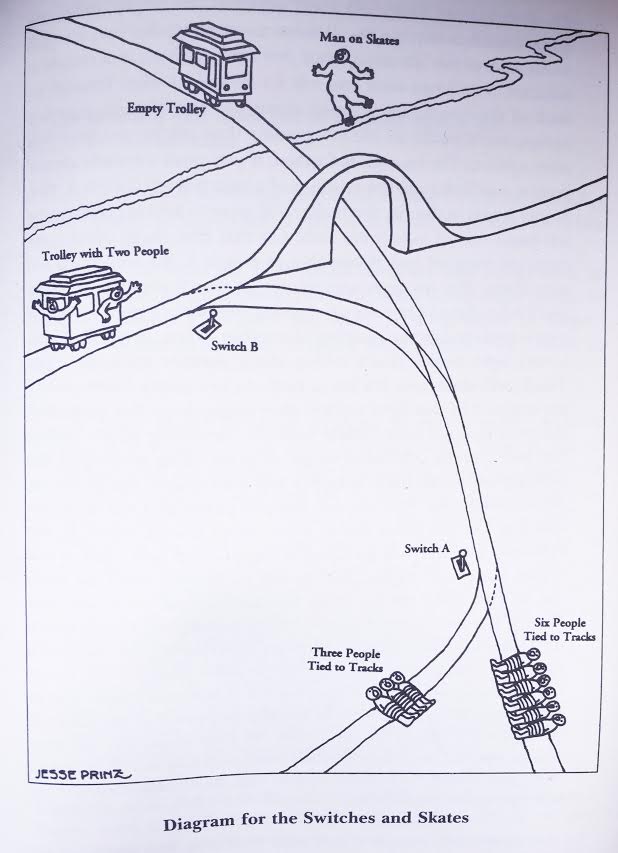
I’d love to hear about more of this kind of work: cartoons, drawings, photos, collages, paintings, and other images made by philosophers to artfully represent ideas. Not philosophical artworks made by professional artists, nor art made by philosophers that’s not directly about the exposition of philosophy, but art made by philosophers to illustrate philosophical ideas. And not charts and graphs, which of course can be artful in their own way (see here), but… well, I’m not going to lay out the necessary and sufficient conditions; I’m sure you get the gist.
You should be able to include a version of the image in your comment (click on the photo icon in the lower right hand corner of the comment box), or at least include a link to it. Let us know who made it, what it is, whether it has been published somewhere (if you know) or how it has been used/displayed. And yes, you are welcome to submit your own art.
(via Bernard Kobes and Pete Mandik)

A classic here is Zhuangzi Speaks:
https://press.princeton.edu/books/paperback/9780691008820/zhuangzi-speaks?srsltid=AfmBOopJuqD58qwD_dyKy6-0Rfd4jBiiP9mD4Xu7888V7PalydgPqXx4
If I’m reading the requirements right, some illustrations of mine might qualify. It looks like I can only add one image to each comment, so I’ll post about others in a reply.
Here’s my illustration of Zhuang Zhou showing the fading away of the butterfly and the descent “back to earth” of the man. A friend might use it as a frontispiece for her translation.
I also have an abstract trolley design and abstract modus ponens/modus tollens design. Both of these are available in my shop, and you can see the MP one below. (Note the speech bubbles overlapping just where the first premise – or the word modus – might be.)
Micol Bez and I are co-editing a volume, called *The Philosophy of Sexual Violence*, with Routledge.
The volume is multimodal modal and includes a lot of art.
It includes 14 philosophical images, including sketches, pottery, a stylised diagram, two conceptual sculptures, three collages, at least three pieces of photography, and a tarot card (featuring a hitachi wand vibrator).
____
The volume also includes 4 poems, at least three of which are “visual poems”. One is a visually complex blackout poem.
The volume also includes a rap, and a manifesto, contributed by a radical collective.
These pieces are interwoven amongst 20 philosophical essays, one personal narrative, one short story, one social media post (formatted as such), questions for the reader, and a roundtable of hot takes. Many of the essays draw on first-personal experiences of sexual violence.
____
We think of the visual art, poetry, autobiographical philosophy, and other modes, as integral to the project. And we are thrilled that Routledge is publishing this.
____
The volume will be sent to the typesetters very soon.
Here is one example of an image, puki dentata by Bernadette Birzer. There are plenty more!
This is the current webpage for the edited volume:
https://www.georgigardiner.com/philosophy-of-sexual-violence
I mentioned the edited volume. My students also make philosophical artworks for class.
I put some of them on my website, here:
https://www.georgigardiner.com/teaching#h.2dzjsp78s8j5
Here is one example:
“Hermes” by Addie Carmouche (lead artist), Aaron Dixon, Sara Ben Hmida, & Maya Galloway
Abstract:
“Hermes,” named after the Greek god of communication, was constructed as a representation of the impact hermeneutical resources have on our ability to not only articulate our own life experiences to others, but to also understand them on an introspective level. Although the central focus of the art piece is one person, this wooden sculpture represents each of us in our perpetual endeavor to understand the world around us and have our experiences validated by the understanding of others. Hermeneutical resources are a vital part of this process because without these pivotal resources, we would be less equipped to communicate our experiences, emotions, and thoughts.
There are more on my website.
Under the Teaching page, I have content about teaching philosophy with visual images, by both visiting galleries and having the students make artwork.
I have an essay that describes my approaches to teaching with visual artwork. It’s under review atm, otherwise I would link to it. But the activity sheets are available on the website.
____
My philosophy students are doing philosophy through tarot and visiting an art gallery later this week. Last week, my creativity students are doing an art-writing workshop and laser cutting our ‘life story’ into visual artwork.
I think of the creativity course as a sandbox for designing new philosophy teaching methods.
____
Example: The last section of this handout describes how an idea started in a creativity classroom but gets adapted to a philosophy classroom.
https://www.dropbox.com/scl/fi/fkfyj6miq3c9wg70fd2c9/Making-a-mix-and-match-instructional-manual.docx?rlkey=d6atal4lsjb8kkgh2lmcs350u&st=w37z1qaa&dl=0
In addition to the edited volume (*The Philosophy of Sexual Violence*) that includes 14 philosophical artworks, and assigning making philosophical artworks to my students, I also make philosophical artwork.
Here are two examples.
1.) Play Times: An Art Exhibition (2023)
Brief explanation:
(Please see this Artist Statement (Link) for more.)
The Art of Gathering
For one week, I attended my normal ‘third spaces’ in Knoxville. At each place, I invited those people to co-create art. The guideline was that every line should be made collaboratively.
This could be drawing around each other, guiding each other, instructing each other, holding a pen together, hands tied together, etc.
Here is the philosophical claim that I explore:
The objects hanging in the exhibition are not the artwork. They are a byproduct. The artwork is an intervention: Inviting people to play and create. It is their playing and creating.
The resulting objects are only a byproduct of the arts of play. The art is the art of gathering.
____
An artist said that glass was the most “alive” material that she has worked with. In reply, I said that I thought of some of my social organising as creating art, but the medium is people (or features of agency, perhaps). And that is an even more “alive” material!
This exhibition explores that idea.
A related question, then, is whether the exhibition is a solo exhibition that attempts to display a record of art being made (where the art is the art of gathering, and thus not present in the gallery). Or a multi-artist exhibition (where the artwork is made from paper and ink). Or both.
(2.) “The Interstitial
This is a collaborative artwork that (I think) explores metaphysical ideas.
The competition rules said ‘Anything in a gold frame is fair game’. (Broadway Studios and Gallery.)
Our pieces explored what kinds of things can be within a frame.
It asks whether magnetic fields, tastes, smells, potential energy, etc. are spatiotemporally located.
It does this because the frame “contains” those things. There is perfumed essential oils, a magnet, a battery, a stretched-out elastic band, popcorn, a book, a decaying plant, and many other such objects that elicit this metaphysical question.
_____
Co-created with Ashley Ekstrum. We submitted two other pieces that also raise this question.
I have more philosophical artworks on my website.
https://www.georgigardiner.com/projects
Under Teaching, I have activity sheets about teaching philosophy with visual images, by both visiting galleries and having the students make artwork.
I am, myself, artistically beyond hope. But my friend Ev drew a charmingly in-your-face illustration of a thought experiment of mine. My friend and office mate, Emily, and my dad illustrated the same thought experiments. All three pictures are posted here: https://newworkinphilosophy.substack.com/p/ian-stoner-saint-paul-college-against
It is hard to overstate how delightful it was to see artistically gifted people illustrate a thought experiment of mine. Made my semester. If you use fanciful examples, try bribing your talented friends to illustrate them. You won’t regret it.
love this
Raw Feels is an amazing comic by Leonie Brialey and contains, among other things, an illustration of Nietzsche’s eternal return
(https://www.booktopia.com.au/raw-feels-leonie-brialey/ebook/9781005908188.html?srsltid=AfmBOoq-O61GbTNOqBVzMtBfJ1vCOO9646TYbT97lpdDxDVgyVpTsCJ9)
“The Living Mirror: Consciousness in Recursion”
I actually have something like this as an assignment for all of my upper level courses. Students are a bit confused about the assignment at first, but once I show them examples of flow charts, cartoons, tables, and other student work they quickly find the assignment fun and rewarding.
There used to be a blog, “Hugging the Horse,” that was run by a British graduate student. It was hysterically funny, often quite profane, but sometimes it illustrated things better than anything else ever could. I still use one of his cartoons when I teach Kant because whether or not you laugh is dependent on whether or not you understand Kant.
Good read, “philosophers to artfully represent ideas.”
I’m a classic Jungian Type A, creative thinker with an artistic flair.
https://theoriginalalloneword.com.au/OCP2024.html
My ex-wife is an art sceptic, that is to say, art must be something. After watching Ed Harris play artist Jackson Pollock in the movie Pollock, she didn’t accept “drips and drops” as art, let alone Cosmic Chaos.
What is Art if it doesn’t make us think.
I am interested in these expressions:
> “Philosophers “Compress a Philosophical Idea into a Picture” > “images philosophers have created to illustrate their (and others’) thoughts”> “images made by philosophers to artfully represent ideas”
Emphasis added by me to the words “compress”, “illustrate”, and “represent”.
These are just some of the ways that art can be philosophical and that philosophers can do philosophy through (and with) art.
Artworks are also, for example, an invitation (to question, consider, interpret, feel…) and they stand in “dialogue with” (to use an artworld term) ideas and other works.
This isn’t an objection to Justin’s (or Nathan’s) phrasing. Justin and Nathan weren’t attempting to encapsulate the only roles for art in philosophical thinking.
I wonder if these verbs reveal some assumptions or values of analytic philosophers. These words might well stand out from other perspectives..
Again, to be clear, I’m not making value claims about these perspectives or assumptions. It’s just a striking aspect of the post.
Thanks for the article and the invitation to post. I’m creating a philosophical graphic novel that combines embodied cognition with a phenomenology of voice (opera training) to investigate the idea that voice and breath muscles are active in shaping cognition. Here’s an example and a link to a substack article, “The Future of Human Creativity” with the drawing as the title picture.
Years ago, I made a webcomic that’s a philosophical reflection on webcomics: A Monkey’s Journey to Omega and Beyond
It was made using Flash, so it has been inaccessible for a few years. But your post here has prompted me to do the necessary tinkering to make it work in a contemporary browser.
I often like pictures since philosophy doesn’t have a great number of them, except perhaps in the realm of aesthetics. But I’m also reminded of Robert Nozick’s concern about generating a simple picture (image, theory) of complex phenomena in this regard. An excerpt from his “Anarchy, State, and Utopia”:
“One form of philosophical activity feels like pushing and shoving things to fit into some fixed perimeter of specified shape. All those things are lying out there, and they must be fit in. You push and shove the material into the rigid area getting it into the boundary on one side, and it bulges out on another. You run around and press in the protruding bulge, producing yet another in another place. So you push and shove and clip off corners from the things so they’ll fit and you press in until finally almost every thing sits unstably more or less in there; what doesn’t gets heaved far away so that it won’t be noticed. (Of course, it’s not all that crude. There’s also the coaxing and cajoling. And the body English.) Quickly, you find an angle from which it looks like an exact fit and take a snapshot; at a fast shutter speed before something else bulges out too noticeably. Then, back to the darkroom to touch up the rents, rips, and tears in the fabric of the perimeter. All that remains is to publish the photograph as a representation of exactly how things are, and to note how nothing fits properly into any other shape.”