
“If individual vices can be virtuous from the perspective of a group, is the inverse also true? Does this mean that virtues, in some cases, can be vices in the context of group behavior?”
That’s the subject taken up by Mandi Astola (Delft), Steven Bland (Huron), and Mark Alfano (Macquarie) in the following guest post. The post is based on a recent article of theirs, “Mandevillian Vices“, published in Synthese.
This is the sixth in a series of guest posts by different authors at Daily Nous this summer.
(Posts in this series will remain pinned to the top of the homepage for several days following initial publication.)

Some Virtues Become Vices When Too Many People Possess Them
by Mandi Astola, Steven Bland, and Mark Alfano
In Ghost in the Shell, the protagonist Major Motoko Kusanagi is asked to justify why she involves a normal human in her mission, rather than a powerful cyborg with superhuman capabilities. She replies: “If we all reacted the same way, we’d be predictable, and there’s always more than one way to view a situation. What’s true for the group is also true for the individual. It’s simple: overspecialize, and you breed in weakness. It’s slow death.” Cyborgs are stronger, more resilient, better fighters and better investigators than regular humans. However, if all the members of the crew are strong, resilient, and skilled in the same way, then the members are all similar in that way and diversity is diminished.
Many of us accept that diversity in gender, ethnicity, background and experience is generally a good thing for many groups. Many of us also accept that diversity of opinions is good. A “marketplace of ideas” is more likely to be interesting and fun, more likely to cater to the needs of different people and less likely to result in polarization and staleness, and, like Motoko Kusanaki says, vulnerability to attack and exploitation.
These types of diversity are all positive. But what about diversity in virtuousness? Might it also be better to have people with different sets of virtues and vices? And does this mean that even vicious character traits can add value to collective reasoning by increasing diversity? Are there reasons to think that we should resist trying to train everyone to a procrustean ideal of virtue, and instead embrace the benefits that vice can induce in the collectivist contexts where we spend most of our lives?
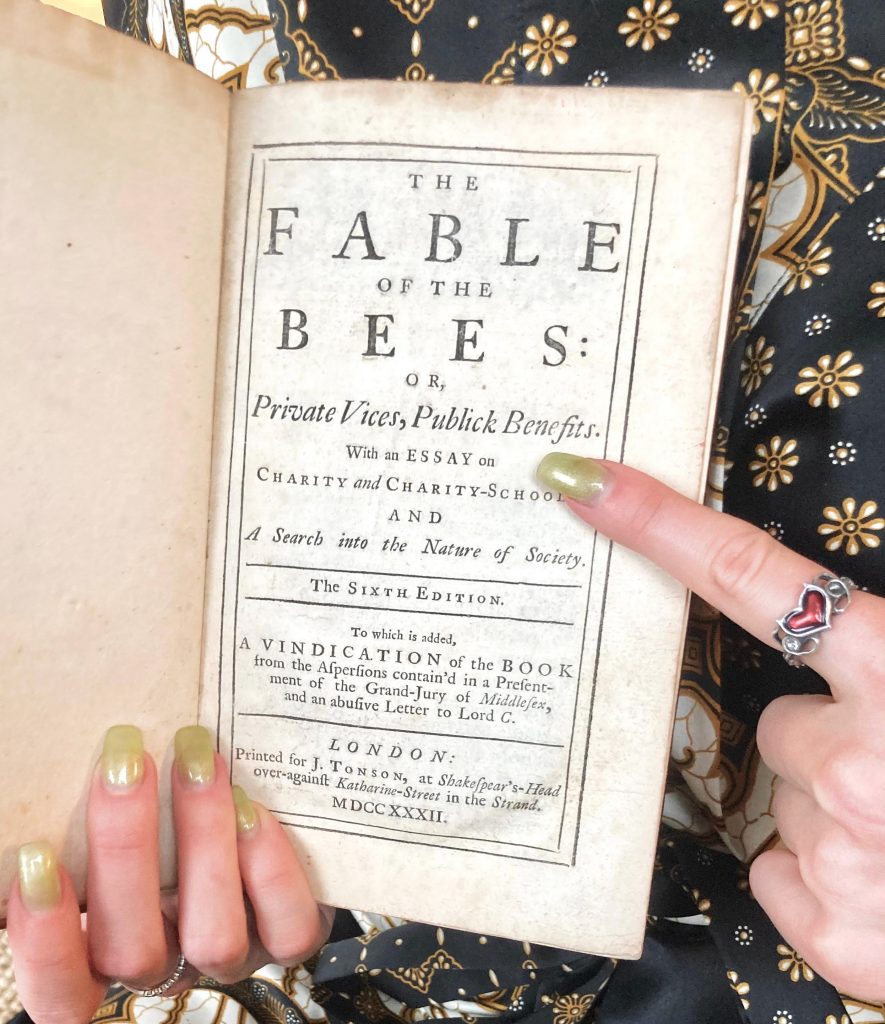
Bernard Mandeville, a Dutch economist and philosopher of the 17th and 18th centuries, wrote extensively about the public benefits of private vices. His work inspired many other important economists, such as Smith and Keynes. For example, its influence can be seen in Keynes’ paradox of thrift. If all the households live frugally and manage their finances prudently, then the economy suffers because fewer products are produced and purchased. Reckless splurging contributes to general economic welfare. Individual vices that have benefits at the level of collectives are called mandevillian virtues, and several philosophers have written about them in the context of virtue epistemology and virtue ethics (see Smart, Bland, Astola).
When there is too much apt deference and open-mindedness…
Overspecialization breeds in weakness in the domain of thinking and reasoning. If we were all intellectually virtuous thinkers, then we would often think similarly, and miss out on the benefits of diversity.
One example of this is apt deference. Human beings are uniquely capable social learners: by relying extensively on one another, we come to know much more than we could if we relied only on our own limited devices. Social learning can increase not only the quantity of what we learn, but also the quality. We can harness the wisdom of crowds by aggregating the judgments of individuals, provided that they are independent and reliable. Francis Galton famously encountered this phenomenon at the West of England Fat Stock and Poultry Exhibition, where eight hundred fair goers wagered on the weight of a large ox. He discovered that the average guess—1,197 pounds—was only one pound short of the ox’s weight, and much closer than the vast majority of guesses. Wise individuals, it seems, defer to wise crowds.
But if everyone follows this policy, the wisdom of the crowd undermines itself. People are deferring to people who are deferring to people who are deferring, and then it’s just turtles all the way down. Even groups of reasonable conformists are liable to converge too quickly in their thinking: they forsake their collective wisdom and think like limited individuals. Consequently, groups are often well served by containing a mix of diffident conformists and independent non-conformists. The former harness the wisdom of crowds; the latter preserve it.
We see this advantageous division of cognitive labor in scientific communities. The vast majority of scientists do what Kuhn calls ‘normal science’: they solve existing puzzles within prevailing paradigms. These puzzles can be formulated only by relying on the principles and procedures that most other scientists take for granted. However, Kuhn thought that science also advances by revolutionary leaps that involve the replacement of one paradigm with another. Most attempts at scientific revolutions fail; their advocates stray too far from their discipline’s accepted wisdom. But scientific progress depends on their making the attempts. Where would biology be without the Darwinian revolution, or physics without the quantum revolution? The stubborn independence of a few scientists can also prevent theories from being prematurely rejected. The bacterial theory of peptic ulcer disease would have died decades ago were it not for a handful of advocates who refused to be swayed by, among other things, Walter Palmer’s inability to find Helicobacter pylori bacteria in his biopsies of digestive systems (he was using the wrong kind of stain to detect them).
The kinds of theoretical diversity that allow science to thrive can be maintained only if there is a critical mass of scientists ready to advocate for unpopular theories. On the flip-side, science can converge on better theories over time because most scientists are ready to defer to the judgment of their colleagues.
This kind of thing can happen when people exhibit what seems to be a virtue: avoiding myside (confirmation) bias. However, group deliberation might suffer when everyone does this. As Mercier and Sperber argue, myside bias can be epistemically beneficial in a dialogical context. When two people, both biased in opposite directions, have a discussion that’s guided by an unbiased mediator, both will need a lot more convincing, and this often means that more arguments are explored in the discussion than would be otherwise. Discussions are, after all, more interesting when people disagree a little.
There is however an amount of disagreement at which discussions become boring again, when polarization happens and interaction and exchange become difficult. This is why we stress that epistemic vices are not always good for groups, and if there is too much of them, then inquiry suffers. When that happens, the group faces a potentially irresoluble conflict in terms of attaining truth and understanding.
When there is too much mercy and forgiveness…
Imagine that a police officer stops a stressed out father who is driving his crying and fighting kids to school. Tears well up in the father’s eyes when he realizes that he has forgotten his driver’s license. The police officer might mercifully let him go with a warning, realizing that the man is on the verge of a mental breakdown. This seems like the right thing for him to do. But if everyone were always merciful in this way, then norms regarding traffic safety and rule-following would likely deteriorate. Some moral virtues also become disadvantageous when everyone possesses them. Forgiveness and mercy are among them.
Cooperation is a big part of morality, perhaps even the majority of it. And a little forgiveness and mercy can grease the wheels of cooperation because everyone makes mistakes. This is why the tit-for-tat or copycat strategy (being nice to those who are nice to us and nasty to those who have been nasty to us) is evolutionarily stable. In certain contexts, especially when miscommunication is prevalent, an even more forgiving strategy is stable: the so-called tit-for-two-tats or copykitten strategy. The basic idea is that one only defects if one’s partner has defected twice in a row. As lovely as this strategy is and as virtuous as the people who employ it might seem, if too many people adopt the copykitten strategy, the population becomes vulnerable to exploitation by aggressive defectors. Copykittens are predictable and forgiving, which can be great for cooperation, but a group of only copykittens is arguably overspecialized in forgiveness as a collective at the cost of an inability to enforce norms.
The division of moral and cognitive labor
Having everyone behave more virtuously sounds like a valuable and worthwhile aim. In many contexts, it is. But, we argue, there are also collectivist contexts where the realization of this aim would have negative unintended contexts. If everyone were virtuous, then they would think and act similarly. And dispositional monocultures are problematic when they lack the diversity required to sustain an efficient division of moral and epistemic labor.
Moral and epistemic diversity can trump individual virtue. When some moral agents are vindictive and others are forgiving, the former specialize in guarding and maintaining moral norms while the latter guard and maintain flexibility and harmony by allowing for the occasional violation and possible readjudication of those norms. Likewise, diverse collections of independent and deferential thinkers can effectively divide the cognitive labor required to harness and maintain the wisdom of crowds.
We should note that often such divisions of labor are gendered or racialized. Society expects a lot more forgiveness from women than from men, and Black people in the US, and possibly other places too, are often pressured to forgive racism. These pressures may both depend on and support social inequalities, and because they rely on evolutionarily stable strategies, such inequalities are liable to become entrenched. Whenever there is a division of labor—whether it be economic, cognitive, or moral—it is therefore important to be mindful of the position of and pressures faced by those at the bottom of the hierarchy. We want the benefits of cognitive and moral divisions of labor, but not if that depends on and perpetuates unjust or oppressive systems. This is not to insist that different populations and sub-populations have exactly the same strengths and preferences, but that whatever the distribution of strengths and preferences, proactive care needs to be taken to ensure that those with the least power are not unduly exploited. Even if some people are more disposed, by nature or nurture, to altruism and turning the other cheek, that does not mean that a just society should encourage or eagerly accept their self-sacrifice. Indeed, having a few spiteful protectors of such innocents may benefit the group.
Challenge for virtue ethics and epistemology
Mandevillian virtues and vices constitute an empirical challenge to traditional accounts of moral and intellectual virtues. It is not the first such challenge. Situationists have leveraged results from social and cognitive psychology to argue that virtues are much less prevalent than people have thought. In our new article, we use results from psychology, computer modeling, and the philosophy of science to argue that virtue theorists underappreciate the effects of personal dispositions on collective forms of thought and action. Given that most of our moral and intellectual lives are lived in collective contexts, this strikes us as a significant blind spot. Maybe it’s time for virtue theory to take a collectivist turn.

I’m not sure why “Mandevillian virtues and vices constitute an empirical challenge” rather than a normative or conceptual challenge. It is an empirical question, I suppose, whether actual communities tend to cultivate individual virtues or collective, Mandevillian ones and whether they tend to suppress individual vice or Mandevillian vice. But the more important question is which they ought to do— and what kind of individuals we should strive to be given the tension between the individual and collective standpoints.
You’re totally right that mandevillian virtues and vices are a challenge that has huge conceptual and normative implications. The “empirical” in “empirical challenge” refers to the origin of the challenge, these ideas came out of looking at empirical research.
Your second question – what kinds of individuals should we strive to be? – is a good one, given the traditional virtue-theoretic emphasis on the cultivation of virtues in individuals. But I think the existence of Mandevillian virtues and vices requires us to ask a further question: how do we strike a balance of diverse cognitive/moral agents that best facilitates collective epistemic ends? This is part of the collectivist turn mentioned in the last paragraph. The answer will involve organizational and institutional interventions – the establishment of norms, incentives, constraints, etc. – that typically get overlooked or under emphasized by agent-centered virtue epistemology.
Interesting question how much of this is empirical. I guess it could have turned out that just throwing together only virtuous individuals yields the best collective outcomes. But that turns out not to always be the case, which is an empirical finding. I agree, though, that there is then a normative question of how to respond to this finding. We suggest that a reasonable response, at least for some types of groups, is to cultivate diversity of traits.
Did Plato, Aristotle, or Aquinas believe that the virtues must be such that a society or other collective would be better off if every member of that collective fully possessed them, rather than only some members?* If not, are any major contemporary virtue theorists committed to this claim?
* at least, in Aquinas’s case, better off in this life.
I don’t think Aristotle says that explicitly. It is good for individuals to be virtuous, so I can imagine that by this reasoning you want each individual to be virtuous. And if you accept the unity of the virtues thesis, then you accept that all virtues support each other, and one virtue is not complete without also possessing the others. And because you want this for everyone individually, you end up wanting a society consisting of fully virtuous people. People like Mandeville asked the question about what this would do to the collective. Virtue is generally defined with reference to the individual’s flourishing and the ability to maintain good relationships with others. But the collective that one is part of, and the good of that collective, is something different than one’s interpersonal relationships.
In the Republic, Plato seems to be arguing that there is only one right way for a soul to be constituted. I’m not sure about his other stuff, or really at all an expert on Aquinas. Aristotle says in the Nic Ethics and Politics that there are different virtues for men and women, based on their different natures. We are, of course, wary of that kind of essentialist reading. In the contemporary virtue ethics and virtue epistemology literatures, people don’t usually make the universalizing claim explicitly, but they do seem to assume it.
Interesting piece, thanks for sharing. I am just not sure that your examples really work, however.
(1) If everyone defers all the time that creates a paradox. But always deferring is no virtue. And even if everyone defers most of the time (which may well be the case given the amount of specialization in modern societies), that doesn’t lead to a paradox.
(2) I am not a fan of the normal/extraordinary distinction in the sociology of science. For one thing, like “paradigm,” depending on what level of generality you pitch a particular claim almost anything can be normal or extraordinary science. More to the point, I don’t see why we need a mix of defending unpopular theories sometimes versus counting (the awful lot of) scientific consensus there is as truth tracking across scientists as a group. Shouldn’t each scientist exemplify the right mix on a virtue approach? You say, “There is…an amount of disagreement at which discussions become boring again,” but the ultimate aim of science is (or is compatible) with being very boring.
(3) Similarly with mercy, virtue is having the right mix. If there’s too much mercy in society (I find that hard to picture) shouldn’t virtue theorists say that too many people are being unvirtuously merciful?
I don’t see why we should treat these cases as people not being properly virtuous, rather than as something like a collective action problem. The virtue theory behind such an approach – group virtue theory? – is not, I think, widely held.
Just to follow up: the empirical literature on virtue development tends to find that changing traits is really hard, and that even longitudinal interventions only make a small difference. Given that, we think it’s valuable to think about how best to put flawed people together in collectives, taking advantage of both the strengths and the weaknesses of members. It would be nice if everyone were an omniscient phronimos, but that’s not going to happen any time soon. In the meantime, we help each other navigate our diverse dispositions and exploit their interactions as best we can.
Wow! Lots there. I won’t even try to respond to most of it. But let me defend my claim about (1) the deference paradox.
As you know, the liar’s paradox depends on interpreting (for example) “All Cretans are liars” as “All Cretans are always lying whenever they speak” or there’s no paradox, just a reason not to trust Cretans.
You say if everyone defers then “People are deferring to people who are deferring to people who are deferring, and then it’s just turtles all the way down.” But you need more than an unvirtuous level of deference to get turtles all the way down. You need everybody always deferring every time to get a paradox. This doesn’t seem a genuine worry about deference.
In other words, any virtue theory will say there’s such a thing as too much of any virtue, including deference. What is new in your account is that there is a separate collective action/virtue problem. Without a genuine paradox or something this does not seem to add anything to virtue theory.
Good luck with the work! Thanks for your time.
Hmmm, interesting. The liar’s paradox is one of the deepest paradoxes out there. We certainly don’t want to suggest that what we’re talking about is as deep a paradox. But it is a head-scratcher. I think of the deference thing as more akin to the problems that arise from training an AI on AI-generated synthetic data. The ouroboros problem has already been documented in that area where there was recently a lot of hype. In the same way, if human testimonial deference doesn’t ground out eventually in cognitive contact with reality, we have a problem.
“the point here is about apt deference, so deferring in situations where it is most rational to defer. And in cases where you don’t know the answer to something, but find yourself in a large group with lots of people who are also looking for the answer, it is in many cases rational to defer to what the rest are doing, because groups tend to be wiser than individuals.”
In some cases, yes, but there can be other factors. The intellectually virtuous agent might have learned through long experience to trust their own tendency toward stubbornness. They might defer to the advice of an older colleague, whom they have learned to trust more than the group, and who is advising them to hold their ground. They might just have developed a good intuitive sense of what is required of them in a situation, even if they can’t articulate it.
My point is, what counts as “most rational” isn’t always reducible to something you can state as an argument. As I read Aristotle, practical wisdom often presents as more of a knack or a know-how than as something you can put on paper. And it always depends on exactly the kinds of details that thought experiments like this abstract away from. I think this article does a great job at enriching and complicating our view of virtue and especially prudence, without truly threatening a traditional virtue ethics, which can diffuse these kinds of paradoxes in the way I just outlined.
Yes, “what is most rational” is probably not the best way to define the most prudent way to think. I think that many of us defer to what the rest of the group thinks, not by drawing the conclusion as a result of argumentation, but just by feeling out the vibe and realizing it is better to go along with it. And the people who do not get the vibe in this way, broaden the scope of exploration for the group.
So much to disagree with! First Mercy as a virtue involves understanding the other’s predicament and taking it into account and most importantly not being mean or vindictive or reributivist about it. It is not “let the guy go, he’s having problems..” it smore take the guy home talk to him and his family.. try to find a way to improve the individuals driving without causing undo pain. We all recognize that punishment is sometimes necessary as a deterrent, but in fact in our (USA) culture,retributism in the norm.As Aristotle says, the virtues are the mean, and there is always a way to go to fair. This is just practical wisdom, not some deep fundamental problem with treating the virtues as norms.virtue ethics.(not a virtue ethics person myself, but qua practical/applied ethics, its pretty damn good–just not fundamental).
It is an important to recognize that women are expected to be more understanding.merciful than men. But that does not mean that..what “womanish” virtues are bad or inferior..What this teaches, at lest to. me, is that the male paradigm of being less meriful more judgemental needs serious modifcation. So. much more and its late .. but that is a start
Ok, my fundamental problem is that I see ethical truth is to be determined like anything else,.. by rational argument. Reasons are either good or bad OBJECTIVELY and each of us must consider these reasons on our own. To suggest that social coherence of values or whatever is prior or more important than that leads to absurd consequences (look at the history.. whole societies have been, I think disasterously wrong. Of course engaging with others and considering their reasons is VITALLY important, but it is in the end up to me. (or you) call me an ethical solipsist if you like..that does not make the view false
yeah its not even moderately solipsistic! I was being unfair to my own view:)
“in fact in our (USA) culture, retributism in the norm.” Well, Mandi is European, Steve is Canadian, and I’m an American living in Australia… There’s no need to prioritize the more objectionable attributes of my compatriots… <3
It strikes me that all these issues can be resolved by individuals displaying the virtuous action the right amount, in the right circumstances. So instead of everyone always being open minded, for instance, people are open to alternative perspectives but not too open. How open you should be will depend on various details, so that our discussion will be adequate if it has as much clearness as the subject-matter admits of, for precision is not to be sought for alike in all discussions, any more than in all the products of the crafts It is almost as if the virtuous action is a non-arithmetical mean between two vices.
I think you’re giving voice to how most virtue theorists think about these matters. But our point is that if all individuals achieve the virtuous mean in all circumstances, then the collective may lose out on the benefits of epistemic/moral diversity. Collectives may benefit when most of their constituents are open-minded, humble, aptly deferential, etc., but they often benefit from having a minority of dogmatic holdouts, arrogant rebels, etc. Expecting individuals to recognize how to think/act in ways that are maximally beneficial at the level of the collective is too demanding. We should focus more (though not exclusively) on institutional measures of achieving the virtuous mean at the level of collectives, which may involve incentivizing some individuals to behave viciously in some respects, as Kitcher and others point out in the case of scientific inquiry.
Many of the suggestions in these comments amount to saying that to be virtuous is to have a virtue in just the right amount or just the right circumstances.
But this suggestion suffers from the same fundamental difficulty as Rule Utilitarianism: Rule Utilitarianism threatens to collapse into Act Utilitarianism, or even an empty theory, if the rules are allowed to include clauses like “follow this rule just in those circumstances where it is good to follow it”.
Virtue ethics will similarly collapse into something empty if the virtues amount to “display this virtue just when it is good to do so”.
One of the things that makes Virtue Ethics attractive is that it gives us advice we might concretely follow—be compassionate, be brave, be honest, etc.—but it will lose that if it says “be brave only when being brave is the right thing to do”. That is empty advice.
I think I agree. Our suggestion is that the ceteris paribus stuff can sometimes be handled by individuals on their own, but that it can also be (better) handled by relying on other people with different traits.
I mean that is exactly what Aristotle says when cashing out many of his virtues, right? “In the right way, to the right person, at the right time,” etc? The (tricky) suggestion is that you can’t get to much more precise than that, and that a great deal of practical wisdom (as well as interpersonal negotiation and discussion) is necessary in order to know what counts as “right”.
Again it’s the action that must be done in the right way etc., not the virtue. A virtuous person doesn’t act wisely only sometimes, to some people, but all the time.
It is not the virtue but the activity that should be engaged in when it is good to do so – i.e. right time, place, manner to achieve the virtuous mean. The virtue itself is never bad – it’s not bad to be courageous, but good. The issue is whether this or that particular action, in its context, is courageous. And since people in groups are not always engaging in the same actions in the same circumstances, it’s not clear how a collective action problem arises. Even in narrow domains, group members usually are doing different things to accomplish a collective goal.
But ‘being brave’ must necessarily include some notion of rightness; Skydiving without a parachute might be ‘brave’ insofar as it is fearless, but is clearly not a virtuous action. What I am trying to get at is that the virtues must be necessarily good, and can only be necessarily good in certain contects. Hence, the idea of ‘the right amount of braveness’. This also follows from the principle of the reciprocity of virtues.
i think it should also be noted that virtue ethics does not necessarily purport to be easy or concrete. In fact it relies heavily on context-specificness and criticises principle-based ethics for not following that. The idea of virtue ethics as I understand it follows more closely from the ideal of continued moral development than the attainment of stable virtues.
This all stems from a position that virtues are indeed a source of goodness, and not merely a useful evaluative or psychological tool. But, to me, virtue ethics without such value would largely become meaningless. As it would collapse to mere pop-philosophy.
As some people in the thread have suggested, I think most virtue ethicists would prefer not to speak of someone having too much or too little of a particular virtue based on some standard external to virtue. Virtue is meant to hit the mean by definition and you shouldn’t be able to have too many people hitting the mean, because the mean would shift to compensate for what other people in society were doing.
On the other hand, some people have rightly replied that it’s very demanding to make an individual virtuous person have to keep track of the prevalance of traits in society as a whole and moderate their open-mindededness or mercy accordingly.
To make these seem a less demanding, I suggest an appeal to Christine Swanton-style role-differentiated virtues. If Aristotle is right that the mean is relative to the individual, the social roles an individual plays influences the mean for them, e.g. the mean of honesty is different for each of the roles of a parent, lawyer, doctor or politician. Now there may be other roles to be played in society that have gone underappreciated, but each have their own distinctive mean of open-mindedness, apt deference, mercy, and forgiveness, such as:
The devotee
The renegade
The curmudgeon
The bleeding heart
The hardass
The undisciplined dreamer
People with different combinations of classically feminine or masculine traits
People would fall into one of these roles, partly by chance opportunities afforded to them by their unique personality and background, and partly by choice and with self-awareness, recognizing that their temperament does some good to the people around them, in a sufficiently diverse context and within reason. These roles wouldn’t be entered into with the attitude of optimization for social goods, but also not without sensitivity that there is a sort of division of labor here between people with different personalities — all types are required — and one can should lean into one of these roles to a greater or lesser degree depending on the situation, the community and the zeitgeist.
This doesn’t seem to me as something that would be beyond the reach of the sort of person we’d call virtuous. (This is not to say that people shouldn’t be as well informed as possible by institutions so as to be able to get an accurate view of their social context.)
This is a very important point on which we agree. Section 5 of our paper deals with the importance of roles, though there’s much more to be said about their relationship to the virtues.
Yes! Role-based virtues are the future, as is extending virtue ethics and epistemology to collective agents.
What counts as a role? Like in the Meno will we need a different set of virtues for the old or the women?
Yeah, a gender or age based division of labor is not great… ideally a role is something that a person authentically grows into or willingly adopts, without too much external pressure. I would say that a role can be an institutionally defined one, i.e. the diversity officer in a company might be given the role of being woke-police, or an organization might have a role for a pedantic bureaucrat. But these roles can arise informally and naturally too, like having one brutally honest person in a group of friends to deliver harsh truths when no one else dares.
I’d argue it’s not that too many people have virtues. It’s that too many people have disordered virtues.
“When virtues are properly ordered, they naturally lead to goodness and harmony. Conversely, when these virtues become disordered, evil inevitably arises”
With that being said. I enjoyed your article and appreciate the perspective you brought to it.
A similar question struck me when I read about Durkheim’s view in sociology that a certain level of crime is beneficial because it keeps society together by uniting and directing collective morality against certain types of acts etc.
The question was “can it be that for every particular individual it is immoral to perform a certain act, but for the group it is good if SOMEONE performs it?” So that both of these statement are true at once:
(i) “Someone should do x.”
(ii) “For each individual, they should not do x.”
I think the solution is simply that “good” is taken to mean something like “virtuous” on the individual level but “utilitarian” on the group level, and if that’s the case the tension goes away (or at least it remains only trivially, between the ethical frameworks). There is no contradiction involved in an individual’s vices having practically beneficial outcomes (on whatever level).
But the question remains of how society should handle such tensions. Are there acts we consider a person immoral for performing, but we also “acknowledge our debt to the immorals”? I think many people have some more or less implicit views like that.
Oh interesting! Do you happen to have the citation ready-to-hand?
The go-to in Durkheim’s own work is probably chapter III (especially the third section) of his The Rules of Sociological Method (1895). But for a quick overview there is also plenty written about it in the secondary literature.
Even if he only treats it as a peculiarity of sociological theory, and not as an ethical conundrum, Durkheim explicitly recognizes the tension: “We are faced with a conclusion which is apparently somewhat paradoxical. Let us make no mistake: to classify crime among the phenomena of normal sociology is not merely to declare that it is an inevitable though regrettable phenomenon arising from the incorrigible wickedness of men; it is to assert that it is a factor in public health, an integrative element in any healthy society.”
But in a sense, Durkheim’s treatment is closer to the ethical perspective than it might appear to a modern reader, because he assumes a much closer connection between the law and common morality, saying that “Crime /…/ consists of an action which offends certain collective feelings which are especially strong and clear-cut.”
I would say this is a very “pre-technical” (almost pre-modern) view of criminal justice. I think the vast majority of laws today are at best loosely related to the moral passions of the average community member, and that they are primarily in place to ensure some technical efficiency of the social apparatus. (E.g., speed limits are what they are for largely technical reasons and not because the average Joe/Jane finds certain velocities categorically immoral.)