
What happens to the articles published in an online-only journal when that journal not only ceases to publish, but ceases to exist?
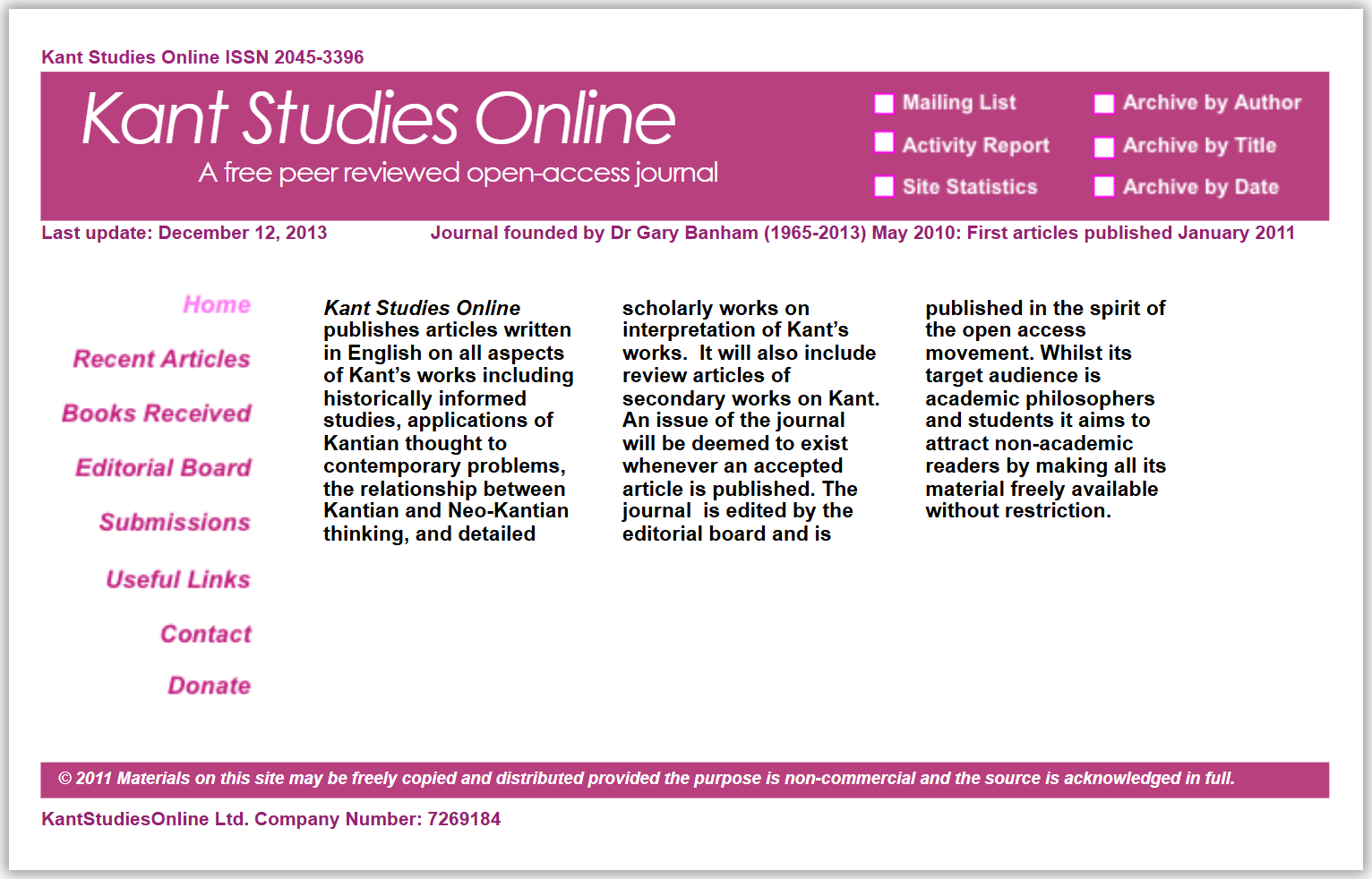
That question is raised by the case of Kant Studies Online, an online only, open-access philosophy journal that published articles between 2011 and 2016, the website of which is no longer accessible. The journal was founded by Gary Banham, who died in 2013.
The journal published articles through 2016, according to PhilPapers. And while there appear to be versions of some of these articles at PhilArchives (available via their PhilPapers listings), that is not the case for all of them.
Nor are the journal’s articles available through archived versions of the site at the Internet Archive.
The disappearance of Kant Studies Online was brought to my attention by Jef Delvaux, who writes:
I am concerned about the gap in the record of Kant scholarship, more broadly I am concerned that philosophers are not sufficiently aggressive in ensuring that their scholarship is preserved, especially when it is published in online venues. Arguably there is a role to play here for librarians. I thought that, perhaps, you could post a call addressing those who have authored pieces for Kant Studies Online to upload their papers and/or tables of contents to PhilPapers or the academic repository of the Internet Archive.
That might be good advice for authors of articles in other online-only journals.

The scale of the problem of disappearing journals is pretty shocking. Some recent(-ish) numbers: https://arxiv.org/abs/2008.11933
There are a number of consortium arrangements between publishers intended to address this issue by shared and multiply redundant archiving. For instance: Home – Digital Preservation Services – CLOCKSS , which is used by LSE press (who publish Philosophy of Physics, of which I’m editor-in-chief).
Any reputable online-only journal needs to have such an arrangement; ideally, more than one. (This is one reason why even an online-only, open-access, journal needs to have a proper professional publisher.)
If the journal uses OJS, as many online journal do, it should at the least be using the PKP Preservation Network as a stopgap in the absence of LOCKSS/CLOCKSS. And if nothing else journals could archive content in a stable open repository like Zenodo, which enables the curation of collections that could be associated with specific journals.
Chiming in rather late to say that there are options for independently-published online and open-access journals as well. JESP is archived by Portico, which is run by the same nonprofit that operates JSTOR.
This is a good time to remind everyone that the Internet Archive has a browser extension that anyone can use to archive sites. This way if you see something worth saving, you don’t have to rely on their crawlers to capture it. Just press a button and a snapshot of the site is recorded and archived for everyone. The same extension allows you to view older versions of a url when you run into a 404 error, which is great for sites that are restructured often.
Wayback Machine extension: chrome-based (Chrome/Opera/Brave), Firefox