
Yes I Like Piña Coladas: On Haecceities and the Normativity of Love (guest post)
The start of the school year is creeping up on us but it is still summer.
If you can, find some time to relax in the sun, perhaps by a pool or ocean, enjoy a tropical drink, and enjoy the following guest post.
It’s by Nick Laskowski (University of Maryland), who provides us with a seasonal example of the time-honored tradition of philosophers overthinking song lyrics.

Yes I Like Piña Coladas:
On Haecceities and the Normativity of Love
by Nick Laskowski
When I received Justin’s invitation to write a guest post, the consequentialist’s compelling idea that it would be permissible, as well as the perhaps less compelling idea that it would be obligatory, to use the opportunity to promote the best outcome for the profession became vivid. Perhaps I would make an argument for why senior philosophers should almost always submit non-anonymous referee reports to avoid submitting lazy or nasty reports. Or perhaps share first-hand evidence that the perceived persecution some philosophers keep droning on and on about isn’t unique to conservative positions on gender: ordinary territoriality and vanity—maybe even my own!—cost my co-author and me eight years in publishing our recent paper defending the view that your gender is the one you intrinsically desire to belong to. Bias against gender conservatism isn’t even the right kind of thing to explain our ur-woke idea’s slow route to print.
Instead, I’ve decided to prioritize fittingness and write on something more appropriate for the summer: piña coladas, or rather, Rupert Holmes’ 1979 pop song “Escape (The Piña Colada Song)“.
It’s a feel-good song with lyrics about a couple who appear to fall out and then back into love with one another. It’s written in the first person, so it is Holmes himself who expresses boredom about his own relationship with his long-time romantic partner with the lines “I was tired of my lady” and “We’d been together too long”. Accordingly, he checks out the “personal columns” of the newspaper (i.e. 20th century Tinder) in the hope of finding a new romantic partner, where he finds the following ad:
If you like piña coladas
And gettin’ caught in the rain
If you’re not into yoga
If you have half a brain
If you like making love at midnight
In the dunes on the cape
Then I’m the love that you’ve looked for
Write to me and escape
Hence the song’s title. Now if you’ve never read the lyrics before, you might be hung up on the fact that Holmes is trying to ditch his partner. Reserve your judgment. Seeing himself as someone who likes piña coladas, getting caught in the rain, and so on, Holmes describes (anonymously) meeting the ad’s author at a local bar:
So I waited with high hopes
And she walked in the place
I knew her smile in an instant
I knew the curve of her face
It was my own lovely lady
And she said, “Aw, it’s you”
Then we laughed for a moment
And I said, “I never knew”
The big, seemingly sweet reveal, of course, is that the ad’s author was the very partner from whom Holmes was trying to escape. Holmes’s partner tried to ditch him for someone who likes piña coladas, Holmes tried to ditch his partner for someone looking for someone who likes piña coladas, and each ends up realizing that their existing partner fits the bill. It’s a twisted kind of “meet cute”.
But their meet up is more twisted than cute and not just because they each avoid engaging in the morally bad behavior of cheating on their partner by benefiting from a generous amount of moral luck. The song should not inspire any “Aww, shucks” because it presupposes a low down, dirty, sordid view of the normativity of love that’s probably false.
Think about the reasons why you romantically love your husband, wife, partner, or partner(s). When I do so, I find myself reaching for my wife’s creativity, attractiveness, strength, and various other qualities. When I invite my students to engage in this exercise, they also tend to reach for their own partner’s qualities. And qualities seem like an excellent place to reach. Indeed, on reflection, it’s not terribly obvious what else might serve as our reasons for (romantic) love. It’s easy to conclude that a person’s qualities exhaust our reasons for loving them.
The song seems to assume this kind of qualities view of our reasons for love. After all, Holmes’s lady’s ad for a new romantic partner just is a list of qualities—she’s looking for a romantic partner who exhibits the qualities of liking piña coladas and getting caught in the rain, having half a brain, and the like. And before meeting at the bar, Holmes describes himself as answering the ad in the following qualities-centric way:
Yes, I like piña coladas
And gettin’ caught in the rain
I’m not much into health food
I am into champagne
I’ve got to meet you by tomorrow noon
And cut through all this red tape
At a bar called O’Malley’s
Where we’ll plan our escape
In his mind, Holmes should answer the ad because the person on the other end of it is looking for someone like him—someone with the qualities of liking piña coladas and getting caught in the rain. But that’s just it. Holmes’s partner isn’t looking for him. His partner is looking for someone, anyone, who exhibits the qualities of liking piña coladas and getting caught in the right. I happen to love piña coladas (though as far as creamy tropical drinks go, I prefer a painkiller). Now assume that I also like getting caught in the rain, and, generously, that I have half a brain, and so on. The qualities view seems to imply that there is a tie between Holmes’ partner’s reason to love me and her reasons to love Holmes. That is, the qualities view implies that if Homes and I both show up at O’Malley’s, Holmes’s partner ought rationally to flip a coin. Meet cute? Twisted.
As it happens, there is an easy way to break the tie in favor of Holmes. For example, some philosophers (like Tom Hurka in his book The Best Things in Life, which is where I, a metaethicist by training, started learning the little philosophy of love I know) argue that the way out of this kind of puzzle is to locate our reasons for love not just in any old type of quality, but the qualities that we exhibit in virtue of standing in various historical relations to one another. Homes and his partner presumably shared many happy moments together in the past. But even if they didn’t, and their time together was more fraught than fond, their relationship was unique—no other individuals inhabited the very same places at the very same times as they did when they did whatever they did together as a couple, nor will they ever. There’s a sense in which that’s special, and that specialness attaches only to them.
So Holmes and his partner’s shared history plausibly tips the balance of reasons in favor of his partner loving him over otherwise qualitatively identical me. That view’s fine, I suppose (though I’m sure someone has made the point that there’s a possible “Repugnant Conclusion” analogue for such reasons for love that should give us pause). It does seem to yield the right result about our case, after all.
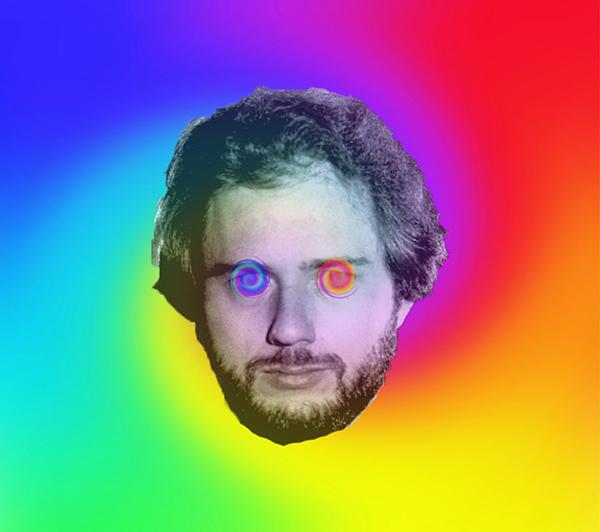
Rupert Holmes with thisness (artist’s rendering)
Nevertheless, I alluded to a much more fun view above, namely, that Holmes’s partner’s reasons for loving Holmes includes the “thisness” that is Holmes himself. The haecceity that is Holmes gives his partner a reason to love him that I lack, thereby making it rational to pick him over non-historically qualitatively identical me. Rupert Holmes’ “Escape (The Piña Colada Song)” turns out to be more cute than twisted after all, at least on a haecceity-based view of the normativity of love, the haecceity bit of which I leave to commentators to work out below. Have fun!
I have the sense that this criticism is conflating two issues: whether the properties in a partner Holmes’ wife is soliciting are banal (they are) with whether the characters are conceptually confused (I don’t believe they are). The objection of the author, that because these properties are so banal that practically anyone could fit her criterion, does humorously deflate the romance of the couple’s reconciliation. But in general, I don’t feel I should be disturbed by the mere *possibility* of another woman matching the description I provide of the best qualities of the woman I love. As long as it is sufficiently improbable that anyone else have those qualities, I don’t see what problem you could leverage, with this rhetoric, against the soundness of my affection. It is a cliche, isn’t it, to describe the people we love as “one-of-a-kind”? This, to me, reflects the logic that love is (in some strands of popular imagination) predicated on a (perception of) uniqueness, which is precisely the logic that guides the woman in the song. So I don’t find this argument cogent at all.
There are many songs on this topic that are better, philosophically as well as musically, than (for God’s sake) the Pina Colada Song.
Neil Sedaka’s “Breaking Up is Hard to Do” suggests the historical view when, urging a partner not to break up, it says “Think of all that we’ve been through.” But a song Elvis recorded on his first Sun record suggests haecceitism when it says “I love you for a hundred thousand reasons/But most of all I love you ’cause you’re you.” Likewise the Jerome Kern/P.G. Wodehouse song “Bill” with its line “I love him because he’s … I don’t know … because he’s just my Bill.” (The latter cited in a paper about McTaggart’s view of love by my late ex-colleague Dennis McKerlie.) And there are surely dozens of other songs expressing similar sentiments.
Pop songs often contain philosophical ideas. For example, to illustrate Mackie’s idea of objective prescriptivity, where something is both capable of objective truth and intrinsically motivating, like Plato’s Form of the Good, think of The Teddy Bears’ “To know, know, know him/Is to love, love, love him.”
Thanks, Tom. You say that there are many songs on this topic that are better in various ways. No doubt. But let’s not let perfection be the enem…ur, um, well that one probably isn’t going to work on you of all people, so I’ll just say that while I love me some Elvis (I was married by one, after all), I see him (and Sedaka, etc.) as less fitting for riffing on love on the day before I leave for a holiday at the beach than Holmes.
I never understand the Pina Colada song. Why wouldn’t both people realize the relationship is well and truly done — they’re both so ready to cheat, and seeing that their current partner seems to meet the description in the ad should just show them how inadequate the ad is. Anyway, Rachel Achs discusses the song in “Hypocritical Blame Is Unfitting,” Oxford Studies in Metaethics, vol. 19 (2024).
Here’s the ultimate stalker-haecceity song: Raydio’s “You Can’t Change That” (1979). The lyrics suggest the loved one can keep changing her qualities (address, phone #) but the singer will still love her:
“You can change your telephone number
And you can change your address too
But you can’t stop me from loving you
No, you can’t change that, no, no
You can change the color of your hair
And you can change the clothes you wear
But you’ll never change the way I care
No, you can’t change that
‘Cause you’re the only one I love
And you can’t change that”
Thanks for the Achs reference. That one should have been on my radar.
I’ve always liked “You Can’t Change That” but seeing the lyrics typed out is eye opening. “Ultimate stalker-haecceity song” is maybe even an understatement!
It feels like this criticism of the song‘s supposed normativity of love is missing the point. The song is about partners in a stale relationship longing for something else. It plays with the fantasy of being able to fall in love with a stranger through a text, a simple description; hence the joy that so many people have in singing along to it and playing along in the fantasy, like the song was picking them out in particular, or like they could just find their perfect match in a like manner.
But the chorus lines are not as naive as depicted here; of course you cannot love someone just for having these qualities. The song is well aware of that. They are more akin to flirting: (playfully, dramatically) presupposing the kind of shared history, intimacy, uniqueness (or whatever you take to be the fit maker for love) which is not really there.
In the end, the tension is resolved in an improbable way: the longed for stranger turns out to be the partner that’s already there and meets the normal requirements of fitting love—shared history, what you like. Of course, this wouldn’t really happen like that, but again it plays more of a fantasmatic role: to imagine meeting for the first time again, flirting again, falling in love again, with your already all-too-known partner.
All of this is to say: overthinking song lyrics is all good and fun!
I needed to miss the point to make my silly little one 😉
In any case, I like your take on the song.
I love overthinking song lyrics.
I think the point of this song is epistemological.
The singer: (1) seems to think they know everything there is to know about their partner (this is empirically false), (2) has therefore closed all further inquiry (curiosity) about their partner – not even stopping to ask themselves if their current partner matches the traits in the ad, (3) upon learning their mistake in (1) and (2), revises their belief and decides to continue the relationship (this is a journey mirrored by their partner as well – which is key to the song’s interpretation).
I think the ‘thisness’ point is intriguing but from the perspective that the ‘thisness’ is a shared epistemology. Using the ‘qualities’ view, there is an implicit assumption that people are two independent entities that are searching for matching entities. I find this view unconvincing.
I think it’s far more likely that people in relationships are become something new together that they otherwise could not be alone. This often includes learning new things about themselves: what roles they can fulfill, what they can achieve, how the other person makes them feel about themselves, how they can feel about other people, what compromises they are or are not willing to make, etc.
This applies to all caring relationships – not just romantic. Parents are not looking for a kid with certain qualities (perhaps some are, but that is not in scope here), parents are learning about a) their children, b) themselves and c) their role in the family. Children similarly learn these things from their parents. Friends learn these things about each other, and so forth.
Sometimes what people are learning, or at least, assuming, is that in a loving relationship they are worthwhile for no other reason than that they exist, unconditionally, and that someone can ‘know’ their flaws and not reject them (this is foundational to parent – child relationships, but to a large extent, all close relationships).
So I always took the song to be a satirical critique of externalism and that the main point of the song is to demonstrate that relationships are internally justified.
I will close with an offering of sappy country songs for your analysis:
On Foundational Beliefs – Livin’ On Love – Alan Jackson
On Forgetting – Forever and Ever Amen – Randy Travis
On Ignorance – Wish I Didn’t Know Now – Toby Keith
An interesting problem for the haecceity-based view of love: to the extent that something other than the beloved’s qualities justifies my love, then to that extent I have no reason to care if my beloved improves. Let’s say my beloved is prone to fits of pique and I love them nonetheless. I’d imagine that (ceteris paribus) it’d make sense to love them even more if they no longer get upset unjustifiedly. But the haecceity-based view can’t yield this conclusion, at least prima facie. (Perhaps someone’s already said this–I don’t know the literature well–but this indifference objection seems like the flip side of the trading-up objection.)
Of course, there might be non-quality-based reasons why don’t rely on something intrinsic to the beloved, if love is a sort of promise, for example.