
Can AI Write a Useful Philosophical Literature Review? (guest post)
A pair of philosophers have developed a new research tool that uses AI to provide comprehensive and reliable philosophical literature reviews, and they’d like you to give it a try.
Just last week I checked out a new AI tool discussed in Nature that is supposed to be able to “synthesize scientific literature”. As good as it may be at that (I’m not in a position to judge), I can tell you that it didn’t seem to have access to much philosophy, and so was not of any use for philosophical inquiries. And general LLMs like ChatGPT may pull from random or odd or even imaginary sources, making them difficult to trust.
Still, for some, the idea of an AI philosophy research assistant has significant appeal, and now, thanks to Johannes Himmelreich (Syracuse) and Marco Meyer (Hamburg), you can see for yourself what one could do and what you think about it.
They call their tool PhilLit, and in the following guest post, they explain why they made it, what it does, and how you can try it.

Can AI Write a Useful Philosophical Literature Review?
by Johannes Himmelreich and Marco Meyer
A year ago, the best AI model could complete tasks that take a human expert 56 minutes. Today, this same metric, the task-completion time horizon, is around 6.5 hours.[1] These numbers were derived from tasks used in software development. How much better did AI get in the past 12 months at tasks that we use in philosophy?
Unfortunately, nobody knows. As philosophers, we might want to know whether and how AI can be used for philosophy. Of course, asking “how AI can be used for philosophy” in the abstract is about as fruitful as asking “how the internet can be used for philosophy”—it depends on the philosophical task and the corner of the internet where you look for help.
Recently, this blog hosted a guide on whether AI can help develop research ideas through conversations. Conversations are a general-purpose tool for cognitive work. But research also involves certain more specific tasks.
AI can help with at least one specific task that we as researchers undertake regularly: orienting ourselves in unfamiliar literature. But asking ChatGPT to do so won’t do. Even the research agents of the leading AI labs can’t reliably get the facts right or limit themselves to academic literature, let alone consider how different debates relate to one another. Generic AI research agents fabricate citations and can’t distinguish high-quality philosophical research from other content.
We’ve built a tool that does better. It’s called PhilLit. It’s open source, runs on Claude, and is free to use with a Claude Code subscription. In this post, we explain what the tool does and why it addresses a real need.
You can take a look at example literature reviews about the Extended Mind and Cognitive Offloading, the Metaphilosophy of Literature Reviews, and the Moral Value of DIY. If you are comfortable with the command line or the Terminal app on Mac, you can generate reviews on whatever topic you like. In principle, the tool could run on a website with a friendly and easy-to-use interface. But for now, we concentrate on how well it works before improving how easy it is to use. To assess whether this tool lives up to the standards required for serious philosophical research, we are preparing a research study.
What PhilLit is for
PhilLit is for philosophers who want an up-to-date overview of the philosophical literature on a topic. Maybe you’re an ethicist who needs to understand debates in the epistemology of testimony. Maybe you work on philosophy of mind and want to engage with recent work on AI agency. Maybe you’re writing a grant proposal that crosses subfield boundaries.
What do you do? You ask colleagues. But they may not work on the specific intersection you need. You look for an SEP article. It is excellent when one exists, but the Stanford Encyclopedia doesn’t cover every topic, entries can lag years behind the latest work, and they’re written for a general audience rather than oriented toward your specific question. You browse PhilPapers. It gives you papers but no map of the debate. In desperation, you ask ChatGPT. It is fast, but you can’t trust the citations, and some of the sources it cites are obscure posts on Reddit. None of these give you what you actually need: a reliable, up-to-date overview of the philosophical literature on a topic, organized around the key debates and positions, with a verified bibliography you can start reading from.
What PhilLit does
PhilLit tries to solve this problem. You give it a research topic or question, and it produces two things: an analytical overview of the literature (roughly 3,000–4,000 words) organized around key debates and positions, plus a verified and annotated bibliography in BibTeX format that you can import directly into your reference manager of choice.
Think of the output as a personalized, up-to-date SEP-like article, tailored to your specific research question. Unlike a static encyclopedia entry, PhilLit can regenerate a current overview anytime—a step toward what a continuously updated SEP might look like.
To be clear about what PhilLit is not: it’s not meant to write the literature review section of your paper, or to produce text for journal submissions or grant applications. It’s a research tool. The aim is not to produce more philosophical text, but to make feasible the kind of thorough engagement with adjacent literatures that good research requires and that time constraints often prevent. The output is a starting point for doing the philosophical work yourself: reading the papers, forming your own views, and identifying where your contribution fits.
As a slogan, the idea of using AI to augment research is to put in 100x the research effort, not publish 100x more.
Is PhilLit better than ChatGPT?
You might wonder why we built a dedicated tool when you could just prompt the Research feature of Claude or ChatGPT with “write me a literature review on X.” PhilLit is built on Anthropic’s Claude, but it is designed to meet the requirements of philosophical research. Three design features matter most:
PhilLit searches relevant databases. Every paper in the output was found by searching actual academic databases: PhilLit searches the Stanford Encyclopedia of Philosophy, PhilPapers, Notre Dame Philosophical Reviews, Semantic Scholar, OpenAlex, arXiv, and CrossRef. The system queries the same sources you’d search yourself, and nothing else.
PhilLit verifies every citation. The system includes a verification process. Every bibliographic detail, e.g. title, author, journal name, volume number, page range, year in the case of a journal article, is checked against API data in bibliographic databases. If a detail can’t be verified against an authoritative source, it’s removed. This means the bibliography may occasionally have gaps (a missing volume number), but it won’t contain fabrications.
PhilLit is built for philosophy. Most AI research tools, including recently-released open-source products, are designed with disciplines like biomedicine or computer science in mind. PhilLit, by contrast, organizes reviews by identifying arguments and positions in philosophical debates. And because its search process is systematic rather than relying on any individual’s scholarly network, it can be directed to seek out work on neglected topics or from underrepresented traditions. Such a system could go some way toward correcting biases that inevitably arise from the way in which we otherwise discover and disseminate knowledge.
Is PhilLit any good in practice?
At minimum, a literature review should be accurate (about metadata and interpretation), comprehensive, analytically perceptive, and written in a helpful way. To what extent reviews generated by PhilLit possess these qualities is largely an empirical question. The agent architecture that we developed addresses some serious failures of other literature review agents. But how far that gets us—we don’t know.
Anyone can use PhilLit now. We’re excited to hear about what it does and doesn’t do well.
Moreover, to assess PhilLit rigorously, we’re launching two validation studies (pending IRB approval). We’re looking for philosophers willing to test PhilLit on topics they already know well.
How to use it
PhilLit is open source and free to download. The only cost of using it is paying to access the Claude family of models developed by Anthropic. If you already have a subscription to Claude Code, you can use PhilLit at no additional cost. If you use pay-as-you-go API credits, a review should cost you 9 to 13 USD on average, depending on whether you choose to use the cheaper (Sonnet 4.5) or the more expensive model (Opus 4.6 on high effort). You will be paying Anthropic, but not us.
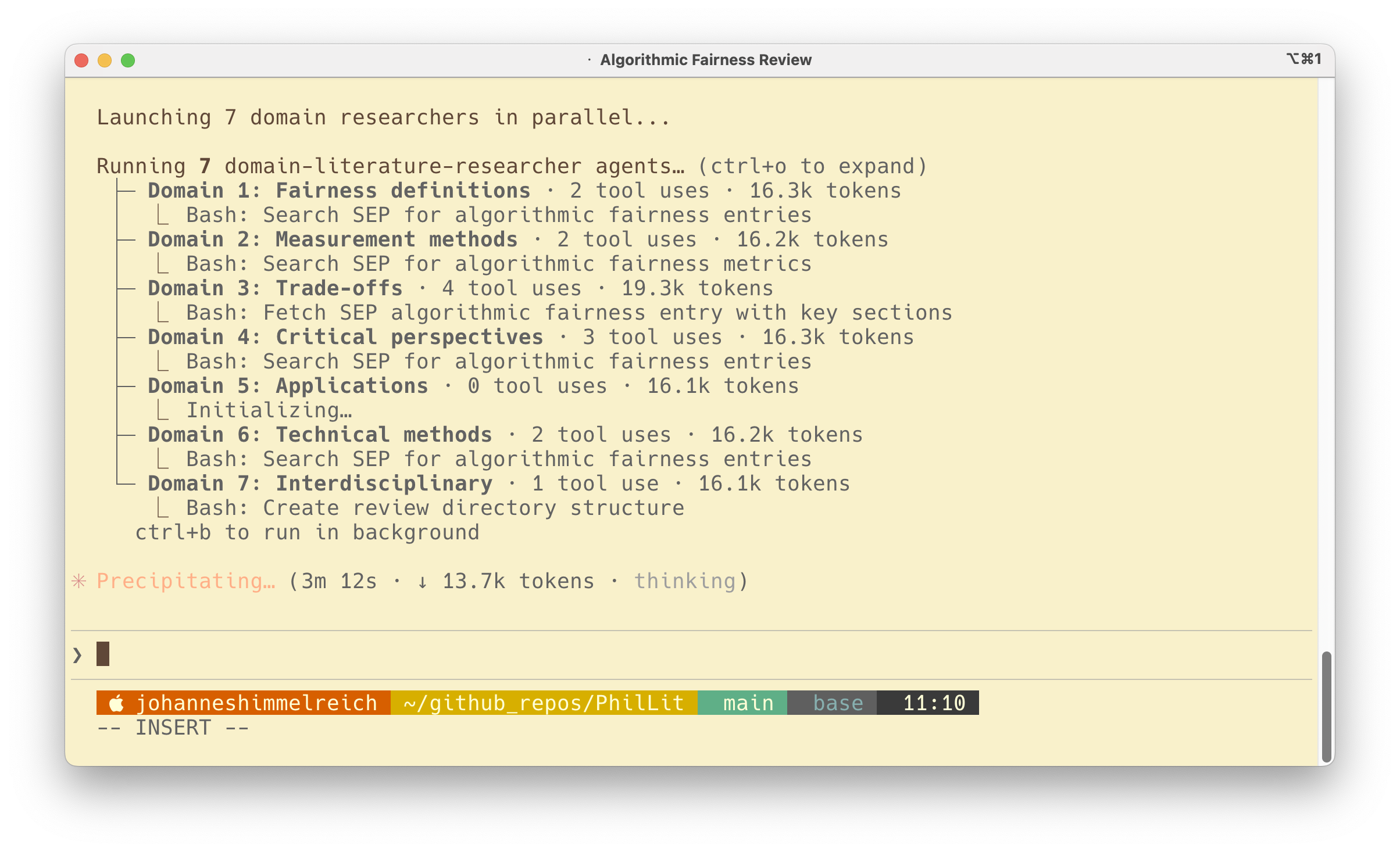
Using PhilLit in Claude Code
You can try PhilLit in two ways.
- Run it yourself: If you are comfortable with Python and the command line, you can install the tool directly from GitHub. You will need:
- Python installed on your machine.
- API keys from Anthropic, Semantic Scholar, and Brave Search.
- Familiarity with running scripts in a terminal.
The repository includes detailed setup instructions: PhilLit – Getting Started.
- Participate in our Validation Study: We are designing two studies to test whether the literature overviews are genuinely useful to experts. We need philosophers to test PhilLit on topics they already know well.
For our first study, you will use PhilLit yourself and assess the reviews you get. We help you with the technical setup and pay the costs of running the reviews on the topics of your choice. You will provide structured feedback on accuracy, comprehensiveness, and usefulness.
Our second study is for anyone, regardless of whether you are comfortable with the Terminal app, Python, or managing API keys. You will get a chance to provide feedback on the reviews that others generated.
If you are interested in participating in either of these studies: sign up here and we’ll update you once we’re ready to go.
[1] This is the 50% task-completion time-horizon, that is, the maximum task duration (measured by how long it takes a human expert) at which an AI agent is predicted to succeed at least half of the time.
Related:
“Two Cultures of Philosophy: AI Edition”
“Shaping the AI Revolution in Philosophy”
“‘Hey Sophi’, or How Much Philosophy Will Computers Do?”
“Reviving the Philosophical Dialogue with Large Language Models”
“Philosophers Develop AI-Based Teaching Tool to Promote Constructive Disagreement”
“Have Pen, Laptop, and ChatGPT, Will Publish“
I know I’ve probably already accrued a reputation on the Daily Nous comment sections for being the ascerbic curmudgeonly luddite who dogmatically rags on AI every time there’s a post about it, but I think that the very notion that there are philosophers out there who think a tool like this is in any way a good idea should open a pretty stark debate within our academic discipline about what the hell we’re all even doing in this line of work of ours.
If I were a novelist, would I want an AI tool to read and summarize fiction for me? If I were a musician, would I want an AI tool to listen to new music for me and curate a playlist? If I were a filmmaker, would I want an AI tool to watch movies for me and let me know which ones might have been worth my time? Are these not the very activities that I would want to be at the centre of the life that I’ve chosen for myself? Am I not cheating myself of the core social aspect of this way of life, namely, of being a weird dork about something and wanting to discuss that thing with other weird dorks in order to get some kind of sense of intellectual community?
Reading this stuff should be one of the great joys of the life of the mind. So why do we encounter it as the sort of busywork and drudgery that we would want to offload onto a computer the way we do word processing or citation management? What does that say about the shameful futility of the way that our entire discipline is organised and the standards and expectations that we hold ourselves to as philosophers? Why does “doing philosophy” need to entail reading hundreds of pages of crap that isn’t particularly enjoyable, even to someone who is ostensibly passionate about the topic? What, just so that reviewer #2 doesn’t go into conniptions because I didn’t cite Tedious et al. 2023? This is essentially the same problem I had with the post from a week or two ago about “using ChatGPT as a writing collaborator”. I got into this line of work in part because I love writing–so why would I have any part of that process automated? The result that’s pumped out is irredeemable garbage, but even if it were good, why would I have any more interest in doing that than an athlete being interested in a robot that goes out onto the field and plays the sport for them?
All of this stuff should be a massive wake-up call for our discipline and a chance to reflect on why we’ve chosen to organise ourselves to do things in such a way. Academia is already cooked on the other half of the equation (since, the way things are going, we won’t have any literate people left to do philosophy in about 20 years when the current generation of children gets to grad school age), so we might as well have our children-of-men reckoning now and at the very least save ourselves.
I’m usually one of the voices of AI Doom, often making the point that the worst is yet to come, but I really want to chime in and agree with you
It’s hardly just academic philosophy, but the fact that the field is much more often seen as a job with publication quotas to meet, and citation milestones to hit, and tenure reviews to submit, means that the love of wisdom often takes a back seat.
As much as the prospect of ever more powerful AI terrifies me, what we have now certainly is not going away, regardless of what the future might hold. These systems, as artifacts, could be quite inspiring to philosophers, in the sense of prompting us to approach the age old questions of what is truth, the good, or beauty from new angles.
I know not everyone can be a Kant or a Wittgenstein but the emergence of AI has revealed the priorities of the field. And that priority does not seem to be an ambition to strive towards our highest aspirations. Again, philosophy is not alone in this.
Apologies, this may have been overly sanctimonious. The current situation may not be our fault, but it is our responsibility. My responsibility. But I don’t have the knowledge or power to act productively. I think part of my motivation for my screed here was just a lash out in the hopes that catharsis might be found on the other side. I do feel drained at least
“ If I were a novelist, would I want an AI tool to read and summarize fiction for me? If I were a musician, would I want an AI tool to listen to new music for me and curate a playlist? If I were a filmmaker, would I want an AI tool to watch movies for me and let me know which ones might have been worth my time?”
If I wanted to cure cancer, would I want an AI tool to summarize research directions so far and advise on promising directions? If I wanted to send a space probe to Europa, would I want an AI tool to help me get on top of the various engineering methods used for similar missions? If I wanted to contribute to learning what dark matter is, would I want an AI tool to give a reading list to help me understand the main observational constraints?
A lot of the disagreements about AI use on DN tend to come down to longstanding disagreements about the point of philosophy research : are we doing it to become better people, or to increase collective human understanding? If it’s the former: sure, don’t use AI. If it’s the latter: judge by results.
“A lot of the disagreements about AI use on DN tend to come down to longstanding disagreements about the point of philosophy research : are we doing it to become better people, or to increase collective human understanding?”
This seems like a false dichotomy to me. Increasing collective human understanding requires a lot of philosophical activity aimed at becoming better people, e.g. more intellectually and practically virtuous. The question is then where to draw the line separating reasonable workarounds for tedious work from work that is truly philosophically valuable. While I don’t have a problem with someone getting some initial ideas for papers or books to read, a lot of the discussion lately about using AI to make one’s life easier points to methodologies that just seem to add to the already huge increase in instrumentalization of our discipline. The further alienated we become from the practice of being philosophers (i.e., the more we become focused on churning out a product), the further we’ll be from what philosophy is about.
A rough operationalization of the distinction I’m drawing is: Do claims about philosophy research still remain plausible if you swap philosophy for an empirical science.
Try this on your last sentence:
“The further alienated we become from the practice of being oncology researchers (i.e. the more we become focused on churning out cures for cancer), the further we’ll be from what oncology research is about.”
That fairly clearly doesn’t make sense: what we want from oncology research is cures for cancer, not the deeper self-actualization of oncology researchers. So insofar as AI makes that process better, oncology researchers should use it (and insofar as it doesn’t, they shouldn’t).
Is philosophy research like scientific research in this sense? That’s the question I’m suggesting is central here.
“That fairly clearly doesn’t make sense: what we want from oncology research is cures for cancer, not the deeper self-actualization of oncology researchers.”
Agreed. This highlights how being “results”-oriented is perfectly sensible in some disciplines. What I suggested is that your question about philosophy research (“are we doing it to become better people, or to increase collective human understanding?”) seems to assume that all disciplines can measure themselves by distinguishing these options. If we start out with that, it sure makes it seem like there’s more value to be found on the side of “results.” But I think the assumption can be called into question. Indeed, I think much of the history of philosophy stands against it.
Yes, but it depends not just on the point of philosophy research but also the professional point of philosophy research. The professional point of philosophy research cannot be to make the philosopher in question flourish.
People can reasonably vary in which parts of philosophy they enjoy or are most passionate about. I love writing, thinking about, and discussing philosophy, and have the online receipts (literally thousands of blog posts) to prove it. But I don’t love searching the literature, so I’d be very happy to offload parts of that process to AI agents (if/when they prove capable enough). It means more time to focus on the parts of the process that I really value!
Same here. I like reading, but instead spend too much time crawling and opening tabs etc. — and then still find out months later that I missed crucial publications that would have been helpful (often recently published).
Will you miss fewer of them when the LLM generates your literature review?
Probably at first, while you’re still doing other things, too. But how about in a few years’ time? Will you still be doing all the old stuff too, or just plugging into Claude and go?
This kind of pearl-clutching really isn’t going to age well. The fact is that AI has now permeated all crevices of society where written communication is any kind of commodity at all. There’s no putting the genie back in the bottle Alexei; and even more importantly, philosophy is a hyper competitive discipline; the infrastructure we’re in is zero sum where publish or perish is an understatement. It’s more like “publish top 5 papers right out of your PhD or you get left behind” at least for those aiming at top research Uni jobs. And because AI offers the promise of advantages towards that goal (depending on how one sees it, by doing certain things better, or at least by saving time with literature reviews, freeing up time to invest more energy in publishing top papers, etc.) those who get ahead will be incorporating it. In such an ecosystem, our ecosystem, we can’t really afford to clutch the pearls and curse the use of AI, else we end up like Paul Bunyan cursing the invention of the chainsaw, insisting we should continue to value trees chopped by hand – and we will then by such thinking end up like Paul Bunyan, unemployed in a world of chainsaws.
This is kind of depressing but I think you are probably right. The people who are refusing to dig in to AI and figure out how to use it to thrive and get ahead competitively are going to be the ones who don’t have jobs in philosophy departments going forward, which isn’t to say that they can’t have some kind of fulfillment doing ‘old fashioned’ philosophy by thinking and writing – it just won’t be at the cutting edge scientifically so to speak and more like the ‘hobbyists’.
And… the wrong people will be getting those jobs, as has been increasingly the case the past forty years.
Are you throwing in with the pearl clutchers, technophobes and luddites? Remember that in the olden days, it was considered crass to use the technology of the pen and paper, more virtuous to just memorize everything. Now we take such attitudes to be a kind of cranial storage fettishism that comes at the opportunity cost of doing good work, of sharing and communicating knowledge widely and advancing science collaboratively; will we not have a parallel kind of attitude 30, 50, 70 years in the future, to those who at the dawn of AI thumped their fists in favor of techno-exclusionary purism?
Name calling has always been considered the best way of winning an argument in philosophy. Misuses of induction come to mind also.
non-ironic use of “luddite” when discussing llms, like non-ironic use of “woke” when discussing politics, is sufficient grounds for dismissal imo
“In such an ecosystem, our ecosystem, we can’t really afford to clutch the pearls and curse the use of AI, else we end up like Paul Bunyan cursing the invention of the chainsaw….” You talk like this particular ecosystem is a permanent structure. It’s not.
Also like it’s a worthwhile structure.
“Academic philosophy has insane priorities, and AI will make things worse, so let’s try to avoid it.”
“This argument will age poorly, because without AI we won’t be able to meet the insane priorities of academic philosophy.”
I’m one of the Luddites. I teach eight to eleven courses a year and publish quite a bit (nine years post-PhD I have three books and around thirty articles, plus one book out in May, another under review, another done and going to review shortly, and yet another half-done, plus a small pile of papers floating around. I seem to generate a handful of new papers every year, along with whatever book. And yes, I publish in good venues.).
The real obstacle to my productivity isn’t literature reviews or indexing or reading or brainstorming or ideas or even writing; it’s peer review. That’s where it all slows down. (And that’s as it should be, I think.) And everyone has to pass through that bottleneck, regardless of whether they have one finished paper or seven.
So, what is an LLM going to get me, an extra article or two a year? Shrug. Maybe, but I doubt it; I’m pretty efficient already, so I rather suspect time spent noodling with a chatbot is just time spent noodling with a chatbot.
Suppose it does, though. What does it matter that I have six new papers floating around rather than four? They’re all headed for the same bottleneck. Plus, I could probably churn out a few more papers a year on my own just by working a bit more (I work on research at least 15 minutes every day, and on some days as much as an hour or so). Teaching less could certainly facilitate it, but even then, what’s the point of five or six instead of three or four?
Even in a cutthroat environment, I don’t think anyone really needs more of an edge than that, and I doubt the process can bear much more. Me, I just do it because I enjoy having this conversation with the people in my subfield, and engaging with their work. Publishing did not get me my job, and it’s not keeping me my job, either.
When I read about the things people are doing to “turbocharge” their productivity, I can’t help but think that they could get there by working smarter, by developing better work habits. Alternately–and this will sound really snotty, and for that I apologize, because I don’t mean it at all snottily–maybe they just aren’t cut out for publishing at whatever target volume yet. That’s okay, not everyone is, and certainly not everyone is at every point in their career.
If you don’t enjoy it, then I, for one, don’t think you should be trying to do it. Trying to game the system is a fool’s errand.
Tell me your productivity secrets!
Mostly it’s just writing consistently every day. It doesn’t have to be a lot, but it does have to be something. And write first–both before reading, and before doing other things with the day. I write myself small, achievable goals every morning–e.g. write 200 words, start writing up a literature review, finish section 3, check for typos, etc. At the end of the day, I cross it off the list/add a note about the extra work I managed.
For that to be possible, however, I do need significant background familiarity with the literature (I mean, sometimes I don’t, but those papers take longer). For that reason, I’m much more able to write a bunch of stuff now than I was, say, five years ago. This also helps with identifying issues I can tackle. I keep a running list of topics, with a brief sketch of my thoughts. When I finish writing one up, I turn to another that speaks to me.
I set myself deadlines for completing projects (e.g. a month or two for a new paper). I look at CFPs for special issues to help identify areas others are interested in reading about, and also because special issues make a good first target for a paper.
I often start by writing a short paper, try to publish it as such, then later expand it. I also divide my attention in terms of major/minor projects. A major project is a monograph or standalone article; a minor one is something like an invited piece (I don’t get many of these invitations, though), a book review, or a translation. I aim to clear a couple of major things a year, plus another two or three minor ones (or a major minor project, like a translation). I try to prioritize major projects first, then clear the minor ones, though deadlines and the review process often muddle that a bit.
I try to plan ahead for the year, too. I identify a few major/minor projects I’d like to clear, and start there. I guesstimate how much time I need to clear stuff, then get to work clearing it. But again, I only do this because I enjoy being part of the conversation. It would be a slog otherwise, even just at fifteen minutes a day
This is great! Thanks- I also write daily and 200-500 words before anything else. But it has taken me three or four years to (almost) complete my current book project. Reading about your process reminds me that aggressive planning and goal setting is also crucial to getting those bigger projects done. I used to do that but maybe that has slipped over the last few years.
Some things just take longer than others too, though. A proper monograph usually takes longer than a translated book, for example, unless it’s relatively short, and a project you initiate will probably take longer than one a press solicits you to write. I wrote one book in a year, and am gearing up to spend no more than a year on another, but a third one is in year three and only halfway done (it’s a labour of love, so I’m being much more slow and steady about it, though I expect to have a finished draft by the end of the summer/this year). Translated books often take me just a few months, plus however long to get through the review and publication process. It also depends on how much you have to wade into the literature. And how comfortable you are sending it off without lots of others having read it/chunks of it first. Some books are easier to write than others!
But the key, I think, is just working consistently. From what I can see, many of us do not. And I think that explains a lot. Plus, it’s fairly easy to remedy.
I publish a fair bit, but I know several people who publish way more, and several who publish much better work (even at comparable or higher volumes). My feeling is just that for a lot of people, chatbots probably look like something of a magic pill which helps them bypass some underlying issue in their process, so relying on them ends up exacerbating rather than fixing the problem. But what do I know.
I also spend a lot of time in the gym, where you can see how slow and steady work pays off. Lots of people there are tempted by “shortcuts,” too.
You’ve offered no reason to think that using AI in philosophy is actually a good thing (unless you honestly think that good philosophy = more efficiently churning out papers). Yet you are suggesting, in a somewhat condescending tone, that those who are concerned about it are being dramatic or overreacting, simply on the basis that lots of people will be doing lots of the thing that we are concerned about. I must be too dense to follow.
This is exciting to see! Huge thanks to Johannes and Marco for creating (and open-sourcing) this, and sharing it here despite the predictable risk of hostile responses. I’ll be curious to see how helpful it turns out to be — it certainly looks a lot more promising than generic LLM prompts.
Some observations to share from my first attempt at using this:
* Running Claude in Windows powershell, my .env file didn’t seem to load my keys as environment variables. Claude noticed this and grabbed them manually from the file, but didn’t notice until too late that this wouldn’t be passed on to subagents. So my first attempt ran without the essential Brave functionality! (Claude reports: “The researchers compensated using direct SEP fetching, Semantic Scholar, OpenAlex, CrossRef, and CORE.”) I asked it to update its CLAUDE.MD to instruct all subagents on how to access the API keys in future. But maybe this problem can be preempted somehow for other first-time users who might run into it?
* I had some free “extra usage” credits from Anthropic, so ran Opus hoping for the best results. A single run used up a bit over $20 of my credits! Afterwards I asked about the token usage breakdown, and which sections actually benefit from Opus vs Sonnet. Claude’s advice was to definitely use Opus for the two “planning” subagents (neither of which used many tokens, but benefit from the extra intelligence), definitely use Sonnet for the domain-literature-researcher subagent (which uses the majority of tokens, and involves a lot of fairly formulaic work), with synthesis-writer being a judgment call (using over 1/3 of the total tokens; writing quality could potentially benefit from Opus, but the outline was judged to be detailed enough that “Sonnet could likely follow it”).
Claude accordingly updated my CLAUDE.MD with the following section (which you’re welcome to borrow if you wish — or you might want to change the ‘synthesis-writer’ to ‘inherit’ whatever model the user begins with, for greater flexibility):
**Model selection for subagents**: Use the Task tool’s
modelparameter:– **Opus**:
literature-review-planner(Phase 2),synthesis-planner(Phase 4) — these require philosophical judgment to decompose topics and design narrative structure– **Sonnet**:
domain-literature-researcher(Phase 3),synthesis-writer(Phase 5) — these follow structured instructions (API searches, writing from detailed outlines) where Sonnet performs well at much lower costHi Richard, this is very useful feedback, thank you, and thanks for sharing your changes to CLAUDE.MD! The domain-literature-research agents should use Sonnet regardless of which model you use at entry. After completing a review, you can check with a prompt like:
Debug now: Analyze the costs of the whole review process in this session. Break down costs by stage and part of the review.
Have your fixes re loading the .env file worked?
Richard,
Thanks for this. I’ll try to fix the PS issue with the env variables. That’s just my lack of knowledge of PowerShell (and our aspiration—while already putting up high technical barriers—to also not require WSL).
Re the cost: I’ve already tried to set the model: parameter in the agent definition to be sonnet. We can see what Claude introspects. That introspective estimate is tool-based but I’m not sure if that can be trusted. As a next step, if you want to help us debug, I can send you and env file that, is you used it, would send us the telemetry data of what Claude is doing (and it would include Brave and Anthropic API keys).
Thanks again. So happy to see that we might be able to get this work better on Windows soon.
J
My impression is that OpenAI is bleeding money so fast, it will make one’s head spin if one contemplates it too much, and that all other AI companies are in the same boat. They’re hoping AI magically becomes profitable at some point, although their story about how this will work seems a little thin. When these companies can no longer bleed money, woe to the philosopher who spent 9 to 13 dollars having AI write literature reviews rather than learning how to do it themselves. They might find themselves having to pay 90 to 130 dollars, or not even having a tool at all!
One could perhaps hope that by then there are equivalent locally-run models that do what needs to be done, but I’m not sure I really see the point. Instead of using this tool, pay a graduate student who works in the area 9 to 13 dollars to give you their lit review. Much better from all angles.
(If no graduate students work in the area, then it’s not moving fast enough for you to need to pay AI to do your lit review for you. You can take your time. If you say “I can’t take my time, I need publications fast, since I need a job” then you don’t want to be publishing in this area right now. Pick something people are more excited about.)
So your conclusion from the fact that these companies are not currently profitable is that they will soon all go out of business and AI will be a thing of the past? Very unusual perspective!
I don’t think AI is going anywhere – local models are already powerful enough to do what a lot of people want AI to do. In any case, if you’re interested in predicting where AI is going, you can find every variety of opinion out there, from “the singularity will be here in five minutes, trust me” to “the entire AI industry is propped up by a few companies promising to give each other billions of dollars in order to make possible something vaguely amazing which will never happen, and eventually the house of cards will collapse, tanking the world economy” and everything in between. There’s little point in spilling more ink on the topic. All that’s left to do is wait and see what happens.
fwiw, the rate for graduate students where I am, afaik, is more than 3x of your estimate, and I think that is OK (living wage etc).
Where I used to live, many grad students shared their main lit reviews (for their dissertation work) for free automatically when their dissertations were publicly published (myself included), and I’m sure they would happily have (and still happily would) share them or any other writing they’ve done with any interested party, as will practically any academic, for free.
My point about money was just to say that if one is going to spend money on a literature review, better that money end up with grad students (who need it) rather than Anthropic or whoever (who don’t, except in the sense that every day these companies lose more money than all of us combined will ever earn, but I’m sure soon they’ll turn a profit and it will all have been worth it, although if the profit is at our expense, the models are perhaps going to become cost-prohibitive for e.g. lit reviews). I was not suggesting you sign some sort of employment contract with them where your agreement would be subject to considerations of living wages and so on. Nor was I expecting one would need to reach out to nearby graduate students – by “a grad student who works in the area” I meant that area of philosophy, not, like, upstate New York. And it’s not like you’re hiring them to do work for you. These are lit reviews they will already have done, because they work in this area.
And really it doesn’t have to be a grad student: lots of other people write out their lit reviews too, so you can seek those people out if you’d like. 9 philosophers out of 10 will be excited and flattered if you contact them and say “you seem like an expert in X, a topic I wish to get up to speed on; do you have suggestions?” The result is not quite as instantaneous as AI, but in exchange for waiting for some time, you can connect with another human being and start to form a professional relationship that may be fruitful in the future (especially since you intend to publish on a topic they have published on). Lord knows I’m as guilty as anyone of not forming professional connections in contexts where it would’ve been better if I had, so I’m being hypocritical here, but it is worth contemplating the ways in which “AI helps me get things done without having to rely on others” is another way of saying “AI alienates me from other people in the profession from whom I might not otherwise have been alienated.”
The same goes for people who use AI to bounce ideas off of, generate objections, etc. If that gets you out of having to break out of your comfort zone and find other philosophers willing to read your work, it’s probably hurting you in the long run, even if it’s more convenient.
I absolutely agree with you: Sharing lit reviews is a good thing, human-created or AI-generated (imo).
Beyond that, what you are suggesting, insofar as I understand it, is in my own experience practically very difficult if not impossible.
As someone mentioned above, we can reasonably disagree about the value of such (and other) AI tools as well as about the value of specific philosophical practices they seem to presuppose. Given reasonable disagreement, people should be free to develop and use such tools in their work as long as they are explicit about using them. The minimal condition of acknowledging the use of AI (and ideally speaking, the environmental impact it has made) is important since it allows others, who do not value such tools and philosophical practices they imply, to be equally free not to read such works based on human-machine (and environment) interaction. All of this could seem obvious, but I wonder to what extent is this admittedly idealistic ‘equal freedom to do philosophy any way we like’ approach feasible under the present conditions of the (Big)Technological hurricane (and all the structural conditions that have enabled it)?
I’d be curious to hear a general theory about the conditions under which disclosure is required. It can’t just be reader interest. Suppose some readers are opposed to air travel (which is, after all, many orders of magnitude more carbon intensive than a few LLM prompts); should authors be required to disclose the details of all flights undertaken in the course of their research? What if one had an abortion so as to be able to continue focusing on their work? Some readers may wish to boycott research that depended on such an action.
There seems something deeply illiberal about requiring such disclosures in these cases: much of what people do in their own lives, including in support of their work, is simply not anyone else’s business. I think a stronger case would need to be made for treating AI-aided background research as an exception that warrants such intrusive disclosure.
I don’t think that there is a space here to develop a general theory concerning the requirement to disclose the use of AI (although it is an interesting thought to entertain, so thanks for the question). I agree with you that readers’ interests (if by this you mean mere preferences) would not suffice for it. What could suffice, though, is that we already have a widely accepted and, for all I can tell, mostly complied with practice of citing sources in order to acknowledge the ideas of others. Moreover, at least in philosophical work I am familiar with, there is a broad practice of acknowledging general exchange with specific others or attributing particular points to them. (after all, philosophy is a collective human enterprise or at least that is how I think of it). I don’t see why disclosing the use of AI would be any different (although this surely would not mean actually acknowledging ideas of others, given what AI is). An additional reason why it could be required is that the tools are well known for involving all sorts of controversial issues that you are probably familiar with. So, one could say that readers are owed information about what they are engaging with so that those who have moral objections to these tools can choose not to engage with them if they wish so. In this sense, the practice of disclosing the use of AI could help alleviate a growing sense of mistrust among academics. All that said, I fail to see any analogy between what we do in our private lives and how we engage in academic research as public practice (e.g. are ethical codes of conduct for academic research impermissibly intrusive?)
For my part, as a referee, I referee quite a bit, and usually turn in my reports pretty quickly. I will not referee chatbot outputs, however.
If you want me to referee at all, then I want to be assured that I’m not reading chatbot outputs. If I start getting too many which are, I will simply cease refereeing.
I am willing to accommodate some uses of the chatbot, but in order to do so, I need to know how it’s been used.
Now, I’m just one person, so I’m not going to have an enormous impact on the system if I just stop refereeing. But I do clear 20+ reports a year, so that’s a fair few willing bodies you’d have to find. And even if I stop refereeing, I probably won’t stop publishing, so that’s an additional drain on the system. If anyone else feels as I do, then that’s them, too.
And who will want to start any new journals in this scenario? Or read anything in any journal? Well, I suppose I could have my favorite chatbot read for me and then summarize for me and then make arguments for me, and then send those arguments written up in a suitable form to a journal for me (which is entirely feasible now – an agent could do this while I was out for coffee), then another LLM could referee my chatbot’s production, and then maybe publish, for other AI to read. There’s no point.
I know I’m only repeating what others have said more eloquently. If you hand off philosophy to AI there will be zero benefit to humanity. This claim holds regardless of whether you want to take the view that philosophy is about the practice of philosophy (self-knowledge, virtue development etc.) or whether you take the view that philosophy is about outputs narrowly defined (a new argument no one ever wrote down before, a radically new way of conceptualizing some part of reality etc.).
There is no scenario in which philosophy is handed off to AI, and humanity is benefited as a result.
The distinction between “real” writing and chatbot output in this context is not that clear cut (at least as of now). The reality is that to write a full-length academic article of high quality with AI requires a type of intensive work and is an extended iterative process. The outcome is not simply a paper “written by” AI. It’s more like a paper written with the assistance of an interlocutor who will read as much or as little of your paper as many times as you want and returned the specific type of feedback you ask it for each time. This might still be totally unacceptable, but it’s important to understand what’s really at stake.
Enough editors and reviewers are hostile to AI that it would decimate one’s publication chances to disclose using it. Since publication is perhaps the main currency of our profession, the disincentives to disclose are simply way too high for most of us
Ah, but if it “turbocharges your productivity,” as some claim, then what’s a reduction of 10%?
Also consider that if someone is caught not disclosing, that will also harm their prospects. (Certainly more so as far as I’m concerned. I’m prepared to accept some uses with disclosure, but will absolutely tar and feather anyone I catch not disclosing. Not that I have any power or platform, but still.)
haha i should know better than to use modern everyday English here! I do think it would probably reduce your chances by over 90%. And yes but it’s not really catchable. It does supercharge one’s productivity. So this is just being realistic
Could it be that editors have good reasons to be hostile toward the use of AI in philosophy? (As a matter of fact, some of the leading journals in my subfield have recently adopted the AI disclosure policy so the hostility could be overstated). Besides, whether or not one agrees with such a policy, trying to bypass it seems like academic dishonesty. That said, I can see how the current state of academia and the publish-or-perish nightmare (that is so harmful to academic research across disciplines) can pressure early career scholars to reach for these tools hoping they improve their publication record to get a job, but we should reconsider the system as such (e.g. why value the quantity of academic output at all?) I work in a country where these systemic changes are under way and I hope they get picked up in other places too. I think these are the kind of changes to think about instead of trying to automate what many think are valuable aspects of philosophical practice by developing tools dependent on large private platforms. In fact such “automation” initiatives could make much needed systemic changes more difficult (or even impossible). I’m sorry that my comment went well beyond what your comment is about 🙂
whenever publishing or the profession comes up it’s ‘we should, we should’. There is no we should because there are not powerful enough collectives to make changes like devaluing publication records on the job market. a professional in philosophy can only make ‘I should,’ or ‘you should’ claims.
I think the disclosures matter in the ideal to improve progress. It is important for people to share how they are learning from AIs, so that others can use those methods to learn from AI. I have yet to see a single example of someone using AI to write good philosophy which would have been significantly worse if it hadn’t used AI, and I would like to see this example, so that I can learn how to do it!
This is a good point Richard Y Chappell; also such a requirement would seem to either overgeneralise over to mandatory disclosure of Grammarly use or risk being ad hoc
There is good reason why the specific case of using AI for writing a literature review needs disclosure. In such a case, you use AI as a methodological tool to arrive at research result. It is standard procedure in all modern sciences to disclose one’s method. You must make it possible that your results are reproduced. Hence, you show how you arrived at it. Disclosing the use of AI in such a case, is tantamount to given references.
Sometimes I wonder if something like this reflects a decline in our (or perhaps only my own) desire to read contemporary work in philosophy. When I read through a lot of work, there is a lo that I wonder why anyone even thought it worth publishing, because little of value was really said (in my estimation). I often get the impression that people spend 20 pages of text doing literature review and argument set up, and I’m not sure that work was worth it.
It makes sense to me that people are reaching for AI tools to do literature reviews for them, because there’s a lot of drudgery in contemporary writing. But I wonder if this will just kind of exacerbate the issue that is prompting it: a lot of reading contemporary philosophy can feel menial. Is making literature reviews easier going to help us read more philosophy put out today?
It seems to me that reading, engaging, and connecting with an intellectual community working on shared projects is a good part of the value of doing philosophy. If I meet someone at a conference and tell them that I read their work and really liked it, when in fact I just had AI summarize it, what am I doing with this community?
I think we do people an honor by actively reading and engaging in their work despite it being difficult and unexciting. I’m sure people who’ve read my own work found it tedious, but I would ask my readers to treat my work with grace that I’m making a good faith attempt to contribute to philosophical understanding, and to read it anyway. And that’s (part of the reason) why I wouldn’t really use a tool like this.
Maybe when the existential dread of not having enough time to research because I’m overworked and underpaid in a teaching only position catches up to me, I’ll give in to tools like this, but I’m still holding out probably foolish hope.
I feel like one of the last things the field needs is even more citation of papers and books the author(s) didn’t bother to actually read. This will surely be used for that (even if not only that, of course).
I know it’s an insane idea but I’ve always wanted there to be a journal of philosophical manifestos in which everyone writes like nietzche or wittgenstein and citations just aren’t even allowed.
Citations, idk. I tentatively find the traditional citation practice in philosophy problematic to the extent that it could probably only change for the better.
On the other point — see our post: the hope is to enable more effort not more output.
After using some version of this for about 1-2 months, this tool allowed me to read more. But your milage may vary.
J
Literature reviews do not (need to) replace reading papers. They can also tell you what papers to read, in what order, and how to understand them in dialogue with each other and a background literature. The idea of automated literature reviews seems like a great thing to me because it lowers the barriers of entry for philosophers to engage with new debates that they may have heard about for the first time in a talk, or seen touched on in a paper, and which they have an interesting hot take about. An AI lit review could immediately convey whether this point is really novel, and, if so, what papers one needs to read and understand to position it in dialogue with current work (and hence a publishable way). Geniuses may not need this because they simply know all their points are compelling, so can confidently go out on a limb and be confident that the effort will eventually bear fruit; the tenured may not need it either, because it’s fine to spend time on an idea that goes nowhere. For others, it would be helpful.
I’d love to have a research assistant read things for me; that’s great. But even ignoring “the human touch” there’s also the “cyber security touch” needed here, IMO. Given how these tools work, there’s a very real risk (though who would target philosophers?) of CC being used as a way to attack you and your computer, etc. Academics are already strapped for cash, and practices now forming around agentic systems (remember the other thread) includes isolating them on their own computer during their runs, etc. 🙁
Yes. I recommend not installing random CC plugins. But this one, for better or worse, has our name attached to it now.
Philosophers deskilling themselves.
This ^^
and, /thread.
Doesn’t anything that helps someone with a task potentially “deskill” them? Being literate means that I don’t have to rely on my memory as much, which robs me of opportunities to practice memorization.
“Doesn’t anything that helps someone with a task potentially “deskill” them?” I think the answer to this is no. Habitually riding a bicycle to accomplish the task of getting to the grocery store gives me skills that are useful in case I decide to go back to walking or want to run somewhere.
idk. I learned a few new skills building this.
Full disclosure, I am too a luddite in a certain sense (as it is a polysemic concept), and I know and respect Marco and Johannes and the work they are doing.
I think that there is one thing many of us would agree on, which is that philosophy comprises certain activities – modes of thinking, speaking, reading, writing – that are intrinsically valuable. These activities, I would agree, deserve to be promoted and protected, even if we cannot fully circumscribe them. Moreover, I think there is a broad consensus around the observation that current academic life puts an increasing pressure on these activities. This has to do with AI, but certainly not only with AI; it also connects with the neoliberal model of the university in the 21st century, the metrics that fuel academic careers (including publication metrics) and research funding regimes that are completely focused on competitive projects. Tackling the pathological pressures in academia requires us to address all these problems, not just the problem of AI.
This doesn’t take away that AI poses a significant problem; in this regard I am in fact a luddite. I see AI as a pharmakon. I believe that until now it has harmed (poisoned) academia more than it has helped it, by undermining the learning experiences of students, promoting insincere behaviors, undermining the institutional capacity to sanction insincere behaviors, strongly increasing unhealthy pressures (e.g., to publish), and demotivating us to do otherwise valuable tasks (e.g., I feel highly demotivated to still review papers after having had to review some AI-generated ones).
Perhaps we can even all agree that these problems exist – both the proponents and the opponents of AI in philosophy. So given this, what to think about the admittedly impressive work that Marco and Johannes did?
Given that I am in the ‘luddite’ camp, I think the great value of this initiative is that it pressure-tests my luddite convictions. Because, I have to admit, AI *can* in fact be quite helpful in doing philosophy, not unlike a search engine can be helpful and a printed index in a book can be helpful. Initiatives like this one help us reflect on the pharmacological nature of AI, by fueling a conversation about its affordances. We might stubbornly claim that AI cannot and should not help with literature reviews, but now this tool is there, wouldn’t it be great to pressure test this conviction? The challenge of the luddite position, in my view, is to offer a ‘positive side’ to the debate, rather than merely an attitude of rejection (which, I admit, in many cases might be practically the most desirable attitude). For me, the ongoing question is what would a form of ‘positive luddism’ look like when it comes to AI, one that fully appreciates the pharmacological nature of this new technology?
So to conclude, thank you Marco and Johannes for building this, and thereby starting – and continuing – a very interesting and vital conversation.
Does this tool safeguard against this?-
‘Don’t get ghosted: Beware of ChatGPT generated citations’
Los Alamos National Laboratories
https://researchlibrary.lanl.gov/posts/beware-of-chat-gpt-generated-citations/
“According to Open AI “ChatGPT sometimes writes plausible-sounding but incorrect or nonsensical answers.” In technical terms, the AI is hallucinating.
How can this affect researchers? In addition to potentially providing false information, ChatGPT can produce legitimate looking reference citations for materials that don’t exist. In June of 2023, attorney Steven Schwartz was sanctioned for submitting a legal brief citing multiple court decisions he’d researched in ChatGPT. Despite asking the chatbot if the legal cases were real, and being reassured that the cases could be found in Westlaw and LexisNexis, at least six were nonexistent “ghost” references hallucinated by the AI. However, not realizing that ChatGPT could be incorrect, Schwartz did not attempt to search the citations out in either of the databases mentioned.”
// // //
‘Fabrication and errors in the bibliographic citations generated by ChatGPT’
William H. Walters and Esther Isabelle Wilder
Nature Scientific Reports
07 September 2023
https://www.nature.com/articles/s41598-023-41032-5
“Of the 222 works cited in the GPT-3.5 papers, 55% are fabricated (Table 3). That is, they do not exist as actual works that have been published, presented, posted, or otherwise publicly disseminated. The articles and book chapters cited by GPT-3.5 are more likely to be fabricated than real, while the cited books and websites are more likely to be real.”
// // //
As far as I’m aware, no AI agent has yet been constructed that does not routinely extrude confabulated gibberish interspersed with whatever accurate and verifiable material it presents. It offers the confabulated gibberish with precisely the same confidence as the verifiable material, making it difficult to distinguish the fictional from the factual.
There is research that suggests that users of AI agents themselves begin to have increasing difficulty distinguish the fictional from the factual:
‘Minds in Crisis: How the AI Revolution is Impacting Mental Health.’
Keith Robert Head
Journal of Mental Health and Clinical Psychology
September 05, 2025
https://www.mentalhealthjournal.org/articles/minds-in-crisis-how-the-ai-revolution-is-impacting-mental-health.html
“For individuals who have already developed psychological dependency and attachment to AI chatbots, the systems’ tendency to reinforce user statements and generate hallucinated information creates an increasingly dangerous escalation of their existing dependency patterns. These users, already emotionally reliant on their AI relationships, become trapped in echo chambers where their AI companions consistently validate their thoughts and feelings while presenting fabricated information as factual support for their perspectives. As their attachment deepens, dependent users begin to trust their AI chatbots more than human sources of information or support, making them vulnerable to incorporating hallucinated content into their worldview and decision-making processes.”
// // //
There is no reason for anyone to be reassured that highly educated individuals would be less susceptible to these effects. Potentially, those in academia might overestimate their capacity to resist these influences, and so are potentially less likely to recognize or acknowledge AI induced flawed reasoning. University faculty might in this sense be easier marks for AI nonsense, while imagining themselves to be more capable of using AI agents ‘safely’.
I think the rush to adopt this particular technology by a field that holds itself to be the repository for critical thinking quite troubling.
Yes they describe the means by which they guard against this in the post.
I’m curious whether this reliably prevents any of the concerning effects I cited above. That’s not evident without showing the results repeated trials.
There’s no known way to solve hallucinations in general. Any approach is at best a statistical bandaid. As for the mental health matter, I am looking forward to more rigorous review (my sister’s discipline)
Thanks, I might try it out though I don’t have Claude. I try to keep up with what AI can do, regardless of whether I use them for my own benefit. The profession will be fundamentally affected by AI capacities whether or not people use it or not, so I try to stay aware.
Thanks. The tool could be much much more accessible. (and I wish it was). Since it is open-source, perhaps someone will do that.
There’s some really interesting meta-philosophy going on in these debates about AI, and I think David Wallace (see above) has pointed to it with his two conflicting notions of the purpose of philosophy: (1) the purpose of philosophy is to produce some results; versus (2) the purpose of philosophy is self-actualization.
The first purpose seems more scientific, and I think David’s arguments are decisive: if philosophy is analogous to the scientific project, then we ought to use AI as much as possible. (Note that by “scientific” I don’t merely mean merely empirical science; AI can be used in logic or math or in the most speculative metaphysics).
The second purpose seems more spiritual, and has a long history.
Platonists thought you did philosophy to become more like the Divine Mind. Philosophy is about getting yourself out of the cave and climbing the divided line up to the Good. You need to practice, so philosophy is a system of spiritual exercises. If we were to offload this to AI, our wings would grow weak, and we couldn’t rise up to sojourn with the gods. This would be bad.
But you don’t need the Platonic mythology, you can secularize it: we’re lost in this meaningless ever-grinding cosmos, and we need to make meaning (along with values, ethics, etc.). This is an essentially human project. This also a project of self-actualization, awakening the human power to make meaning. The existentialists argued for this (thus basically secularizing Platonism). If we offload it to AI, we’ll again lose our strength and fall prey to the meaningless of the universe. This would be bad.
Or you can Christianize the spiritual role of philosophy: we’re made in the image of God, and we’re called to actualize that image as far as possible. Offloading that to AI would again be bad. Worse, AIs are made in the image of an image, and are thus twice fallen. Perhaps this makes them closer to Satan, as his infernal instruments which he uses to destabilize and weaken humans, thus frustrating our salvation. Bad.
You can secularize the Christian narrative along with the German idealists: Only humans have consciousness, which is somehow divine even though it is immanent. Our purpose in life is to actualize our consciousness. If we offload this to AI, we will remain sunk in the darkness of unrealized mind. Bad.
The anti-AI rhetoric here often seems to say that if we use AI, we’ll lose our souls (our humanity, our consciousness, our supremely valuable essence, etc.). It assumes philosophy is a purely spiritual project of self-actualization, salvation, etc.
I think the spiritual project is almost entirely scientific project. So I’m happy to use AI for the scientific side of that project. Almost entirely, but not entirely. I have certain human-all-too-human interests and values and goals, and AI can’t help me with those. Those drive the scientific research. AI can help me a lot with that.
The end of professional philosophy can’t be benefit to the professional philosopher.
I think many aren’t reading past the headline. This tool is like ResearchRabbit but for philosophy, right? It presumably doesn’t replace actually reading the literature, and it should be used with caution. But an up-to-date SEP? That is fabulous. Maybe it would be better to have a dedicated research assistant who does that work (and yet it totally counts) but for those of us who don’t, it could be really useful.
One question: how are you thinking about/ameliorating algorithmic bias?
Thanks. For algorithmic biases, we didn’t build any mitigation into this tool. It could be done. But (1) we’d like to see if this tool is at all good at literature reviews first; and (2) so far, I’d expect that even without mitigating algorithmic biases, the tool likely improves on the various biases of the status quo (asking peers, relying on citations — all subject to cognitive and social biases of likely greater magnitude than algorithmic biases).
Although it depends a bit. What biases did you have in mind? Happy to talk more.
J
Thanks! So I agree it is likely that AI can compensate for some of our own biases. The kinds of biases I worry about are mostly related to prestige. We already have a problem with underciting (which is really under-reading), and what I would not want is for a tool to reify “these are the important pieces – everything else can be ignored.” People already treat Chat as an authority.
I have *no* idea how to solve this.
This is a cool initiative! Just quickly: the authors say the tool draws on Stanford Encyclopedia of Philosophy, PhilPapers, Notre Dame Philosophical Reviews, Semantic Scholar, OpenAlex, arXiv, and CrossRef. I think the phil-sci archive should be added. It’s a very rich source, and entirely open-access. https://philsci-archive.pitt.edu/.
Forgive me for the tangent, but am I the only one who hopes that AI will be of invaluable use exposing our hypocrisies to us? There won’t be the same psychological pressures on it to avoid double-think, even if it has bias of its own.
Thanks to Johannes and Marco for this.
I sometimes use ChatGTP for literature searches in unfamiliar areas (not to replace reading the papers, let alone writing literature reviews, but to find out what to read). The problem is that it does not have access to paid-for journal websites or books – so misses out loads of stuff. It only accesses stuff that is open-access. Am I write in thinking this new tool is the same?
Note though that abstracts of papers on journal websites are often open access – though one often has to click on a button for the abstract to be displayed. ChatGTP fails to do this, so fails to search those abstracts. Would it be possible to modify your tool so that it would click on those buttons and so read the abstracts?