“The aim is not to keep everything exactly as it was before gen AI took off. That would be both impossible and undesirable. The aim is to preserve the parts of philosophical education that are still worth preserving while changing the surrounding infrastructure enough to make that possible.”
That’s David Bourget, a philosophy professor at Western University and executive director of the PhilPapers Foundation, who has created a new tool to help professors—not just philosophy professors, but anyone who teaches by having students write—struggling with the prospect of their students using ChatGPT, Grammarly, and other AI tools to cheat on their assignments.
The tool, currently in beta testing, is called MATCHA (Modern Authoring Tool for Certified Human Authorship). You can try it out here. But before you do, you should read Professor Bourget’s post about it, below, where he describes its purpose, features, and limitations.
MATCHA: A New Tool for Curbing AI Cheating
by David Bourget
Over the past year or so, I’ve been working on a software project whose aim is to make cheating hard again. The result is an app called MATCHA, which stands for Modern Authoring Tool for Certified Human Authorship. In this post, I will explain how MATCHA differs from alternative ways of managing AI plagiarism, how it works, and what it can do beyond preventing AI plagiarism.
Current responses to AI plagiarism seem to fall into three main categories: detecting, scaffolding, and abandoning essay assignments. Detecting worked to some extent for a time, but it now seems both fraught and ineffective. Even analyzing detailed edit histories is largely ineffective on its own, because students can simply hand-transcribe AI-generated essays, giving them plausible deniability. Scaffolding an assignment into multiple steps does not solve the problem either, because ChatGPT can complete the individual steps just as easily as it can produce a finished essay. Abandoning essay assignments does get rid of plagiarism, but at the cost of abandoning a traditional pillar of liberal arts education.
There are two different approaches that MATCHA makes possible. The first is aimed at ordinary home assignments. The second is aimed at supervised writing labs. Both approaches are forms of prevention rather than detection. The goal is not to guess, after the fact, whether a text was produced by AI. The goal is to structure the writing process so that using AI is no longer the path of least resistance.
Start with home assignments, which is the case many of us care most about. MATCHA’s approach here has three key ingredients.
The first ingredient is the production of a detailed record of all work done within MATCHA—not just the editing history, as many Google Docs plug-ins and other tools provide, but a broader proof of work that includes browsing and reading activity, which takes place within MATCHA’s built-in, whitelist-controlled browser (MATCHA only monitors browsing within its own browser). When a student submits a project, the instructor receives a summary of how much of each cited or otherwise relevant work the student has read, along with the more standard editing-history statistics. In cases of doubt, the reading and writing process can be replayed. One available graphical summary of reading looks like this (it’s possible to view stats about specific works by clicking the slices):
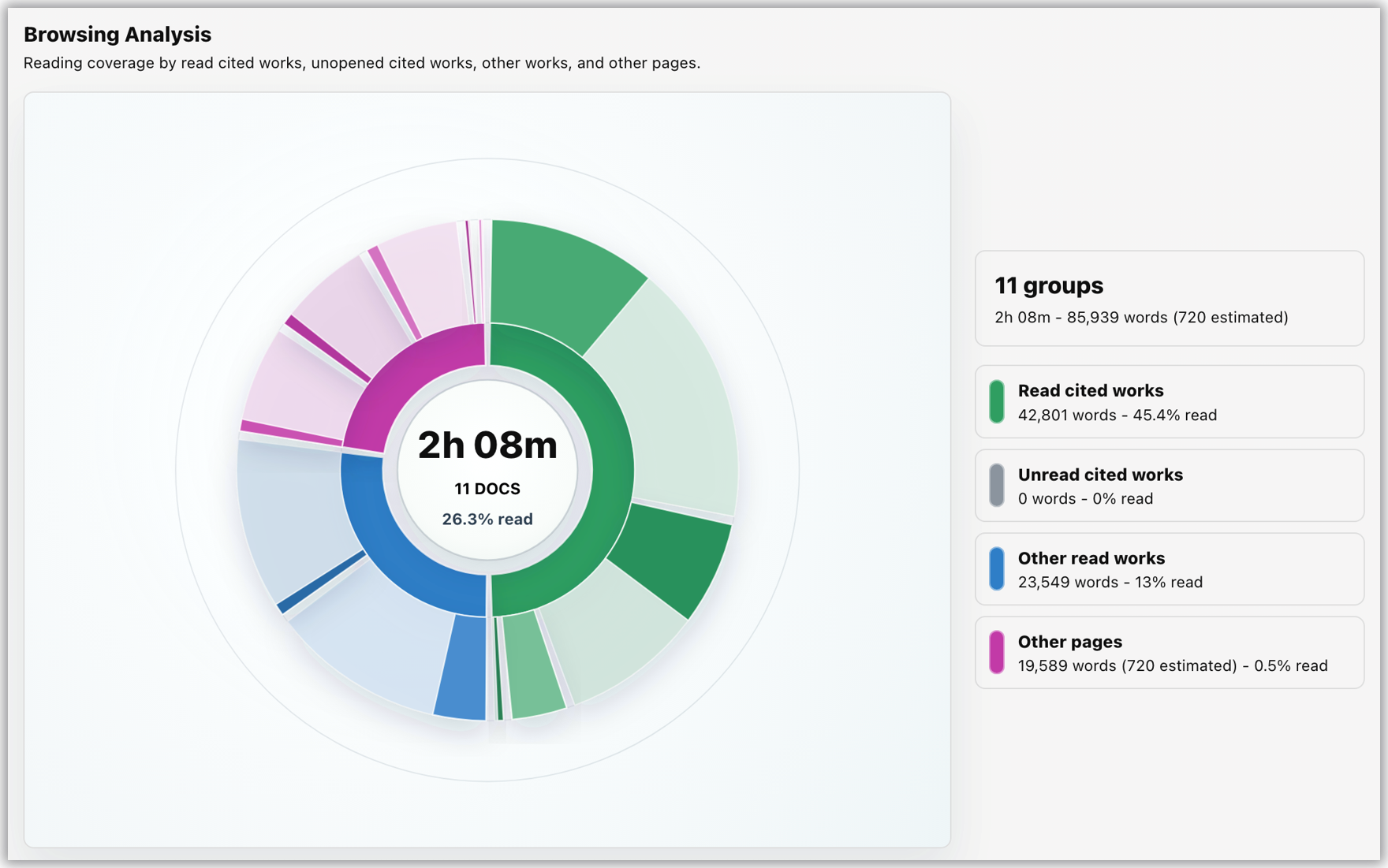
This is not meant to be magic. A proof of work is not a proof of the entire inner process within a student’s mind. Students can think offline. They can read printed books. They can have conversations. Etc. But a plausible record of reading, drafting, revising, and engaging with sources is still evidence of something. And the absence of such a record can also be evidence of something, especially when producing the record was part of the assignment.
The second part is in-person authorship-assessment quizzes. The idea is simple. If a student really wrote the paper, they should usually be able to answer questions about it: why they made certain choices, what a cited author argues, how one part of the paper connects to another, what they would say in response to an obvious objection, and so on. MATCHA can help generate student-specific questions and provide an initial assessment of the answers, so that this does not create an unreasonable amount of extra work for instructors. But the instructor remains in control. The generated questions should be reviewed, and the final judgment should be the instructor’s.
The third ingredient is to make these things matter. Students need to know that they are expected to submit a plausible proof of work and to be able to answer questions about their own papers. This can be done in different ways, but the basic idea is to tie part of the grade to the writing record, the reading record, and the follow-up quiz.
Even when put together, these measures do not make AI cheating impossible. Nothing does. What they do is make successful AI cheating significantly harder. In many cases, it may become about as hard as doing the work properly. That is a large improvement over the current situation.
The second approach made possible by MATCHA is the supervised writing lab. I find this approach especially promising, though it requires more institutional coordination. MATCHA can block AI tools, other apps, and automation on students’ computers. If someone can supervise the writing to prevent other devices from being used, AI plagiarism can be prevented to roughly the same extent as other forms of cheating in a supervised writing environment. This gives us an alternative to the usual forced choice: we do not have to choose between ordinary take-home essays, where AI use may be very hard to control, and in-class essay exams, where students have too little time to do long-form work. A supervised writing lab allows students to write over time, but in a controlled environment. MATCHA supports this with a check-in/check-out system that allows supervisors to enable writing when students are in the space and block it when they leave.
There are obvious logistical challenges. Someone has to provide the space. Someone has to supervise it. At Western, we are fortunate to have some available rooms and TA hours that can be used for this purpose. A key point, though, is that the supervision need not be especially heavy-handed. In many cases, a TA can supervise a lab while doing other work, such as grading. This means that some regular TA hours can contribute to lab supervision.
MATCHA can also be used for other in-person activities. Its Single-App Mode blocks all other apps, not just AI tools, which makes it suitable for writing exams. It can also be used for in-class note-taking. If students take notes in MATCHA, this eliminates the usual laptop distractions without having to ban laptops altogether. Since MATCHA creates a centralized attendance record for each activity, instructors can also use it to assign participation credit.
I should say that MATCHA isn’t about avoiding AI entirely. The app has its own built-in AI assistant, which can help with writing and (soon) research. Crucially, however, instructors control the level of help available (for example, “grammar only”). All the work done by the assistant is tracked and labeled. The assistant also has a pedagogical mode, which makes it turn errors into practice exercises: instead of correcting every error, it highlights passages that need revision and provides hints, giving positive or negative feedback as the student tries to improve the text.
I should be explicit about the status of the project. MATCHA is not just a pedagogical proposal or a research prototype. It is software intended for real use, and it will eventually be a paid product, since operating and maintaining it involves real costs. At the moment, it is still in beta testing. Instructors who are interested in trying it with their students can request access, and beta users will not be charged for their first year of use. The beta period is partly for improving the app and partly for learning how it works in different teaching contexts.
Even if you are not teaching or don’t need something like this for your courses, you might want to check out MATCHA as a word processor. I gave it many features that I wanted in a word processor, such as the ability to insert citations directly from in-app PhilPapers searches, or interoperability with both LaTeX and Word. These and other features (live collaboration, automatic proxy browsing, etc.) can make the lives of academics much easier. All the anti-AI-cheating features can be turned off when MATCHA is used outside educational settings, so they don’t get in the way (but it might soon be valuable for some of us to be able to point at a MATCHA proof of work).
Postscript
When I talk about this project with a large enough group, someone usually raises a version of the following worry: isn’t this just conservatism? Why try to preserve old writing assignments? Why not adapt to AI in the same way that math instruction adapted to calculators?
The calculator analogy is mistaken. First, we do forbid calculators in early education, precisely so that students can develop basic arithmetic skills. If the analogy worked, it would suggest that we should restrict AI while students are still learning to write, argue, interpret texts, and respond to objections. Second, calculators never threatened to do all the relevant work for students. A calculator can carry out computations, but it does not do the whole work we are trying to assess in math courses. AI is different: it can do all the work we might reasonably ask of an undergraduate student.
I’m not opposed to AI in general. There are many good uses of AI, including in teaching, research, and elsewhere (people like to point out that MATCHA’s website has AI-generated illustrations; yes, it does). But there is a real danger in allowing AI to replace the very activities through which students are supposed to develop their abilities. In philosophy, those activities include reading difficult texts, reconstructing arguments, finding objections, revising one’s own claims, and writing with care. These are not incidental to philosophical education. They are a large part of it.
The aim is not to keep everything exactly as it was before gen AI took off. That would be both impossible and undesirable. The aim is to preserve the parts of philosophical education that are still worth preserving while changing the surrounding infrastructure enough to make that possible. I hope MATCHA can help bring long-form essay writing back to the center of the philosophy curriculum—not because the old ways were perfect, but because students still need the kind of training that writing assignments provide.

Oops, all the links ended up being “mailto:” links. Until this is fixed, here is a correct link to the main page: MATCHA Writer.
Sorry about that, David. The links are now fixed.
I have been using this spin on “retrospective in person” assessment for a year now, but in a more haphazard way. This is a really good idea. Thank you.
Thanks for your work on this, David! I especially like the idea that students should be answering questions about their work. To me, that seems like a better way to assess their ownership over a paper, rather than checking, policing or otherwise manipulating their writing process. In my own teaching, this is always done publicly, either in class or on a message board. Using social pressure to encourage students to do their own work helps dispel the idea that coursework in philosophy is just an exercise, instead of the vital and communal process that it should be. If students have the right motivations – to communicate with peers and investigate ideas and arguments for themselves – then policing LLM use becomes unnecessary.
I have a worry with this that I have with lots of attempts to curb AI usage for assignments. I worry about placing extra burdens onto students who were actually going to do their own work anyways. I worry that this is unfair to them. And I worry that it will hurt their love for philosophy.
I think that if I, as an undergrad, were forced to take a quiz on my own work in order to prove that it was mine, I would find that annoying/frustrating. I would not want to take another class with a professor who made me do that. And it might have hurt the likelihood of my falling in love with philosophy.
Also, while it is not outright contradictory, there is something incongruous about telling students, “You have to take this AI-created quiz in order to prove that you haven’t used AI.” I think it is important that any assignment that I create is created by me. I would not feel comfortable telling students not to use AI while also using it to create assignments.
So, while this is one of the better solutions that I have seen, I still think it might be worse than the problem. Just like many prefer that we let the guilty go free in order to assure that we don’t convict the innocent, I am willing to let AI users skate by (and usually get sub-standard grades) if it means maximizing the chances that others fall in love with philosophy.
Thanks for bringing up the concern about AI-generated quizzes. I didn’t elaborate on this in the post, but the system is designed so that the AI only suggests questions. The instructor or grader reviews and adapts them while grading the papers. That seems importantly different from letting the AI be authoritative. The same is true of grading more generally: AI can provide useful guidance and reduce some of the burden, but the instructor has the final say.
I also understand the worry about increasing the burden on students. My hope is that short follow-up quizzes won’t feel too onerous, since students who researched and wrote the paper themselves shouldn’t need to prepare for them separately. The point is not to add another assignment, but to give students a manageable way to demonstrate authorship when needed.
In any case, MATCHA is quite flexible. Instructors can use the proof-of-work features without quizzes, or the quizzes without the proof-of-work features. They can also decide whether and how to reward proof of work.
My own preference is to use the writing lab model for undergraduate courses, while relying on MATCHA’s proof-of-work system for graduate courses. That’s what I’m planning for next year. The writing lab model is a bit logistically complicated to set up, but there has been a lot of interest at my university, and the project is now supported directly by the VP Academic. I think students may end up liking this approach: it gives them a more social writing environment, along with help from TAs, while preserving the value of doing the writing themselves.
I worry about how realistic it is to implement the writing lab model. You write that a TA (or someone else) can do grading while watching students, but realistically in my university, they would immediately cheat through this with their phones on their lap, if you’re not careful enough.
Plus, this assumes one has TAs.
That’s a valid concern, but keep in mind that MATCHA blocks copy-pasting from outside the app. To copy an essay from AI, a student has to do it slowly, character by character. They would eventually be caught even if the TA was pretty inattentive.
For what it is worth, I am a TA monitoring one of these writing labs as I write this. The possibility of one of the students cheating is about the same as it would be during one of the many exams I have proctored – it is certainly possible, but a quick scan around the room every so often is pretty much all that is required to ensure that no one is using ear buds or a phone on the lap. Obviously, I cannot guarantee that some clever student has not figured out a way to cheat, but then, the same can be said for exams.
I empathize with a lot of what you write, but one concern I have is that letting AI users skate by is also a way of hurting students’ love for philosophy or hurting the likelihood of their falling in love with philosophy.
Allowing access to a tool the promises (even if it doesn’t deliver) friction-free and effortless access to course credit in your philosophy course seems like it will lead to more students never looking up from their screen long enough to catch the philosophy bug. Many of them will make the calculation that since they can just have AI generate their papers, they don’t need to do the reading or pay attenting in class.
If we don’t do anything to disincentivize using generative AI tools, then we’re hurting the likelihood of falling in love with philosophy for students with anything but an iron will.
One answer is to change how we structure our courses so that paper grades aren’t the only thing that incentivizes engaging with the material. In so much as this has always been good pedagogy, all well and good. In so much as further changes are made as a response to generative AI, then we’ve already moved from “no change to my courses at all” to “some changes to my courses in light of AI.” Once we’ve made that move, then we’re no longer just letting AI users skate by, we’re actively shaping things to make their AI use less likely. If that’s what we’re doing, then the things this app is trying to accomplish seem like reasonable suggestions. Jury’s out whether they’re the best options, whether the app works as advertised, etc. etc. but it seems worth exploring rather than rejecting out of hand and I’ll be interested to hear from instructors who do try to implement it.
It would be interesting to see how current students would actually perceive that “take a quiz to prove it was mine”. I don’t know that it would feel any more arbitrary or insulting to students that any other assignment (many of which they already find arbitrary and insulting even though *we* understand why quizzes and reading and writing are valuable things to do) – and even if it would have felt arbitrary and insulting a few years ago, students right now seem to have very strong emotions about their peers who use AI to cheat, and might actively welcome these sorts of tasks that seem obviously connected to something they dislike.
“The aim is not to keep everything exactly as it was before gen AI took off. That would be both impossible and undesirable.” Why? And why? I did things pre-AI recently (by adding my course to the directory at https://certifiedaifreeskillsandknowledge.org/), so I can confirm that it is both possible and desirable. The many students listed there would tell you the same.
Thanks for linking to this page!
The site promotes a policy on which “all graded work is done in person, offline, and on paper/orally”. This is not how things were before gen AI. (I meant immediately before, not 100 years earlier! I meant that we can’t go back to using Word at home and relying on Turnitin to detect plagiarists, which is what Turnitin itself is trying to achieve with their detection tool.)
MATCHA was designed to provide comparable protection against AI use as pencil and paper when used under supervision, but without the inconvenience of going back 100 years on communication methods. I would have thought that some someone signing the above pledge would be sympathetic. There’s an optional AI assistant feature, but it’s instructor-controlled.
You would be surprised to hear perhaps, that in some other countries, philosophy is evaluated in person, orally or through writing, only. It’s not universally considered a 100 year old method.
It’s definitely not ideal, but it has been more resilient to AI.
I am sympathetic to your efforts, although I am not a fan of commercial subscription models–think about the Adobe trap many universities suffer from. But I find your 100 year jab too polemical. Laptops became common in the 2000s, i.e. 20 years ago. Students neither brought their PCs nor their typewriters to class. Moreover, age doesn’t decide about value.. There is growing evidence that going back to pen and paper can be good for students: https://www.vice.com/en/article/schools-are-bringing-back-pen-and-paper-and-students-are-thriving/
I believe it should be both: remembering what has worked for a long time and regaining the benefit of technology. Your app sounds very useful for higher-level classes!
Thanks for the link! This article is about one high school class (grade unspecified) while MATCHA is really designed for university courses. I agree laptops in grade schools and high schools have gone too far in some cases. But I would think the harm comes mainly from the distractions they bring (e.g. social media), not from the fact that they are digital, light-emitting devices. MATCHA effectively turns a student’s laptop into a sophisticated typewriter + ebook, so it might actually help. Helping students focus on note-taking and course material is one of the uses we’re expecting.
You are right, I only pointed to anecdotal evidence. But the science behind the cognitive benefits of handwriting over typing is rather strong. Here is an article with several links to empirical studies: https://www.scientificamerican.com/article/why-writing-by-hand-is-better-for-memory-and-learning/
The problem is thus not only distraction. Digital devices deprive us of traditional techniques of learning that left a strong mark in our neurological structures. Nevertheless, I think digital tools can have a place in higher education. And your app will help in this regard. But we should not eliminate handwriting completely from class–also not in university courses. Mobility might serve as a helpful analogy: we need cars, trains, and airplanes to overcome large distances. But walking has a lot of benefits. So, you should not stop walking and go everywhere with a motorized vehicle.
David Bourget’s aim is, “… to preserve the parts of philosophical education that are still worth preserving while changing the surrounding infrastructure enough to make that possible.” He indeed seems to have come up with a piece of infrastructure that does that. Nonetheless, it would be nice to see an initiative aimed at getting something positive out of AI – for students, and for philosophy
Try our Pedagogical AI! It guides students to correct their own mistakes without giving them the answers outright. That’s an excellent way to learn. Without AI this would require individual tutoring, which is not always practical, so I think that should count as a good use of AI.
I’m somewhat torn by the take home use of MATCHA.
First, a desiderata of any thing I implement is that it isn’t spyware. This is edging towards that, in order to block the other sites you need to have usage permissions at least. I was hoping that this would be free and open source which lowers my spyware concerns.
But second, I am always hesitant to require use of a specific tool or software.
One reason I like it, is that I was terrible at actually engaging with the literature in undergrad. I just wrote my opinion and found sources to support me. Something like this might have put me on the right track sooner.
Now about TAs supervising labs. I really hope you’re not saying that grading hours could be used 1-1 for this. Contact hours are significantly different from non-contact (prep/grading) hours. I also don’t think I could grade as effectively if I am also supervising a room.
I think it makes more sense to serve a more office hours like role, because I would expect students to encounter questions as they write. I understand it would be difficult to balance speaking to students with a quiet space for writing but I still like the idea.
Several good questions to think about here!
First, is this spyware? Definitely not! Spyware collects invasive data on you without your consent. MATCHA doesn’t collect any data other than a few very clearly stated observations within the built-in browser (not in your regular browser). It does not require any special operating system permissions. It doesn’t access anything in your computer other than your project file.
Second, why not make it free? I thought about that. Dave Chalmers and I made PhilPapers free, and I think that was the right thing to do for this service. But I don’t have the time and energy that I had 15-20 years ago that enabled me to sustain a big IT project pretty much all by myself for years. Honestly, running PP on the cheap has cost me a lot. So this time I structured things as a self-funding enterprise that will have resources to grow. Besides, it’s expensive to run and will grow a lot more expensive. The privacy, security, and (most importantly) support requirements for something like this require significant infrastructure, organization, and labor. There is no way to do it on the cheap. It just couldn’t be viable in an open source framework. Still, if you look at the pricing for school use, it’s very cheap compared to typical proctoring software (which costs $5-7 per student per use!). It’s basically priced at cost because I want it to be affordable for the largest number of students as possible.
Third, is it fair to ask TAs to supervise while carrying out other duties? One thing I should perhaps have highlighted in the article is that MATCHA will soon have a self-check-in tool, which I plan to use in the Fall. My writing lab will have a phone attached to a desk by the door, which students can use to scan themselves in and out. The attending TA won’t be interrupted by check-ins and check-outs. They will be sitting at the back of the room doing their thing while students work with MATCHA. Once every 5 minutes or so, they can do a visual scan of the room to make sure no one is using their phone to copy something. Students don’t have to be watched very closely because MATCHA won’t let them insert a big chunk of text at once. With MATCHA, AI plagiarism requires them to hand-transcribe the essay. That takes time. It’s not a viable plan if there’s a TA that can look up at any time.
Another thing to keep in mind is that it’s perfectly possible to combine a writing lab with the at-home system for higher security. In that case the room supervision can be even more lax.
This seems to me a more promising approach than an after-the-fact detection software. However, I would like to see the possibility to use citation software (Endnote, Zotero, etc.) such as in Word. Not many students at my university use these, but they should, and I don’t want to deter them from this.
I am usually quite skeptical of educational technology that purports to use AI to counter AI and in that regard I find this project pleasantly surprising. I am not a philosopher but a historian and have been looking for something like MATCHA, although I have a few reservations and questions about its use.
I also agree with others here that this sort of tool would be really annoying to use as a student, but I don’t see a way around this problem, and this seems like the least bad option in that regard. Most of my writing as an undergraduate at a small liberal arts college was produced in the early hours of the morning, sporadically, in ways that would produce bizarre looking user reports were I being monitored by software such as this. If I’d had to do all of my writing in some kind of proprietary monitoring software’s word processor, or if I had been made to do all writing (to say nothing of research) in a proctored computer lab, I would have hated it so much that I would have never gone on to graduate school, which admittedly would have been a wise decision. But that’s just me. I agree that there’s a serious risk of disincentivizing students from any kind of sustained academic writing by making the process so heavily surveilled and policed and so forth; I also agree that allowing (either explicitly or through negligence) students to write class essays through LLMs has a negative effect on students who are willing to do the work without generative AI. This is all kind of outside of the control of this particular software.
Still, it seems like the most valuable element of this–and one which I have not found replicated elsewhere–is that it purportedly creates a controlled environment where students can produce academic writing without AI tools whatsoever. If this really works, or can be made to work, that seems to me like the most fruitful avenue for handling AI writing in the humanities. Certainly I agree with the creator that current approaches to AI deterrence by detection are not working, and I wish to avoid sacrificing the long-form research essay, which I still think is the most productive use of a student’s time.
Thanks for the questions!
About using a phone or other device at home: We’re definitely aware of that. This is discussed on the site in a box titled “Can MATCHA really stop transcription at home?“. The whole at-home system is designed to take that possibility in stride. Briefly, we can’t physically prevent transcription; this is why we have the complete work history feature and follow-up quizzes. Those features de-incentivize transcribing an AI essay because if you do this you will still need to spend hours fake-reading and fake-editing in MATCHA, THEN study your AI essay to pass the quiz. You might as well have done the work, perhaps with some AI assistance (which you can get from MATCHA itself much more conveniently than outside if you’re writing in MATCHA, because you can’t copy-paste in and out of MATCHA).
MATCHA has extensive support for references. (It’s so good that I only want to use MATCHA for my own writing.) You can switch the citation style to Chicago. In fact, the instructor gets to pick the style so your students don’t even have to think about it. You can’t use it with Zotero because MATCHA normally runs in Single-App Mode, but you can import existing references from Zotero into its built-in library Also, MATCHA’s built-in browser has the same “Add to library” feature that Zotero has (when visiting a page about a work, you can add it to your library with a click). Even better, it has a Direct Citing feature: you can search search indexes (CrossRef, Semantic Scholar, PhilPapers, PubMed, arXiv, and more) directly from MATCHA and add references with one click. EVEN better, if you paste a passage from a work you’re reading, in many cases it will automatically insert the citation and add the work to your library. These features both save time and facilitate correct citation practices.
Why go through all this trouble when you can have in-class assignments? Isn’t that a much simpler solution to worries about AI-generated work?
It’s simpler, but in-class assignments cannot measure students’ ability to write research papers. If teaching scientific writing (i.e. writing and researching a research paper over longer periods of time) is one of the learning goals for the course, in-class assignments don’t help you measure whether students have achieved that goal. And since one important goal in a university education (at least where I work) is to teach students scientific methods, that has to remain a key learning goal in at least some courses.
And how are you going to measure students’ ability to write research papers? Given the ease of cheating with LLMs, take-home assignments are no longer a meaningful measurement tool.
That is the big question everyone is currently facing and that this is a possible answer to.
Using only in-class assignments just gives up on writing as a learning goal, essentially. That surely is a valid choice in some courses, but for others, we will want to retain that goal and so we have to explore the alternatives.
My courses meet 26 times per semester. If I want them to spend significant time on their assignments (which I do, because I want to assess the kind of work that involves significant intellectual effort), and if I want to give them lots of assignments because rapid feedback on many assignments is pedagogically much more useful than occasional feedback on a few assignments, and if I want to do this in class, that’s going to take a large chunk of my 26 meetings. This will entail covering much less material.
Maybe I should just suck it up and resign myself to getting through much less each semester. But I feel like I’m already near the minimum of what I’m happy to teach per semester, because I try to keep my the reading assignments very short. Going below even that would mean compromising on their education too much, I feel.
Maybe my sense of how much stuff to cover in a semester is miscalibrated. Maybe I should be fine with covering much less than I currently do. But, I am describing my current motives for not switching entirely to in-class assignments.
For anyone who does 100% of their assignments in class, I am interested in seeing a syllabus to see how much you get through each semester.
This is my worry also.
But a large chunk of the students are not going to spend the time you want them to on the assignment and instead use AI to do most or all of it. Given the present reality the aims you’re describing may mot be achievable at all.
For a variety of reasons that may be specific to my circumstances, I have found oral exams and other methods have helped ensure that the students who use AI are not a large chunk.
In any case, this is all about tradeoffs, not about the obvious right answer, and my point is that it seems to me the tradeoff involved in in-class assignments results in far too little material explored. One does after all have to care about the learning of students who do do the work. Hence my desire to see anyone’s syllabus so I can get a sense for whether I’m right.
This is sad for the reasons you allude to, but in my large intro class at a regional public school I settle for the tradeoff in the other direction. That is, I still cover a decent amount of material but have fewer assignments (or fewer assignments that get legit feedback). For an intro gen ed course with 75 students, no TAs, AI, and with two other classes to teach, I think it’s the most appropriate compromise for the situation.
Sadly, a lot of us are stuck teaching online courses, so that option isn’t available.
There’s something unnerving that the most viable way of getting students to write essays is to monitor what they’re doing.
Can a student sign up for this service independently? I would love to be able to prove my essays aren’t AI, if I should ever need to. It’s sad that no one seems to trust anyone anymore—worse still is that they have a good reason not to trust them… (Pretty much every anonymous study on AI usage has found that over half of students have used it dishonestly.)
Absolutely! Thanks for reminding us of the harm that a lack of protections against AI plagiarism is causing to honest students by exposing them to accusations of plagiarism or unfairly raising the bar for them.
Anyone can use MATCHA as a standalone writing app for free. In addition to building a tamper-proof record of your work, it has features that can make your life much easier, like automatic citation of quoted works (other powerful features, like directly inserting citations by searching indexes from the app, require a low-cost subscription). If anyone ever questions your authorship, you can offer to share with them the .mcha file so they can see the writing process.
I think all authors should start using something like MATCHA because they might want to be able to prove their authorship when more powerful AI comes along and everyone’s authorship is in question.
The app appears to work only on US-style academic emails, such as .edu. I live in Europe (which it explicitly asks me when setting up an account), and my email ending with .de (Germany) isn’t supported. Is there a workaround?
It works with any email, but we offer free perks to verified academic users. We have tried to compile an exhaustive list of university domains around the world but likely missed some. If we missed your university, email [email protected]
I have been using MATCHA for a summer class I’ve been teaching online. I’ve been extremely happy with it so far. So many more of my students’ essays look like (and presumably are) actual student essays again. I’m really grateful to have access to the early version of this software; I’m a huge fan.