
The Journal of Natural Law is a new peer-reviewed journal “committed to publishing the best interdisciplinary research on natural law in philosophy, theology, and legal theory.”
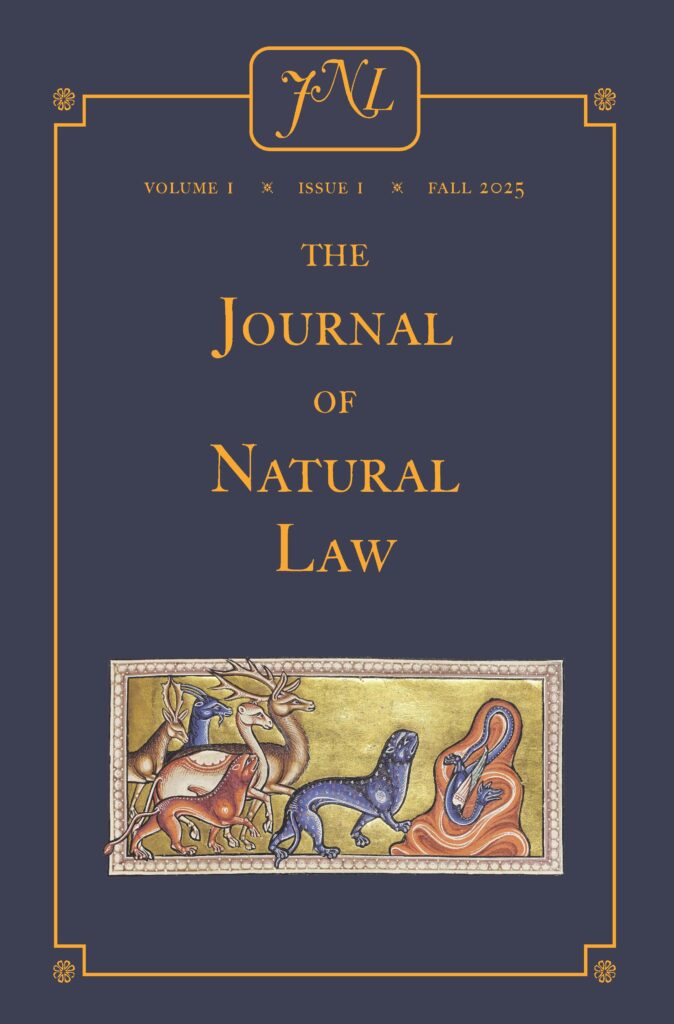
The journal is edited by Brian Besong (St. Francis University).
He authors a surprisingly polemical introduction to the journal in its first issue. Here’s an excerpt:
Ours is an age marked by profound intellectual losses and gains. Dazzled by progress in the empirical sciences, and perhaps hoping to emulate it, many philosophers and theologians cast aside their patrimony in favor of novelty. Nowhere is this more visible than in moral philosophy, which has seen the construction of an edifice at once highly sophisticated and manifestly barren. While moral philosophers have stubbornly resisted the corrosive effects of moral relativism, the normative conclusions drawn can be even more startling. Nearly a quarter-century ago, The New Yorker dubbed Peter Singer the most influential philosopher alive. His influence has only grown as the intellectual grandfather of the increasingly visible Effective Altruism movement. This is, of course, the same Peter Singer who has defended, among other things, sex with animals, corpses, and the severely mentally disabled, as well as infanticide—while staunchly opposing the eating of meat.
Given his publication record, Peter Singer is an easy target. Though he remains the most iconoclastic of contemporary moralists, even the more cautious voices in philosophy, theology, and jurisprudence have steadily drifted away from the ethical tradition that once undergirded Western civilization and constituted one of its greatest intellectual achievements. For notwithstanding its diversity of formulations and conclusions, the basic principles of natural law have formed the cornerstone of Western moral and political thought for more than a millennium, informing discussions on the nature and existence of human rights and of legal authority, the principles of just war and morally sound economic policy, and the principles of international law, to name a few. Natural law stands alone among moral theories in its classical pedigree—rooted in the teleological ethics of Plato and Aristotle, developed by the Stoics, advanced by Cicero, and given theological depth by Augustine of Hippo, to say nothing of its later systemization. Its advocates are still found in the top courts and universities worldwide.
If we wish to restore to prominence what has been lost or at least neglected, we must look beyond the dominant academic channels that have amplified voices like Singer and others while suppressing dissent from the new moral hegemony. The Journal of Natural Law aims to provide a venue for restoration, dedicated to developing and advancing the natural law tradition.
The journal is published biennially by the Catholic University of America Press. It does not appear to be an open-access journal.
The first issue, which came out recently, is here.

So, I’m guessing they won’t be asking Peter Singer to serve on the editorial board.
Good to know exactly where he stands–firmly in the Middle Ages.
That’s the “when!” The “where” is “the West.”
In this case, the time is also the place.
Well, during the Middle Ages the development of what we now call the natural law tradition included people like Ibn Rushd and Ibn Sina, but you wouldn’t know it from Besong’s characterization of the tradition, which focuses on its (sole?) development by and effects on “Western civilization” and “Western moral and political thought.”
I cannot fathom why they would think that calling out one specific philosopher, in a letter introducing their new journal, was a good idea.
Unless the journal was called “Steak & Philosophy”…
I don’t have strong views on Prof. Besong’s editorial. (Though I have enjoyed reading some of his previous work. The volume of essays he and Jonathan Fuqua put together with Ignatius Press was also rich and interesting– special shout out to Candace Vogler’s chapter.)
The contents of the first volume of this journal also look interesting, I’m eager to read Schuessler’s piece. But I can’t help but noticing that of the SEVENTEEN authors featured in this first issue, all of them appear to be men. And all FIVE of the books reviewed appear to be by men. The editorial board also appears to be comprised of all and only men.
Surely it isn’t the case that all of the “best interdisciplinary research on natural law in philosophy, theology, and legal theory” is by men? I’m hopeful the editors can work to secure contributions by women and other authors going forward.
See my comment above.
Thank you for the kind words about my work and the first issue. I’m pleased to share that Jean Porter, whose contributions to the natural law tradition have shaped the field for decades, has joined the editorial board this year. Her appointment reflects the same principle that will guide all our editorial decisions: scholarly merit alone. I am, for my part, confident that this commitment will serve the field well over time, and we welcome contributions from every quarter.
I think the worry is that women will not feel welcome to contribute (and one is probably not enough to curb that).
Peter Singer is one of few moral philosophers who have done two things that I regard as essential to having a full-blown moral theory. (i) He has an explicit and empirically-grounded thesis about the nature of moral value–pleasures and pains. (ii) He has an account of how this value is to be implemented in a practical way, following Bentham and Mill’s example. I really see no other present moral theory–with perhaps the exception of virtue theory–as one so posed. My own preference is some form of virtue utilitarianism actually. And, I think so-called natural law theory is a form of theistic authoritarianism FWIW.
Jesus!
I think the term “natural law” is actually a problem with respect to this manifesto.
What is natural law theory? Well, some use it very broadly to mean any theory of ethics grounded in the world…. so, even Hobbes and Hume (and maybe, actually, Singer, depending on whether he’s in a nonnaturalist mood). But then, no-one has abandoned natural law, it is an utterly dominant paradigm, there is no “new moral hegemony”, there is a vast plurality of powerful natural law theory in ethics.
But notice that this journal is not publishing papers that indicate that scope. It is doing Catholic moral philosophy. So what the editor means is that Catholic moral philosophy once set the framework for Western ethics. That is historically correct. But when you put things that way, you are forced to recall that most people in Western countries don’t want the restoration of a hegemony that excludes most of the citizenry, who are not Catholic. And probably 99.9% of them know that there is no absurd forced choice between Catholicism and being pro-infanticide.
It is salutary at this point in the discussion to recall that, just as there is no general requirement for philosophers to overcome their ignorance about natural law theory, there is also no requirement to display that ignorance in a public space.
I’m looking forward to reading the exchange on Vallier’s book.
I like a polemical flourish as much as the next guy, but to characterize Singer as a defender of “among other things, sex with animals, corpses, and the severely mentally disabled, as well as infanticide” without context does not bode well for the seriousness with which this project will engage with opposing viewpoints.
I’m not sure what the fuss is all about. That a Catholic publisher would publish a new journal on Natural Law isn’t terribly newsworthy, and mainstream academic philosophers will pay no more attention to this one than they do to The Thomist. Which is fine. I’ll let Prof. Besong answer the criticisms of his Introduction as he sees fit, but it seems to me he was using Singer to represent what he thinks is a wrong way to think rather in the way Singer has used Catholic teaching to represent the sanctity of life view he thinks is ok. I would say that’s ok too. It’s also worth noting that NLT predates the Middle Ages, is not exclusively Catholic, and is marked by serious internal disagreements.
Nothing like seeing a typo a moment after hitting ‘post.’ That should have said ‘the sanctity of life view he thinks is not ok.
Looking forward to the issues on Grotius/Pufendorf, and on the Darwall/Schneewind takes on natural law and the birth of modern moral philosophy.
I don’t remember seeing an introduction to a first issue that was both so polemical *and* so personal. I understand and even appreciate the former. I find the latter very weird. “The anti-Peter Singer” journal is an odd way to position yourself unless you have a serious axe to grind. And that seems self-undermining.
This seems like it could be an interesting journal, but what a bizarre introduction. It’s just a lot of culture war axe grinding and he’s picking some funny targets. There’s a lot to unpack in a short bit– it is as they say a rich text– but three things jumped out at me: 1. It’s not honest to say that natural law theory has been “suppressed.” There’s no sort of politically motivated witch hunt firing or even threatening folks for researching or teaching NLT. The most charitable reading is that NLT is just unfashionable, but that’s a far cry from being “suppressed.” The less charitable reading is that despite claims to be “written on every human heart” natural law theory just has limited scope and isn’t terribly plausible to those without very specific religious commitments. None of that is to say it’s wrong much less undeserving of serious attention, but it’s a better explanation than some sort of conspiracy. 2. I notice that commenters here are already protesting that natural law isn’t just a Catholic tradition, which is true enough (though it’s also true that as a whole even Protestants and Orthodox Christians aren’t nearly as taken with it as Catholics) but Besong’s invocation of the “West” itself seems designed to exclude Islamic philosophers who might be read in the natural law tradition. 3. The obsession with Singer is just utterly bizarre on so many levels. Not the least of which is the fact that a world where Singer was in charge probably looks more in line with Catholic teaching on social justice and war than does one where say J.D. Vance is. I’d think that someone like Nick Land or Nietzsche would fit the role of anti-natural law figure much better. Nozickian style libertarianism would even be better than Singer.