
“In the early 1970s, fewer than 10% of articles cited any empirical sources. However, by the 2020s, this grew to over 50%.”
That finding is from a new study by Michael Prinzing (Wake Forest University), “The Role of Empirical Evidence in Philosophy,” forthcoming in Synthese.
Prinzing used a GPT model to examine the citations in 38,442 articles published across 21 highly-regarded philosophy journals between 1970 and 2024, and then manually classified the most frequently-cited sources in the sample. (He explains in his article the measures he took to ensure the accuracy of the AI tool.)
Here are charts showing the rise in articles citing empirical sources and the rise in the empirical sources cited per article:

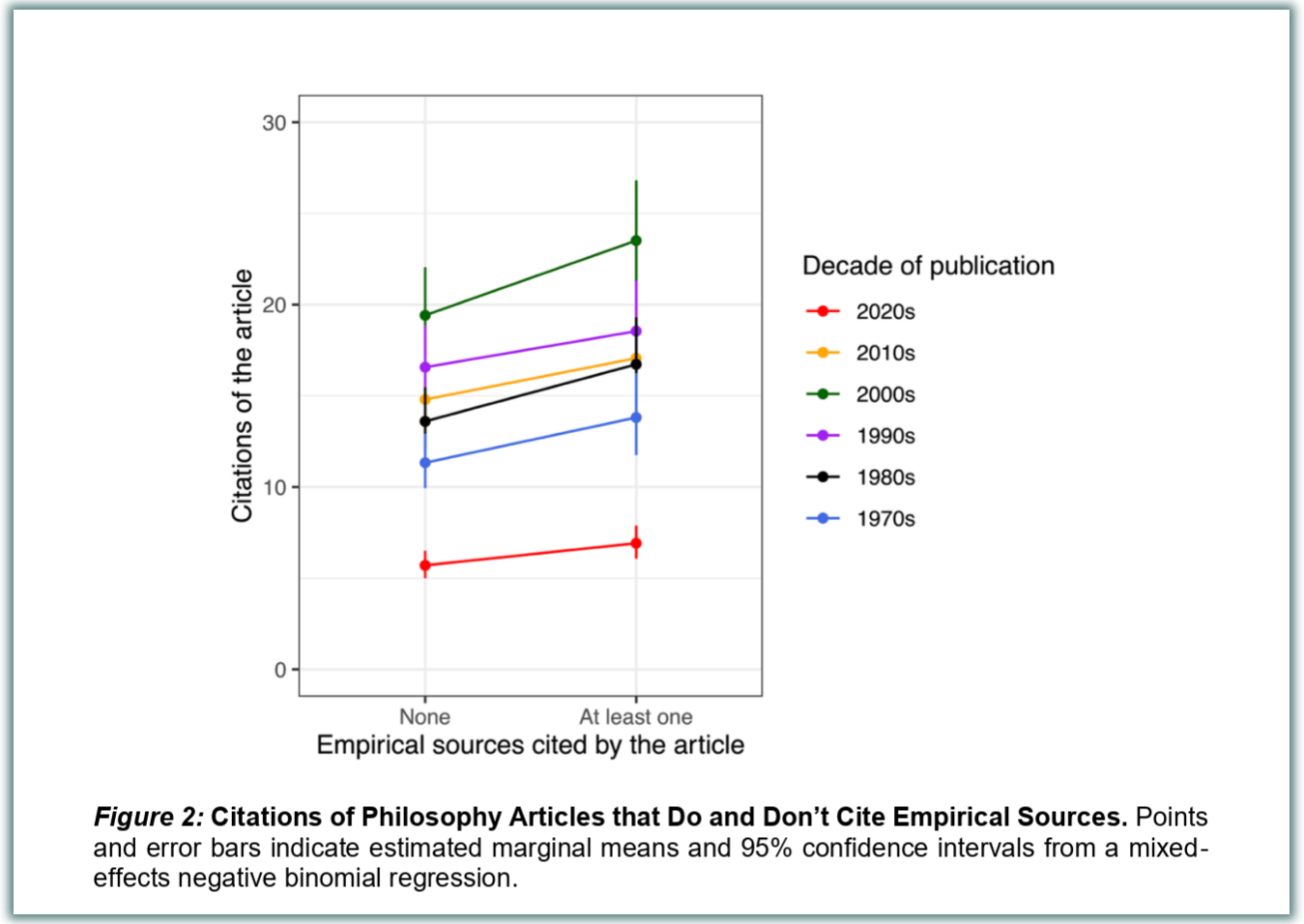
Prinzing also shows that articles that include citations to empirical sources have themselves been cited more than articles that completely lack them:
An additional aspect of the study shows a rise in the frequency of terms such as “empirical findings” in philosophical literature over the past fifty years.
What should we take from this? Prinzing writes:
If a sizeable and influential portion of mainstream philosophy engages with empirical research, then this gives us good reason to think that empirical methods and evidence play an important role in philosophical inquiry… [S]uch descriptive facts about philosophical practice shift the burden of proof in debates about whether empirical methods and evidence should play an important role in philosophical inquiry. The present findings indicate that, in recent years, articles published in prestigious, generalist philosophy journals were more likely than not to cite at least one empirical source, and the average number of empirical sources cited is about 4 or 5. Moreover, philosophy articles that cite empirical sources are themselves cited more often, indicating that they are more influential than less empirically engaged articles. Finally, a smaller, though non-trivial proportion (about 20%) of recent articles have discussed empirical research under that description, using phrases like “empirical findings, “empirical evidence,” and “empirical studies” in the text of the article itself. Together, these findings strongly suggest that a sizeable and influential portion of mainstream philosophy does engage with empirical research. It follows that we have good reason to think that empirical methods and evidence do play an important role in philosophical inquiry. Additionally, it would seem that, in meta-philosophical debates, the burden of proof is on those who think that empirical methods and evidence should not play an important a role in philosophical inquiry.
I’m not sure I know anyone who holds, as a blanket statement about all of philosophy, that “empirical methods and evidence should not play an important a role in philosophical inquiry.” Clearly some subfields of philosophy must rely on or engage with empirical evidence. Various subfields in applied ethics (biomedical ethics, engineering ethics, business ethics) are likely to engage with empirical evidence, as are areas that are centrally connected to social or political issues, such as feminist philosophy, philosophy of race. It seems that philosophy of science has become more empirical, in part through the development of subfields that focus more on the practice of science. That these are all subfields that have grown substantially over the past 50 years may help explain the data Prinzing reports. It might be interesting to focus on more traditionally a priori areas of philosophical inquiry and see the extent to which they have become more empirical.

Interesting data. My intuitive reaction to this revelation is, however, disapproval. As the article points out, nobody thinks philosophy ought to have no intercourse whatsoever with empirical evidence, but there are also strong reasons to think that it must involve more than simple post-hoc interpretation of empirical data. Is this not part of what distinguishes the discipline from its peers? We don’t simply look at the data and try to explain it, we are interested in how there can be data in the first place, what exactly it means to collect data, the grounding and/or justificatory conventions undergirding empirical inquiry as such, and so on. Uptake of these concerns is more-or-less unique to philosophy in our day and it absolutely does entail more than simply surveying the data as it is delivered to us. I therefore feel very uneasy about any apparent move in the direction of assimilation to the quote-unquote “hard sciences.” Physics envy is a rightly mocked disciplinary mental illness.
Intuitions aren’t always informed by data that make them reliable. There’s been robust interaction between philosophers and subsciences for decades, wherein philosophers use their conceptual engineering to help scientists from competing paradigms to communicate instead of talk past each other and also to interpret/enhance their projects in light of the history of and latest analytical philosophy concerning relevant families of concepts. With the latter, equivocations, non sequiturs, hasty generalizations, category mistakes, and misuse of old philosophy are remedied. (Sometimes the empirical work reveals going philosophy to be too exclusive to admit the data as even being possible, but frequently we learn that if our philosophy is accurate, then it is accurate for other, simpler worlds than the one that’s actual.) Until the last fifteen years, it was not unusual for new scientists to leave school without philosophical education much newer than the falsificationism of the 1930s.
I’ll ask you to reread my initial comment, this time taking note of the part where I acknowledge that “nobody thinks philosophy ought to have no intercourse whatsoever with empirical evidence,” but that philosophy simply involves distinctive additional concerns that shouldn’t be undervalued.
There is often a kind of motte-and-bailey dynamic going on in discussions like these, I think.
On the one hand empirical investigation is supposed to be paradigmatically exemplified by sciences like physics. Empirical investigation is investigation that involves no or minimal a priori philosophy. (That is of course already very dubious to say the least, but I take it that an idea like this is commonly in play here.)
But on the other hand all sorts of investigations – some of which are obviously constituted by all sorts of a priori philosophy – are commonly taken to be empirical investigations. The forms that empiricality can take are now so diverse that empirical investigation is just investigation that in some way relates to something that has been observed in the broadest possible sense of “observed”. Things like thinking and acting (psychology) and decision-making (economics) are among the “empirical phenomena” to be “observed.
Philosophy is, like psychology and economics, about things that we inescapably encounter, such as thinking and acting, and decision-making.
The present paper, for example, takes psychology and economics to be empirical. (Note that I am not criticizing the paper for this.)
On this broad understanding of “empirical” it is neither particularly surprising or interesting that lots of philosophy is and should be empirical. Philosophy asks questions about thinking and acting (psychology) and decision-making (economics). This in and of itself implies very little about what philosophers should study and cite.
It seems to me that people often try to have the thrill of the former with the banality of the latter.
A welcome development! You can’t imagine Aristotle leaving out a discussion of the relevant available empirical evidence.
Some more detailed thoughts on the subject.
Unless it concerned the number of women’s teeth!
Reminds me of a Richard Borcherds video.
https://youtu.be/mAmX0MAjSxs?si=jOmiYc-oyvj97Q2v
Citing empirical work means citing empirical work. Nothing more, nothing less.
I worry, however, that such citations are becoming a cue — a way to signal (to reviewers and readers) one’s membership in the right tribe and adherence to the right fashions…
If we use empirical work that way, we will gradually become like psychology: lots of cites but little to say. For all my Quinean leanings, I certainly don’t want philosophy to become THAT…
Yes, this is more-or-less the angst underpinning my comment above.
An alternative hypothesis: perhaps the fraction of sources cited that are empirical has remained constant, but the average paper cites more sources, so the fraction with a non-zero number of empirical sources cited has gone up? (At least, I would want to separate out this factor from others.)
And in terms of the correlation between being cited and citing empirical sources – I suspect this really is mostly driven by the fact that more empirical fields tend to have citation norms that involve a lot more citation generally, and less empirical fields tend to have citation norms that involve a lot less citation, and thus, the kind of paper that is more likely to cite empirical sources tends to be in a field where even non-empirical papers are more likely to be cited. (That is, it would be interesting to compare rate of citation of papers in formal semantics or philosophy of psychology that do or don’t cite empirical sources with the rate of citation of papers in Early Modern or philosophical logic that do or don’t cite empirical sources.)
This is excellent to see. Hopefully this will help more philosophers see that the future of philosophy is interdisciplinary. Indeed, the current philosophical fields that are actually moving forward are almost all interdisciplinary. In discussions about consciousness and moral psychology, for example, real progress is being made, and this is because philosophers in these fields are engaging with scientists. In metaphysics, on the other hand, no progress is being made. Metaphysicians go around in circles, intuition pumping, and this is primarily due to metaphysicians’ unwillingness to engage with empirical work.
I’ll say it’s more from metaphysicians’ unwillingness to engage with logical and mathematical work. Of course, I think metaphysicians should formalize their work as much as possible. Ideally, put it into Lean.
And I suppose you don’t harbor any methodological priors whatsoever with respect to what you regard as “moving forward,” “making progress,” etc. This comment is a completely objective window onto the reality of human knowledge. How convenient.
Methodological priors? That sounds like the kind of thing that circular intuition-pumping philosophy purists care about. The interdisciplinary fields that are producing these real results have transcended this confused idea. Philosophy has historically tried to avoid both the Scylla of dogmatism and the Charybdis of skepticism. The interdisciplinary fields have recognized in their impatience with this project the grand insight* that real results are actually only one head-first collision with Scylla away. The interdisciplinary fields have transcended philosophy itself. The love of wisdom has become the actuality of knowledge.
*This insight is of course not a product of intuition-pumping, but rather a real result of the interdisciplinary fields that are opened up by this insight. The interdisciplinary cart is not pulled along by an insightful horse that is other than that cart. Rather, the interdisciplinary cart pulls itself along through an insightful horse to which it is speculatively identical. The interdisciplinary fields are the unity of the horse-cart opposition; through this opposition they are pure self-movement The interdisciplinary fields are the absolute. How exactly this is to be understood is left as an exercise to the reader.
It must be really nice to work in such an area. I’m sure it’s just a matter of time until you guys provide us with the foundational concepts of moral psychology properly defined without any unjustified assumptions regarding the very concepts you’re inquiring, the models you use to measure it and how you interpret the data.
Interesting—but citation ≠ substantive influence. In bioethics (esp. enhancement debates), work often cites science without being strongly shaped by it, sometimes relying on “science-fictional” assumptions instead (see the study below). Would be interesting to see if philosophy shows a similar pattern. https://link.springer.com/article/10.1007/s11948-025-00531-6