
Out of Context Philosophy
If you open up a philosophy article or chapter on your computer, the software you’re using, now updated with various AI features, may present you with something like the following message: “This looks like a long article. Would you like me to summarize it for you?”
You may be unlikely to use this feature. You’re skilled at reading philosophy and you understand the value of reading through it yourself.
But what about other people? What about your students?
What can we tell them to encourage them to read primary texts rather than the various summaries of them that today’s technology offers up?
You probably have your own set of reasons you might share with them. But I suspect that it probably does not include the following reason, offered up recently by Zach Weinersmith of SMBC-Comics:
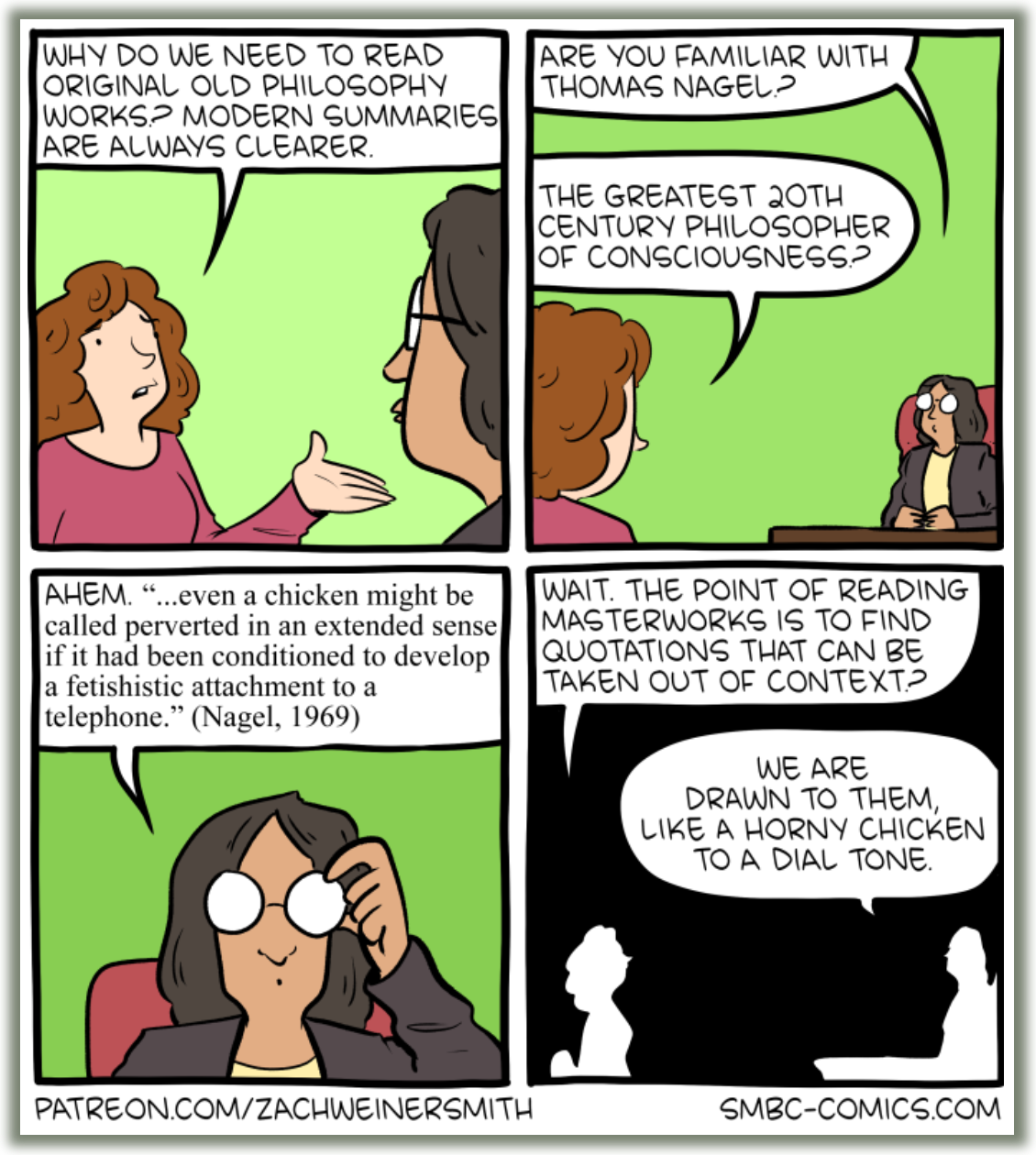
[Zach Weinersmith, SMBC Comics. Share with permission. The quote is from Thomas Nagel’s, “Sexual Perversion”. However, the quote is actually not in the original 1969 Journal of Philosophy version of the article but the revised version reprinted in the 1979 collection Mortal Questions.]
The Nagel quote is a good example. I bet you have others. Let’s hear them.
Meredith Williams’s Wu-Tang Clan lyrics: “Checking for understanding in a child who has taken the pill is, in fact, training the child in the mastery of the skill” (Wittgenstein, Mind, and Meaning: Towards a Social Conception of Mind, Routledge 2002, p. 213)
“How does a bird’s progress out of the stadium, where it has been mistaken for a fast ball, differ from a progress out in search of better food?”
In Michael Thompson’s Life and Action
I’m fascinated in how Nagel ended up in the ‘old philosophy’ section. I reckon there’s somebody a bit older doing philosophy.
I interpreted the interaction as being set in a future century.
— Fodor, Propositional Attitudes
No! The “point” of reading original texts is to discover that what look at first glance like funny passages to quote our of context and to rack up likes on social media, are often crucially important for making sense of a historical philosopher’s entire project. These are the parts that get left out of summaries and abridgments, whether done by Jonathan Bennett or by AI. It’s the work of actual scholars of the history of philosophy, the few who are left, to ensure that historical texts get read in a spirit of exhaustivity and charity towards their author’s intentions, rather than getting parted out like old cars into still-serviceable arguments on the one hand, and fodder for decontextualized meme-making on the other.
As the quotable context-free old chestnut has it, ‘any philosophy that can be put in a nutshell belongs there’.
I believe that’s owed to Hilary Putnam. I heard him say it in person, but I think it is in one his books.
In “Words & Life” it’s the epigraph of James Conant’s introduction (p.xi). We can take Putnam to have approved of that, I would think.
Tamar Gendler, “The Puzzle of Imaginative Resistance.” Not old, but still one of my favorite out-of-context quotes.
Banana fact: the word “banana” (or “bananas”) appears 114 times in Thomson’s Realm of Rights
If I remember correctly, the context is that you have promised Alfred and Bert each a banana, but you only have one. Thomson’s favorite example of a moral dilemma. (This is extra funny if you know how overdramatic the examples usually are in the dilemmas literature.)
Yes! How she writes it is also hilarious:
The horror…the horror…
“Similarly, we might say we are not describing alcohol itself if we describe the effects of drinking alcohol after taking cocaine” (Terence Irwin, Plato’s Ethics, p. 190).
The context, wonderfully, is Irwin’s explanation of Glaucon’s request that justice be praised apart from its rewards and reputation. Some causal consequences belong to justice itself; others belong to justice under added conditions. So too with alcohol itself. (Brought to my attention by Vanessa de Harven.)
I can never quite explain why Plato’s Meno‘s “I should answer that bees do not differ from one another, as bees” makes me giggle as much as it does.
Although I grant that translations other than Jowett’s (1901) render it less amusingly.
I feel the same way about Gorgias‘s “Suppose there are two men, each of whom has many jars.”
One of my favorites: “If painters were constantly in painting motion, and engaging them involved transporting them to the relevant wall, then they would be relevantly like train rides and sweaters on counters: but painters aren’t like that.” (G. A. Cohen, ‘Two Addenda to “Freedom and Money”‘)
If you want your students to use endnotes or footnotes, ChatGpt won’t provide that, so requiring a scholarly apparatus should block at least some AI plagiarism.
The frontier models, of course, provide footnotes and endnotes perfectly. It just costs 150-200 per month.
You definitely don’t need to be paying that level! The $20 models are certainly fine for this. And I suspect you can get the relevant behavior out of the free models if you give them good instructions and pay attention to what they provide and ask for appropriate revisions. (But a student turning to AI to short-circuit the work they have to do probably isn’t going to do all that.)
“This also seems to be true of some monkeys.”
Possibly the greatest footnote of all time, in ToJ.
“If our man’s picture is good pornography, it would be pretty mingy of him to keep it permanently hidden so that nobody but him shall ever see it – a nicer person would let his friends have a look at it too. But he is within his rights to hide it.” JJ Thomson – The Right to Privacy (p299)
Malebranche, who tries to prove the impact of imagination on the body by saying he knows a case of a pregnant woman in Paris who thought too much about food and gave birth to an apple instead of a baby.