
Last week, I asked philosophy instructors to let us know how much reading they assign in their undergraduate courses.
As of yesterday afternoon, there were around 700 responses for the “lower level” philosophy course poll and a little less than that for the “upper level” philosophy course poll.
For lower-level philosophy courses, a little over 36% of respondents said they assigned around 20 pages of reading per week, followed by almost 21% assigning around 30 pages per week and around 18% assigning around 10 pages of reading per week.

For upper-level philosophy courses, around 23% percent of respondents said they assigned 30 pages of reading per week, closely followed by 22% assigning 40 pages per week. 17% say they assign around 20 pages of reading per week, and almost 16% report assigning 50 pages per week.
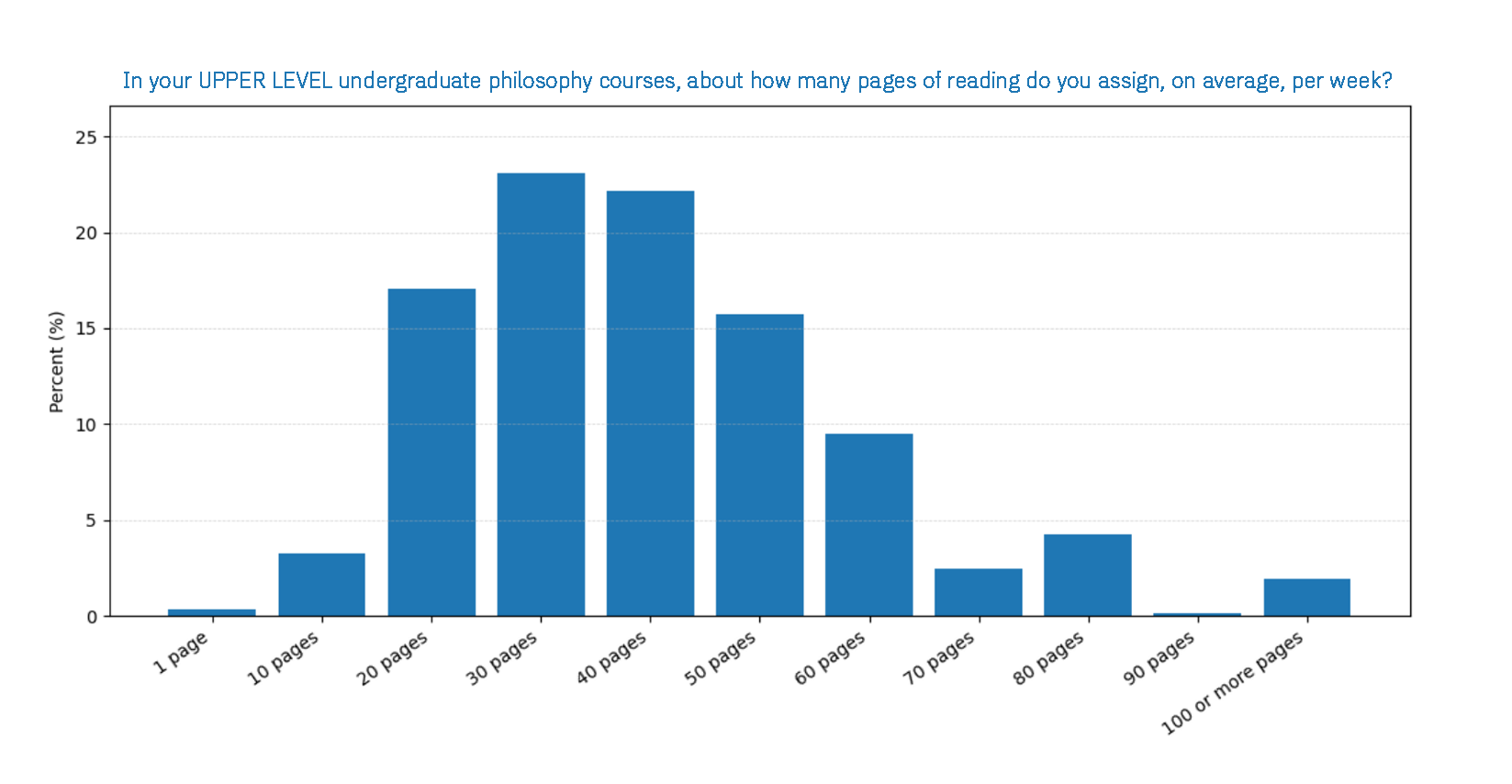
If we treat “100 or more pages” as 100 pages, the average number of pages of assigned reading per week in a lower level undergraduate philosophy course is around 27 pages, while the average in an upper level undergraduate philosophy course is around 40 pages per week.
Now whether the students are actually doing the assigned reading is another story.

Truly interesting! I wonder if the respondents have counted the appendix or source in. As a student, there’s nothing more surprising in reading than finding out more than ten pages of endnote.
I was one of those who said that I assign a 100 pages or more in both polls and only later realised that the way we do things here is slightly different in that the students only take one course at a time (all our courses are taught sequentially rather than in parallel). So, the 100 pages I assign is not a quarter of their reading load that week, it is the entirety of it.
Instructors who rely on learning management systems [LMS] (e.g., Canvas, Moodle) to provide at least some of the required course materials should be able to check site logs to discover when if ever students accessed those materials. If any non-required materials (“optional readings”) are also made available via the LMS, whether and when any students accessed those materials can also be determined using site logs.
Site logs can also be used to estimate how much attention a student pays to a course. [As the sole instructor across several decades for a large, heavily LMS-dependent course, I found that students who averaged 2.5 or more logins weekly tended to do significantly better than those with lower averages
That number was heavily dependent on course structure – I gave two one-point ‘micro-quizzes’ weekly during non-hour-exam weeks, where each microquiz consisted in one T/F question. The correlation each semester between total microquiz score (max 20 points, about 4% of the total point score) and the rest of the total course score was about 0.5. I interpreted that as a (crude) measure of attentiveness, where paying more consistent attention helped to boost scores. Students who waited until just before hour exams to access required readings covered tended to get far lower scores.]
During, say, 2002-2012, some students in the course always did access some optional readings. During the last decade of my teaching the course (2012-2022), about 0.0% accessed optional readings.