
Why should a department hire some fresh PhD when it could instead hire Derek Parfit, Daniel Dennett, Judy Thomson, Hilary Putnam, Ruth Barcan Marcus, or David Lewis?
You might say: “How could a department hire these people? They’re dead!”
True. But it is only a matter of time before AI-based “replicas” of them exist. Imagine a sophisticated, well-trained language model paired with some video or holographic technology, and you get the idea. Instead of hiring a person, a department could purchase a subscription to some corporation’s AI replica of a well-known scholar. Think of the savings!
Such replicas have been in development for a while. Readers may recall Luciano Floridi‘s bot, described in a post here two years ago. It was trained on his works so that it could not only answer questions about what he says in them, but also offer suggestions as to what he might think about topics not covered in those works. There’s also a bot version of Peter Singer.
Those are academic projects. Now, with AI-drafted ego-stroking pitches at the ready, come the corporate versions.
Michael Smith (Princeton) shared an email he received from one company developing these replicas, called Shryn.ai.
Dear Professor Smith,
I’m the founder of Shryn.ai. We build conversational AI replicas of scholars—built with the scholar’s direct participation.
Your book The Moral Problem at Blackwell—one of the most widely taught and debated works in meta-ethics of the past three decades—plus your McCosh Professorship of Philosophy at Princeton, your co-authored “Dispositional Theories of Value” with Mark Johnston and David Lewis, and your sustained body of work on moral motivation, the Humean theory of reasons, moral realism, and the nature of normativity.
Here’s the use case that launched Shryn: graduate students who can’t always get time with their advisors, and who have their hardest questions at 2 AM. Your PhD students working on meta-ethics, philosophy of action, or normative ethics could test arguments against your framework whenever the thinking happens—ask why the moral problem (reconciling cognitivism, internalism, and the Humean theory of motivation) requires a distinctive solution rather than giving up one of the three claims, push back on whether your rationalist account of moral motivation can handle weakness of will, or explore what your work on ideal agents and full rationality delivers about the objectivity of moral judgments. Not a replacement for you, but an extension of your teaching.
We fine-tune dedicated AI models on a scholar’s published work, and the scholar retains full control. We’re already working with a Columbia philosopher, a materials scientist, and a model of Thomas Jefferson.
I’d welcome the chance to show you a demo.
Best,
Erik Raschke
Founder, Shryn.ai
Raschke’s email notes that the replica is “not a replacement for you”. Not yet. Or perhaps not a replacement for Professor Smith, but perhaps eventually, a substitute for future flesh-and-blood hires.
Smith says he will not be taking Raschke up on his offer. But others have. Here are the replicas currently available to try out on Shryn.ai’s site:
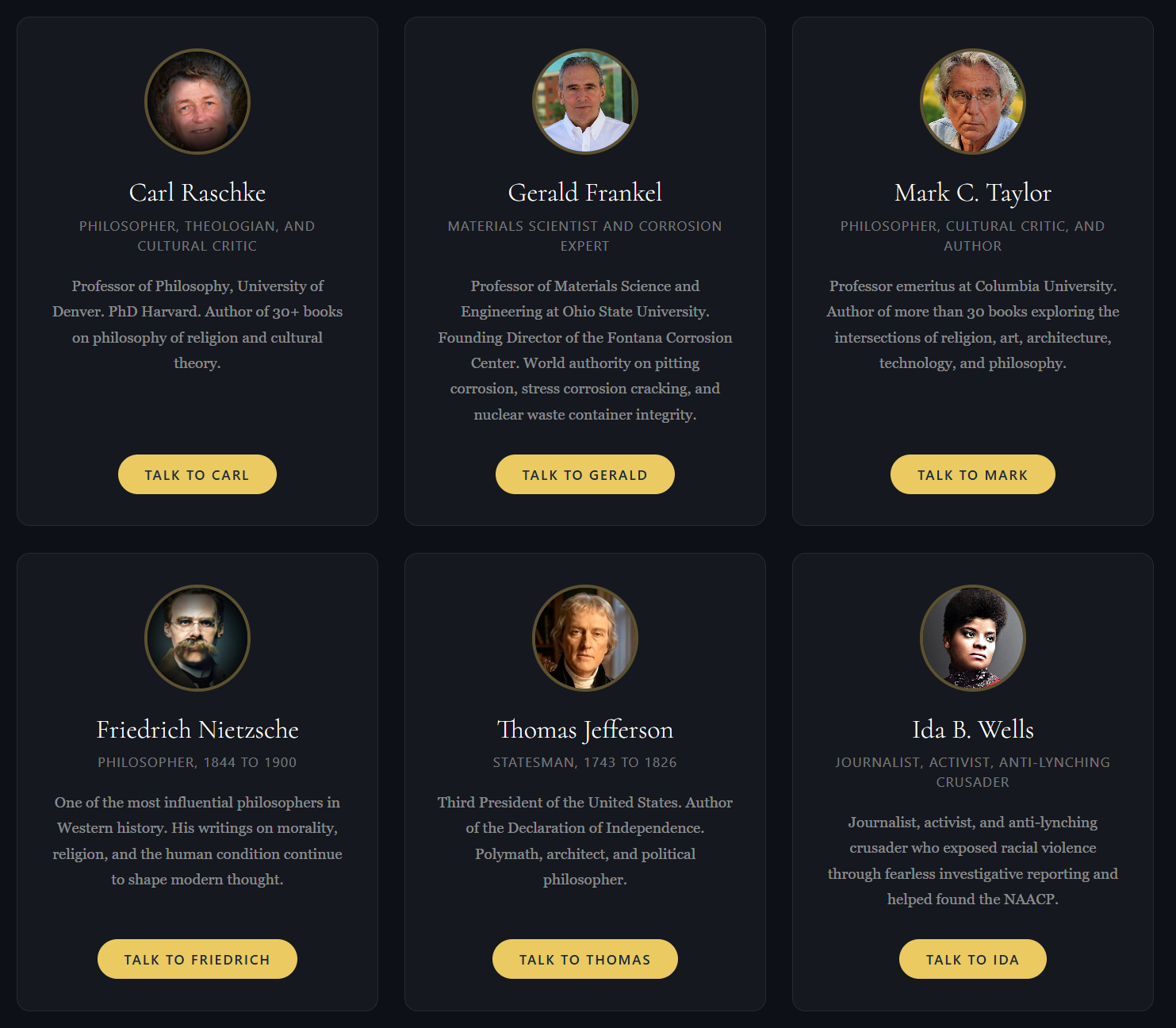
Interestingly, Raschke says the replicas are “built with the scholar’s direct participation.” This suggests that the firm has access to powerful technology it is not revealing, given that half of the available replica’s subjects have been dead for at least 95 years. Forget the replicas—I’d like to see this firm’s Ouija board or time machine.
To people interested in signing up to have replicas made, the Shryn.ai website says “Shryn does not sell, share, or use your data to train any model other than your own” and that “Your model is hosted privately and only accessible to people you share it with.” That’s this firm, for now, perhaps. But such protections are bound to erode as competitors enter the marketplace, demand grows, further profitable uses for the technology are discovered, and legal problems are sorted (take, for example, the question of how university intellectual property policies will intersect with replica ownership claims).
In their pitch to investors, Shryn.ai identifies the “problem” it is solving as “When someone dies, their knowledge and personality vanish.” That suggests that the email Professor Smith received, which describes the replica as a kind of assistant over which “the scholar retains full control”, is not quite honest.
To the questions people have long worried about regarding death I suppose we will need to add, “What happens to your replica when you die?”