
Thomas E. Hill, Jr. (1937-2026)
Thomas E. Hill, Jr., professor emeritus of philosophy at the University of North Carolina, Chapel Hill, has died.
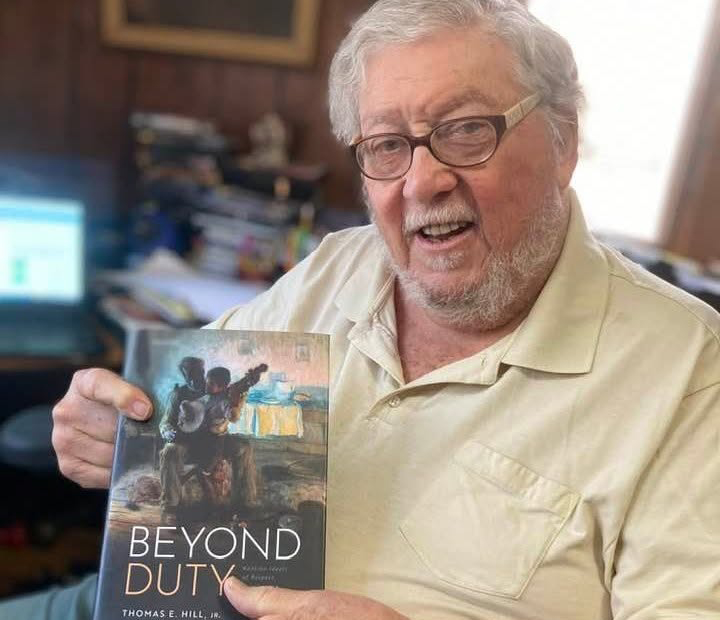
Professor Hill was well-known for his work in ethics, the history of ethics, and political philosophy, and especially for his scholarship on Kantian moral and political philosophy. He is the author of Beyond Duty: Kantian Ideals of Respect, Beneficence, and Appreciation (2022), Virtue, Rules, and Justice: Kantian Aspirations (2012), Human Welfare and Moral Worth: Kantian Perspectives (2002), Respect, Pluralism and Justice: Kantian Perspectives (2000), Dignity and Practical Reason in Kant’s Moral Theory (1992), and Autonomy and Self-Respect (1991), among other works. You can learn more about his writings here and here.
Professor Hill joined the Department of Philosophy at UNC Chapel Hill in 1984. From 1968 to 1984 he taught at the University of California, Los Angeles. Prior to that, he held positions at Pomona College and Johns Hopkins University.
He died this week.
Update: A moving appreciation of Thomas Hill, Jr. by Daniel Muñoz.
Very sad to hear about the passing of Thomas E. Hill, Jr. I spent a year at Chapel Hill in the (very) early 2000s and remember him as a very kind person and great teacher.
I was Tom Hill’s student at UNC from 2011-2017. He supervised my master’s thesis and was the second reader on my dissertation committee. As a mentor, Tom gently offered a wealth of quiet suggestions and deep insights while helping me to find my own style. He was deliberate, sensitive, and understated; he did not take short-cuts; he did not make a big show of reaching a Big Conclusion. Learning from him required patience, open-mindedness, and humility. He was a life-changing teacher.
When I entered the PhD program, just out of college at age 22, I think I mostly saw philosophy as a negative undertaking: one lies in wait for others to futilely build theories and then bombards them with an onslaught of devastating counterexamples. Tom’s vision of philosophy was so much brighter and more expansive. Although he appreciated and affirmed the value of fair competition (he was a successful wrestler and played offensive line for Harvard), he warned me of the pitfalls of conceiving of philosophy in metaphors of war. Indeed, he reminded his seminar students at the beginning of every semester that philosophy was not easy, and he invited us to see what kind of progress we could make if we pursued its great questions collaboratively and as equals.
Developing the courage and ability to articulate my own ethical outlook took time. One day, feeling frustrated, I showed up at Tom’s office hours to ask why he, someone who respected and had once been gripped by ordinary language philosophy, was so invested in positive, theoretical work. What good could it possibly do? Tom did not belittle my question, nor did he betray any disappointment or frustration. Instead, he tenderly and hopefully explained how good philosophy might retain its theoretical aspirations while being honest about its limits. “People take theories and use them to change the world,” he said.
Tom’s prose models the qualities he encouraged in his students. His writing is clear, charitable, and expressive of an exceptional sense of what matters. While his philosophy begins, as he wrote in the introduction to Autonomy and Self-Respect, “with genuine puzzlement,” it never reduces the philosopher to a cheap puzzle-solver. His work makes his grand themes—respect, equality, human dignity—urgent and accessible without draining them of their power to inspire. It reflects a Kantian vision, of course, but, like Tom, it is also distinctively American, even (and especially) in its criticism of American bigotry and war. Reading Tom’s writing made me a less cynical person, deepening my understanding of our highest values and renewing my commitment to them.
I was lucky not only to learn from Tom, but also to become his friend. During my first week in Chapel Hill, Tom and his wife, Robin, welcomed me by inviting me to join a group of his students that met regularly for dim sum. Through those meals, as well as trips to the symphony, discussions of his football days, and hours in his classes, I came to delight in Tom’s subtle and warm sense of humor in addition to his famous bigheartedness.
When Tom retired, he generously agreed to participate in a reading group with Vida Yao (another former UNC student) and me that we convened over Zoom for years until his recent health issues and our busy schedules made it impossible. In these meetings, we tried to draw out Tom-the-teacher but he insisted, predicably, on a more egalitarian arrangement. He almost always refused to select texts for us but gamely read everything we assigned—often the work of some of Kant’s fiercest critics. Rather than defensively attempting to undermine these detractors, Tom approached every session with an open mind. Mostly, he wanted us to do the talking, interjecting from time to time to lightly steer us in more fruitful directions or to share amusing anecdotes of the characters he encountered as a younger philosopher at Oxford, Harvard, and UCLA.
I relished those sessions and I will cherish my memories of them along with my memories of working with Tom as a student. He was a wonderful philosopher and friend who enriched my life immeasurably. I will miss him.
Today we lost one of the finest persons in our profession. He was a truly warm human being, kind, generous and welcoming. I was never Tom’s “student” ( didn’t go to UCLA or UNC) but I did get to spend the summer of ’93 at NC with 11 other people, who had some claim to being engaged in Kant scholarship, at a NEH summer seminar. It was 8 weeks, 4 days a week, three hours in the seminar meeting, and then virtually every day many of us would head to the Lenoir cafeteria for lunch. That often lasted more than three hours as well. It was, to be sure, the graduate seminar I never had the opportunity to participate in when I was a graduate student. Tom chose great people–there were no greenhorns, and we all brought something to the table. And he wasn’t there to shove his views down our throats–he was there as a teacher and (just as important) as a learner. One of the remarkable things about Tom was his ability to try to push us even further than we might be comfortable going without being threatening or domineering. His influence on me as both a teacher and as scholar was immeasurable. We also developed what amounted to a more than thirty year friendship. I will also say that having come to know a number of his former students over the years, that he left his mark on them as well. He was (of course) a top tier Kant scholar, but he was much more than that. And I am grateful for having been his friend and student. I will miss him dearly as, I’m sure, will countless others.
As another of the participants in that 1993 NEH summer seminar, I can attest to everything that Richard Galvin says here. It was a great group and Tom led it so well without seeming to break any sweat at all. He let everyone do their thing, such that you could easily forget that it was all working because he was at the center of it all.
Tom was sneaky like that. With Kant, most everyone starts with the default assumption that this is a forbidding theoretical apparatus constructed by a remote intellectual force. You then have to do a ton of work to explain and defend the theory, or to cut Kant down for trying and failing to realize such grandiose theoretical ambition.
If you pick up a Tom Hill paper, the basic sense you get is that Kant was a good guy who was just trying to explain how we can all be good people together.
But if you start poking at the argument, asking whether the moral reality or the Kantian position can really be as straightforward as that, you quickly see how much control Tom had over all the hard stuff. He was sneaky like that. Pay closer attention to the ways Tom frames his claims, and you will see that he was always defending a particular way of reading Kant, against a battery of textual and moral objections. But somehow those objections never came to dominate the narrative, which always kept its determinedly positive focus on what was so sweet and reasonable in Kant. That determinedly positive focus, of course, was Tom’s real achievement. As Karen Stohr says here, Tom never said that you had to read the text his way. He always said that you might want to read it his way…and why would you not want the text to be sweet and reasonable?
You see, Tom was modeling being a good person in the way he argued, philosophically. But he wasn’t being at all sneaky there, because Tom genuinely was a throughly good person. I am finding it difficult to convey what a total sweetheart he was. Everyone in these comments is saying it, everything they are saying is true, and somehow it is not enough. It is not adequate to the reality of Tom’s kindness and generosity.
I had the great fortune of studying with Tom at Chapel Hill. I finished my dissertation in 1999, but I never stopped learning from him. Perhaps Tom’s most salient characteristic was his profound moral decency. It pervaded his philosophical work and his interactions with everyone and everything around him. He did not shy away from conflict; indeed, he could launch a devastating critique of an argument when the occasion called for it. But he did so with kindness, charity, and always with an eye toward how it could be improved. Philosophy, for Tom, was about nurturing ideas, not trampling them underfoot. It is perhaps no surprise that so many of us have been drawn to him and to his way of doing philosophy.
One of my favorite works by Tom is an older essay in his collection, Dignity and Practical Reason. The article is titled, “Making Exceptions without Abandoning the Principle, or How a Kantian Might Think about Terrorism,” and it typifies Tom’s philosophical style. In it, he tackles a very difficult practical problem, one that poses particular challenges for Kantianism. He offers a brilliantly nuanced and sophisticated approach to the problem, with the suggestion that it is just how a Kantian *might* think about terrorism. Not ‘must’ or ‘ought’ but ‘might.’ Tom was a very wise man, an Aristotelian phronimos in my view. But he never put himself forward as giving the final word on a topic. That would have been at odds with his own intellectual humility and his conviction that philosophical progress is gradual, subject to revising and rethinking, and most importantly, something we do together.
To be one of Tom’s students was to be treated as a partner in intellectual inquiry, even when it was patently obvious that one of those partners was wildly underqualified compared to the other. He had high standards, particularly when it came to charitable interpretation of whatever we were reading or writing about. But he lived by those standards himself, granting us that same charity and being unfailingly respectful of our efforts to say something sensible. Tom treated everyone in his orbit as a fellow member of the kingdom of ends. I was a convert to Kantianism, and it was Tom’s moral character that converted me as much as anything he wrote.
I realize that I am portraying Tom as somewhat of a saint, and he would have been the first to object to that characterization of himself. (I can visualize him frowning at the very idea.) Tom never expected perfection of anyone, but he was always hopeful that we might all manage to do just a little bit better. In the later part of his life, Tom became especially interested in the concept of appreciation. I know he had more to say about it than he had time or energy to write, but one thing that is true of Tom is that he himself knew how to appreciate things. Philosophy, of course, but also birds, music, good meals, the stray dogs and cats that found their way into the Hill household. Most of all, though, Tom knew what it mean to value and appreciate people. He wrote about it and he lived it. I grieve Tom’s death, but I am so grateful for having had the opportunity to participate in his beautiful life.
Hey Karen–I can see the frown right now. But of course everything you said is true.
Richard
I was also one of the participants in the wonderful 1993 NEH Summer Seminar led by Tom and noted by Richard Galvin and Larry Krasnoff in these comments. I additionally spent a semester and then later a year as a visitor in the Chapel Hill Philosophy Department. So, I got to know Tom pretty well. In addition to being the distinguished intellectual we all knew him to be, he was a friendly and encouraging presence who made the Department there a very welcoming environment. He came to the seminar each day with his thoughts written in pencil on a yellow note pad, and it felt as though we all were just having a conversation. Since my expertise was in Hume, I felt like a fish out of water discussing Kant, but Tom encouraged me to draw on my own background, and over the course of those few weeks, I developed my thoughts, not on the differences between Hume and Kant, but on their commonalities. I left the seminar with the seeds of one of my best (and later, published) papers. Both Tom and his wife Robin were so gracious to extend their hospitality to visitors in the Department. I am grateful that I got to know them both, and I’m so sorry about Tom’s passing.