Summer Fiction Reading
I don’t know about you, but I read more novels during the summer than any other time of year.
I probably can fit in a few more before the school year begins. What have you read lately that you like?
As for me, two recent fiction reads stand out as being of particular interest to philosophers:
- The Last Samurai by Helen DeWitt. I finally got around to reading this book, which was published in 2000. No, it’s not about samurais. Rather, it’s the story of an extremely bright young boy living in late 20th century London with his eccentric mother, a woman of idiosyncratic high standards and low tolerance for idiocy, no matter how common. The book explores learning, freedom, art, courage, and relationships in a way that’s explicitly informed by John Stuart Mill’s autobiography and, implicitly, his On Liberty. It’s smart, funny, and very well-written. It also regularly references the 1954 movie Seven Samurai. I had never seen the film, but about halfway through reading the book, I decided I should watch it. It holds up, and I recommend watching it at some point during your reading of the book.
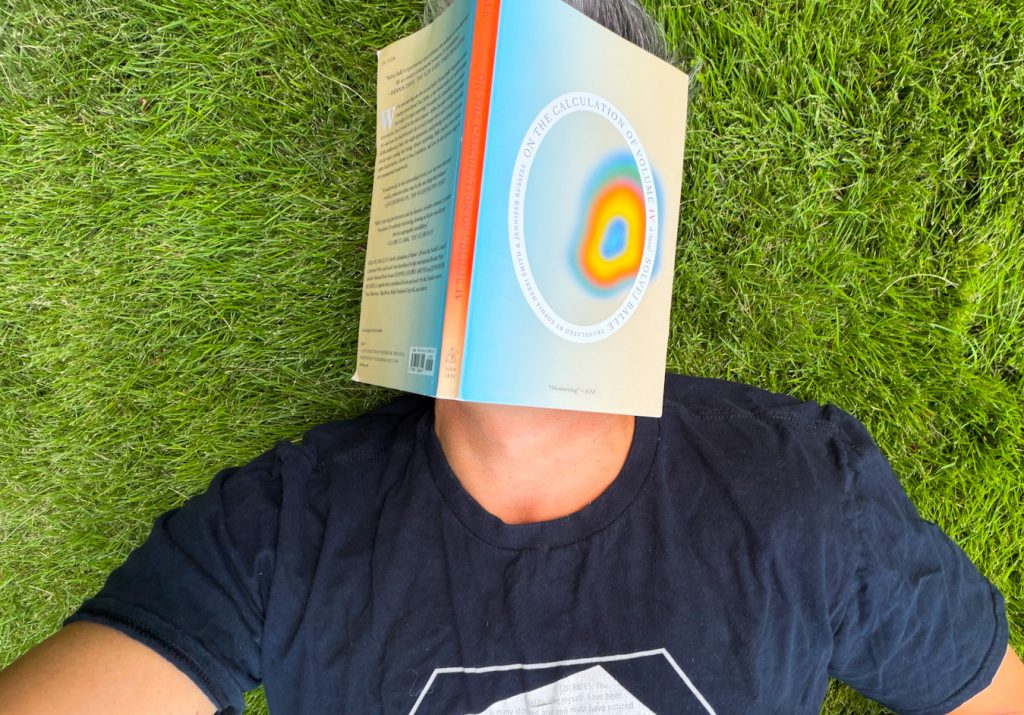
- On the Calculation of Volume by Solvej Balle. This is actually a series of seven short novels, four of which have so far been translated from Danish into English. The first book was published in 2020. (I’ve read the first four.) This is the story of a woman, Tara, who keeps waking up on November 18th. You may be thinking, “oh, like Groundhog Day.” Not really. Groundhog Day is an amusing movie. On the Calculation of Volume is a rather remarkable and patient exploration of what life would be like if you kept waking up to the same day, surrounded by people who, unlike you, are experiencing the passage of days as we normally do. It’s a story of confinement, of the challenges of living under certain kinds of constraints, of how one should live under these unusual circumstances. And of course there is the question of whether the lessons of this odd form of life hold for our own. It’s very much a story about paying attention, in more ways than one.
Your recommendations welcome.
Can we also have thread on nonfiction …. if it is not philosophy
I’ve been writing a novel that relies heavily on interpolating novels commonly read in high school. The project has led me to reread many of these novels for the first time as an adult. I highly recommend rereading The Great Gatsby. There’s so much in it that is hard to understand as a younger person. Also, it’s short!
This guy Bill Shakespeare wrote some great fiction. Also Tom’s Crossing by Mark Danielewski (recent release) is great
Thank you for the recommendations. Lately, I’ve been reading KD Salinger’s 9 Stories. It’s absolute fantastic. The detail, and perspective of children
Let me preface this by saying that I joined a book club at the beginning of the year to force myself to pick up novels that are traditionally out of my wheelhouse, so I recommend doing that if you want a change in your reading.
I recommend two Irish novels, The Names by Florence Knapp & Nesting by Roisin O’Donnell. Both are primarily about a wife in an abusive relationship, but The Names tells the story from three possible timelines. I wouldn’t have picked up either one if it wasn’t for the book club!
They are not very “philosophical,” but I have begun reading the Wallander book series by the Swedish writer Henning Mankell. For fans of detective fiction, they are excellent.
*We Are All Completely Beside Ourselves* by Karen Joy Fowler is a fantastic book. If you know nothing about it, do yourself a favor and don’t read the back or the description on Amazon. (I will add, at the risk of breaking the rules, that the book pairs very well with Peter Godfrey Smith’s *Living On Earth*).
Can we read the first page? If not, any advice on how to decide whether to read it (besides your endorsement)?
While I’m writing, I’d recommend Stoner by John Williams. It’s about a guy whose surname is ‘Stoner’; it has nothing to do with weed. Just artful, insightful, sometimes inscrutable writing about the big challenges in life: love, marriage, parenthood, workplace conflict, friendship, and wisdom. It’s about a young man who was born and raised on a Missouri farm, and who becomes a teacher and scholar of Renaissance literature. It was a page turner for me, but also got me thinking.
Wait, of course I can do that, what a question!
I loved Stoner. I still remember the bit set in a 1st-year college classroom when he awakens to the possibility of serious engagement with literature.
I permit it. But just for you.
It’s a family saga about an unusual family. I’ll leave it at that.
D.
Ray Nayler’s The Mountain in the Sea is inspired by PGS’s Other Minds. It’s pretty decent fare.
John Cowper Powys’ Autobiography (1934),his greatest work of fiction. He admits near the end that he’s treated himself as one of the fictional characters in his novels, embellishing memories to get at some truths about himself.
He made a living on the popular lecture circuit in early 20th-century USA, debating Bertrand Russell among others. But his ‘lecturing’ seems to have been more like performance art (according to Henry Miller), and he seems to have relished the prevalent academic branding of him as a ‘charlatan.’
His own philosophy seemed to be panpsychism with a fundamental dualism between good and evil. He doesn’t pretend to have been that ethical, confessing to a sadism that he’s long struggled to contain.
He often comes across as a pompous windbag, endlessly spinning out his twisting sentences. In fact, I decided to stick with the book as a treatment for my internet-diminished attention span — Can I stagger through these tortuous sentences, tracking every last clause and em-dashed allusion, and distill some nugget of meaning?
The latter part of the book features some essayistic writing on the USA’s culture. E.g., “I wholly disapprove of the American custom of allowing policemen to take upon themselves to punish offenders before they appear before a magistrate. In some ways, no doubt, there is more “yield” and “give” in an American prison than in an English one; but I cannot help feeling there is also more opportunity for individual sadism.” He also remarks on “a certain crude alliance, which I have noticed cropping up now and again in America, between big business and the mob, a thing that always struck me as a peculiarly barbarous and dangerous sign, an alliance in fact between the noisy enemies and the insidious enemies of the dignity and decency of life.”
I recently re-read W. Somerset Maugham’s _Of Human Bondage_ and _The Razor’s Edge_, both of which I’d read many years ago as an undergrad. I liked them both quite a bit, but think I liked OHB more than I did before, and TRE a bit less. I’d say both are very worth reading or re-reading. I think they are the sort of books that seem different to younger and older people. I also recently read (for the first time) Hemmingway’s _A Farwell to Arms_, in a fun edition produced in the Soviet Union for students of English that had a helpful glossary in the end. That was especially useful for Italian places and some historical facts, but also amusing when it was wrong on things that the Soviet editor simply didn’t understand. I can’t exactly say it was a fun book, but I’m glad to have read it. One thing that stood out to me from all three books is that people used to drink a lot more, all the time, and not think anything of it.
Friends and colleagues started a faculty book club around 25 years ago, and we read mostly fiction meeting several times a year. Great for me–I read hundreds of books that I never would have otherwise.
Of late I can recommend Percival Everett’s James, a takeoff on Twain characters that is genuinely terrific. I loved Don Winslow’s The Final Score too, a collection of short stories involving crime from very different perspectives (the final story is being made into a movie starring Jake Gyllenhall). I’ve read everything by Jess Walter–you can’t go wrong with any title by him–Over Tumbled Graves is a great one, and Beautiful Ruins is a true masterpiece.
If you want SciFi and aren’t familiar with Emma Newman’s _Planetfall_ series, do yourself a favour and check it out now. It’s so, so good.
And if you want three or four good SciFi and fantasy novels a year, check out Adrian Tchaikovsky. _The Tyrant Philosophers_ series is particularly good.
If you’re looking for something short, elegantly written, and with some philosophical themes as an added bonus, Julian Barnes’s new book, Departure(s), is one of the best books I’ve read this summer. Another is Percival Everett’s The Trees — though I should note that in addition to being longer, it’s quite gruesome and disturbing, kind of a mix of detective fiction, horror, and commentary on racism past and present (the title refers to trees used in lynchings). And while some of my favorite contemporary writers are often described as having “Hemingwayesque” prose, I realized that I hadn’t actually read anything by Hemingway since high school and had never read The Old Man and the Sea. So I read it this summer and will just say: there’s a reason that’s a classic. If you’re like me and largely stick with contemporary fiction, take a chance on an older book that has some affinity with contemporary works you like.
I want to recommend Taiwan Travelogue! It’s yuri, it’s about food, it’s about colonization. It’s also a metafiction about translation. It also recently won the Booker Prize for translated literature and National Book Award for Translated Literature before that, if you care about that sort of thing.
I think most recommendations so far have been anglophone authors and western authors, so it is also something a bit different. ^_^
I recently read Maxim Biller’s Mama Odessa. It is semi-autobiographical, though fictionalized. It was an engaging book, telling the story of his mother’s passing, with many reflections on being a child of displaced eastern European/Soviet intellectuals living in Germany (and West Germany). (Disclosure: I read the book in neither German nor English). HIGHY RECOMMENDED
I am reading, and very much enjoying, The Life and Opinions of Tristram Shandy, Gentleman (Laurence Sterne).
It’s supposed to be an autobiography — I’m 400 pages in (of about 600) and the protagonist has just been born. Fantastic.
As a big sci-fi genrehead I’d recommend Peter Watts’s Blindsight and Ann Leckie’s Ancillary Justice. Sci-fi fans will probably have already read one or both, but even non-sci-fi-ing philosophers will likely get a kick out of their wildly different explorations of identity and consciousness. Also: there’s never a bad time to read William Gibson’s Neuromancer for the first time.
Currently re-reading Shirley Jackson’s We Have Always Lived in the Castle, which I mention not out of any particularly philosophical interest but just because I’m having a lovely time with it.
Jack London’s Martin Eden. Returning to it again. Has always haunted me.
I’ve been reading novels by the Korean author and Nobel Prize winner Han Kang, and especially recommend Greek Lessons and The Vegetarian. Her writing style (as translated) is unique, elusive, poetic, evocative, and it conjures up forms of experience that are quite alien, such as a woman who has lost the ability to speak and sees words and language as structures that block reality, and another woman who believes she is a tree. Greek Lessons is particularly enigmatic and philosophical, with the woman who can’t speak studying Ancient Greek with a teacher who is going blind. He left Korea as a child with his family when they moved to Germany, and he grew up and went to university there, where he got a Ph.D. in Ancient Greek philosophy. There are a lot of allusions to Plato. Almost everyone I know who has read Greek Lessons immediately re-reads it because it’s so challenging to figure out what is really happening.
Of novels I’ve read recently, the ones that made the deepest impression are: Phantom Limb by Chris Kohler, a piece of dark magical realism, set in modern day and Reformation-era Scotland; and Haven by Emma Donoghue, a claustrophobic story (as many of hers are) about the founding of the monastic community on the remote Irish island of Skellig Michael in the (?) sixth century. They’re about religious faith, or the lack or loss thereof, so that could be considered of philosophical interest. And, unsurprisingly given the locations, the weather is practically a character in itself in both.