
When There’s no Fun in Funding: External Research Money, Ethics-Washing, and Positive Academic Freedom (guest post)
Governments and firms are turning to philosophers and other scholars more and more in regard to the ethics of developing and regulating technology. Yet this engagement with ethics may be superficial, careless, or even manipulative—and the ethicists involved may not even be in a position to realize this.
“Ethics-washing” can take several forms.
In the following guest post, the authors (in alphabetical order)—Lisa Herzog (Groningen), Marijn Hoijtink (Antwerp), Gijs van Maanen (Tilburg), Ann-Katrien Oimann (KU Leuven), and Linnet Taylor (Tilburg)—describe some cases of it and some challenges in identifying it, and emphasize the need for collective action to address it.
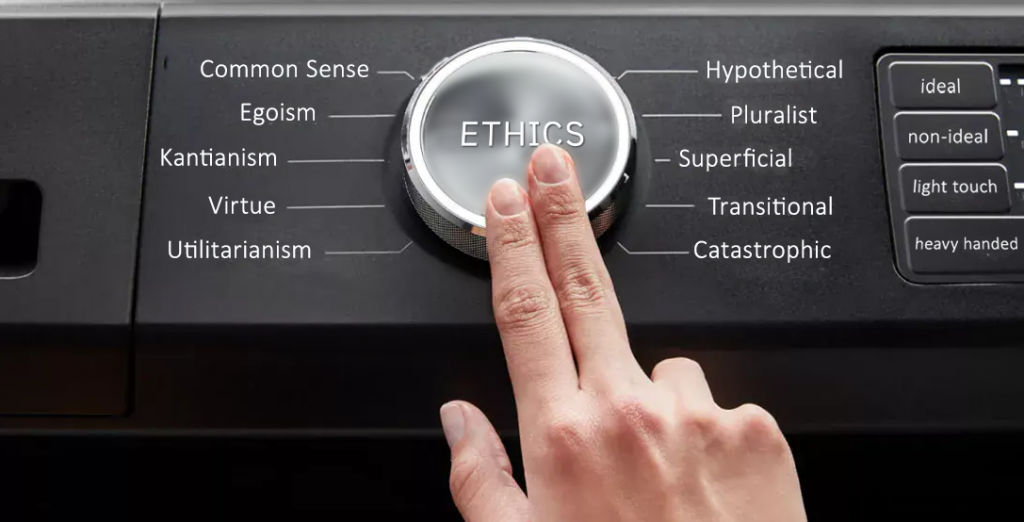
When There’s no Fun in Funding:
External Research Money, Ethics-Washing, and Positive Academic Freedom
by Lisa Herzog, Marijn Hoijtink, Gijs van Maanen, Ann-Katrien Oimann, Linnet Taylor
For legal and ethics scholars, the recent boom in digital technologies has brought new challenges when it comes to navigating collaborations and funding opportunities. Consider the following situation, based on a real-life case. An assistant professor in law, let’s call her Sarah, gets invited to serve as ethics advisor in an international research project on digital surveillance technologies. Reading through the project description, Sarah quickly realizes that the project’s aims and methodology are contrary to legal and regulatory norms and problematic from a human rights perspective. They are also contrary to the findings from a decade of work in her own research. She refuses the invitation and explains the reasons why, but does not hear back from the Principal Investigator. A few months later, Sarah learns that the project has been granted, and sees with surprise that her name has been listed, during the grant review process, as ethics advisor. She writes to the project officer at the grant agency, explaining her views on the project and her refusal to participate. But she does not hear back from them, and the project goes ahead unhindered.
Or take the following example, loosely based on work by Corinne Cath and Os Keyes. After many applications, Adam finds his dream PhD position: at a university not too far from where he lives, in a field that connects nicely with his Master’s program. His job for the upcoming four years is to reflect on responsible uses of AI in governmental decision-making. He will work in an interdisciplinary team that also includes a large private tech firm and government representatives. He is told that the team will directly implement his ethical recommendations. But when the project starts, he notices a pattern: his ethical arguments are challenged and set aside by other team members, or simply ignored. Similarly, in large research consortia or commercial projects, researchers are sometimes hired to chair ethics advisory boards, only to sense that these boards exist primarily to satisfy regulatory or internal compliance requirements, with little real influence on the design or deployment of the technology. In that sense, “ethics-washing” can also be understood as the invocation of ethical principles without any real intention of taking them seriously.
These examples do not arise in a vacuum. Over the past decade, efforts to govern information and communication technologies—most notably artificial intelligence—have increasingly been accompanied by an explicit turn to ethics. Funding agencies and technology developers now routinely invoke ethical principles in the form of guidelines, standards, and best-practice documents, alongside a growing number of similar frameworks issued by states, international organisations, and private actors (including prominent initiatives, e.g. Ethics Guidelines for Trustworthy AI issued by the High-Level Expert Group on AI, various AI ethics guidelines for the use of AI in Defence issued by various countries). In many of these settings, ethics is framed as something that can be incorporated into research and development processes through checklists, impact assessments, or design choices, rather than as an ongoing site of critical reflection or contestation. At the same time, claims to expertise in ethics are advanced by a wide range of actors, including lawyers, computer scientists, social scientists, philosophers, and industry practitioners. The resulting proliferation of ethical frameworks and advisers has made it increasingly difficult to determine what counts as credible ethical guidance, who should provide it, and what practical role ethics is expected to play.
The relationship between ethics research and its uptake in practice is fraught with difficulties. The two stories hint at what can, in analogy to ‘green-washing’ or ‘art-washing’, be called ‘ethics-washing’. It describes the cooptation of ethicists—or other researchers making ethical claims—by commercial actors who wish to present themselves as more ‘ethical’ than they probably are. In ethics-washing processes, any conclusions resulting from one’s research will not significantly affect the adoption of the technology or policy under consideration.
Narrowing the scope, biasing the message
Ethics-washing, then, is performative: the researcher is enlisted to support the notion that a particular actor is doing good, or at least not doing harm, without being able to make any practical difference where this is not the case. Ethics research, in such contexts, is transformed into what Marli Huijer calls ‘regulative ethics’: research that, “[r]ather than question the hard core of science and its societal implications,” is meant to “educate society on how to deal with” new technologies, and “instruct […] scientists on how to behave in a socially responsible manner.” Bigger questions about the desirability of the technology as such, or about alternative solutions to the problems it is meant to address, are no longer part of the picture.
Public or private actors steering the direction of research that they fund is not a new phenomenon. “Funding bias” is an established term in the biomedical field (e.g., here) to describe the alignment of results with what funders want, so that a different message gets out to the public or to other institutions, e.g., regulatory agencies. Various European ‘tech ethics’ institutes have been receiving funding by big tech firms, which according to one of the professors interviewed by The New Statesman, could very well affect the kind of questions to be asked. Questions about the accountable usage of technologies such as self-driving cars, to give a recent and much-debated example, could end up replacing questions about whether we need such technologies in the first place. Beyond the steering, whether directly or indirectly, of research themes and fields, scholars have also raised questions about how researchers’ growing reliance on external funding may threaten the public role of universities as centers of independent and curiosity-driven research. Such questions will become even more urgent now that many governments are cutting back funding for fundamental research.
Less thinking has been done on the specific problems of ethics-washing. However, although ethics-washing is still ill-defined from an institutional point of view, we argue that it risks undermining our institutions, disciplines, and contributions as researchers, and fueling public distrust in science.
Individual and institutional responsibilities
Ethics-washing is a practice that so far has been mainly defined against the backdrop of research integrity principles, and therefore as something that individual researchers have a responsibility to avoid. It does indeed play out partly on the individual level, as can be seen from the stories above. As researchers, we may be actively recruited to lend our credibility to a particular actor or project; alternatively, we may find ourselves in a situation where we have to withdraw if we are not to legitimize something that should not be happening. In this case, the responsibility lies with individual researchers to recognize when they are being used as means to an end, and to step out of such collaborations, or at least to call them out if stepping out is not an option.
Perceptions of this challenge, and how to respond to it, differs across disciplines. What may be a well-established form of collaboration in one discipline would be a problem in another. For instance, computer science has a long history of security and military collaborations, the humanities much less so. Therefore, depending on one’s discipline and historical alliances, there may be different thresholds for what is considered a problematic form of ethics-washing.
However, understanding ethics-washing as only an individual problem or responsibility is at least part of the problem we aim to surface. Researchers are part of disciplines, but also part of research groups, departments, faculties, and institutions. Ethics-washing partnerships or collaborations can take place at any of these levels. It is helpful, moreover, to distinguish ethics-washing from the steering of research fields, which entails adopting an outside actor’s perspective and research questions, rather than conducting research on questions stemming from independent inquiry. If we define ethics-washing, as above, as the purposeful use of a research collaboration to divert negative attention from a problem with the research sponsor, this may not even be visible to the individual researcher. For example, a sponsored chair may be created in anticipation of a particular problem, rather than as a result of it, without revealing the ethics-washing element to applicants for the position. It is also possible for ethics-washing to take place in what initially seems an untargeted and diffuse way, for example when a technology firm sponsors a legal or ethics research group over a long period of time, during which they produce work that focuses on some issues rather than others – even though the neglected ones are those that are most ethically sensitive.
This is why addressing ethics-washing as something individual researchers should not participate in, as is happening currently, is problematic. It obfuscates the processes through which institutional ethics-washing works, and reduces the institutional responsibility to scrutinize collaborations for ethics-washing one by one, rather than considering developments in a field, e.g. AI ethics, as a whole. Furthermore, it disincentivizes institutions from developing a definition and monitoring procedures that could lead to better checks and safeguards. Ethics-washing may be even more financially and reputationally beneficial for institutions than for individuals, which may explain why research institutions have been so slow to respond to concerns about it.
Ways forward in countering ethics-washing
Ultimately, however, we propose that this is not a problem that can be solved by appealing only to university managers, who are not incentivized to disrupt their institutions’ income streams and are not always willing to facilitate contentious discussions. Instead, the problem of ethics-washing requires us—as researchers—to collectively engage in conversations about ethics-washing and to discuss where to draw the lines. This does pose the problem of how to ‘police’ one’s peers, something that has proved difficult across all the disciplines facing this problem over recent decades. However, in the absence of institutional acknowledgement of the problem, a horizontal approach where researchers attempt to influence each other’s choices on the individual or departmental level—with consequent costs to working relationships—seems currently to be the only possibility. Academics are, after all, subject to numerous forms of peer-evaluation that are organized horizontally, from peer-review to informal exchanges in which approval or disapproval is expressed. Spreading the word about possible problems, and taking a clear stance in such conversations, are therefore important steps for determining the norms to which we hold ourselves to account as a professional community.
Such collective debates and awareness-raising across disciplines would also help us navigate some of the objections raised against critiques of ethics-washing. For example, there is always the question of whether one can still make a positive difference, or whether others will do a worse job in doing the ethics assessment if one does not accept the invitation. This line of argument is well-known to lead onto a slippery slope: couldn’t they put pressure on you to do even the most gruesome things, then? The best response to such arguments, however, is not just to draw a clear line for oneself, but to do so as an academic community, so that one knows that others will not cross it either.
Ethics-washing deserves attention in academic governance, research integrity codes, and public discussion. Individuals such as Sarah and Adam in our examples should not be left alone in what can be agonizing existential worries about the role of researchers and the responsibility of science in society. We have a joint responsibility, as an academic community, to develop a stance on it. To refuel this discussion, especially in times when academic budgets are slashed and universities are militarized, we invite colleagues to share and discuss their (personal) experiences with ethics-washing via email.
Yes, undoubtedly some academics subordinate scholarship to politics, and that is bad for scholarship (and for politics). But I am much, much more concerned about those who, consciously or not, smuggle their politics into their scholarship under the guise of dispassionate neutrality. It is far more insidious and, I suspect, far more widespread.
This is such a widespread problem but there has also been so much discussion on the topic that it’s no surprise that this is happening so routinely. Another dimension is the habit in social science research always to have to consult with impacted groups which of course is great in theory but in practice can often be extremely superficial or lead to unmet expectations. Often though it creates further jobs for the academics who are involved in this, followed by the pretence that it made a difference. (These are all worst case scenarios of course.) One institutional aspect of this is the frequent requirement of funders to have somebody ‘doing’ the ethics. Almost 20 years ago now I took a job looking at ethics for an EU funded project on genomics research, only to find on arrival that there was basically nothing for me to do, the research was already underway, and I had to spend three years making up things do to, since I had a family to support. Idiotic tasks had been pencilled in for me – all because it gave the massively expensive research project a better chance of getting funding. At least I got to write a book where I could mention ethics washing!
And AI is certainly leading the ethics washing game at the moment. I was also gobsmacked to see, by watching Grayson Perry’s recent documentary enthusing idiotically about Silicon Valley, that Anthropic have a copy of a book I wrote on AI Ethics – I know this because the camera did a lingering close up of it on a coffee table in their offices – it is there for show, probably chosen because it’s a thick hardback with a serious looking cover so fit the part – the grandiosity behind Anthropic’s claim to be ethical is off the scale. It’s simply part of the dangerous competitive game they are playing with OpenAI. Dario Amodei recently said in an interview that he did not think it was necessary to worry much about AI safety, because AI companies were run by extremely intelligent people, and very few extremely intelligent people were evil, and the next second admitted that he thought it possible that the AI his company was producing might lead to disaster for the human race. Yet they have someone ‘doing ethics’.
Hi, one of the authors here. In case people want to share experiences with ethics washing anonymously, we have prepared a form for that purpose. See here: https://cryptpad.fr/form/#/2/form/view/wKK7sigD8E7tT5iuKeChexcihmVgoyp93Mzh2KDIvzs/
I’m a bit worried that (UK) universities that value “impact” would just celebrate. REF values these sorts of things.
Especially since (if I understand correctly) there’s no requirement that the impact be positive. In theory, starting a pandemic or war would be as impactful as stopping one…
I have a parallel concern that I think is worth considering – namely all this ethics isolated from metaphysics and epistemology. Ever since my undergraduate days I’ve noticed that what started as a debate over ethical systems, principles or even moral judgements were in fact rooted in metaphysics and epistemology. I’m a secular person, but my “ally” was G. E. M. Anscombe’s recognition of the same problem in her “Modern Moral Philosophy”. Now, as a cyber security professional I am professionally confronting the same “metaproblem” and I fear that others in computing do know enough (most of the time) to recognize ethics as sometimes relevant, but get them to recognize that “there’s more where that came from”? A challenge.
IMO one’s view on cyber security is even affected by one’s view (even if implicit) on topics like boundaries, parts and wholes, probability, “what sort of creature are we?”, “theory and evidence” and much, much else. The probability one is the only one I know which has been studied much.
I’ve always seen this ethicswashing as not just restricted to ethics, but it applies to philosophy more general. The more we’re pushed and push ourselves to be useful in our research, the more we’re manipulated by the larger powers to be useful *to them*.
This all reminds me of my mother’s experience as a social and gender consultant in international development, in the ’90s and ’00s. She went into the field wanting to help make sure that energy projects would benefit people in the regions they were being built, and wrote many well researched reports on the topic which then basically just got ignored so that the company could build the thing they wanted to do anyway.
Thanks for this. I wrote a blog post on ethics-washing and techno-capitalism: https://biopoliticalphilosophy.com/2026/08/01/from-bioethics-to-ai-ethics-a-genealogy-of-philosophical-sell-outs/
‘…During the Industrial Revolution, techno-capitalists used their monopoly on the means of industrial production to exploit workers, enslave vulnerable groups, and poison the Earth. Many of the ethicists of the time gave these “captains of industry” the greenlight by defending privatization, colonization, and the duty to “develop” the land in Eurocentric ways, such as building factories and plantations that oppressed humans and destroyed ecosystems. Today’s techno-capitalists are following the same playbook: hiring ethicists to greenlight their “development projects,” whether transhumanist neural implants, eugenic evolutionary research, or AI infrastructure including servers, data centers, and LLMs. When 18th-Century proletarians torched their factories, trashed their asylums, and smashed shop windows in protest, they were using the only language that capitalists understand: sabotage.
This is the playbook we should be using today, pushing back against technologically-driven labor shortages, worker exploitation, and environmental degradation. What we should not be doing is using the language of “ethics” to whitewash techno-capitalist development projects. Laundering capitalists’ inhuman aspirations is an abuse of philosophical expertise and a waste of talent.’