
Anthony Kenny (1931-2026)
Anthony Kenny, professor emeritus of philosophy at the University of Oxford, well-known for his work on the philosophy of mind and history of philosophy, has died.
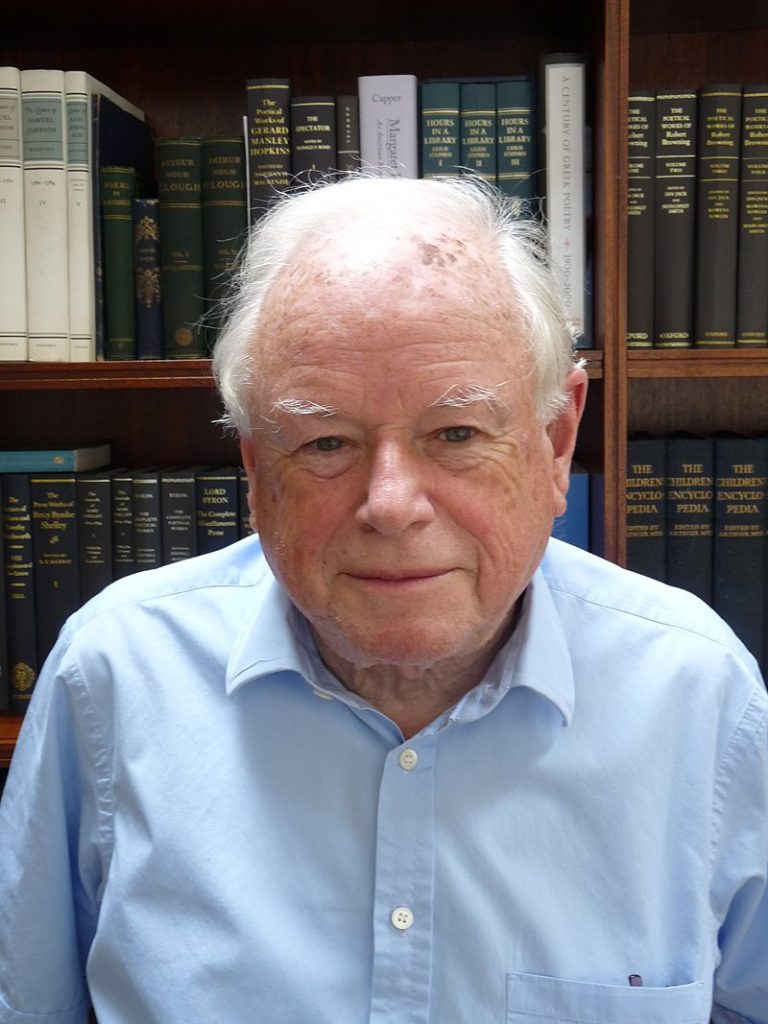
Professor Kenny wrote widely on the philosophy of mind, history of philosophy, and philosophy of religion. He is especially recognized for his work on Wittgenstein, Thomas Aquinas, and Descartes, including his critique of Cartesian dualism. Professor Kenny is the author of numerous articles and books. Some of his more well-known books include Descartes (1968), The Five Ways: St. Thomas Aquinas’ Proofs of God’s Existence (1969), Wittgenstein (1973), Aquinas (1980), What I Believe (2006), and A New History of Western Philosophy (2010). You can read more about his work here.
Professor Kenny was on the faculty at the University of Oxford for his entire career, from 1963 until his retirement in 2001. He also lectured at a number of institutions, including the University of Edinburgh, the University of Glasgow, the University of Cambridge, Columbia University, the University of Chicago, the University of Washington, the University of Michigan, the University of Minnesota, Cornell University, Stanford University, and the Rockefeller University. He earned his DPhil from the University of Oxford in 1961.
He died on August 3rd, 2026.
A New History of Western Philosophy drew me to his other works. https://a.co/d/0ftftdUg
A magnum opus.
He was also a major figure in Oxford governance in the 1980s and 1990s, and was Master of Balliol College 1978-1989.
Yes, he was quite kind as Master, though I’m not sure I ever agreed with any of his philosophy.
A great loss for philosophy.
Long ago, Kinny told me the story of him and Descartes’ Skull. During the time he was in Paris, working on his Descartes manuscript, he was told many times that he should go to visit Descartes’ skull, which was on display in the Musée de l’Homme. He resisted and resisted, until the penultimate day of his stay, when he finally caved. But when he got to the display, the skull–settled between those (allegedly) of the two co-crucified with Christ–the space was empty: no Descartes’ skull. He sighed with relief, but to no avail. A museum guard approached, told him that the skull was in the director’s office, and proceeded to lead Kinny thereto. Upon entry, he explained his (uneager) quest to see the skull, at which point the director reached into a drawer, pulled out a skull covered with cabalistic iconography, and unceremoniously plopped it into an awestruck Kinny’s hands. ‘What now?’ he thought, and could only manage a weak ‘is there anything special about the skull?’ ‘Absolutely nothing’ replied the director, scooping up the skull and putting it back in the drawer.
Even as he told the story, it was clear to me that Kinny was still a bit awestruck at the very idea that he’d held Descartes’ very skull in his hands. Who wouldn’t be?
good…story…