
“Over and over again I see philosophers go so far to take everything at face value that it leads them to a worse understanding of what is actually going on in an argument.”
Philosophers are an unusual bunch. Normally when someone gets up in front of their colleagues at work and gives a speech about, say, how “life has no ultimate meaning,” the appropriate response would be something along the lines of, “hey, are you feeling alright?” and perhaps a call to HR. But when a philosopher does this, the rest of us respond with “what, exactly, do you mean by ‘ultimate’?” and other things that basically say: “prove it.”
There’s a saying around here: philosophers are people, too. What would taking that idea seriously mean when it comes to philosophical discussion and disagreement?
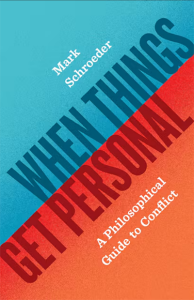
In the following guest post, Mark Schroeder, professor of philosophy at the University of Southern California, looks at one aspect of this: the role that “diagnosis” plays in ordinary life and the role it might play in philosophy. The ideas are drawn from his new book, When Things Get Personal: a Philosophical Guide to Conflict.

Listening and Diagnosing
by Mark Schroeder
When Sam (true story, fake name) took his first philosophy class, he was gripped by the problem of skepticism. But not just gripped in the way that many philosophically minded students are. Sam became genuinely worried about whether he was surrounded by palm trees, brick buildings, and skateboards, and nothing my colleagues said could ease his concern. At last he went home for the holidays and shared his worries with his mother. Her response was immediate. “Sam, you’re letting your OCD get control of you again!”
Suddenly, with the help of his mom, Sam saw everything that he had been thinking about and going through for his first semester away at college in a new light. With a diagnosis of what was going on in hand, Sam no longer felt the need to answer the nagging voice in his head challenging him to prove that he was not being deceived. With a renewed sense of self-understanding, Sam was able to return to his classes the next semester with better focus and more trust in sidewalks (though he still decided to major in philosophy!).
When Diagnosis Goes Well
Sam’s case is one where diagnosis goes well. He really does have a clinical diagnosis of OCD, which while well-managed, affects his life in diverse and pervasive ways. OCD affects your thoughts and, thereby, your actions in a variety of ways that are not essentially rational. But from the inside, they can feel as natural, compelling, and rational as the thoughts that strike anyone else. Living with OCD requires recognizing when one is experiencing these effects and developing strategies to ignore those thoughts.
Rather than listening to Sam’s explanation of Descartes and the problem of skepticism, his mom chose to ignore it. But Sam’s mom isn’t in the habit of ignoring everything that he says. Likely she was listening closely earlier when he was telling her about his calculus class or about a cute girl on his floor. What licensed her to ignore his worries about skepticism rather than trying to answer them was her diagnosis of their source. She diagnosed them as being merely the product of his OCD. When I use the word “diagnosis” I am talking about what happens in this case—not just that his mom takes an “external” perspective on his ideas, but that she uses her understanding of where his idea comes from to screen off engaging with it.
Signal, Noise, and Diagnosis
Diagnosis is a great tool, in many contexts. OCD isn’t the only distraction in interpersonal relationships. We’re all imperfectly embodied in many different ways, affected by nerves, hunger, exhaustion, hormones, attachment styles, daddy issues, and the ideologies into whose grips we’ve fallen, just to name a few. When someone snaps rudely at you, it’s important to be able to identify whether that is news about them and your relationship with them, or it’s just the alcohol speaking, and you need to wait for them to sober up and apologize in the morning.
This diagnosis allows resentment to recede—allowing imperfectly embodied beings like us who are affected in irrelevant ways by things like alcohol and nerves to get along better than we would otherwise be able. It is a consequence of the fact that we’re all imperfectly embodied that not everything is signal; some of it is noise. And diagnoses are like hypotheses about the lighting conditions in a photo. They help us to identify how something could be noise, rather than signal.
One of the great insights in Strawson’s ‘Freedom and Resentment’ lecture, I think, is that what goes for resentment generalizes to a whole class of other ways of relating to one another that are distinctive of relating to persons, rather than things—what recedes in the face of diagnosis is not just resentment, but also respect, admiration, and love. To Strawson’s list, which includes only attitudes, I would add other forms of relating distinctively to persons that aren’t well-described as attitudes—like listening to, engaging with, answering, and being persuaded by. Skeptical arguments aren’t worth resenting (well, maybe that’s another post), and Sam’s mom wasn’t going to resent his. But she could have listened to, engaged with, and either answered or been persuaded by his argument. Instead, her diagnosis led her to ignore his argument and suggest that he should, as well—for the sake of his mental health.
Philosophy as Safe Space from Diagnosis
There is wide variance among people, in how comfortable we are diagnosing one another. But in my experience philosophy heavily self-selects for people with a low comfort level with diagnosis like this—people who, like you (though unlike Sam), may be a bit horrified that Sam’s mother was so quick to write him off rather than hear him out about closure principles for knowledge.
After Thrasymachus does his thing in Book 1 of the Republic, Glaucon and Adeimantus take up his challenge. Sure, that guy was an asshole, they allow (here I’m loosely paraphrasing). But let’s not diagnose his challenge as something that we can safely ignore rather than listen to, because it comes from his assholery. And for the remaining books, Socrates and his interlocutors proceed to take Thrasymachus’s challenge seriously despite its source. Students are drawn into philosophy precisely because, particularly in contrast to many of the other humanities fields, it is a place where ideas can be taken seriously as ideas, rather than dismissed as manifestations of class privilege or the patriarchy or woke ideology or OCD. (Or less charitably: it is a field where we can be assholes and still have our ideas taken seriously.)
This character of philosophy as a field and of the predilections of those who self-select into it is really instrumental in setting us up for respectful engagement. When a colleague gives a talk about skepticism, we don’t suggest a new medication in the question period; instead we offer proposals about which premise can be rejected and how—even if we go on to wonder about their medication on the drive home.
More Diagnosis in Philosophy, Please
Still, this predilection can be taken to a fault. Over and over again I see philosophers go so far to take everything at face value that it leads them to a worse understanding of what is actually going on in an argument.
We need diagnosis in philosophy for the same reason that we need it in ordinary interpersonal relationships. We’re all embodied in imperfect ways, and that means that since the authors of philosophy articles and books are people like us, they are bound to reflect those imperfections as well. Some of us got PhDs from USC in the 2010s and talk about “reasons” all of the time when things could have been equally well (or better!) expressed in terms of “value”. Some of us got PhDs at Harvard in the 1960s and have a little Quine who sits on our shoulders and clucks disapprovingly every time we think the word “analytic”. And quirks of our graduate training are far from the only source of imperfection or distraction in our ideas. Sometimes we simply fail to notice things. And sometimes the copyeditor moves our comma and we don’t catch it.
As a result, the best understanding of our views and arguments might not take them at face value at all. It might require replacing the word “reason” everywhere with “value”, or using “proposition” differently than how we use it, or using the word “analytic” even though we explicitly disavow it. Diagnosing that this is what is going on doesn’t require disengaging from the philosophical conversation as a whole; it just requires selectively understanding what to overlook, in order to better engage with the whole.
It may be condescending to describe one of these views without qualification in this way while directly in conversation with the person whose view you are discussing, but there can’t be any general principle that tells us that these descriptions must be wrong.
Judgment Needed!
Diagnosing why someone is saying something or putting in the way that we do has to be one of our tools for understanding one another. It is a tool that we can’t do without in life, and it is a tool that we can’t do without in philosophy. But that doesn’t mean that it is an easy one to apply.
Take Sam, for example. Sam’s OCD affects his life pervasively. After completing his undergraduate philosophy degree, he went on to get a PhD. His (side note: awesome) research is distinguished by an incredible meticulousness that is driven by some of the same traits that animate his OCD diagnosis. His fiancée loves him for many reasons, but especially appreciates that he never leaves the apartment unlocked. Sam’s OCD plays a role just as much in these parts of his life as in his freshman-year worries about skepticism. It could be that the precise causal role that it plays in each case is different, but I don’t know why we would think that is true, or how what I have told you about Sam so far is enough for you to know it.
Having an available diagnosis of someone, I suggested, is like having a hypothesis about the lighting conditions. Knowing that the light is reddish allows us to see a surface as white despite its reddish sheen. But some things cast in reddish light are really red.
Discord
Because knowing when and how to use diagnosis requires judgment, we will sometimes disagree. You may describe my view back to me using “value” rather than “reason”, on the premise that this better captures what I am really saying. And I may insist that that is not so. We disagree about what is important in my view, because we disagree about how to use diagnosis to distinguish signal from noise—what is, in my preferred terminology, inherent to it, and what is incidental. In my work on interpersonal conflict I call this kind of mismatch in how we apply the signal/noise distinction discord.
It is hard to have a conversation about the view, under these conditions. But this is no different from what is hard about relating to one another outside of the philosophy seminar room, where discord is pervasive. Sam’s mom was lucky that when she offered her diagnosis, he was immediately receptive and agreed that she was right. But things don’t always go so well. When your friend drunkenly reaches for their phone to booty call their ex at midnight, it will likely feel condescending to them if you take it from them and just respond, “you’re drunk”. It may go more smoothly if instead you pretend not to be able to find the phone, and revisit the issue in the morning when they see things your way again.
Conflict in Philosophy and in Life
Because philosophy is one big conversation that we have in the open in places like books and journal articles, we can’t just have side conversations behind someone’s back, or wait until the morning when they are sober. When we diagnose what is really going on in an argument or idea, we will be doing it out in the open, where they may take it poorly. And because diagnosis requires judgment, we may turn out to be the ones who are wrong.
So there are all kinds of reasons to err on the side of caution. It is terrible to fail to understand one another because we fail to listen, and fail to listen because we’ve diagnosed one another. But it can’t be out of bounds, because it is also bad to fail to understand one another because we take everything at face value. This balancing act is hard, and we need to give one another grace for not always getting it right. In that, I think, philosophers can take a page from what is hard about navigating interpersonal relationships more generally.

Is this still philosophy? It doesn’t mention AI at all so I’m worried this is just some relic of old thinking
I hear they have humans writing things now. What a world.
I suspect that the great many people in philosophy who avoid arguing with other philosophers on the internet are doing a little more diagnosis and ignoring, while those that do a lot of arguing and responding are doing less of it. As Mark points out, the difficulty is that sometimes the first is the more respectful response, but sometimes it is the second.
This dovetails with something I’ve long suspected: that one of the biggest disconnects between philosophy and politics is the role of ulterior motives in the latter. Virtually nobody in a political disagreement takes their opponents’ words at face value. Instead, they search for the hidden agenda behind the words — an agenda that will only come to light once it’s too late. Pro-choicers, for example, don’t take at face value the pro-lifers’ concern for the life of the infant; they think it’s a cover story to justify control over women’s bodies. Pro-lifers, for their part, take a correspondingly dim view of their opponents’ trustworthiness about their movements’ stated goals. It isn’t exactly the same as diagnosing; it’s more like suspecting — trying to catch one’s opponent misrepresenting what they actually plan to do. You might bemoan these features of political discourse, but I think of them as part of its inherent structure, part of what makes it the unique domain it is. Now that “real politics” (in contrast to the ideal-theory kind) is entering philosophy, some of these differences between traditional philosophy and actual politics are becoming too evident to deny.