
When over the past 85 years have certain terms and persons been more or less frequently discussed in the philosophical literature?
Eric Schwitzgebel (UC Riverside) has begun looking into this. In the following guest post, he shares some initial findings.
The information may be useful in a number of ways. As he notes, “looking for distinctive terms or phrases connected to particular arguments, we can also track when an argument receives wide uptake.”
(A version of this post first appeared at Professor Schwitzgebel’s blog, The Splintered Mind.)

Discussion Arcs for Topics and Philosophers
by Eric Schwitzgebel
Let’s define a discussion arc in philosophy as a curve displaying how frequently a term appears in philosophical journal abstracts, titles, and keywords. Discussion arcs can reveal trends over time, as they come and go.
For example, “ordinary language” was a popular topic of discussion in the 1960s:
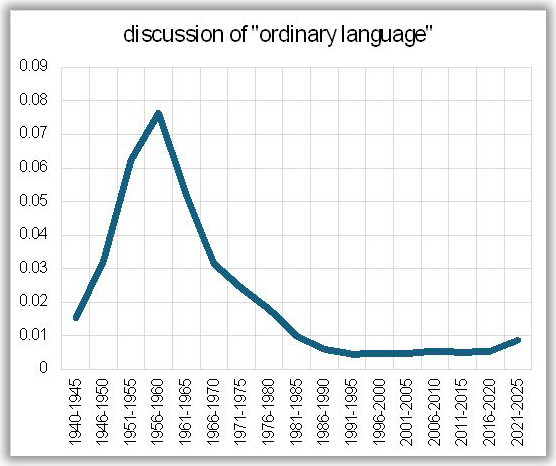
My method: I searched for the term in the abstract, title, or keywords (subject) of articles in Philosopher’s Index, in five-year chunks from 1940-1945 to 2021-2025.[1] I then divided the number of hits by a representative universe of hits for abstract or title containing “language”, “epistemology”, “mind”, “metaphysics”, “ethics”, “moral”, “political”, “aesthetics”, or “logic”.[2]
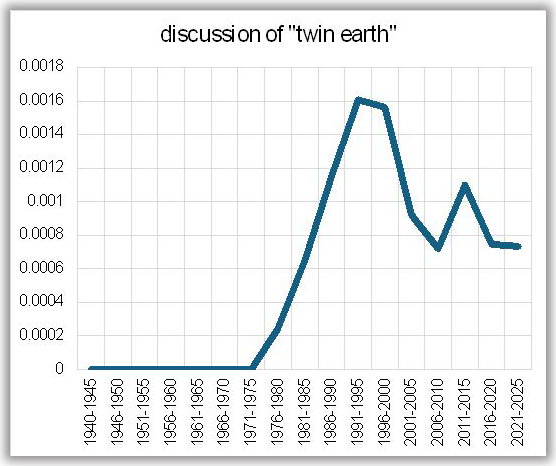
By looking for distinctive terms or phrases connected to particular arguments, we can also track when an argument receives wide uptake. For example, Hilary Putnam’s famous “Twin Earth” thought experiment, though originally presented in 1975, didn’t receive much immediate uptake, receiving peak discussion in the 1990s:
We can also look for topical trends. If you think artificial intelligence is recently hot, you’re right!
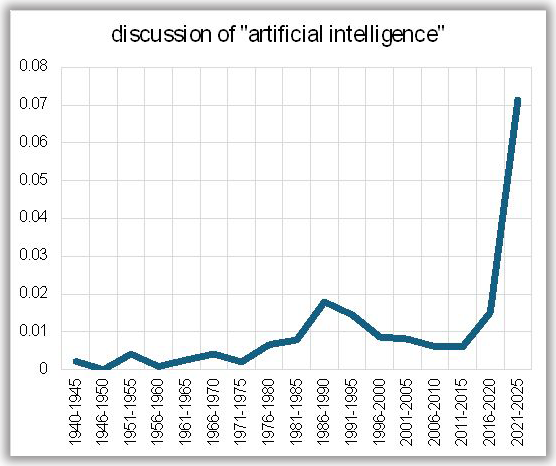
The figure also shows a smaller peak in the late 1980s, before the “AI winter” that has recently thawed.
Another thing you might see in the artificial intelligence arc, if you squint, is noise early in the data. This makes sense, since the early data have far fewer hits in the representative universe of articles containing one of the nine keywords: 457 articles in 1940-1945, compared to 33,552 in 2016-2020.
We can also examine the discussion arcs of particular philosophers. Note that “discussion” in the sense I’ve defined is very different from citation. A philosopher who is cited in passing might have very little influence on the shape of an article. In contrast, if a philosopher’s name is explicitly mentioned in the title, abstract, or keywords, that philosopher’s work is among the chief topics of the article. Discussion rates and citation rates thus capture different phenomena and will sometimes diverge.
Here are the arcs for the seven “most important Western philosophers of all time”, according to a poll by Brian Leiter in 2017:
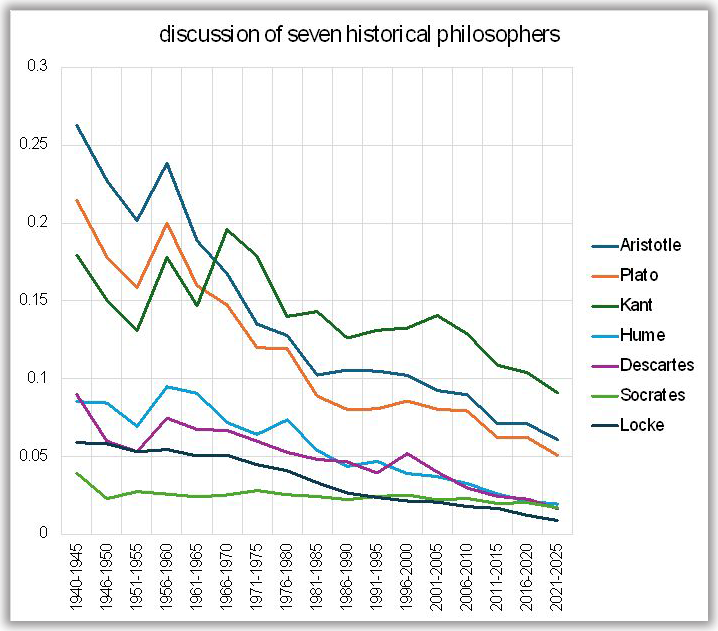
Notice how much discussion there was of Aristotle in the early 1940s! “Aristotle” alone gets more than a quarter as many hits as the broad disjunctive search for “language” or “epistemology” or “mind” or “metaphysics” or “ethics” or “moral” or “political” or “aesthetics” or “logic”. Plato and Kant each also get almost as many as Aristotle.
Since then, there’s been a steady decline in the proportion of articles mentioning these prominent historical figures. My sense is that this is due to two factors: first, the decline in the relative prominence of history of philosophy compared to other areas of philosophy; second, a shift within history of philosophy toward considering a broader range of traditions and figures, including non-Western traditions and women philosophers.
It’s perhaps also interesting that Kant has declined less than the ancient Greeks, overtaking them as the most discussed philosopher.
I thought I’d finish today with discussion arcs of some more recent historical figures, who peak at different times:
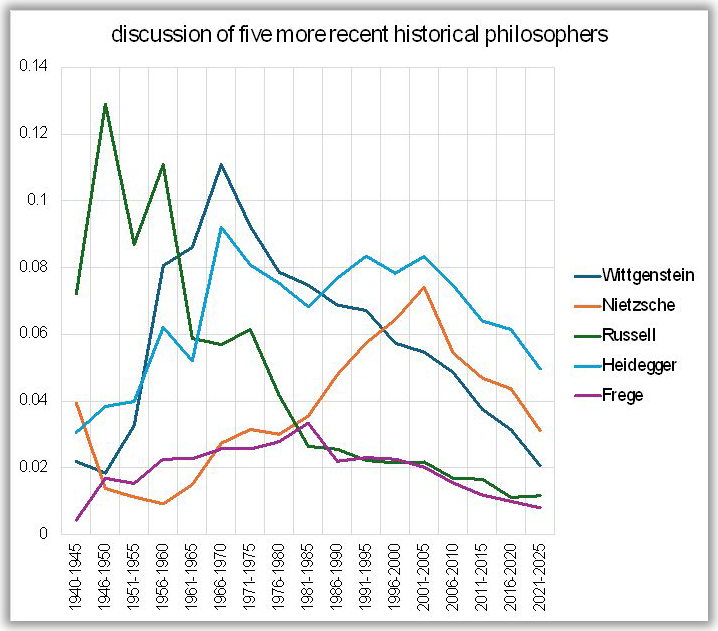
Notice that Russell peaks in the 1940s to 1950s, during which period he is discussed almost as much as Aristotle, Plato, and Kant, who themselves are (as I noted above) discussed in a striking proportion of articles. There is a little false positive noise for Russell (some other people with “Russell” as a first or last name), but my estimate is that about 90% of hits are accurate.
Wittgenstein peaks in the late 1960s, Frege in the early 1980s, and Nietzsche in the early 2000s. Heidegger’s influence is moderately steady from the late 1960s to the early 2000s, declining modestly in the past couple of decades.
Perhaps worth mentioning: These data cover a wide range of journals, regardless of prestige. In an analysis a few years ago, I found that the journals conventionally regarded as prestigious mention prominent “analytic” philosophers such as Frege, Wittgenstein, Quine, Chisholm, and Putnam much more frequently than prominent “Continental” philosophers such as Nietzsche, Heidegger, Sartre, Foucault, and Derrida: The analytic/Continental divide is alive and well. There might be other interesting trends to discover if we subdivide the universe of articles.
In a week or two, I’ll do a follow up post looking at the discussion arcs of prominent philosophers born 1900-1945, partly to test my “age and fame” hypothesis: that philosophers tend to have their peak influence around ages 55-70.
[1] The data begin in 1940, so I used a six-year chunk for the first period. As of Feb 27, data for 2025 are only about two-thirds complete and there are no data for 2026.
[2] This is not all articles, especially in the early period, where abstracts are less available. The idea is to roughly compensate for having fewer abstracts, and thus fewer opportunities for hits in the early data, by comparing the rate of appearance of the target terms with the rate of appearance of several, but not too many, widely used terms across a variety of philosophical topics.

This is absolutely cool and revealing. To my mind, such timelines are more than visual aids. They constitute genuine historical inquiry: https://philpapers.org/archive/CHADOT-7.pdf
I’m surprised by the rapidity of Nietzsche’s decline post 2001-05. I would have thought he was still hot but I guess not.
Can you do the American pragmatists next?
I’m curious about the following (exhaustive?) inclusion criteria: “if a philosopher’s name is explicitly mentioned in the title, abstract, or keywords, that philosopher’s work is among the chief topics of the article”. Perhaps I am an outlier in this regard, but I very rarely include an interlocutor’s name in an abstract, and never do so in a title or in keywords. This includes reply papers, though the name might show up in the abstract sometimes. This is despite the fact that some of my papers heavily engage with one or another specific person.
I imagine this would be different if I were doing any kind of historical work; surely ‘Plato’ would always be in my keywords if I were working on Plato. If I am not an outlier, I wonder if this skews the analysis toward older figures having a larger influence than more recent figures in an incorrect way.
Thanks for this thought! It does seem likely that there are many papers who take X’s work as among the chief topics of an article without naming X in the title, abstract, or keywords. Does this distort the data? Yes, if we misinterpret the raw numbers. And also yes, if there are systematic patterns in which some authors are likelier to be mentioned by name under such conditions than others.
Maybe, as you speculate, historical figures *are* more likely to be mentioned by name in such conditions. This is one reason to approximately match the birthyears of figures for comparison, at least for birthyears fewer than 200 years ago.
I also wonder whether there is a skew for more recent figures which is related to a different Daily Nous article from the past few days. Some views are now labeled as e.g. “Lewisian” or “Davidsonian”, and perhaps when such a view is the subject of a paper, Lewis or Davidson (etc.) is more likely to show up in the abstract/title/keywords. Someone like Dave Chalmers strikes me as roughly as influential as these figures (perhaps somewhat lower than Lewis, and now perhaps somewhat higher than Davidson), but “Chalmersian” is not (to my knowledge) a term that anyone normally uses. My suspicion is that his name therefore shows up less in abstract/title/keywords, but this is just an intuition. Of course I’m just speculating, and not sure how large this effect would be if it is real.
Yes, all that seems plausible to me.