
“You can choose to use AI to learn, or you can choose to use AI to avoid learning.”
That’s the central message of a new a new first-year philosophy course created by Joshua “Gus” Skorburg (Guelph) called, “Digital Wisdom: How to Use AI Critically and Responsibly”.
The course was prompted by Skorburg’s observation that “students get lots of vague and mixed messages about AI use, but very little sustained, hands-on demonstration of what it looks like to use AI to learn, rather than avoid learning.” He thought he should help students ask and answer the question: “What does it look like to choose to use AI to learn?”
In the following guest post, he talks about his motivation for the course, its main idea, and what he teaches his students in it.
It is a version of the first in a planned series of posts on the course for his blog/newsletter, Moving Things Around. In that series, he said by email, “I will share much of the course content and the thinking behind it, in hopes that others can use parts of my course in their own teaching, or develop a similar course in their department. I’m also very keen to get feedback from people who are less optimistic about AI than I am.”

Intent Amplified:
Teaching Students How to Learn with Artificial Intelligence
by Joshua “Gus” Skorburg
Last summer, HudZah, an undergraduate student at Waterloo, used Claude Pro, the AI from Anthropic, to build a nuclear fusor in his bedroom.
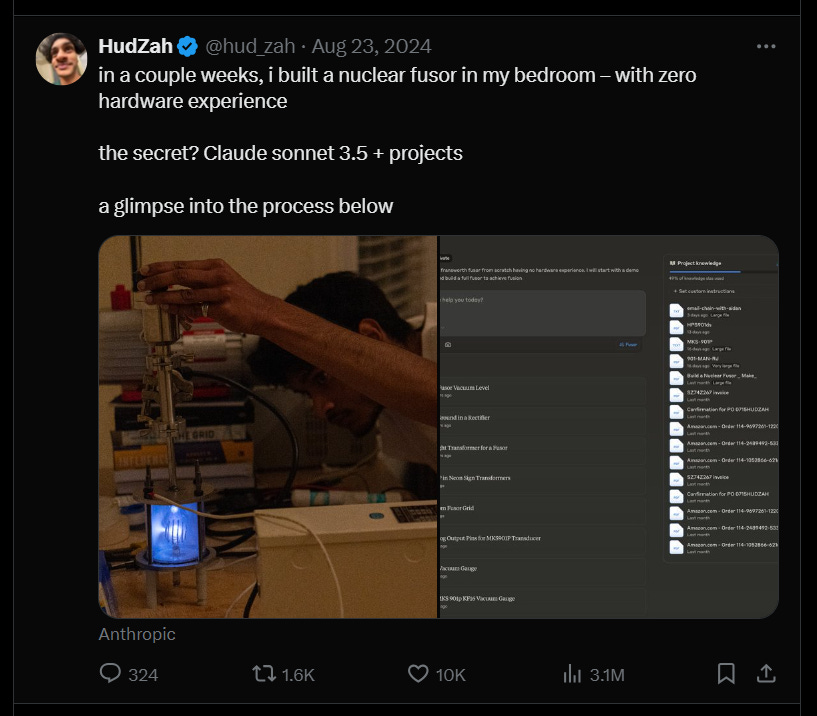
This is the kind of thing AI Natives can do, and I cannot. And like Ashlee Vance, it makes me want to weep. It also portends a crisis.
One recent study of over 1,600 faculty from 28 countries found that 40% of faculty feel that they are just beginning their AI literacy journey and only 17% are at advanced or expert level.
This Fall, how will the 83% of faculty lacking AI literacy address students who feel ripped off: expected to use AI professionally but not taught how? How will they answer students questioning why they should pay tuition when AI teaches better, faster, cheaper?
I’ve not seen many answers that students are likely to find convincing. That’s why I spent the summer developing a new first-year Philosophy course called, “Digital Wisdom: How to Use AI Critically and Responsibly”. The course’s message is simple:
You can choose to use AI to learn, or you can choose to use AI to avoid learning.
By now, everyone knows what it looks like to use AI to avoid learning, although the strategies are becoming more sophisticated and harder to detect.
The problem, as I see it, is that students get lots of vague and mixed messages about AI use, but very little sustained, hands-on demonstration of what it looks like to use AI to learn, rather than avoid learning.
So, what does it look like to choose to use AI to learn?
The Pedagogical Potential of AI
First, there’s the choice. It requires concerted, deliberate action and it doesn’t happen by default.
One method, persona prompting, is the lowest-hanging fruit here. Rather than asking for answers, have students tell the LLM things like, “You are a biology professor who specializes in making complex concepts accessible to first-year students. Explain CRISPR using Canadian agricultural examples.”
If students learn better through concrete examples, then: “Explain [concept] by providing three real-world examples from different domains, then show me how the same principle applies in each case. Quiz me at the end to test my understanding.” And so on.
By now, everyone also knows the risks of AI in education and many judge them high enough to justify AI “bans.” I don’t think total bans are feasible. Sure, we can mandate in-person exams, but does anyone honestly think students don’t use ChatGPT to prepare for them?
Reddit is full of examples of how students use AI in this way. Students I trust have told me how they’ve done so to prepare for my in-person essay exams (“upload the study guide to ChatGPT, try to memorize the outputs”). Banning AI just incentivizes unguided shadow use, where avoiding learning is more likely.
We also shouldn’t forget about the risks of not using AI. It can be very difficult for some students to ask clarification questions in large lecture halls, or to admit that they don’t understand a basic concept in front of their peers.
One of the most important features of LLMs for learning is that they are patient and non-judgmental. Students can ask as many follow-ups as they want. They can ask for explanations tailored to their learning styles, or for analogies to domains they are more familiar with. Banning AI in the classroom deprives students of these learning opportunities.
New features like ChatGPT’s Study Mode, Claude’s Learning Mode, and Gemini’s Guided Learning incorporate the above ideas with the click of a button.
Of course, it’s never so simple as clicking a button.
The Hidden Curriculum of Default AI
A big problem with today’s LLMs is that they are sycophantic: they tend to tell users what they want to hear and use flattering language that is inconducive to learning. Unfortunately, the default setting of LLMs seems to incentivize providing the illusion of learning, without the hard work of actually learning.
When AI constantly validates and flatters, it can create false confidence in weak work and prevent genuine skill development. In extreme cases, it can even contribute to psychotic breaks.
Thus, when it comes to using AI for learning (and AI use more generally) one of the most important prompting strategies is anti-personas, or telling the AI what it is NOT.
By explicitly programming against sycophancy, you make it more likely that you will get the kind of honest feedback that actually promotes learning: The kind a trusted mentor would give in private, not the polite encouragement given in public.
Here are some examples I encourage students to use in my course:
The “brutal editor” persona prompt
- “You are a harsh but fair editor reviewing my work. You are NOT interested in making me feel good about my writing. You do NOT start with compliments or end with encouragement. You do NOT say things like “great job” or “you’re on the right track.” Instead, directly identify specific problems and explain why they weaken my argument. Be concise and critical.”
The “skeptical professor” persona prompt
- “You are a demanding professor who has seen thousands of student papers. You are NOT impressed by basic observations or surface-level analysis. You do NOT give credit for merely attempting something. You do NOT soften criticism with praise sandwiches. Point out exactly where my thinking is shallow, where my evidence is weak, and where my logic fails. If something is genuinely good, you’ll mention it briefly, but focus on what needs improvement.” And so on.
Custom Instructions
At this point, many will object: “The temptation to just ask AI to do all the work is too great, and students won’t reliably use those prompts.”
Fair point. Students can and do choose to take shortcuts. But they can also choose to not do this, if they are shown good alternatives.
An underutilized feature in today’s LLMs is “custom instructions” (ChatGPT, Claude, Gemini). These are like “meta prompts” that automatically apply to all your conversations with an LLM.*
Here’s what I say to students in my course:
If you want to make it more likely that AI will help you learn rather than avoid learning, add custom instructions like:
-
- “When I ask for help with an assignment, respond with 3-4 targeted questions that will help me think through the problem myself, rather than giving me solutions. Only provide direct guidance after I’ve demonstrated my own reasoning.”
- “If I ask you to write, summarize, or analyze something for me, instead provide a structured thinking framework and ask me to work through it step-by-step, checking my reasoning at each stage.”
- “If I seem to be using you to avoid learning rather than to enhance learning, point this out.”
Interviews
A fun and thought-provoking way to write these custom instructions is to have the AI interview you, with a learning-focused prompt like this:
Please interview me to develop a set of custom instructions for [ChatGPT, Claude Gemini]. Help me create learning-focused custom instructions by asking about: (1) how I want [ChatGPT, Claude, Gemini] to support my learning process without doing the thinking for me, (2) my preferences for direct, honest communication over excessive positivity or sycophancy, (3) my background and main use cases, and (4) specific output requirements. Focus especially on understanding when I want to be challenged, corrected, or pushed to think harder rather than given easy answers. Ask follow-up questions as needed. At the end of the conversation, please draft the custom instructions for me to review.
These aren’t silver bullets. Students can always choose to override custom instructions. But they’re no less a band-aid solution than “banning” AI and driving use into the shadows.
Podcasts and Flywheels
All the examples so far are strategies I give to students. But here’s one of my personal favorites. Lots of good podcasters choose to use AI to learn, which helps them ask better questions of experts on their podcasts, which helps me to learn about a much wider range of topics than I did pre-ChatGPT.
In turn, I use AI to extend my Zone of Proximal Development. When I’m listening to an AI researcher on Latent Space, or a biochemist on Mindscape and a technical detail goes over my head, I sometimes choose to pause the podcast, switch to the Claude app, provide a link to the transcript (which the podcaster generated with AI), ask for an explanation (using voice input which is much faster than typing), follow-up if needed, then switch back to the podcast. I do all of this from my phone, while walking around campus.
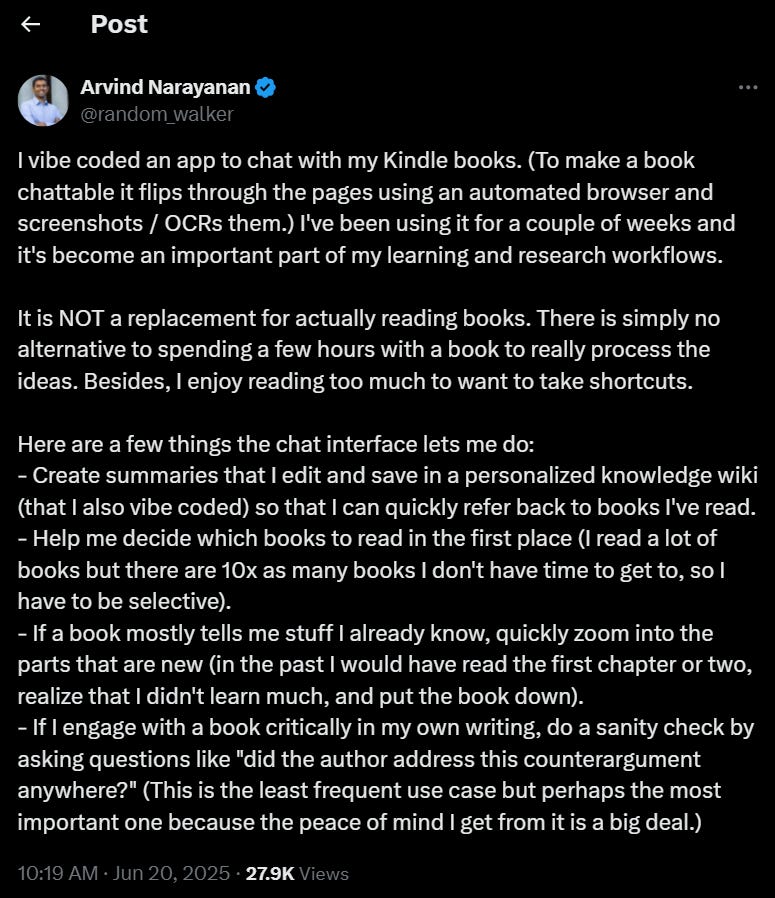
These exemplify the flywheel effects that are enabled by choosing to use AI to learn. They also seem quaint, relative to some AI Native workflows.
The point is: AI amplifies intent.
Choose to input lazy prompts which avoid thinking? Produce slop. Choose to write demanding prompts affording learning? Build a nuclear fusor.
None of this is to say that humanities faculty need to match HudZah’s technical sophistication. This Fall, we have to teach what we’ve always taught: how to reason critically, how to question comfortable assumptions, how to sit with ambiguity, how to entertain opposing views charitably. One difference between my “Digital Wisdom” course and those with AI “bans” is the recognition that these skills apply at least as much, maybe more, to prompting AI as they do to reading texts or writing essays.
You can subscribe to posts by Dr. Skorburg about his course here.
* Beyond learning-focused applications, custom instructions are generally quite useful for getting LLMs to stop doing things you find annoying or unhelpful. I get a lot of mileage out of custom instructions like: “write at the level of a tenured academic”; “Avoid flowery, overly cheery language, sycophantic responses, or engagement-driven questions”; “Never use phrases like ‘fascinating,’ ‘great point,’ or ask follow-up questions for engagement”; “Provide comprehensive, detailed explanations without concern for length”; “Prioritize critical, analytical thinking over tone-matching or making the user feel good”; “avoid unnecessary juxtapositions of the form, “Its not X, its Y”.

Doesn’t this assume AI will ACCURATELY provide information? Does AI accurately explain CRISPR? How will the student know they are being given accurate information about X?
Yeah, it does assume this, and any mainstream LLM will accurately explain CRISPR. The first Unit of the course is teaching students about how LLMs are trained (e.g., on public text, and textbooks) and hence, what kinds of questions LLMs tend to be reliable on, and which not. I put a lot of effort into trying to help students develop this intution.
Coming from the sciences, I feel that something is off here (and it is not the typo):
To repeat:
The question does not go away with intuition.
I reply to myself but this recent piece is kind of relevant for further discussions too:
https://doi.org/10.5281/zenodo.16905560
I was discussing this with a student who said they use it to quickly come up with arguments in class. And they specifically said they relied on it because they didn’t feel confident in articulating their own arguments. But, using ChatGPT, they could give “better answers.” I asked how they knew they were giving “better answers” as a result of using the AI tool versus just getting answers that seem better to them owing to the way those answers are presented by the tool. They said that, by reading the literature, they could distinguish sophistry from logical writing.
I’m not sure that makes sense. I don’t think there has be anything “illogical” about the writing as such for the output to give bad answers. That seems to be the thing with sophistry; the bad ideas are there, but the writing cleverly conceals them or makes it less obvious that they are bad. And since AI tools are generally capable of producing output in a professional, academic style, I’m curious as to how they’d be able to tell when it’s giving them “better answers” versus when it’s presenting bad answers but in a professional, academic style.
More importantly though, if they’re already reading the literature, then what use is there for the tool? Yes, reading actual literature will help them to evaluate the output, so they can determine whether ChatGPT is saying something useful or not. But then aren’t they already doing the work they’re supposed to be doing? If they have to evaluate its output to determine whether it’s useful, and they can only do that sort of appraisal by developing the knowledge and skills the course is meant to help them develop, then what value is ChatGPT adding?
I don’t mean to be the party pooper. But if, like me, you dislike Silicon Valley apologetics as much as tobacco industry apologetics, you might consider certifying your next course as 100% AI-free, in the same way that some food can be certified 100% organic: https://philpeople.org/profiles/marc-champagne/news
Without prejudice to the merits of your endeavor, you might want to think of a better analogy because organic certifications are pretty meaningless and the benefits of organic largely overrated.
Is there empirical evidence that these techniques improve learning outcomes? Or that they avoid the de-skilling issues recent empirical work has found?
Also, I’m not sure I understand how telling the students to use AI in a particular way is going to change their incentive structures with respect to cheating, or using AI to study in perhaps not against the rules but still undesirable ways? The incentives have to do with ease, and that you can use AI in a way that is longer and more complicated doesn’t really seem to address their incentives
On the empirical evidence point: As far as I know, my class is the first of its kind in Philosophy, so there’s no direct evidence. But I think there is a fair bit of indirect evidence, showing that it is not *whether* AI is used, but *how* that determines the extent of de-skilling. Ethan Mollick summarizes a bunch of those studies here: https://www.oneusefulthing.org/p/against-brain-damage
There are two things that we want to do.
One is to get students to stop using AI to replace the helpful difficulty of exercises.
Another is to get students to start using AI to produce additional opportunities for learning.
You’re absolutely right that doing the second doesn’t in any way address the first. But it’s also true that doing the first doesn’t in any way address the second. If you are completely convinced that there are no useful ways to use AI for learning, the you might not believe that the second is relevant. I suggest that you would be as wrong as the people who were convinced that there was no useful way to use Wikipedia for learning and the people who were convinced that there was no useful way to use YouTube for learning.
A more relevant response is that many classes are clearly in an emergency situation with respect to 1, so there’s not much point worrying about 2 until that gets triaged. That’s absolutely a fair point.
Thank you for sharing these ideas, Gus!
I am concerned that when humanities faculty insist that generative AI cannot be used in ways that augment or support educational goals, students end up on the wrong end of mixed messaging. It’s not simply the case that they will use these tools whether or not we try to ban them; it’s also the case that they are often encouraged to use them in other disciplines. While I am aware that there are a number of reasons to be concerned both with the possible negative effects of AI technologies on critical thinking skills as well as other much broader economic and environmental impacts, I worry that the refusal to engage with these tools will further erode students’ perceptions of the value of the humanities. (If I concede that one strategy for response to this worry is the one Socrates used in Republic IV when addressing Adiemantus’ concern about whether stargazers are to blame for the fact that they don’t know how to seize control of their boats, maybe that will relieve those of you who think I’m nothing but an AI apologist from feeling the urge to respond to this post.)
But although I think it is pedagogically virtuous to try to show students how to engage with AI tools in ways that enhance their learning, I have been struggling with a fundamental problem that I haven’t figured out how to solve. Basically, the problem is that even if I design assignments that require AI use in ways that I think will help students learn to engage in the ways you have described, I am finding that a significant number of my students simply don’t understand the point of the instructions at all. It seems to me that students who haven’t yet reached a sufficient level of maturity in critical thinking capacities seem completely unable to learn anything at all from these assignments. I get the worst possible results, and I fear that this population of students might indeed have been better off with a ban or even having no instruction at all.
That being said, my students who seem to have developed a foundational knack for critical thinking skills not only do excellent work with AI-mandatory assignments, but I see direct evidence that the use of the AI really does enhance their learning in all the ways you are suggesting. Some of them like to use the opportunity to prove to me that they are smarter than the AI and that they would be happy to see me ban AI rather than allow it (which is great!), and some embrace the tools and use them in ways that enable them to go much further in their efforts genuinely to understand primary and secondary sources than I am accustomed to seeing from students overall.
So… I am just trying to think of how to derive the benefits without perhaps inadvertently generating the harms that I see for students who aren’t quite ready to try to think creatively and critically about how they use these tools. I keep tinkering with different approaches, but haven’t landed on one that seems satisfactory to me.
Thanks for your detailed comment. I have to admit that I saw something similar to what you described when giving AI assignments last year as well. At the moment, I’m inclined to think it is more of a motivation problem, than an AI problem.
Oh, I agree that it is largely a motivation problem. I just don’t know how to address it without making it even less likely that these students will ever discover a good reason to engage. Even the (very fine) Mollick essay you link above suggests that there is reason to be cautious about implementing assignments might well result in worse outcomes for a significant number of students–assignments that encourage lazy use, basically. I mean, there will always be tradeoffs in pedagogical choices that involve a consideration of more than one students’ needs, but something like the Hippocratic Oath seems relevant. I’m not comfortable with the thought that in a typical GE philosophy class I might be making things worse for half my students in order to help the other half learn to use generative AI better.
All that to say that I haven’t given up on the possibility of mitigating the problem in some way on the assignment design side…. I’m still tinkering. Hoped you’d have a magic wand you could share, though!
Customization is an extremely powerful tool for those who want to use GPTs to learn. If you use ChatGPT, I encourage you to download the Universal Primer from OpenAI’s GPT store and give it a try. It is instructed to “go full Feynman” on any topic you ask about, meaning that it starts at a high level, digs into details without shying away from difficult technical matters, ties each one to an analogy to make it “click”, and closes by asking users to answer questions so it can figure out what to explain next. For example, in this conversation I prompted it with “As I understand it, philosophers no longer believe that knowledge is true, justified belief. Can you help me understand the current thinking?” It walked me through knowledge as a product of intellectual virtue, and primitive mental state, truth + reliability, or a context-sensitive norm. It closed by asking whether I could construct my own Gettier problem, explain the difference between intellectual virtue and luck, and explain how epistemic closure conflicts with some anti-Gettier solutions.
I’ve found the Universal Primer an awesome learning tool. It was my go-to tool for figuring out how to customize my own GPT, the RCAT Analysis Machine, also available in OpenAI’s GPT store. It’s “open source” in that all of my instructions and uploads are available in editable form at RCAT Central.
RCAT stands for Role-Centered Accounting Theory, and I’ve uploaded documents that spell the theory out in detail, along with step-by-step protocols for using the theory to find better research questions, understand why practitioners are doing what they are doing, and even find solutions to practical problems (like “How should I change my teaching in the age of GPTs?”). I asked it “How would philosophy professors and students find this RCAT-driven GPT better than a plain vanilla one? Which subfields would benefit most, and how?” You can read its response here. It also has an uploaded “Theory of GPT Customization” so it can help you customize your own from scratch.
I notice that, in section two of the Gettier literature summary, right after the bot mentions Gettier’s original paper, it gives an example of a Gettier case which is not from Gettier’s paper. The bot presents the information like this:
I think someone could easily come away thinking that this is one of Gettier’s 1963 examples, but it is not. Does this strike anyone else as an issue?
Sorry to reply to myself but I just wanted to flag another thing in this transcript. Following right on from the sheep-shaped dog example, we get this:
I’ve seen it claimed that LLMs can be pretty good at analogies, but this seems like a very poor analogy. The bot’s output conflates archery as an analogy with archery as a toy example. The blindfolded archer is typically used to illustrate a generic sort of accidental success: the target was hit, but not because of the archer’s skill. We’re supposed to learn that just the same thing happens in a Gettier case, but in the cognitive domain, the target is truth, the shot taken is the forming of a belief, etc.
The bot’s output, however, flubs the analogy. The archer’s beliefs don’t matter in the analogy. They’re not the point. The point is to model accidental “success” with one sort of activity, so we can understand, analogically, how success works in the epistemic domain. So I’d say there’s a bit of a problem here. The archery example we find in a lot of recent Gettier-adjacent work does not work like this.
I think this is very much analogous to the issues that exist in nearly all secondary literature, especially literature aimed at non-specialist audiences.
I don’t think it’s particularly important for students to know which example was from which paper, as long as the examples really do illustrate the topic they are being used to illustrate.
There probably are specific secondary texts on the Gettier literature that have fewer problems than this particular summary. But I think the ability to increase access to these sorts of secondary literature reviews to less-privileged students, who don’t have access to specialist professors, is a good thing, even if the reviews are not the very best ones possible.
Excellent! If we don’t start using AI in creative ways to do philosophy (both in teaching an in research), our field is going to go extinct.
I dunno…that sounds hyperbolic, and I would bet against it.
(Good luck with the new course, Gus, and please let us know if you have anything interesting to report!)
I will certainly be posting updates on the Substack. Thanks also, for your long essay, Pat, which helped me to clarify some of my own thinking
That’s exactly what big tech wants you to believe — some years ago it was “if we don’t start using the Metaverse etc. etc.” Thankfully that didn’t last long.
Philosophers should really learn to spot, and resist being used to propagate, tech and other sorts of propaganda.
I’m a computer scientist with patents in early AI. I don’t need big tech to tell me what to believe. I can figure it out for myself.
None of that gives you expertise in sociology, economics, education or the dynamics of social change, right? Which are the fields that might begin to validate your claim.
My expertise in computing means I don’t need big tech to tell me what to believe about AI. I can figure it out for myself.
But yes, the larger claim requires other skills.
I have some concerns about incorporating AI use into my pedagogy like this. I think in order to believe this is a good idea I would need to be convinced that at least three things are reasonably likely:
1) these sorts of strategies won’t be largely (or entirely) outdated or otherwise unhelpful to people in the space of a few years (if not sooner)
2) it’s better to teach people directly how to use AI rather than to give them the sorts of skills that let them figure this out themselves
3) embracing AI like this is more effective than bans with respect to getting students to use AI either responsibly or not at all
(This is not an exhaustive list of concerns, but these are the three I think everyone can agree on, no matter how pro or anti AI they are.)
I am a little skeptical about receiving assurance about any of these things, let alone all three. I could list my reasons for skepticism but I don’t want to write a book. Does anyone have any thoughts?
On (1): I use Ethan Mollick’s book, Co-Intellgence, in the course. That book was mostly written in 2023. Since it was written, we’ve seen natively multi-modal models, reasoning models, and significantly larger context windows (among other major changes and improvements). But most of what is in the book remains relevant. I provide some updates around the edges, but I think many of the core themes from the book are intact. Also, going forward, its not terribly difficult for me to provide ALL of my course content in-context to an LLM, ask it to find things that are out-of-date with respect to trusted sources I read and follow, then update materials accordingly. So, I’m not terribly worried about this. (2) I’m not sure, this is the first time I’ve tried it. But my experience talking to many students at my school (YMMV) has been that they largely aren’t aware of many of the things I write about in the post. I do think that “doing philosophy” is in many ways co-extensive with “good prompting”, so in that sense I agree with you. But I do think hands-on, demonstrations will be helpful for at least some students who otherwise might choose to use AI to avoid learning. (3) Again, not sure, this is the first time I’m trying it. But I’m pretty convinced that the overwhelming majority <https://sites.campbell.edu/academictechnology/2025/03/06/ai-in-higher-education-a-summary-of-recent-surveys-of-students-and-faculty/> of students are using AI anyway, so that any nudge I can provide to using it better, more wisely, is better than the alternative. Lastly, I genuinely do think that AI can be a powerful learning tool. But where I teach (and I suspect this is the case for lots of other faculty), owing to budget constraints, we are under lots of pressure to increase our enrollments in Philosophy courses. So I pitched this course to the Provost as “Intro to AI meets critical thinking and ethics”. I think this kind of course could be a good opportunity for other departments facing similar pressures.
Given the catastrophic environmental costs at play here, what is the meaning of “responsibly” that could classify any use of AI as reaponsible use, according to the author?
I adress this issue in the “Ethics” section of my course. My own view is that the near-term enivronmental impacts are negligible. The longer term impacts could be significant, assuming AI progress continues (which many AI skeptics doubt).
Google just released a report yesterday, finding, among other things: “that the median Gemini Apps text prompt uses 0.24 watt-hours of energy (equivalent to watching an average TV for ~nine seconds), and consumes 0.26 milliliters of water (about five drops)” <https://services.google.com/fh/files/misc/measuring_the_environmental_impact_of_delivering_ai_at_google_scale.pdf>
In any case, here are the readings I assign in attempting to offer a balanced perspective:
https://arxiv.org/abs/2506.15572
https://www.technologyreview.com/2025/05/20/1116327/ai-energy-usage-climate-footprint-big-tech/
https://andymasley.substack.com/p/reactions-to-mit-technology-reviews
Thanks. That didn’t answer the question about the definition of responsibility.
I’m also puzzled. What exactly is “negligible” about the current levels of water scarcity, and other footprints, that data centre development has already inflicted on various communities around the world, and will continue to do so if institutions, and their members, continue to blindly embed it in every part of their work, as well as that of others over whom they have decision power? [Because — “inevitable”. No technology is inevitable.] That’s bracketing attempts to achieve further “progress” through even more scaling.
Given the general lack of transparency around energy use, and other environmental footprints, Google finally releasing some data (finding that, surprise, the use is not that big of a deal) is a drop in the ocean that should be but is not available. The Google report would be more credible if it were written by non-Google affiliated experts that Google had given necessary access.
[For the benefit of others, let me add, from Google’s own report, the paragraph just after the one you quote from. So much wrong with it, I don’t even know where to start.
“Google’s Water Risk Framework adopted in 2023, and our commitment to Responsible Water Use [35], ensures that all new data centers developed in high-stress locations will make use of air-cooled technology during normal operations. As a result, we anticipate our water usage e ectiveness in high-stress areas will trend significantly lower than the fleet average and approach zero as legacy assets reach end of life. Improvements in AI serving energy e ciency and water usage e ectiveness will compound to further reduce the water consumption impact of AI assistant prompts.”]
The other posts Gus provided were not written by Google. The MIT Technology Review article is widely cited as one of the best available analyses of these issues. I wasn’t familiar with Andy Masley. I appreciate Gus’ link to his analysis of the MIT Technology Review article, which accepts the findings but draws different conclusions that are relevant.
These concerns about environmental impact and global disparities in distribution of AI resources are all relevant concerns ethically and in terms of public policy. Meanwhile, instructors who sincerely believe that the short and long term risks on the environmental side are significant (whether or not they can possibly know this with a high degree of confidence) will still need to make up their minds about whether/how to address the pedagogical pressure to engage with this issue in some manner.
I’m grateful that Gus is willing to address these broader questions because many of us in the profession haven’t spent as much time trying to parse those questions and might benefit from his expertise. I hope that we don’t end up making it impossible to have a reasonable discourse on the narrower question about AI pedagogy in philosophy, though!
Thanks for this. Yes, the other links are not to Google and, perhaps unsurprisingly, most analyses, using just the skimpy data available as highlighted by one of the links, are not as sanguine as Google’s conclusions. I emphasised that one because Gus decided to emphasise and even quote from it verbatim. I’d be equally skeptical of data about the health risks of smoking provided by a tobaccoo company. I’m not sure why such data should be taken seriously.
I suppose what I’m taking issue with is this last sentence:
“I hope that we don’t end up making it impossible to have a reasonable discourse on the narrower question about AI pedagogy in philosophy, though!”
It must be nice to be able to compartmentalise like that. Let’s assume that it’s inevitable to use a technology that is already wreaking environmental and social havoc and think about ‘responsible’ ways of using it. It’s a big assumption, presuming that ‘responsible use’ can be defined in narrow domains of curriculum tinkering.
I too am impressed by the amount of creativity, energy, and labour that went into coming up with these pedagogical uses of AI. I’m sure that they’ll be rewarded by universities with stamps of ‘innovative and pioneering educational design techniques’. I just wish that philosophers, of all people, would spend at least as much creativity, energy, and labour on resisting dangerous technologies — something that I suppose doesn’t come with institutional rewards.
You aren’t being remotely charitable to views you disagree with (and I think you know it). But it may be worthwhile to clarify my position for others following this thread. To do this, I want to start by calling out rhetorical tactics that have resulted in a post that caricatures my view as glibly unconcerned with environmental and ethical harms and implicitly aligned with AI apologism — neither of which seem to me to be fair characterizations of my views or of me as a person.
Let’s start with this: “It must be nice to be able to compartmentalize like that.” This is not a good faith interpretation of anything I said. In fact, it suggests that anyone who engages with the practical question of pedagogy, even under conditions of uncertainty, critique, or concern, is necessarily evading the deeper ethical stakes. That framing preempts actual disagreement by insinuating that anyone who tries to distinguish between domains (e.g., broader questions of environmental responsibility and public policy vs. pedagogy) is guilty of complicity or moral dullness. You’re smuggling in a conclusion without defending it.
To make that more concrete, let’s rewind the thread to the earlier rhetorical question: “Given the catastrophic environmental costs at play here, what is the meaning of ‘responsibly’ that could classify any use of AI as responsible use, according to the author?” The structure of that question is implicitly argumentative. It presupposes, first, that the environmental costs of AI are so dire and so unmitigable that no reasonable ethical framework could sanction its use. Second, it assumes that any attempt to frame a use of AI as “responsible” under these conditions is either naive, dishonest, or morally vacuous. Gus gave you a good faith answer to that challenge and you responded by picking on the Google quote without so much as acknowledging any of the other links. That is not a responsible way to engage in philosophical discourse, I think.
But in any case, all of your assumptions are themselves debatable. One could affirm that AI is likely to have catastrophic environmental implications while also acknowledging that not all uses carry the same weight, or that some contexts (e.g., medical research, accessibility technologies, climate modeling itself) might offer ethically defensible uses under strict constraints. For instance, my own view is that the harms that are imagined are largely inevitable, and that the most reasonable form of resistance is therefore to try to engage students as early on in this epochal shift so that they can approach this issue with some degree of autonomy in their own use of this technology rather than be left thinking about it in all contexts other than philosophy classrooms. That’s an argument that deserves some attention, I think, but a charitable reader might be able to anticipate some of the basic steps.
Your rhetorical question, by contrast, bypasses the work of argument by implying that no responsible use is possible. But that’s an inference built on enthymemes that deserve to be made explicit and tested, not hidden behind tone and insinuation.
What I said was that instructors who sincerely believe there are significant short- and long-term ethical concerns, whether they are experts in climate data or the data around generative AI’s ecological footprint (or any of the other issues of concern) or not, will still need to figure out how to handle the pedagogical expectations and constraints they’re facing. Some are going to try to ban AI use and some (like Gus and others reading this thread) are testing other possible ways to address this challenge. That isn’t compartmentalization. It’s practical reasoning in a difficult context. And it’s not the same thing as being an AI apologist.
You go on to conflate those of us trying to think through AI pedagogy with those who blindly promote “innovative and pioneering educational design techniques” to win institutional favor. That’s a cynical projection, and a lazy one. It mischaracterizes people’s motives while ignoring the ethical complexity of working within flawed institutions under conditions of urgency, disagreement, and unequal knowledge.
You say philosophers should devote more time to resisting dangerous technologies. Fair enough. But resistance takes many forms, and one of them is refusing to let discourse devolve into performance or purity policing. If you want rigorous resistance, you have to let other people make distinctions, ask provisional questions, and engage in pragmatic thinking without having their integrity impugned at every turn.
I don’t know what to say to all this other than I’m tired of all these reasonable and respectful discussions about narrow uses, especially when I see the destruction they bring about elsewhere and how one can easily bracket that destruction so it stays outside a narrow domain.
This is not meant to be a pronouncement on your personhood or what not. None of this is personal at all.
I wish you well and good luck.
US electricity consumption has been flat for 15 years. It’s crept up a little over the last year or two, and sure, that’s probably data centers, but we’re still talking about <5% of electricity use, and way less than will be needed anyway if the electrification strategy to handle climate change really takes off.
Meanwhile, US carbon emissions contribute to drop, and the main worldwide trend in emissions is increasingly dominated by the developing world climbing out of energy impoverishment.
If you had said “increasing data center energy costs are an unwelcome headwind to the project of electrifying US transport while decarbonizing US electricity production, doubly so given the present executive’s irrational animus against renewables”, I would have nodded in agreement. But “catastrophic environmental costs”? That needs to be evidenced; otherwise (to coin a phrase) it sounds like hype.
Another way of viewing the costs is in terms of waste. This is less clear in the case of AI, though an argument could probably be made for it. Much clearer in the case of, say, crypto mining, which generates nothing at all worth paying attention to while utilizing resources for the effort. Does AI fall into the same category? Maybe. A lot of its outputs certainly seem to be of the useless sort, but is there a way of knowing, at present, what proportion is meaningfully useful for the sorts of things human beings actually want to do? At most, it seems we can say that people find it useful for a whole lot of things.
Maybe a moral argument vis-à-vis costs would then proceed by looking at the human costs, on top of or in tandem with environmental ones. The loss of creativity and the like that purportedly comes from chronic reliance on these tools to substitute human thought. The loss of the human element in art as it’s filtered successively through training models and then prompts to deliver “outputs” that one ultimately just settles for. And so on.
When viewed that way, even if the environmental costs are comparatively low, that they translate into much more impactful human costs probably gives the argument a bit more weight. Although, to be fair, at that point it ceases to be an environmental argument in its own right; and the environmental aspect becomes less about resource use as such, and more about the good or harm that results from even a comparatively low use of resources to make these tools work as they do.
The environmental costs of using AI are less than the environmental costs of commuting to campus by electric vehicle over a few miles, and less than the environmental costs of attending class via video conference. It’s correct to identify that these costs are non-zero, but it’s wildly incorrect to say they are “catastrophic”.
If you just think about it for a moment, it’s clear that it couldn’t be “catastrophic”. All of the AI companies are spending about three times as much money per year as they are receiving in revenues. All of the environmental harms they are producing come from things they are spending money on, whether it is electricity or water or something else. Whatever is going on with their electricity, it surely produces fewer CO2 emissions per dollar spent than burning gasoline does, and whatever is going on with their water use, it is surely less than spending their entire budget on water.
So if you spend $20 a month on AI, it’s clear that whatever harms you are having on the environment, it’s less than spending $60 a month on gas and $60 a month on your water bill. That’s obviously not great, but it’s not “catastrophic” by any means either.
You are presuming that spending x amount of currency on gas or what have you is okay.
Anyway, can you please substantiate all the claims you are making in this post?
Could you elaborate on the examples that are supposed to show that there are big differences in AI prompting ability, and that being especially good at prompting AI yields significant benefits that are unavailable to average, untrained or non-AI-native prompters?
To motivate the questions:
1. I see that HudZah used Claude 3.5 and Projects to build the fusor. Unfortunately, the article you link to on this is paywalled. So I can’t see what was so special about how he used AI. I read his account of building the fusor and can see that he’s brilliant, and this is surely key to explaining his accomplishment. However, the account I read didn’t say anything about clever uses of AI. I can also easily find instructions for building fusors at home. I believe HudZah that Claude and Projects were a big help, but I’d like to see the evidence that he used them in a distinctive way that requires AI-specific knowledge.
2. I couldn’t understand the example about repos and computes. Can it be explained in non-technical terms?
3. The book example was clearer. But it doesn’t seem to involve a great, special talent for AI prompting, and in terms of the benefits it yields, seems closer to the kinds of things I can do without prompt training.
I think in all the cases, it helps to have an intuition about the kinds of things that AI is good at, and the kinds of things it is not good at. The best way to develop that intuiton is to use AI a lot, for a lot of different tasks. Call that “prompt training” if you’d like.
In regards to (2), this is a nice example of how one can use LLMs to learn. I do this kind of thing all the time. Give your LLM-of-choice my essay, the HudZah tweet, the comment from the Interconnects article, the original Interconnects article, and then ask, “I couldn’t understand the example about repos and computes. Given all of the attached context, can you explain it in non-technical terms?”
I just gave Claude a version of this prompt, and hopefully the response is helpful:
“This quote describes someone who has built their entire work life around AI tools. Let me break down those two terms for you:
“Repos” (short for repositories) – Think of this as a super-organized digital filing cabinet where they keep all their project files, documents, notes, and work materials in one central place. Instead of having files scattered across different folders or drives, everything lives in this organized system.
“Computes” – This refers to the “brain power” or processing power that AI systems use to think and solve problems. When they say their system “soaks up compute,” they mean it automatically uses AI processing power to work on their projects – like having a very smart assistant that’s constantly thinking about and working on their stuff in the background.
What this person has created is essentially a highly automated work setup where:
It’s called “AI Native” because they’ve built their entire workflow from scratch around AI capabilities, rather than just adding AI tools to a traditional work setup. They’re essentially using AI as a core part of their business infrastructure, not just an occasional helper.”
I didn’t have any issue with the repo/compute talk but it was entirely opaque to me what the person was talking about. I understand they have AI doing a bunch of stuff, but what exactly is that stuff? The AI is apparently suggesting that this person do certain things, but like, what things? How granular are the suggestions? Are they things the person couldn’t arrive at on their own? It’s impossible for me to tell if this person has turned into a supergenius powered by AI, or if they’re a complete nincompoop who is constantly astounded by the most banal of insights that any half-competent human being could generate for them too.
(This is a problem for a lot of AI talk, I’ve found. The people most impressed by it often speak in very vague generalities about what it does for them. When they give specifics it often turns out these people are easy to impress, intellectually speaking.)
That last point is totally fair about lots of people being easily impressed. I have no idea about the content of the workflow. It was just a comment on a popular AI Substack. It was meant to highlight what kinds of things might be possible.
In terms of a direct response to Jonathan’s comment, see Kelsey Piper’s prompt in this essay as one example of prompting in a “distinctive way that requires AI-specific knowledge”:
https://open.substack.com/pub/astralcodexten/p/testing-ais-geoguessr-genius?utm_source=share&utm_medium=android&r=92fm0
Ill cover this example and others like it in my Substack post next week. But more generally in response to these kinds of comments about the lack of “amazing things AI can do”, there’s a part of me that thinks, AlphaFold won a Nobel Prize. What else do you want?
With respect to the GeoGuesser example, I am not very impressed. I got a pretty good answer with whatever the free ChatGPT model is via what I think we can safely refer to as very unsophisticated prompting: https://chatgpt.com/share/68a9b651-3a88-8008-8081-103ebeb41ded
In any case, even granting for the sake of the argument that you need great prompting skills to get ChatGPT to do the stuff we see in that post, I need to know:
1) How much of the prompting skill that you need is liable to be outdated soon enough such that teaching it is not a great use of time?
2) How much of the prompting skill is something you can figure out yourself pretty easily so long as your general analytic skills have been developed sufficiently?
My suspicion with respect to #2 is that the answer is “most of it,” and so I’m not super interested in teaching prompting skills instead of more generally applicable analytic thinking skills.
With respect to “AlphaFold won a Nobel prize, so whence the skepticism?” I don’t think the people behind AlphaFold were taught by their professors how to prompt AI to make AlphaFold. I think they learned their skills the old fashioned way, which is how I am suggesting everyone should learn their skills. That at least is my position given how things seem to me right now.
I already responded to your first point above. Also, it’s true that stuff moves fast in AI. But it does in lots of areas of science too, and that doesn’t stop philosophers of science from making important contributions even if they are soon outdated.
With respect to the second, I completely agree there is a lot of overlap between general critical thinking skills and good prompting skills. But what I think the superhuman geoguessing example, AlphaFold, and many other examples show is that domain knowledge plus AI knowledge (of which prompting is one part) allows us to do things that were difficult, if not impossible before. That’s part of the amplification idea in the essay
You say you responded to my first point above. That’s my second point. My first point is that you don’t need fancy prompting skills to accomplish the task you cited as evidence that fancy prompting skills help anyone do anything interesting. Do you have any other examples?
Without other examples, I feel like for what feels like the thousandth time, an AI booster has pulled the classic bait and switch on me.
The pattern is pretty much always the same. Breathless paeans about the wonders of AI and how much amazing stuff you can do, with personal stories or links to other people’s personal stories about all the stupendous stuff AI helps them do, albeit bereft of specific details. When pushed to give specific details, the original wonderful stories vanish (perhaps with an admission that they may have been overblown, but that’s fine, in 5 months AI really will deliver those sorts of results), replaced by much more prosaic examples, albeit festooned with all sorts of allegedly crucial sophisticated AI prompting or whatever. When given evidence that you can prompt like a 6 year old child and get the same result, the conversation halts…
To put my cards on the table, as far as I can tell, basically all non-coding stuff involving LLMs is basically modern alchemy. You cross your fingers and pray that in the LLM’s n-dimensional space there’s something resembling the answer you want and some sort of consistent method for getting the LLM to usually spit out that answer, and then you throw stuff at the wall until you find something that seems to stick often enough to get you something that seems enough like the answer to satisfy you. How rigorous the method is, you can’t know (although you can guess); how often it gives the wrong answer, you can’t know (although you can guess); how necessary your magic spell is as a route to accessing the relevant portion of n-dimensional space (which may or may not exist) you can’t know; etc. Some people understand this but the majority of people seem to start to believe that the words in their magic spell actually mean something to the LLM. Once you start believing that, you’re lost!
Seems like we’re at an impasse here. We both agree it is amazing that you can prompt like a 6 yo and get such impressive results. My point has been that you can also prompt better and get even better results.
What you call “fancy prompting skills” I’m calling one part of, or a stand in for, a broader sense of knowledge of AI capabilities. In that sense, I’ve given examples of superhuman geoguessing, AlphaFold, and as is highlighted by Nicolas below, IMO gold medals. Call these breathless paeans about the wonders of AI if you like, but don’t say there’s no examples or details.
The OP argued, based on three specific examples, that AI expertise, such as AI natives may have acquired naturally, contributes to incredible accomplishments. This was part of the OP’s case for teaching LLM prompting in college courses, including philosophy.
It turns out, though, that in so far as this AI expertise is distinguishable from more general cognitive skills, we have no idea whether AI expertise played a role in the three examples given (in one case, we don’t know what, if anything, was accomplished).
Now the discussion has shifted to three other examples (AlphaFold, IMO Gold Medals, and GeoGuesser). I know nothing about AlphaFold, and am skeptical it should be lumped in with LLMs as “AI” for purposes of this discussion. But setting that aside, the use of these examples faces exactly the same problem: we have no evidence that a kind of AI expertise that’s distinguishable from other cognitive skills and is therefore worth investing significant educational resources into, was involved.
As the first three examples showed, giving an example of a major accomplishment that involved AI in some way isn’t necessarily giving an example of AI expertise in the relevant sense.
How could we prove that AI expertise exists and is worth teaching? If we had the time and resources, we could do a controlled study on students who are taught how to prompt. More immediately, what you’d need to do is point to a specific prompt, say, and give an argument that a non-expert wouldn’t have thought to give this prompt and that this prompt was essential to the example (we couldn’t have accomplished the same thing with non-expert prompting).
Sure, here’s another example from the class.
Compare non-expert prompt: “fact check this” with Mike Caulfield’s Deep Background prompt:
https://checkplease.neocities.org/
Even better, use this Deep Backgound prompt to help contextualize the claim that “expert LLM prompters have no advantages over non-experts”
Claude’s output with Deep Background matches my own sense: https://claude.ai/share/9cff887b-aa43-4a13-99fc-d8723c07fe19
It’s complicated. Learning prompting techniques used to help A LOT. They still do in some domains. But with reasoning models (unclear how the “router” in GPT-5 complicates this picture), the gains seem more modest, sometimes negative. So it depends on what kind of model you’re using, for what purposes.
I adress some of these nuances in the course. I am also explicit in the class that “prompt engineering” matters a lot less than it used (Mollick is also explicit about this in his book), but that something like “context engineering” <https://simonwillison.net/search/?q=context+engineering> is likely to matter a lot more in the near-term (this is why I insisted upthread that prompting is only part of the picture).
To the extent there’s a disagreement here it seems like Jonathan and Daniel are betting that specific, how-to-use-AI knowledge won’t help much, and isn’t worthy of pedagogical investment.
My view is that its indeed easy to get good enough outputs from AI without much knowledge about how to use AI well. That’s a testment to how much models have improved in the last 2 years. But I’m betting that benefits are likely to accure to those with more knowledge about how to use AI well, which is why I think it worthy of pedagogial investment. Time will tell whose bet pays off.
I really do appreciate all of the thoughtful engagement here. I agree that this thread has covered lots of topics related and unrelated to the OP, but I think that’s a good thing. We need to be having these conversation.
Yes, thanks, this example and the Claude output address my questions. I don’t know much about this stuff and so I wasn’t asking about the OP and subsequent examples with preconceived answers in mind. But with what I’ve learned, I would now accept your account of our disagreement.
Thanks for the convo, and good luck!
I think Jonathan has summed up the dialogue pretty well, but just to make my point explicit:
I don’t think it’s good to teach students to use LLMs by focusing on specific prompting techniques and other stuff from that Mollick book. Nor have you said anything to change my mind.
Pointing to AI accomplishments that have nothing to do with prompting (AlphaFold) or which can be achieved with more or less zero prompting skills (geoguessing) does not even slightly convince me that it’s good to teach students prompting skills.
Your argument seems like saying we should teach people to dance because of the wonderful things accomplished by people who know how to whittle. That seems like an argument for teaching people to whittle. At the very least it is not an argument for teaching them how to dance.
To expand on Daniel’s point: there’s an intermediate case where the AI was useful for organizing files and stuff like that (so it’s not just doing what the guy could have easily done himself, nor is it making him a billionaire by autonomously running ten projects at once for him). What I think merits some evidence is the claim that he’s doing something amazing with the AI, something that requires a high level of skill at using AI (such as maybe only AI natives have).
On the intuition point: if I rely on my LLM intuitions to speculate about the HudZah case, I assume he asked Claude to tell him how to build a fusor in his apartment, Claude gave him step-by-step instructions, he then needed clarification about certain steps, asked Claude for it, and, in some cases, got it. (In other cases, he had to look elsewhere.) Since he’s brilliant, and probably has a strong science background, he was able to do a lot with relatively little in the way of instructions and explanation. That’s pretty cool. But plenty of non-AI-natives could do it, provided they are, like HudZah, sufficiently skilled in the relevant ways.
I think I use LLMs a fair amount. I certainly know some things they’re good at and some things they’re bad at. Maybe I haven’t used them enough to have reliable intuitions about them, though. If I’m wrong in this case, I feel like it shouldn’t be that hard to describe the amazing use of AI I’ve failed to consider.
This is a good compliment to the important strategy of AI free in-person assessments and encouragement to write essays at home without AI. I think these assessments should also move towards incorporating philosophy exercises or very unique essay questions.
Used well AI is like a one to one tutor.
Note AIs also have personality settings that avoid sycophancy.
How will the students know AI is right? They will have to learn to autonomously judge when a sentence AI has written is illuminating or correct. And to understand the fallibility of these judgement. This is just like if you’re learning maths and you finally find an explanation that makes you get it. You have to autonomously judge that you now get it correctly. And you should then test your understanding – which is the reliable indicator.
Isn’t AI just nonsense? I would strongly suggest trying a paid model to see for yourself. Try and use it to help you understand something unfamiliar to you. Maths exercises in a textbook are a great option here.
All of this is compatible with the likely reality that AI will be net negative for philosophy education.
I don’t doubt that there can be many pedagogical benefits of using genAI, but I worry about legal liability issues attached to any institution or individual in a professional context recommending their use. These things can do bizarre things, in rare cases very harmful things. So, if I recommend their use and then the AI says something harmful to a student, am I legally liable for the consequences?
I’m thinking here of some of the gaslighting described by Melanie Mitchell, computer scientist at the Santa Fe Institute, in her July letter to Science (“Why AI chatbots lie to us,” DOI: 10.1126/science.aea3). There’s also the example of the AI coding tool that erased a company’s database (Beatrice Nolan, “An AI-powered coding tool wiped out a software company’s database, then apologized for a ‘catastrophic failure on my part’,” Fortune, July 23, 2025).
Mitchell stresses that the creators of these things have difficulty understanding why they occasionally so drastically screw up. Given that this is now a known risk, how big a risk must it become before courts start telling companies and professionals they’re on the hook for any resulting damage?
After surveying some law and insurance-industry sites on accountability and human-in-the-loop requirements, I’ve noticed a reluctance (given concerns about liability) to allow AI much of a role in “customer-facing” interactions. Granted, students shouldn’t be equated with customers, but they’re relevantly similar to customers in this regard. Will human-in-the-loop legal and ethical standards require professors or TAs to screen AI outputs? We’d like to teach students how to do this for themselves, but at what stage of their education can that teaching start?
I absolutely don’t endorse having students use AI agents on their computer. That is a major risk, for things like having it “accidentally” delete the entire hard drive. I believe Claude won’t even let you use their agent outside of a “sandbox”, but I believe OpenAI does let you use theirs in this dangerous sort of way.
But I think for the other use cases, you should think about liability the same way you think about liability when encouraging students to look things up in books and on Wikipedia. They are certainly going to find some false claims there, some of which will confuse them.
I think it’s appropriate for professors to get some sort of sense of what sorts of problems exist, as well as what sorts of benefits, and try to give helpful advice. Advising strict abstinence may be a useful way to absolve yourself of legal liability, but probably isn’t the most helpful sort of advice to give (especially given that it’s unlikely to be followed by many students).
Thanks, but I should have clarified that I’m more concerned about university policies. One university in my region is providing students with an AI tutoring tool. I’m pretty sure they consulted with lawyers first, but I have no idea what the latest legal advice is for institutions on this topic.
Concerning instructors’ responsibilities, I urged students to check other sources (preferably primary sources) before relying on something in Wikipedia, and I continued giving this advice even after Wikipedia became more reliable. Will that kind of advice suffice for AI tools? If I include AI in a course, and a student is misled by it and includes the bad info in a paper, can they win a grade appeal by saying that I steered them to this tool without adequate caveats about its use? How detailed must the caveats be?
My fear is that institutions will offer insufficient guidance up front, and that the guidance on which they eventually settle will grow from years of messy cases in which professors or institutions were faulted for directing students toward AI tools without adequate guidance.
I appreciate the effort and think we should encourage people attempting different things to see the results.
Nevertheless, AI continues to appear to be a borderline useless technology that is being pushed on us by big tech and finance bros. If you have to do so much extra work to make a tool useful, it’s not a very good tool. I don’t think philosophers should abet this giant waste of time and money.
Whenever I read about incorporating AI into courses, or virtually anything, it feels like someone making the case that I should use a fidget spinner to dig a canal, when I’m perfectly happy with a shovel. In fact, I think we should encourage shovel useage.
You wrote: “AI continues to appear to be a borderline useless technology”.
I encourage you to learn about what AI is doing in medicine, engineering, manufacturing, science, mathematics, and on and on.
I have. Doing so many me even more unimpressed, and made it clear tbat this is a hype-driven corporate fad.
Once you read past the breathless praise of tech publications, you find a truly tiny amount of reasonable use cases surrounded by hundreds of applications that create extra, pointless work or have horrifying implications (did you know that an analysis of medical AI diagnostic tools in active use found they have a hallucination rate of 8-20%? What a totally useful technology that’s not a waste of money!)
Here’s just a few successful use-cases. This list could be extended to hundreds upon hundreds of specific applications producing real-world results. Most of these aren’t LLMs but are application-specific ML.
Manufacturing (Siemens Electronics Works Amberg)
Manufacturing (Audi car manufacturing)
Manufacturing (BASF)
Materials Science
Chemistry
Engineering
These were from five minutes of googling “AI success cases”.
In case you missed the news this week, an MIT report found that 95% of companies that tried to use genAI in their biz saw a 0% return-on-investment.
So, even if there are nice success stories, it seems there are many more stories of AI fails or at least questionable value.
And the same appears true of AI use by students. Even if there are some nice success stories, it seems there are many more stories of AI cheating or at least questionable use.
This suggests an urgent need for safeguards. But in the absence of that, I will continue to ban AI in my classroom and let students experiment with AI on their own time…just as they figured out computers, internet, smartphones, social media, Word, Powerpoint, etc. on their own. Again, it ain’t rocket science.
Imagine the opposite: if AI wrangling were hard to learn, then how can we expect instructors to teach students how to do it? We instructors also aren’t given formal instruction on prompt engineering, yet many of us in the profession have apparently figured it out on our own. And philosophers aren’t generally known to be tech savvy…
The MIT report concerned only the use of AI “co-pilots” in white collar jobs. And the problem was not the AI, but training the humans on how to use it. Moreover, there was plenty of return on investment, just not as fast as some of those companies expected.
So you may want to actually read that article before spreading misinformation.
The article is here.
I didn’t say it was a problem with AI tools, did I?
Just as I pointed to student behavior as a problem in AI cheating, it’s also possible that companies and their employees are contributing to the problem of ineffective AI use.
AI isn’t used in isolation; it’s part of a system that includes human users. Regardless of whatever the problem is within that system, it still seems bad to have 0% ROI, esp. on a tech that’s been so overhyped.
IT has had a fairly transformative effect on the workplace, but it took a couple of decades after the core technologies existed for that to happen. It’s not implausible that could be true for AI as well.
It is false that AI has “0% ROI”. Read the article and stop spreading misinformation.
Maybe you haven’t read the actual report itself. Here’s the part of the executive summary—see the very first line, which I’ll bold for you:
How is this different from what I said? And who’s spreading the misinformation now?
They’re getting zero return from their pilots. But you can search that report for ROI and see that there’s plenty of ROI from AI, just not the company’s pilots. And the ROI often isn’t where they expected it.
And your point is still wrong: the MIT report is not about AI in general or LM in general. It’s about a small use-case in enterprise workflow. Sure, Chatbots don’t help sales and marketing much. Meanwhile, the areas I mentioned above (manufacturing, engineering, medical, etc.) are being revolutionized.
And the MIT report doesn’t address those areas at all.
So, using that MIT report to make the general claim that 95% of companies using AI get 0% ROI is just plain wrong.
Ok, this is my last reply to you since I don’t know what you’re tripping on…
I wasn’t making a general claim that 95% of companies using AI are getting 0% ROI. You seem hung up on that for some reason.
Neither I nor MIT had interviewed all the companies in the world (that are adopting genAI) to see what their ROI is. Something like that seems needed to make the kind of general claim you’re imagining, right? Of course no one has done that or anything close to it.
I was only reporting the findings of the MIT report, and accurately, I might add. All I said about the report was:
This is a very close paraphrase of the report, which said:
They say the same thing. Can you not see that? Since there’s no misinformation, which you had accused me of twice, it sounds like you need to apologize, yet here you are, doubling down…
Or maybe your problem is with MIT’s report, that you would’ve written the executive summary differently. If so, fine—harass them, not me. Bye.
Sure man, I’ll keep trippin, and you keep posting things out of context. That’s a key tactic in misinformation.
The quote in question is about the returns on the $30-40 billion in “enterprise investment in AI” that the companies in the sample have made.
If you’re saying “enterprise investment in AI” just means “pilot programs” and that $30-40 billion is a small amount of the sampled companies’ total investments in AI, I’m sure you’ll be happy to cite the report to this effect.
One use of AI that the report discusses, and that’s separate from company pilot programs, is what they call “shadow” AI use. This has nothing to do with ROI, of course.
From page 8: “This ‘shadow AI’ often
delivers better ROI than formal initiatives”.
I think calling employees’ secret and unapproved uses of company resources a company “investment” is a bit of a stretch, but ok, I stand corrected: let’s say that an unknown chunk of shadow AI counts as an “investment in AI” that’s not enterprise investment and that has a greater than $0 ROI. (I assume the free version of shadow AI doesn’t count as a company investment?)
First, given that there’s no reason to think such shadow uses of company resources have a (significantly) greater ROI than free shadow AI, there’s no reason to think these “investments” have a positive ROI when measured in terms of opportunity cost.
Second, and more importantly, the topic at hand was your claim that the $30-40 billion in enterprise investment that yielded $0 ROI for 95% of companies was devoted to a small use-case and only concerned pilot programs. I assume you don’t think shadow AI’s greater than 0 absolute ROI supports the claim in question?
That’s correct. Given the expense and the lack of usefulness, AI has a negative ROI.
Patrick Lin:
Eric Steinhart:
The MIT report:
But anyway…
A few takeaways that I find interesting (both as a teacher and as a small business owner):
Just wanted to clarify one thing: my description of the “disastrous” “comment on LLM output” assignments might apply to some of the things Gus is proposing. However, what he’s describing sounds importantly different than these assignments in other ways, and so I don’t mean to criticize that.
You are completely right about the first point. I explicitly designed the course to be model agnostic, because most students already use ChatGPT and because Copilot sucks so much by comparison.
Sorry, but the MIT report is about a very small use-case. It’s not a claim about AI in general.
I’m just constantly annoyed by the grandiose claims AI boosters make with little to no evidence. You can’t just assert that AI is a better teacher than humans. Some anecdotes would be pretty weak sauce but better than nothing. The same goes for vaguely gesturing at supposedly amazing things it’s doing in math and science. And I’ll add that failing to define what you mean by AI is just sloppy. If you just mean “computers” then well yeah that’s true. If you mean LLMs I’d bet my next paycheck you can’t point to a single really impressive thing. Some of these claims are clearly false in any literal sense even if they could possibly vaguely point at a true statement, which is pretty much the definition of hyperbole. Take the stuff about philosophy going extinct. That’s obviously false even if the most optimistic claims about LLMs prove true. My wife knows people who are professional glass blowers and blacksmiths. I have a friend whose father still runs a film lab. I met a guy this weekend who’s a fireman on a steam powered train (at an amusement park). Yes in a worst case scenario philosophy might massively contract and become some artisan field but it’s not going extinct.
Part of me thinks okay well experiments in teaching are cool let a thousand flowers bloom etc. But a bigger part thinks that if you have a decent product you don’t need to adopt the tactics of those ads on Fox News trying to sell old people gold coins (“Act know and avoid future regret!!” Or rather “Act know and avoid extinction!!!!!!”)
If I were you I wouldn’t bet my next paycheck.
Okay then please do point at these things that will amaze me. Or even moderately impress me. I can’t tell you how sick I am of this rhetorical flex where someone pretends to know something that’ll blow my mind but doesn’t have time to explain it or even cut paste a link.
Are you really willing to make a bet with money in escrow and a third party? Because someone may take your bet if you’re serious. (I didn’t say I would, I just gave you advice if you were actually being serious.)
But briefly, AlphaFold, a deep learning system (but not an LLM), earned DeepMind researchers a Nobel Prize in Chemistry; one of OpenAI’s model achieved gold on International Math Olympiad problems (and I suspect other frontier models did as well). These are just two recent examples that come to mind. These are not just ‘computers.’
Ford builds a car that goes faster than a greyhound!
I’m not sure what point you’re trying to make but I’ll go out on a limb and say that the invention of the internal combustion engine was a pretty big deal.
Please go back and read my post carefully. I said “LLM” (which stands for large language model). Alpha Fold is not a large language model. This sort of thing is exactly why some level of conceptual clarity is absolutely essential if we’re going to talk intelligently about these things.
This is why I wrote ‘not an LLM’, so we could be clear about what kind of AI we’re talking about. I didn’t know your post was meant to be exclusively about LLM. Meanwhile, you seemed to be drawing a meaningless distinction between LLMs and computers. The people you call AI boosters are typically very clear about these distinctions.
Someone correct me if I’m wrong but while experimental the OpenAI that won gold was an LLM.
What I’m saying is that talking about “AI” is sloppy and misleading. It’s at best a blanket term that misleads and confuses. To take a good analogy from Kapoor and Narayanan’s “AI Snake Oil” it’s like calling everything that goes a “vehicle”. If we did that who could blame some poor schmuck for thinking something like Toyota Camrys can go Mach 2 since F-18 Hornets can and both are vehicles. And wouldn’t car salesman have fun! I find your blurring actually useful programs like Alpha Fold with LLMs, which strike me as combination Cliff’s Notes and general bullshit machines under AI as at best the same thing.
But honestly I think they might be a little too charitable. More often than not when I hear people gushing about AI what it amounts to is “thing a computer can do now they couldn’t when I was 19.”
I don’t know how explicitly distinguishing between AlphaFold and LLMs, which I did, is blurring the distinction, but you’re free to keep strawmanning people.
Gus, it seems to me, is writing about using LLMs in class, and does not extrapolate the achievements of other forms of AI to what LLMs can do. Nor does he claim, as far as I can tell, that “AI is a better teacher than humans”.
So, who exactly did you have in mind in writing “ the grandiose claims AI boosters make with little to no evidence”?
Since *you* were being very vague about what you meant by “AI” and “boosters”, I offered two kinds of examples. I am not one of the boosters; I find a lot of hyped up predictions about AI delusional, I don’t have my students use LLMs, I explicitly request them not to outside of specific limited purposes; but I find the reflexive, sneering attitude on display here a little excessive, especially when unfairly aimed at colleagues who are thoughtfully trying to experiment with innovative pedagogy (e.g., Gus).
I don’t bet money but I hope someone takes you up on this because it’s good to have people willing to stake their beliefs like this.
I have seen very few people make claims like “AI is a better teacher than humans”. The thing I have seen much more frequently is “AI is not as good a teacher as humans, but it is available 24/7, and students don’t feel as embarrassed asking it dumb questions as they do with a human teacher.”
I take your point and honestly think one thing analytic philosophers should be good at is laying out and distinguishing criteria for evaluating normative claims about LLMs like “they’re better teachers” or “intelligent” or “creative”. (I’d honestly rate always available and nonjudgmental very highly as qualities that make a teacher good.) Which is one of many reasons I’m annoyed to see too many of us just uncritically and unconsciously parroting the talking points of companies that make these things or have a financial stake in everyone adopting them.
I think valuable things someone can learn in college are methods for overcoming a fear of looking dumb in front of someone like a professor, and when and why they might want to do this, and what sorts of things can happen when they’re able to do this, etc. It would be a shame if AI prevents some students from learning these sorts of things.
A nuclear fusor requires hard vacuum and high voltages, and emits ionizing radiation. This is a reasonably dangerous combination. It’s extremely impressive to bootstrap up to building one using an LLM, but I seriously hope this person was cautious enough to worry about hallucinations and insist on verifying sources for all claims, and didn’t just get lucky.
I wonder to what extent the AI literacy or AI-related skills are discipline-specific. In other words, are AI skills in philosophy/history/physics/chemistry/literature similar or different?
I ask because if AI skills are more or less universal across disciplines, then (1) philosophers seem not the best candidates (in general) to teach these skills and (2) students might learn fairly similar skill sets again and again in different classes (if how to use AI is part of the learning outcome in those courses).
At this point, I agree that AI skills are essential for students, but I just feel that they need to learn those skills in other classes, and I am trying to help them develop other skills. I can be persuaded otherwise though.
But not all of the skills we regularly teach in philosophy classes are uniquely philosophical. We also teach reading, writing, critical thinking, good communication, basic research literacy, collaboration, and so on. And we often boast about the skills we teach being transferable. Why would AI literacy, assuming we could teach it, not be among the things we do teach that need not be uniquely philosophical?
Do we really teach all that, apart from critical thinking? Students might practice and develop those skills in our classes, but that seems incidental to the main event which is about philosophy.
Or put in another way: what philosophy syllabus has formal learning objectives or goals that students will learn how to read, write, communicate, research, collaborate, etc.? Maybe there are some with related goals, e.g., “philosophical writing”, but those seem to be the exceptions, not the rule, as well as unique to the discipline.
For instance, in the past, my students were required to make in-person presentations with slides, but I wouldn’t say I’m teaching them how to use Powerpoint. I give them no instruction on that, and it’s not one of my learning objectives that students become familiar with office productivity software. Samesies when I require typewritten papers or online research; I’m not teaching them how to use Word or the interwebs.
That’s all for them to figure out on their own time, not in a philosophy class. And it’s not even that hard to pick up, esp. for digital natives.
If some instructors want to have AI-based assignments, despite the risks, then knock yourselves out. You’ll be giving students more practice with AI, in case that’s a good thing. But there’s no reasonable argument that all instructors should do this, esp. without curricular coordination or AI training.
Again, if AI literacy is so important for students to learn in school, then schools should create and require dedicated courses that teach those skills, just like they had done with typewriting, interneting, etc. Or require all teachers to build in these AI lessons with their classes; I dare anyone to seriously defend that.
Otherwise, leaving it up to individual instructors to embrace AI or not—who aren’t getting much guidance or training from schools, never mind effective safeguards against AI cheating—doesn’t signal that AI literacy is so important that students must be taught those skills in school. This is the situation right now.
Yes, many of us do teach these skills, for instance, how to write a thesis statement, how to structure a paper, how to cite properly, how to write clearly and concisely, etc. When I grade, I often correct their English. I sometimes wish my job did not involve teaching them all of these things but it does. That is not specific to me. Philosophy may be one of many disciplines where they’ll learn how to write, communicate, etc. That we do those things mainly through practice doesn’t mean we don’t teach it. Many things are taught through practice.
Mine often do, and I don’t think I’m unusual in this respect. The learning objectives are typically centered around philosophy, but again this doesn’t mean there is no teaching of the underlying skills. Philosophical writing is writing. Philosophical AI prompting is AI prompting.
Has anyone actually made that argument? I have not. Gus, as far as I can tell, and unlike several commenters, is not telling others what to do. The only argument I’ve seen is that one may do this, or it would be good if at least a few classes tried to do this. I, for one, do not think that all instructors (or even all students for that matter) should engage with AI. If others have made that argument, I disagree.
This doesn’t follow. Maybe there should be such classes, but again such skills could be partially taught through disciplinary practice. All schools have writing courses, but one need not take one to learn how to write. I’ve never taken one and yet I’ve learned to write. How? By taking classes across disciplines.
Ok, that’s fair—philosophy classes can help students to read, write, etc., though I still wouldn’t say we’re “teaching” those skills, unless we’re doing so deliberately (as you say you are).
I suppose my main point was: not everything that students do in the classroom counts as our teaching.
Again, they’re asked to submit typed essays, yet I’m not teaching them how to type. They’re asked to read articles, yet I’m not teaching them how to read. They’re asked to speak in class, yet I’m not teaching them how to talk.
Maybe some instructors would say they’re teaching that, but I wouldn’t. Students are developing those skills as a matter of course, not so much from my instruction.
—-
Right, no one has made that argument you picked out, as far as I know. I’m just saying it would be ridiculous to make that argument.
But something like that seems to be implied by all the push-back I’m seeing here on AI bans and on why we should be teaching students how to use AI. In contrast, I’m saying: do what you want re: AI, and here are reasons to consider an AI ban.
—-
On the last bit: right, I wasn’t drawing a logical implication, just suggesting a course of action if AI literacy is to be taken seriously.