
Abdollah (Omid) Payrow Shabani, Professor of Philosophy at the University of Guelph, died last month.
Professor Shabani worked in social and political philosophy, focusing on democracy, multiculturalism, and issues confronting his native country, Iran. You can learn more about some of his writings here.
Professor Shabani joined the Department of Philosophy at the University of Guelph in 2003. He earned his PhD in philosophy from the University of Ottawa and his MA and BA from Carleton University.
Don Dedrick, chair of Guelph’s Department of Philosophy, shared a memorial notice, posted below.
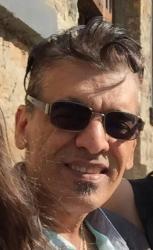
Dr. Abdollah (Omid) Payrow Shabani, Professor in the Department of Philosophy, University of Guelph, died in Toronto on December 23 2023 after a long and debilitating illness. He was 61. His partner Marjan Bateni describes his youth:
Omid came from a war-torn area of Iran, from a middle-class family of educators who had to flee their hometown during the Iran-Iraq war. They had to take refuge in the city of Karaj, north of Tehran, with their house and belongings all gone in the war. When he finished high school, Omid was not allowed to attend university in Iran because he was politically active. All his like-minded friends started mysteriously disappearing or were taken to unknown locations by Iranian authorities, so he fled, moving from country to country, with the threat of death or imprisonment at every corner, doing any possible survival jobs. He drove cabs, washed dishes at restaurants. When Canada finally gave him asylum, he did not speak any English or French. He started learning English by attending ESL classes.
In Canada, Omid settled in Ottawa, earning B.A. and M.A. degrees from Carleton University, and the Ph.D. in philosophy from the University of Ottawa in 2000. He was a Mellon Post-Doctoral Fellow at the New School in 2002, where he studied with Jurgen Habermas. He came to the University of Guelph in 2003. His first book, Democracy, Power, and Legitimacy: Critical Theory of Jürgen Habermas, was published in 2003 by the University of Toronto Press. Throughout his academic career, Omid continued to write about the nature of democracy, about multiculturalism, and about civil society. Many of his publications, including his last article in 2023, concern the political situation in Iran. He taught undergraduate and graduate courses in social and political philosophy, ethics, critical theory, and the philosophy of law at the University of Guelph.
Omid leaves behind a legacy of intellectual vigor, resilience, and a profound commitment to democratic ideals. His contributions to political theory, particularly on the political complexities of Iran, will continue to inspire scholars and advocates alike. In the hearts of those who knew him, Omid’s memory will be cherished as a testament to the indomitable human spirit. Though he is no longer with us, his memory will live on in the hearts of his partner, his daughter, his colleagues, his students, and everyone fortunate enough to have known him.

When you talked, I wanted everyone to get quiet and listen. Your would choose every word purposefully, and the way your words sat together to deliver a concept always amazed me; perfect juxtaposition, beautifully though-out sentences. Your dry sense of humour always cracked me up. It was so hard not to laugh at your sarcastic jokes. You carried so much passion within you, the most fierce of which was your passion for integrity, honesty and justice. You were not an easy person, but every time you smiled my heart would melt for you. You felt the sufferings of others so deeply, but didn’t show much of it. I have never seen anyone as brave and resilient as you were. Never. You went through so much hardship in life, and you stood strong. How much I admired you, respected you, and loved you. How much I admire you, respect you, and will eternally love you. I saw you break into sobs only twice in my life: once when Sattar Beheshti’s mother appeared on TV, holding the picture of his murdered son, and wishing all Iranians a Happy Norooz. The other time was when my dad died. Your demeanour towards adversities of life, the worst of which was your debilitating illness, was fighting them fiercely to overthrow them and accepting them gracefully in the face of defeat. My friend, my companion, my husband, I miss you with every fibre of my being. You did not believe in reincarnation, but I do, and I like to think that you were wrong just this once, that you are now living in Italy in your new life, playing soccer, drinking red wine, and smiling under the sun.
Your description of him is so spot on. I am very sorry for your loss.
I cherished Omid as a friend and as a colleague since he arrived in Guelph in the early 2000s. He was always ready to talk about philosophy or current events, as well as to share his insights about developments in Iran. He had a wonderful sense of humour, sometimes tinged with wry worldliness, no doubt one product of the long period of struggle and challenge that he faced after having to leave Iran as a young man. Now and then he would drop into the conversation some surprising fact that I hadn’t known about him–for example, that he spoke Italian. Italy had been one stop on the years-long journey that took him ultimately to Canada. At every turn, Omid displayed warmth and generosity towards students and colleagues. Joanne and I give our deepest condolences to Marjan and Tara. We will all miss Omid’s presence.
Thanks for sharing your heartwarming memories and sentiments.
I met Omid in first year philosophy at Carleton U. I was 9 years younger, and kind of boorish, but somehow we became friends, and he became like the older brother I never had – correcting me, sometimes chastising me, but always encouraging me and elevating me with his discerning wisdom. I was out of my depth, but we talked about soccer, women, Nietzsche, Lyotard, Italy, motorcycles, Lina Wertmuller films – he opened my limited Ontario mind to so many great things. We eventually grew apart, but I bought his book, and checked in albeit far too seldom. He is gone too soon, and this is a terrible loss. I was aware of some of his suffering firsthand, but he told me “life is very short, and there is nothing afterwards …. you have to squeeze everything you can out of it.” By the feel of others’ writings here, he seems to have succeeded.
Thank you Ben for sharing this lovely tribute 🤍
Thank you for yours too Marjan! I thought it was spot-on, and beautiful! I am really sorry for your loss.
Omid was one of the best things about doing graduate studies at the University of Ottawa. He was loved and respected by many, many people for his passion and drive, his friendship, his love of ideas and the strength of his convictions.
I was a Masters and PhD student in Ottawa U’s philosophy department from 1996 to 2005, and Omid was one of the first people I met. It was immediately apparent from his demeanor that as a new philosophy grad student I was now one of the group. He encouraged me to join in and be part of the scene, both socially and academically. It was extremely reassuring and very important for my academic development (as it was to many) to have his encouragement and to want to do well in Omid’s eyes. We all felt that way.
Your nice eulogy means a lot to all who knew and cared for Omid; thank you Jayson.
Well said, Jayson. Discussing philosophy and politics in a coffee shop with Omid was one of my happy memories from Ottawa, and I think of him often.
Prof. Abdollah (Omid) Payrow Shabani is responsible for much of my career and the unfolding of my life. We met in 2004 when he taught me my first political philosophy course, which focused on Kant’s political writings. I took a significant number of courses with him, and Omid was both my honour’s thesis advisor and Master’s advisor.
Under Omid I spent some of the most intellectually formative years of my life and contemplated the nature of democracy, the roles of free and open communication in enabling and supporting political action, and the importance of privacy for democratic traditions in a digital era. The evolution of technology and self-apparent need to foster and maintain democratic traditions since then have only underscored my commitment to a Habermasian worldview that I learned and developed under his tutelage.
The very way that I see the world — politically, ethically, normatively, and epistemologically — are tightly linked to the time that I studied with Omid. In classes I took with him he embedded in me the need to understand the pragmatic political roles of religion in secular and multicultural political societies, the practice and value of being rigorous and fair to arguments with which we might disagree, the obligation to be open and inclusive to political and normative change, the critical role of expanding our understanding of equity to foster more inclusive politics and societies, and much more.
Since I completed my degrees with Omid I’ve moved on from the formal study of philosophy to undertake more applied academic, political, and policy work. He was always supportive of my ambitions and decisions though, at the same time, he regularly did his best to draw me back to the study of philosophy proper. He always had a paper to share or other academics to whom I should reach out.
As someone who had to flee Iran as a political refugee, Omid was persistently committed to a free and democratic Iran. I remember his stories, of how he was put at risk because of his love of philosophy and in some of his efforts to foster and support democracy in his native state. Democracy, I learned from Omid, was not a word but a practice to which we must remain committed even when that practice may seem futile or hopeless or too lethargic to address the crises of our time. His own practice was a marathon and never a sprint.
If there is a central and guiding lesson of political change that Omid gave me, and I can leave with others seeking such change, it is this: if you adjust a single comma, a logical operator, or placement of a word in law or regulation then you will have led an immensely politically active life. He always somehow had hope when I spoke with him that we can work towards such change, we can be engaged, and we can improve the state of our democracies. This is the power of individuals and communities, made possible in even our flawed democracies. And we can do so with dry humour, fierce passion, and unwavering integrity.
As I think about Omid and the state of the world, today, I only hope that enough of us have the courage, bravery, and grit to work towards changing a comma here or there. Or at least supporting those with the power and influence to do so. Such hopeful ambition continues to be what drives me each day that I wake up to participate in our shared practice of democracy.
Omid and his legacy will live on in all us.
Farewell, Omid. I will miss, and remember, you forever.