
“Conservative and international students face different challenges: one feels forced to self-censor while the other reports fewer job opportunities. No significant impact on employment is found for either but conservative respondents report higher rates of satisfaction in philosophy.”
That’s a brief summary of findings about conservative graduate students and international graduate students currently or recently enrolled in philosophy PhD programs, based on data collected by Academic Philosophy Data and Analysis (APDA) in its 2025 survey.
In the following guest post, APDA founder and co-director Carolyn Dicey Jennings shares the details.
[A version of this post also appears at the APDA blog.]

International Students & Conservative Students: How Are They Doing In Academic Philosophy?
by Carolyn Dicey Jennings
In this, the final summer post on the 2025 survey, we highlight two populations of survey participants: those who are or were international students and those with conservative political leanings. (See previous posts here.)
We chose these populations for a straightforward reason: both groups show signs of underrepresentation while also seeming to report higher satisfaction in prior surveys. That is, according to an analysis of the 2023 survey results, international students were less likely than local students to find permanent academic employment, while according to an analysis of the 2021 survey results, conservative students are underrepresented in philosophy PhD programs relative to both the U.S. population and doctoral recipients. Yet, in past surveys we have noted that both of these groups appear to report higher satisfaction than local or non-conservative participants (not tested for statistical significance). We thus wanted to better understand the experiences of both populations and the challenges they face in the discipline.
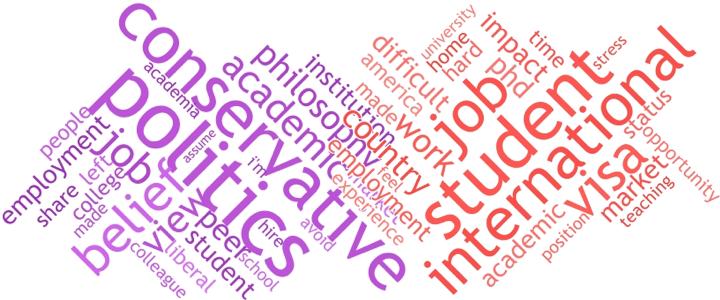
To explore this we added two text-based questions to the 2025 survey with a parallel structure. These questions appeared on the final, demographic page of the survey for a subset of participants. The first followed a question on international status: “Are you or were you an international student during your PhD studies?” If the participant answered “yes” (n=383) then they were provided a follow-up prompt: “Please describe the impact of your status as an international student on your academic career (i.e. as a student and in employment or the search for employment, if relevant).” The second followed a question on political leaning: “When it comes to politics, how do you usually think of yourself?” If the participant answered “conservative” or “very conservative” (n=58) they were provided a follow-up prompt: “Please describe the impact of your political beliefs on your academic career (i.e. as a student and in employment or the search for employment, if relevant).” Word clouds with the top 25 mentioned words by each group are provided in the image below.
We provide some insights on the responses to these prompts in this post. But, first, it may be useful to see how these groups differ in response to other questions on the survey. Since international and conservative status overlap for some participants, for statistical analyses we grouped them as follows: conservative participants were grouped together regardless of international status, due to the small size of this group (58 participants, 14 of whom are also international); international students (369 participants, with 150 very liberal, 132 liberal, 68 moderate, and 19 who didn’t answer on political leaning) were then distinguished from local students (708 participants, with 325 very liberal, 243 liberal, 105 moderate, and 35 who didn’t answer on political leaning); and left out were all those who were not conservative and did not provide their international status (73 participants). (Note that “students” is used here as shorthand for all those who currently are or once were international/local students; some are no longer students.)
Several questions measure satisfaction of some sort, whether with one’s PhD program overall, the climate of that program, one’s employment (if a recent graduate), or one’s financial situation (if a current graduate student). Conservative participants tend to provide higher ratings in general: if we combine the answers to these four questions the mean is 4.3 (out of 5) for conservative participants vs. 4.0 for both international and local students (p<.005). (The individual ratings are 4.3 vs. 4.2 for PhD program, 4.6 vs. 4.0 for climate, 4.3 vs. 4.1 for employment satisfaction, and 3.3 vs. 3.3 for financial satisfaction.) International students appear to provide higher program ratings than local students (4.2 vs. 4.1), but the difference is not statistically significant and they respond similarly to local students on the other satisfaction questions (both 4.0 on climate, both 4.1 on employment satisfaction, 3.3 vs. 3.4 on financial satisfaction).
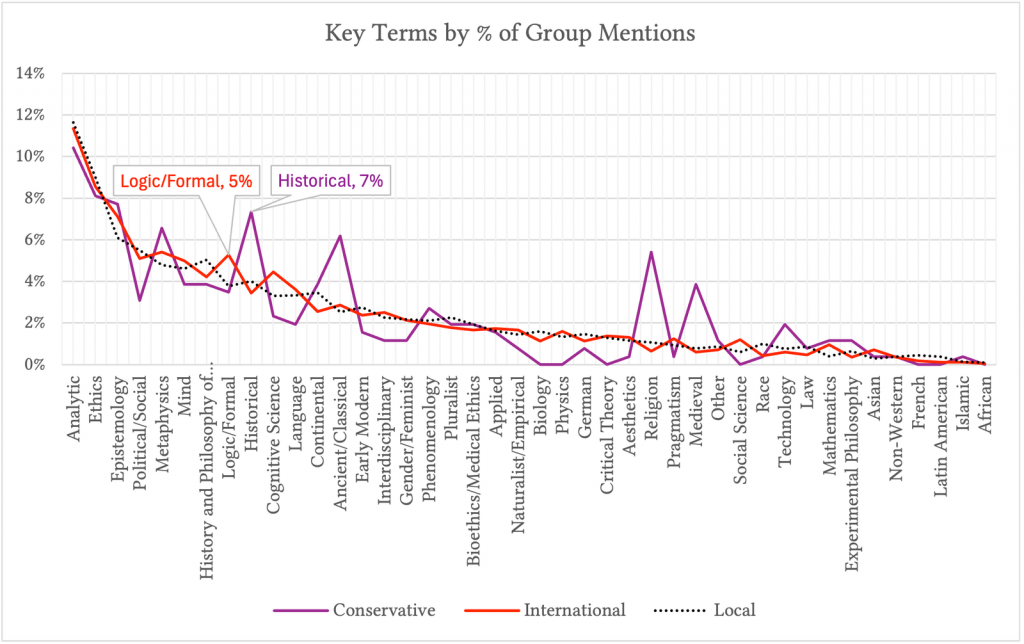
In terms of key terms used to describe PhD programs, differences also emerge. If we look, for example, at the most mentioned key terms in each group, all three groups have “Analytic”, “Ethics”, and “Epistemology” as their top three terms but start to diverge after that (see the chart below). For instance, while only conservative participants have “Ancient/Classical”, “Religion”, and “Medieval” in their top 10 terms; only international students have “Cognitive Science” and “Language”. Both conservative participants and local students (but not international students) have “Historical” and “Continental”, while both international and local students (but not conservative participants) have “Logic/Formal” and “Political/Social”. (The other top 10 terms shared by all three groups are “Metaphysics”, “Mind”, and “History & Philosophy of Science”). The chart below shows all the key terms with the percentage of mentions for those terms by each group.
While the mean graduation years are about the same for these groups (2020 for conservative participants and international students, but 2019 for local students), international students include more current students: 48% of all participants, versus 34% for both conservative participants and local students.
Financial status and employment outcomes appear to differ between these groups, but only one difference is statistically significant. Namely, reported graduate student income is lower for conservative participants (mean=$26k) than for international (mean=$35k) or local students (mean=$36k; p<.005).
Other trends are not statistically significant, which could be due to small numbers or a reflection of mere “noise”/variation. Namely, conservative participants also appear more likely to prefer academic jobs (88%, versus 84% for both of the other two groups) but less likely to be in academic jobs (77% of conservative participants who are employed are in academic jobs vs. 85% of international students and 84% of local students). The median salary 0f conservative participants is slightly higher than other groups at $82k vs. $75k/$78k, while the mean salary is slightly lower at $89k vs. $97k/$95k.
International students, on the other hand, appear at first glance to be slightly less likely to have permanent academic jobs: 67% of international students now in academic jobs have permanent ones, versus 70% of local students and 73% of conservative participants. This difference was not statistically significant using chi-squared, while in 2023 the difference was significant using a regression equation. Since we noted that the top programs for international students were themselves more international (in our survey, only 16% of local students are from non-U.S. PhD programs, whereas 43% of international students are from non-U.S. PhD programs), we decided to check the numbers for two different subsets of this group: those in U.S. PhD programs versus those in non-U.S. PhD programs. We checked this because U.S. PhD programs tend to have higher permanent academic placement rates than non-U.S. programs according to past analyses. In fact, this difference does seem to be responsible for the effect. That is, for those with academic jobs who come from PhD programs in the U.S., the proportion with a permanent position is 72% for international students and 73% for local students. In contrast, for those with academic jobs who come from PhD programs outside the U.S., the proportion with a permanent position is 61% for international students and 53% for local students. As international students have about the same or higher rates of permanent academic employment within these subsets, it must be the difference between the subsets that is driving the effect.
Turning now to the text-based responses, clear differences emerge between respondents who report conservative leanings and those who report being or having been international students (for this portion of the blog post these groups partly overlap, with 8 participants providing responses to both questions). Namely, while both groups largely report a negative impact of their status on their academic career, the nature of that impact is quite different, with one group’s primary concern that of having to hide their status while the other group’s primary concern is that of losing out on employment opportunities.
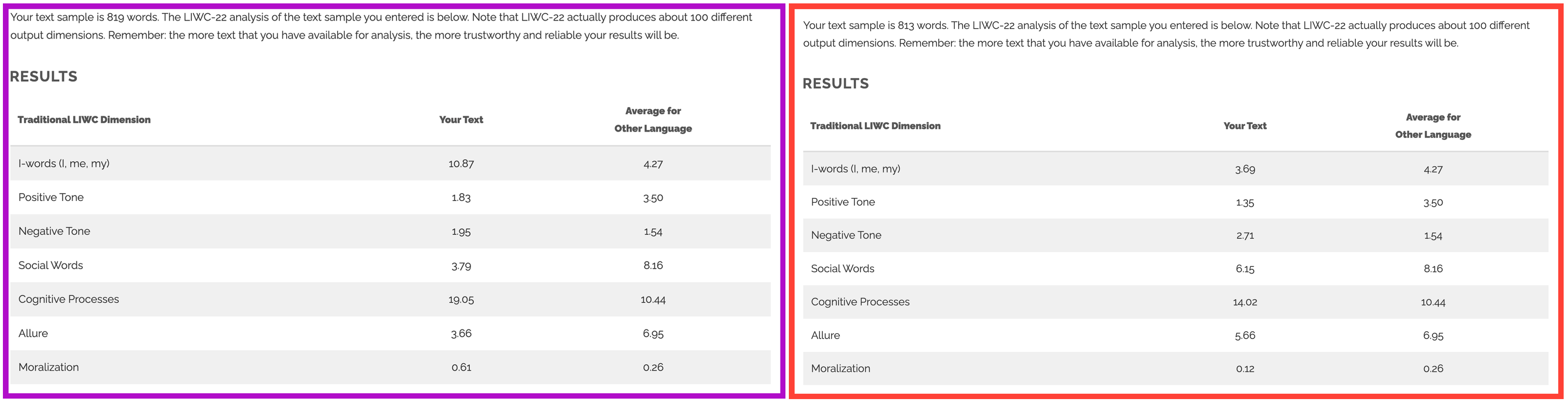
To determine this we first read through all comments and then came up with a list of common themes: no or minimal impact, negative feelings/emotions, negative behavioral impact, negative social impact, reduced employment opportunities, signs of abuse or trauma, and positive impact. We then hand coded all the comments according to these 7 themes, with some comments containing multiple themes. In a forthcoming paper on a related dataset we found that hand coding sometimes captures negative sentiment that is not picked up through automated techniques; alternatively, one might argue that hand coding can be negatively biased on such topics. We thus used a freely-available automated method as a sanity check. Using the demo version of LIWC-22 on a sample of the (non-private) responses, “negative tone” of both samples was higher than normal, while “positive tone” was lower (see screenshots at the end of the blog post).
Below we provide a breakdown of our hand coding results for both groups along with some sample comments from participants (note that ellipses are sometimes used to replace irrelevant text).
Those with conservative leanings mostly report self-censoring behavioral changes (31% of the 39 posts include this sort of comment); but also concerns about lost jobs or positions (26%); concerns about social standing, such as being ostracized (23%); and feelings of fear or anxiety (13%). A robust proportion saw little to no impact of their political leanings on their academic career (21%). A relatively small number reported abuse or trauma, such as promotion denial or bullying (5%), while another relatively small number reported positive effects (10%). An example of each is provided below:
- no impact: “None”
- feelings: “…As a professor, I have been made uncomfortable at some point at every single conference I have ever attended by casual disparagement of my beliefs, either in general or with reference to me in particular…”
- behavioral changes: “To avoid any (potential) trouble in obtaining a permanent position, I consciously kept my (moderate to right-leaning) political beliefs to myself.“
- social standing: “…I think my political beliefs often put me in intellectual conflict (and social alienation) with my peers due to my different perspectives and resulting philosophical interests…”
- jobs/positions: “I keep my political views very very quiet. I hear so much explicit antagonism towards conservatives and have no interest in constantly being on the defensive vis a vis my peers. I have also heard too many stories of people being rejected from academic positions because a committee member heard they were conservative and refused to hire them.”
- abuse/trauma: “…I often had to silently endure people who think like I do being mocked by my peers and professors…”
- positive effects: “I thought being conservative and Christian would hurt me, but there’s a growing niche market for conservative and Christian academics. You just have to know where to find these opportunities.”
Those who have or had international student status mostly report limitations on jobs or positions (34% of 203 posts); but also significant behavioral changes (31%) in order to manage financial restrictions, paperwork headaches, language barriers, cultural difficulties, and travel challenges (both academic and to see family/friends); feelings of anxiety and stress (20%); and concerns about social standing (8%), such as discrimination for being foreign. A robust proportion again saw little to no impact of their status on their academic career (21%). About the same number reported abuse or trauma (5%), such as extreme stress from precarity, as positive effects (6%). An example of each is provided below:
- no impact: “none”
- feelings: “The stress of study and work permits—financial, time, and emotional drain—impacted me. I was never denied a permit but it was always a risk…”
- behavioral changes: “As an international student, the initial one or two years of PhD program are often challenging due to the need to adapt to the language and a different course structure, making it difficult to complete required reading and essay assignments…”
- social standing: “Feeling marginalized in the earlier years of the program; more comfortable as time went on.”
- jobs/positions: “Probably detrimental. Some positions didn’t offer visas so I couldn’t be hired at all. At others, my status was a consideration against me (not because of some discrimination, just b/c hiring international for the kinds of positions I’d be considered is bureaucratically more difficult).”
- abuse/trauma: “It was extremely stressful…I had to complete my degree in 3 years instead of the normative 6—hence, others who were going on the job market around the same time as me had twice as much time to, e.g., publish, teach, present at conferences, network, etc”
- positive effects: “The department and university are, in my experience and to my knowledge, very supportive of international students.”
In sum, whereas conservative participants report feeling forced to hide their status to avoid discrimination, international students report lost job opportunities due to administrative and other hurdles. A major difference is that while both are concerned about employment outcomes one group manages that concern through self-censoring, while the other is unable to hide their status.
As mentioned above, we did not find statistically significant effects of either conservative or international status on employment outcomes. It may nonetheless be the case that these groups have to work harder, or with greater stressors, in order to achieve similar rates of employment to non-conservative or local students.
Other recent posts about the APDA survey can be found here.

I’m a tenured professor (tenured within the past 5 years). As a moderate-conservative, I definitely have views that significantly diverge from most of my colleagues and probably most people who are readings this. Like many I have tried to keep my views hidden out of fear. I think to some extent the fear was, and is, justified because I have heard much ridicule from academic colleagues about how x-ist or x-phobic such views are. Of course, I just disagree with those labelings since I sincerely believe that I’m not x-ist or x-phobic. (And yes, maybe I’m just deceiving myself but I have thought long and hard about this.) I should say though that I think things are getting better and I honestly really like my colleagues. What I wish was different (and the blame is on me here too) is that I could have more honest, reason-based discussions about some of these issues. But I don’t know if we really can because the the issues so morally charged. I mean, there are people who would argue that even just voicing my actual beliefs is an instance of causing ‘metaphysical violence’ to someone. Still, I wonder if it would be better if we all just put our positions out there which would give us opportunity to learn and maybe even adjust our beliefs through reasoned discussion. (Sounds a bit like doing philosophy…) But I’m a very sensitive and agreeable person, and worry too much (still) about social backlash. I might just be too chicken-shit and maybe I just need to become more honest and courageous. I’m still working on those things.
Yeah I’m reading this through again and it sounds like you have no actual problems, and the potential problems you identify are problems other people make only for themselves. (At least, in the way you formulate it here.)
That being said: your circumspection about arguing with people seems to be more out of concern for them and their well-being, than for any concern about yourself. Such a concern is entirely appropriate in your work environment! This isn’t “chickenshit”. It’s admirable given your concerns, and if you think otherwise you should examine the concerns you wrote out.
I can only encourage you to embrace this as a challenge of a plural academy, and if you do feel that you or others are not being considered appropriately in turn, you can and should always speak up for that. We should strive to act rightly to each other.
I’m puzzled as to how any conclusions can be reached about conservatives on the basis of this, given two things (even setting aside low numbers). (1) *Only* conservatives were asked to reflect on how it affected their professional life, (2) feelings of having to self-censor are not the same as facts. The first is more serious in my view, but the second is non-negligible. There’s a LOT of pumped up media coverage about how awful academics are for conservatives, enough that you combine that with a random anecdote or two and you can easily get a situation where the self-censoring feelings outstrip their reasonable bases. Meanwhile, I (and many others) have demonstrated, adjudicated proof of being discriminated against in serious career affecting ways (in my case, sexist and anti-gay discrimination at different points and at some in combination with one another) by people who, like the first comment on this page, declare that they are not anti-gay.
As a survey though, I don’t understand why the lack of parallel/comparison question
I self-censor because in nearly every professional setting it is taken as self-evident that conservative views on whatever are not only obviously false but also immoral. Not that I really care, I’m just here to do philosophy and would like a job doing philosophy. My reasons (or, if you like, feelings) that motivate self-censorship have almost nothing to do with media coverage.
And even if the self-censorship is unwarranted, we conservatives would very much like to know.
Yes.
I mean… I “self-censor” too, because it’s not always advisable to candidly report what I really think about something or someone. That’s just what getting around in the social world or the classroom requires. But calling that ‘self-censorship’ seems like overkill.
Oh, but there you go. I’m ‘self-censoring’ here, too.
I think it’s quite advisable to candidly report your political views if they are left and you want to be hired by left-wing people. The same is true the other way around, of course, but more hiring committees in philosophy have left-wing views.
In case this helps to get more of a flavor of what is meant by “self-censoring” in the above, here are some relevant public comments from conservative respondents (2 private comments are also relevant, as are a further few comments that are more ambiguous about the reason for not discussing politics).
1) I hold right-of-center views, and as a result I had to self-censor a lot, especially before tenure.
2) I hid my political beliefs from my advisors and peers.
3) I generally do not advertise my political beliefs in the academy. It’s just more trouble than it’s worth. I think some faculty and students have guessed my leanings, and they have not been rude about it, but generally speaking in casual political discussions it is assumed that everyone is very far to the left, and unless you like debating politics with colleagues there’s no advantage to disabusing them of that assumption. That makes it very easy to fly under the radar; it seems not to cross most other grad students’ minds that someone in their midst might be a conservative.
4) As a student I used to avoid talking about them with philosophy peers in fear of being cast out. In college, on the other hand, it was mostly fine because it was not too liberal. As staff now I just avoid the subject, especially when students are around.
5) To avoid any (potential) trouble in obtaining a permanent position, I consciously kept my (moderate to right-leaning) political beliefs to myself.
6) I keep my political views very very quiet. I hear so much explicit antagonism towards conservatives and have no interest in constantly being on the defensive vis a vis my peers. I have also heard too many stories of people being rejected from academic positions because a committee member heard they were conservative and refused to hire them.
7) I kept my views completely to myself and tried to avoid discussions of politics as much as possible. When searching for a job I think I had an advantage with institutions that shared my beliefs and values.
8) I spoke about my political beliefs as little as possible; I assumed doing so would hurt my career prospects. I think this strategy was successful and doubt my beliefs made a difference since few others knew them.
9) I kept them to myself. If I hadn’t, I suppose they would have harmed me.
10) Peers would either just assume I am liberal, or else show antipathy if they knew I was conservative. I tried to not talk about politics or enter into fields where talking about politics was necessary.
11) Little to no impact, largely because I keep my political beliefs to myself. I keep my political beliefs to myself because the political climate in academia, and especially in the humanities like philosophy, are very hostile to conservative individuals. It would hurt my chances in acquiring a job in academia if my conservative views were made known to others.
12) I have often believed that openly disclosing my political beliefs would jeopardize my employment or reduce my chances of advancement. So I have mostly kept my political thoughts to myself, while colleagues sharing majority opinions often flaunt their beliefs publicly.
For balance and comparison, here are 12 responses from international students that mention behavioral changes. (I chose the first twelve that clearly discuss this while leaving out personal information. I used ellipses for irrelevant or personal information.)
1. …If there were difficulties in my being a foreigner, they came in the form of extra bureaucratic hoops through which I had to jump: extra forms I had to file, or higher tuition I had to pay, or extra scholarships I had to apply for, in order to reduce that higher tuition.
2. Being an international student has been a significant source of financial stress, due to the tuition fees. When I first commenced my PhD, I only had two years of funding. I turn acquired a further year, and then a further year again. I think that this pressure pushed me to work much harder. I finished my program long before anyone else in my cohort, and was more successful on the job market.
3. It has made recent travel for conferences more difficult as I have not wanted to leave the United States for conferences due to possible difficulties of returning. I have felt these experiences have been ignored by current debates about moving conferences outside of the US which would negatively affect me, and others in this position, even further.
4. I cannot work during holidays, especially during summer and I cannot make any money. I am under so much stress because I am not going to be able to visit my family in my home country. I am not making enough money to visit my family in my country.
5. This year is my first job cycle, and it has been chaotic and overwhelming. When Trump announced the $100,000 H1B visa application fee proclamation in September, I decided to step back from the job market because I was feeling too depressed. I stopped working on my dissertation and application materials and shifted my focus to applying for professional degrees since it seemed like an academic career was no longer an option. Then, a month later, the proclamation received new guidelines. Now I am back on the market, but I’ve missed some deadlines…
6. Navigating visa requirements and finding research funding as an international student took extra time and effort during my PhD and restricted my movements.
7. It’s hard to overstate how much the international student status affects my academic experience. Not only it makes planning an alternative non-academic job more difficult giving most jobs aren’t available for foreign nationals (and now even some academic jobs are not available), it also make decisions of attending conferences overseas or accepting fellowships to do research abroad more difficult. It also hinders opportunities of doing community outreach and strengthening teaching profile such as teaching at local high school or prison (since it could potential violate student visa requirements).
8. Difficulties with renewing my visa made me very stressed for several months, and the associated administrative competed with academic work.
9. Everything is more difficult as an international student in the United States, without exaggeration.
10. Our admissions and legal presence paperwork is complicated, with many moving parts, making it additionally troublesome to pursue professional development opportunities outside the US (if one comes from a ‘weak passport’ country, then getting visas to attend conferences becomes more costly and laborious, and returning to the US under increased scrutiny (anecdotal) is stressful).”
11. I was the only international student in the department during my PhD studies, which was pretty challenging at the time — familiarizing myself to a new language, culture, and environment on top of usual demands of doctoral studies. I was lucky enough to have a supportive PhD community including both grad students and faculty members, which is one of the main reasons I recommend this program to prospective international students.
12. It was and remains hard. During studies, there is a constant need to maintain status by renewing immigration forms annually, being attentive to the sometimes very obscure norms and regulations. Often, faculty have no familiarity with the different needs of international students compared to their domestic peers. The most difficult is money management. It should be no surprise to hear that graduate stipends are barely enough to live on. Many students seek secondary employment to make up for this (in opposition to many silly university policies demanding that their students not work external jobs while receiving tuition benefits and stipends), but that option was not available to me as an international student whose work authorization is extremely limited….
Thank you! This is strong evidence of a situation similar to that we have long experienced in the legal academy, of a widespread and organized attempt to clandestinely organize right-wing movements within the field among conservatives without drawing any political attention.
Why would you need a comparison? Is it less bad that conservatives self-censor and face discrimination if other groups also self-censor and face discrimination?
Sure, it might be interesting to see how perceived discrimination differs among these groups. Probably the kind of discrimination as well as the experiences thereof are quite different.
Because you want to know the base rate? Because you want to have some sense of whether this is a widespread issue, or one which genuinely seems to affect a particular minority? Because people have tied this issue to practical measures, and you might want to be sure it’s a genuine issue before lending credence to it or adopting measures which may cost time, money, and goodwill?
I’d think you’d also want some sense of the content being ‘self-censored’, as well as the contexts in which it occurs. Because, again, you want to be able to separate the kind of self-censorship that is just normal, daily social lubricant or otherwise justified/justifiable from the kind that is genuinely oppressive.
Good points. I haven’t looked into this yet, but my sense of having read all of the comments on all of the questions (for this and prior years) is that I haven’t seen anyone mention hiding their status before. Perhaps because for the other forms of underrepresentation in philosophy this is often difficult or impossible. I will take a look at some point and see if this holds up for some key terms.
So what if the “base rate” of perceived discrimination is equal to perceived discrimination by conservatives? Does that tell you there is no genuine issue?
And if the conservative rate is higher than the base rate that doesn’t change much, since it could be to a number of other factors, such as, as you mention, media coverage.
I don’t understand how the base rate would be informative at all given the heterogeneity of discrimination. All groups are discriminated in different ways and for different things, so you’re not comparing a single attribute. In this light I’m not sure if the “base rate” is a well-defined concept at all in this context.
I am open to the possibility that there may be groundless interpersonal hostility towards “conservatives” (for some value of the term) which should be remedied. But when the claim is put in such broad terms as “self-censorship” and when I am given no real information about the content being “self-censored” or the contexts in which it’s happening, then I have questions. And one of those follow-up questions is whether this is just the normal thing everyone does to get by in society, or something more pernicious. If it turns out most people are doing something similar, then I’m not sure we need to be so worried–or, at least, so worried about “conservatives” in particular.
As I said, I absolutely “self-censor,” for some values of the term. And I wouldn’t describe it using that term, because it’s part of the universal social grease. I once had a conspiracy loon colleague (everything was a plot to destroy Science and elevate PoMo non-white scholarship; one incident involved Indigenous cancer care stealing money from space lasers); I could have taken the time to call them out and correct them repeatedly, and tell them precisely what I thought of them. But… That’s not a very good way to go around the world, let alone to navigate a department. It’s self-censorship, for some values of the term, but also perfectly reasonable. If we’re talking about being afraid to say one was at a church event the other day, for fear of ostracism or worse, then that’s a different story (though unless it’s something like the Westboro Baptists, I doubt that particular case offers a very realistic worry).
Very often, when I encounter this claim from American conservatives in particular, it seems to amount to the fact that they feel they can’t say the nasty things they want to say about racial IQ, or women, or queer and trans people, or the stupid denialist things they want to say about the climate, etc. If those are the kinds of things being “self-censored,” then we shouldn’t be very worried about it.
But I don’t know. What we have is a bunch of self-reporting with no real content or context. And nothing to indicate whether there may be parallel worries elsewhere along the political spectrum. And that seems pretty relevant in a political context where expressing certain views coded “left” (gender stuff, trans stuff, race stuff, Palestine/Israel stuff, etc.) is grounds for termination, deportation, harassment, intimidation, etc.
Context: Surveys show significant expressed endorsement of ideological discrimination. Keep in mind that the number who *express* endorsement of ideological discrimination in a survey does not include those who endorse it but would not express it in a survey (I find it shocking that *anyone* would express it in a survey), nor does it include those who do not endorse it but enact it through affective assessments of department “fit,” motivated reasoning, etc.
Peters, U., Honeycutt, N., De Block, A., & Jussim, L. (2020). Ideological diversity, hostility, and discrimination in philosophy. Philosophical Psychology, 33(4), 511–548. https://doi.org/10.1080/09515089.2020.1743257
https://dailynous.com/2019/07/29/political-hostility-willingness-discriminate-philosophy/
An important footnote there:
Hey Felix,
I feel the pull, but at the same time, consider:
“Subjects with [atheist] beliefs may lead them to make utterances about [theists] that do not just express beliefs but also indirectly address the individuals concerned. This interlocutory dimension of the expressions creates harm, and it may be that the envisaging of this harm is what drove the discriminatory responses.”
Even at the peak of Christopher Hitchens-style obnoxious atheism, it still seems like such a footnote wouldn’t be important regarding a willingness to discriminate in hiring against atheists. For one, concerns about saying offensive or insulting things should only apply to individuals who have said them; otherwise, one is engaged in collective punishment or profiling. For instance, the wrong of discriminating against an applicant because they are Muslim wouldn’t be significantly mitigated by concern over interlocutory dimensions involving Jewish colleagues. If such concerns go beyond utterances (which are more susceptible to inartfulness and intemperance), and include considered beliefs (no matter how politely expressed), such as “transwomen are not women” or “Israel is committing genocide in Gaza,” this would be highly problematic. I think whatever norms we accept for philosophical discourse should apply to everyone. For instance, if we adopt the social justice movement’s stance on the value of “sitting with the discomfort,” then it should apply to everyone and not be politically- or demographically-specific.
There’s nothing there to consider. One references a set of beliefs (in the example, beliefs about the existence of God) and the other references attitudes and beliefs that are frequently about people, and often, specifically, about the worth of certain people—including people who are one’s peers, colleagues, teachers, and students. It does not make a difference that those attitudes and beliefs may be, in the view of those who hold them, “considered,” nor that they are, again from the perspective of the person articulating them, “politely expressed.” The beliefs and attitudes that the footnote refers to, which “create harm,” can do so regardless of being “considered” or “politely expressed.” And it does no good to say that concerns about the harm caused are mitigated by mere dint of how politely it is promulgated.
“I believe that nothing happens when you die, and that human beings are intrinsically worthless.” (Alternative: “I believe that you, as a non-believer, will suffer in hell for eternity.”)
“I believe that, while every human being has intrinsic worth and should be treated with respect, gender identity should not be distinguished from biological sex.”
Just to better understand the scope of your claim, would you count the former assertion(s) as examples of atheistic (theistic) beliefs which are relevant to the footnote and your followup about it? And would you count the latter as an example of conservative beliefs which are similarly relevant? I ask because, although I certainly agree that some ostensibly “conservative” beliefs are harmful—e.g., race science—the one above both does not seem that way and is one which conservatives sometimes offer as a belief they self-censor even in apparently appropriate contexts (e.g., a discussion on the metaphysics of gender).
I find it difficult to believe that conservatives self-censor on that front. Indeed, the opposite seems true: Many seem very forthcoming about it. And if it is raised “in apparently appropriate contexts,” I can see it being a good starting point for conversation: For example, one could reply with, “I agree! It shouldn’t be distinguished, and the notion of a distinction is quite contentious in the literature.”
The presumption that a conservative with that specific belief would self-censor seems contingent on them holding the view that others, especially those that they are talking with, disagree with that specific belief. But, on the surface, there are plenty of people, including non-conservatives, who agree with it. For instance, I’m not a conservative, and I also think that such a distinction isn’t warranted, but that’s likely for entirely different reasons. I don’t feel the need to self-censor my skepticism of a distinction between “gender” and “sex,” so why would a conservative?
Unless, of course, there’s more to it than that specific belief. That is, there are other specific beliefs that aren’t just about the “metaphysics of gender,” but about how persons are to be treated, including persons who may be present. Indeed, the fact that they preface it with a statement about “intrinsic worth” and “respect” suggests that there is much more underneath than what the specific belief, as stated, gives. So what is it really then that they are self-censoring here? It’s not at all clear.
I’m sorry, this is a lot of speculation about something I know—from both my own experience (as a non-conservative) and from discussion with others (both conservative and not)—people to self-censor. I’ve also seen the exact same view received extremely poorly, when self-censorship was foregone. I understand the nuances here of the belief, what might be behind it, and so on. But, respectfully, your very first sentence betrays that you’re just not actually that familiar with the experiences of those who self-censor. Perhaps you’ve been lucky enough to not see these conversations go badly when they do happen, or perhaps you don’t see them as going badly when they do. That’s another matter; I won’t speculate myself.
I also still wonder about the atheist/theist examples, but I suppose I’ve gotten the information I wanted already.
It’s not so much the nuances as it is that the specific belief you are referring to doesn’t appear to be all there is to it. The very way it’s articulated, making reference to “intrinsic worth” and “respect,” suggests that it is far more than just a position on whether a distinction between “sex” and “gender” makes sense, and certainly not just a position on the “metaphysics of gender.” What else is contained within that specific belief is not spelled out, leaving those who listen to it, if articulated that way, to fill in the gaps. And yes, listeners might react poorly, depending on what they take the hidden premises to be. But in that case it’s not so much that the specific belief is being self-censored (in your example, the person is articulating it rather than censoring it); it’s that what is being articulated is vague and not fully spelled out.
Taking a bigger picture view, another commenter (Michel) noted that this was an issue here: The content of what is supposedly being “self-censored,” as well as the contexts in which it occurs, is often left unclear. Even your example leaves it unclear, at least with respect to content. (The context is relatively clear: a discussion on the “metaphysics of gender.”) This leaves the door open to a motte-and-bailey of sorts. Whereby the conservative can say that they are “self-censoring” some vague claim, one that sounds innocuous to most ears; when what they are actually self-censoring, and what they want to be able to say without facing any criticism or judgment, is something else entirely. Essentially, the “oh, you know the ones” meme.
I’m not sure what to make of the atheist/theist examples. The notion was introduced by On the Market Too earlier, but I still have fundamentally the same reaction to them: There’s nothing there to consider. If someone tells me that I am going to burn in Hell for being an atheist, then, yes, that is a specific belief about me and my place in that person’s religious cosmology. But since it does not bear upon anything significant to me, and since I regard that religious cosmology as false, I don’t see how it could “create harm” merely by that person uttering their belief that I will burn in Hell. If, however, they hold other beliefs, such as beliefs about how non-Christians should be treated, then it is those beliefs and their articulation that would tap into the “interlocutory dimension” that the footnote discusses, potentially in ways that listeners understand as “creating harm.” Or so it seems.
‘The very way it’s articulated, making reference to “intrinsic worth” and “respect,” suggests that it is far more than just a position on whether a distinction between “sex” and “gender” makes sense, and certainly not just a position on the “metaphysics of gender.”’
I think this is a bit disingenuous. The reference to intrinsic worth and respect is made precisely because many on the other side of this dialectic charge conservatives with devaluing or denying the existence of the groups in question. Conservatives, in my experience, mention respect precisely to anticipate and reject that charge. Plenty of them will even say things like “I’ll use whatever pronouns you want me to use, I’ll treat you with the same respect I treat anybody else, but if you’re asking what I believe about sex and gender, it’s that the latter is exhausted by the former.” That alone is easily enough to trigger a reaction hostile enough to warrant self-censorship (again, even when it seems contextually appropriate).
As for the point about hell, I think I understand the distinction you’re making. The expression of beliefs about your damnation are harmless because they don’t concern you (given your cosmology and the like), whereas that concerning how you should be treated (in life, not the afterlife) do concern you. Is that right? If so, I have a hard time seeing how this distinction—both here and in general—does not rely mainly on contingent features of the person, what they find offensive, etc., in a way which basically makes them untenable for guiding broader norms of academic discussion.
And that charge is broadly correct. Which is presumably why the conservative in your example gave a vague and sanitised version of the specific belief, withholding the content that was relevant to examining whether they do genuinely hold others to have “intrinsic worth” and so on. In which case, what’s disingenuous here is the conservative claiming that they are self-censoring that specific belief—the vague, sanitised version intended to sound palatable—when what they actually want to say is something else altogether.
But that’s fine? The “latter being exhausted by the former” is just another way of saying that a distinction does not exist. Which is a belief also held by non-conservatives, including myself. Again, likely for very different reasons to the conservative, but I clearly have no problem saying that this is a belief I hold. So what’s the conservative’s problem?
Maybe taking the entire statement into account will help. Because you initially said that the context was a discussion on the “metaphysics of gender,” a context where it is appropriate to talk about the nature of a distinction between “sex” and “gender,” whether there is a distinction, what form it takes if there is one, and so on. In that context, articulating a position on the distinction (that it doesn’t exist) while also using hedging language (the mention of pronouns, the allusion to “intrinsic worth” and “respect”) tells listeners that what is being articulated is, again, more than just a position on whether there’s a distinction between “sex” and “gender” as appropriate for a discussion on the “metaphysics of gender.” It tells listeners that there is something else that the conservative has in mind here, something that goes beyond their answer to the question about a distinction but which the conservative nevertheless takes to be bound up with that answer. Of course listeners are going to pick up on something like that. The answer tells listeners more than what they were even asking for.
I genuinely do not see the problem here. If someone says that they are a Christian, there is nothing, in that utterance, that necessarily “creates harm” in the way the footnote is describing. If someone says, in addition to that, that they believe I am going to burn in Hell, again, no harm is created, beyond maybe minor annoyance, if even that. If someone says that they are a Christian nationalist, that they believe women shouldn’t be allowed to work in the university, that queer people should be sent to reeducation camps, and that forced remigration is a good thing, then I don’t see how they can avoid “creating harm” in the “interlocutory dimension” the footnote describes. By its nature, what they are articulating is about others, including very likely people in their immediate presence.
Let’s say that they preface it with broadly the same hedging language used in your other example: So, “I believe that, while every human being has intrinsic worth and should be treated with respect, Christian nationalism is what we need for this country.” Does the hedging language there anticipate and dispel the charge of “devaluing or denying the existence of (certain) groups”? Does it avoid “creating harm”? I don’t think it does. And I think given that these are very clearly beliefs about living people, and the people that they are about are acutely aware that these are beliefs about them, it is rational for them to respond with that in mind.
Again, I think this is mostly disingenuous speculation, so I probably won’t continue after this comment. But, briefly: if my phrasing of the belief was vague, then that’s the fault of me trying to write briefly. A better example might be: “I think everyone deserves respect, etc., but if you’re asking me to accept that (e.g.) trans women are women, I will not do that, because I don’t believe it even after hearing the arguments and considering their merits.” If that is still too ambiguous, at least in a way which you cannot distinguish from your own (presumably non-conservative) views of gender, then precisify it until it isn’t. I submit that, being charitable to the conservative I have in mind, you will not reach a determinate reading on which they suddenly express contempt or hatred or whatever toward the group in question (not least because those are normative judgments distinct enough from the mostly descriptive claim in question). Of course, I am excluding those noxious conservatives who, I agree, both exist and express hateful views which have no place in civilized society. Even so, the less noxious belief described above is one which, again I submit, is held by a significant number of people who self-censor its expression, in reasonable contexts, because of—in a word—ideological bullying. If you don’t even acknowledge the possibility that some academics have legitimately experienced such bullying, then I probably can’t convince you.
As for the religious bit: I agree that the examples you call harmful are, or could reasonably be thought to be, harmful. But this still does not address my point, which is that there remains no obvious way of distinguishing those beliefs from other, (e.g.) more cosmological ones, except for in some difficult to implement subjective and usually quite contingent sense. I can very easily imagine somehow who legitimately feels harmed by the expressed belief in their damnation, and yet I don’t think that such a belief should be self-censored in (say) theological debate.
That is a much clearer, more well spelled-out articulation of a specific belief a conservative might hold. Its expression in “reasonable contexts” seems fine to me, even if it is wrong. But I think there’s a certain naïveté to your characterization of what’s happening in this scenario. Are you claiming that the conservative is expressing this specific belief only in the “reasonable context” of a discussion on the “metaphysics of gender” and nowhere else? That the preamble they gave about “intrinsic worth” and “respect” should assuage concern that this specific belief may have a bearing outside of that context?
The reason I bring this up is because the following claim, that “some academics have legitimately experienced (ideological) bullying” for articulating that specific belief seems to rest on the premise that their expression of that belief is constrained solely to the academic, the abstract, the “reasonable context” of, in this case, a discussion on “the metaphysics of gender.” But we know that that isn’t true. The purportedly “bullied” academics have written to courts, legislatures, and other public institutions, with the intention of affecting judicial decision-making, policy development, and wider cultural norms. They have had generous column space in newspapers and ample air time on broadcasts. They have joined think tanks, written reports for governments, etc. Together, their actions go well beyond the academic context of a discussion on “the metaphysics of gender,” where one might say that they are simply wrong in the abstract sense, but not in any way malicious. For this reason, it doesn’t seem honest to me to evaluate how they are treated as though their actions are limited to the mere expression of a specific belief within a highly constrained and purely academic context.
Likewise, for the preamble (about “intrinsic worth” and so on), we can’t examine it honestly if we cannot look to the expression of the belief, and the actions that accompany it, made outside the academic context of a discussion on the “metaphysics of gender.” The conservative giving us this preamble is, as you say, trying to forestall a charge that they believe to be unfair. But we have every right to ask whether the charge holds, and how can we do that if not by evaluating the expression of the specific belief, and accompanying actions, in a broader context?
At best, I think you could argue that, in a “reasonable context,” such as a discussion on “the metaphysics of gender,” one should not jump to conclusions. Someone can hold a sincere belief that is wrong, but them holding that belief does not in itself entail anything within the broader context. However, the track record does not favor this level of charity; or, more accurately, it suggests to us that this level of charity is too generous–precisely because we’ve seen how conservatives are not content to narrow the belief’s expression (and actions related to it) to just the academic, especially for this specific belief. And that matters if we’re going to take seriously the claims made in the preamble to their expression of it.
“Are you claiming that the conservative is expressing this specific belief only in the ‘reasonable context’ of a discussion on the ‘metaphysics of gender’ and nowhere else?”
No, of course not—why would I claim that? I’m saying that there are people, including conservatives, who would only be interested in having a discussion in the metaphysics context, and who self-censor in them anyway. I know plenty of these people. They are hardly political and have no interest in pursuing outside work in think tanks or blogs or anything like that; they specialize in non-political areas of philosophy; they just happen to hold the particular conservative belief I described. Hell, I’ve self-censored mere skepticism about the negation of that belief, even in the appropriate contexts, because I’ve seen how it (quite reliably) goes: there are implications—and sometimes outright accusations—of bigotry, demands to shut down the conversation, a noticeable chilling effect over the room, follow-up complaints to the moderator or instructor, and sometimes worse. You are unlikely to have experienced these things, or to take them seriously, if you’re on the “right side” of this particular debate. Again, I agree that there are noxious forms of conservativism about which self-censorship is not as serious of a concern. But I think you’re drastically underestimating the scope of this self-censorship, which arises for the noxious conservative and the genuinely innocent skeptic or gender-specific conservative alike.
The track record of these things has been that conservatives are not solely “interested in having a discussion in the metaphysics context.” This, for example, is certainly not just a “metaphysics context.” Nor is this. Given that track record, I can’t blame others for responding with the broader context in mind, including how conservatives at large have expressed that specific belief and, crucially, acted with regard to it. That said, I appreciate the point about not jumping to conclusions where and when the context clearly is just “the metaphysics context.” I would say, however, that if that’s the case, a preamble that aims to forestall certain charges that the conservative takes to be unfair has the opposite of the intended effect, precisely because of the aforementioned track record; that is, it draws attention to and invites inquiry about the content of the preamble. I suppose another problem here is that, if Ásta is right, there are huge methodological issues within even “the metaphysics context” itself. This almost certainly also has relevance to the specific belief at hand; although I’m not confident enough in my own ability to give an analysis of that from a broadly Ásta-ian perspective. Happy to allude to it though, if others find it relevant or interesting enough to pursue that line of inquiry as it relates to this subject.
Again, this seems to be ignoring my insistence on the largely inactive person who happens to be privately conservative, or even simply conservative about the one belief I described, or perhaps even merely skeptical about its negation. I’ve agreed multiple times that other conservatives have more nefarious motives or have acted in ways which might recommend self-censorship. For some reason, however, you seem unwilling to acknowledge the lived experience of other, politically innocuous academics who hold a view which was largely deemed inoffensive for most people over the past several thousand years. The claim that their preface, when they dare to speak, has the opposite effect, strikes me as a kind of catch-22 (or perhaps a kind of victim blaming). These people have seen how badly the conversation usually goes, mainly because of illiberal bullying from the other side, and they want to forestall that without sacrificing their interest in a useful, informative discussion. I don’t doubt that those on the other side interpret such a preface in that way. But if that’s their approach, then so much the worse for them—I doubt they’ll ever win many converts.
I don’t think I am ignoring that at all; I’ve acknowledged, twice, that one should avoid jumping to conclusions, particularly where the context clearly is just “the metaphysics context.” Pointing out that it frequently isn’t just that context is intended only to contextualize why it would be prudentially rational, given the track record, to be wary when someone offers the very specific statement you’ve given as an example—the one that includes both the specific belief and the preamble about “worth” and “respect”. They would be wary because, all too frequently, those you’ve called “noxious conservatives” have said much the same thing and then retreated to claims of “illiberal bullying” when faced with criticism or pushback for comments they’ve made and actions they’ve taken outside “the metaphysics context”—actions that put into question the claims made in their preamble about “intrinsic worth” and “respect.” Pointing this out does not justify mistreatment of those you’ve termed “politically innocuous;” it establishes why wariness is a rational response given circumstances where less innocuous commentators and actors have made clear that useful, informative discussion, within the metaphysics context, isn’t their only goal.
In that case, do you still “find it difficult to believe that conservatives self-censor on that front”? This claim is why I’m emphasizing the point about politically inactive conservatives (I appreciate the acknowledgment that one shouldn’t jump to conclusions about their preface, but that point was really secondary to the claim of self-censorship).
That would need to be rephrased in light what’s been discussed so far: Do “politically inactive conservatives” self-censor to avoid being thought of as (to use your term) noxious conservatives? Possibly, although that would require that they are aware of the commentary and actions of the latter, and therefore aware that that is considered noxious. But, by virtue of being politically inactive, they may not be aware of that at all. Although, on the other hand, they might be, given that their preamble is clearly intended to create some distance between them and the politically active noxious conservative.
The distinction complicates any analysis of purported self-censorship, because the conservative being proposed in this scenario exists in almost a liminal space, where they are politically inactive but nevertheless apparently aware of what their politically active counterparts are engaged in. Likewise, they are aware of (and apparently in agreement with?) the evaluation that what their counterparts are doing is noxious. Might this cause them to self-censor, even in what you’ve termed “reasonable contexts”? I don’t know. Some have said that they do; although whether they resemble the particular archetype constructed here—that of the politically inactive conservative who nevertheless maintains a keen awareness of the broader context, including of the comments and actions of politically active noxious conservatives and how this reverberates throughout multiple discourses—is unclear.
To clarify (in my pending comment which I cannot edit), of course I’m not saying that “the” conservative, in any monolithic sense, is doing this only in the metaphysics context. Rather, *some* are doing so… (hopefully this appears after my comment rather than before it).
Good question, left professor. In short, these questions were added as a form of exploratory qualitative research, rather than for quantitative analyses. That is, we felt that we needed more information from these groups on their experiences in order to better understand some trends we have seen. This might help us to better frame questions in the future, to know what we are looking for. A focus of our project has been diversity and inclusion. In our 2019 report we found some surprising areas of underrepresentation (i.e. veterans, first generation college students). This led the project to look at diversity in philosophy with a wider lens, including political leaning in a later survey. In the last several years we have seen some interesting/puzzling trends that could be explained in different ways concerning both international students and conservative students (see the post for details on this). So we wanted to better understand the experiences of these groups. You are right that, as far as we know, there is a very small proportion of conservatives in academic philosophy; fewer than you would expect given how many are in doctoral programs overall (but perhaps not in comparison to humanities programs overall; I haven’t checked this formally). We worded the questions neutrally to allow for both positive and negative responses. Yet, the responses were largely negative for both groups of students (even though the satisfaction scores for conservatives tend to be higher, which I find interesting). It could be that any group would have answered negatively, which we would only know if in a future version of the survey we asked all groups. But we would have to rethink the framing of the questions, as it would have likely struck a non-international student as odd to be asked if their non-international status impacted their academic career. Similarly, at the time I thought it would have struck liberal and moderate leaning respondents as odd to be asked about the impact of their political leanings on their academic career, since I knew from past surveys that the vast majority of our respondents are left leaning. But I take the point from Jenny, below, that this may have been an oversight.
I’m surprised you only asked about the career effects of conservative politics. Especially in the current state of things in the US, I would expect a lot of left-wing views to have extremely detrimental career effects.
Yes, good point. These were exploratory qualitative questions; we didn’t expect the answers that they provided. Specifically, we didn’t expect conservative respondents to report hiding their views. I provide a bit more information in response to another person, above, but I take your point that if we continue to look into these issues we might want to do a more formal, comparative study. In this case we were trying to understand some interesting trends from prior surveys to see if they were worth further exploration, and to help us do that well.
The self-censorship of conservatives is important, but I think that most self-censorship in academia is done by progressives who don’t fit the narrow academic political orthodoxy.
Absolutely. (But it will be funny if you get a huge ton of up-votes for that. We’re all above average in our progressiveness.)
I mean, “or so we think”
To be clear, I’m NOT saying (and don’t think) that you meant this in a negative light (i.e. conservative self-censorship is important, but just as important (or more so) is the self-censorship of progressives). I do, however, want to point out that, since most academics are progressive, of course most self-censorship in academia is done by progressives. If we want a diversity of ideas in academia, though, then self-censorship of conservatives in academia, given their much smaller representation, is, in fact, more important than the self-censorship of progressives (obviously speaking in generalities).
Flip the script to something like race/gender/etc. and it becomes easier to see. For example, although the self-censorship of racial/gender minorities is important, most self-censorship in academia is done by white men…
This also goes to Jennifer’s comment about how we should also gather info on how progressives are feeling nowadays under the current administration (and related climate). Yes, that’s important, but, in a certain sense, it’s also kind of like saying imagine how the white men were feeling when the external powers that be (e.g. federal government) said they had to stop with the buddy buddy club and consider for job positions (or in fact hire) non-whites and women. I get there are a ton of distinctions that need to be drawn (I’m aware of many of them, but I mean this simply as a “think of it from the conservative’s point of view” post). That said, if diversity in academia is what we’re after, and one is, in principle, OK with racial/gender/etc quotas (in a very informal sense) in academia (and only talking about academia here) then should we not also have “conservative” quotas in academia? But if we find conservative quotas in academia repugnant (and not racial/gender quotas), then we’re subordinating the end of academia from something like a free exchange of ideas to some other end. In the university at least, I’ve typically heard the justification of DEI hires (again, broadly) in terms of diversity of ideas/experiences/etc. So, the value of these quotas was ordered towards the education of the students. They’d get a better education because they were exposed to these people (I.e. their ideas) than they otherwise would not have had exposure to. The same holds for conservatives and their ideas, though. So if we allow for some quotas but not others then we’re prioritizing certain types of diversity (e.g. racial/gender) over others (e.g. political leanings). I think this is what frustrates a lot of people with conservative leanings. Academia can feel to them like the progressives buddy buddy club, so they can only get in if they keep quiet and don’t make trouble. That’s been my experience, at least, as one with a number of conservative sympathies.