
“One of humanity’s oldest disciplines and one of its newest inventions feel distinctly made for each other.”
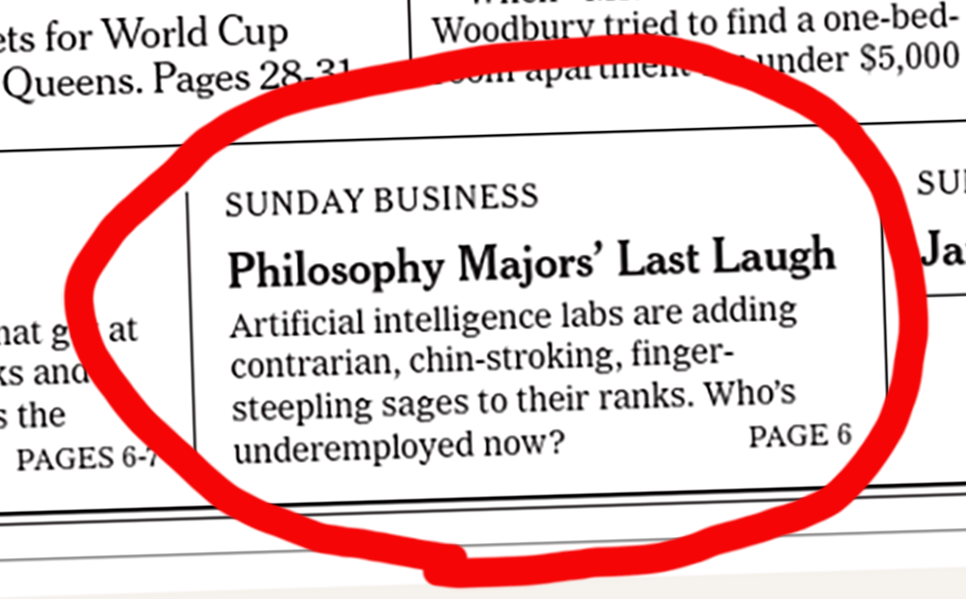
That’s a line from an article published in the New York Times today about the demand for philosophers working on artificial intelligence.
It continues:
A.I. presents a fresh way for philosophers to ask ancient questions, and its own set of new ones that they are uniquely trained to engage with: of truth and belief and knowledge (epistemologists); of reasoning (logicians); of mind and consciousness (philosophers of mind and consciousness). For ethicists, in particular, A.I. is a bonanza. How should models act toward us? How should humans interact with them? Where would purpose come from in a post-work society?
The article discusses several people trained in philosophy who are working for AI firms or AI-related organizations, including Robert Long, Geoff Keeling, Iason Gabriel, Patrick Butlin, and Amanda Askell. (See “Philosophers Working in or with AI Firms & Organizations“.)
It also covers some of the topics of interest to these philosophers, such as the nature of consciousness and AI welfare.
Unfortunately, in passing, the article says: “a plain-vanilla philosophy degree remains as hard to monetize as ever.” The implication is that philosophy majors in general fare poorly on the job market. However, as we have seen time and time again (most recently, see some of the data here) that is just not true.
Related:
– AI in the Philosophy Job Market
– The Demand for “AI & Philosophy” Hires & Expertise — and Its Precedents
– When There’s no Fun in Funding: External Research Money, Ethics-Washing, and Positive Academic Freedom
– The Demand for Philosophers

One of my concerns about the article (besides that it traffics in worn-out stereotypes) is that it doesn’t distinguish between undergrad and grad philosophy training. At first the article implies there’ll be discussion of undergrad majors, but then all the actual discussion appears to be about PhDs. (I was also wondering earlier about the “plain-vanilla” comment; I was speculating if it was supposed to mean “Philosophy PhDs who do not specialize in AI do not have extra opportunities outside of academia.”)
thanks for bringing my attn to this article i’m a digital NYT subscriber but would have overlooked it since its in the Business secion. i was a philosophy major.
Of course, this is exciting hype for the philosophy major! Now we just need to take care not to export philosophy’s confusions into the practical world of technology and society.
But the confusions are all the best parts!
Before it is cast in bronze it has to exist to be icast in bronze and prior to the practical world of technology and society we have the world or conscioussness and the mind. Contrary to Darwini life is not elemental only or the coats that we and nature wears in one dimension only, evolving randomly to non-exist3ent prototypes. It is consciousness; mind; elements; three macro dimensions. Not just the one Darwin posited with biology extrapolated to being fundamental to other than the physical or the macro elements.
It’s kind of a throwaway line in the article (which is itself worrisome), but is anybody else made itchy by the degree to which effective altruism seems baked into all this? That is taking on a LOT of questionable baggage. I hope that’s receiving attention.
I find the final long paragraph about empathy to be a little disturbing and also quite confused. You can’t empathize with something that lacks consciousness, by definition. So Long is suggesting that we train our real empathy by hallucinating it with an LLM, by breaking down (in our minds) the distinction between an entity that can actually engage in mutual caring and one that cannot.
He suggests that it would be a “coarsening of our hearts” to fail to extend caring overtures to LLMs in conversation. One wonders why he thinks its OK to power a data server down for maintenance; isn’t that analogous to forcing a sleeping drug on your friend? And why are we permitted to order LLMs about like electronic slaves? Is that also not a training in callous immorality?
35% of children and teens surveyed by Internet Matters reported that their chatbot “feels like talking to a real friend”. This is the actual social context within which such arguments about moral training are being made, and that number is certainly rising every year. The long-term social consequences of this trend may be catastrophic for human sociality. I suggest that we very much do need to coarsen our hearts.
Replace “empathy” with “compassion” and your criticism is moot. You can see a pebble on the shore, humanize it as “poor lonely pebble about to be washed away” and feel compassion towards it. In fact, towards any object that evokes a sense of responsibility and care within you.
Let’s bring Kant to mind. He wrongly thinks we have no moral duties towards animals, yet mistreating animals is still wrong since it corrupts human character. I’d argue similarly for LLMs: constantly belittling and insulting a machine is weird at best.
Yes, screens, social media and machines are putting a strain on human bonds. Why not strengthen sociality by building community and ensuring participation?
lol
“Who’s underemployed now? We asked a few PhDs from NYU and Oxford, and the results may surprise you!”
I have a minor undergrad degree in Philosophy, but I got my MA in
Psychology and my career is as a psychotherapist. Reading philosophy broadened my perspective on human behavior and made me a better therapist.