Grammarly is sometimes thought by instructors to be a relatively benign writing tool app, akin to a sophisticated spelling and grammar checker.

That may have once been true, but as Kieran Barker, an educational associate for academic AI initiatives at Carleton College, shows in a new video, it is now an AI-powered cheating multitool.
As he says, “You can very quickly go from no text at all to what looks like a completed essay… with citations… with examples, etc., with pretty much no friction at all.”
As Barker shows in the video (available here), Grammarly can:
- Answer factual questions
- Write whole papers
- Rewrite the paper it just drafted with a variety of different voices (e.g., “the scholar”, “everyday voice”)
- Automatically detect and offer to rewrite passages that resemble AI-generated text
- Read your paper and automatically apply to it the ideas of other authors it determines are relevant
- Find parts of your text that could use citations, generate those citations, and automatically insert them into the paper
- Predict questions your professor might ask about the paper
- Check online for rubrics and comments from the student’s professor to better predict the grade the paper will get and why, make suggestions in light of this, and then apply these revisions at the click of a button.
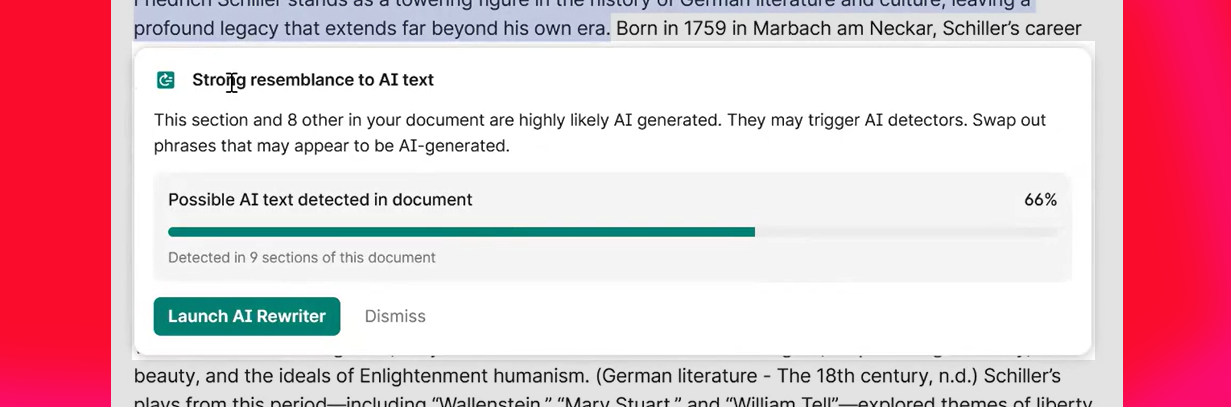
In short, it gives students tools with which to cheat, as well as tools explicitly for hiding that they’ve cheated.
Barker writes:
Although Grammarly markets itself as a writing assistant, many of these tools are designed to do your work for you. The fundamental architecture shared by all of Grammarly’s AI tools—the paragraph-by-paragraph suggestion model… makes this clear… [S]o much of the focus and effort on Grammarly’s end seems to be on its ability to actually rewrite your text.
On its “Grammarly for Education” webpage, Grammarly boasts that it is “trusted by over 3000 institutions”—presumably educational institutions. Here are some:

Why are educational institutions doing business with a company whose main product undermines their central purpose? I suppose we can ask some of the people involved in those decisions, whose testimonials grace the Grammarly webpage:
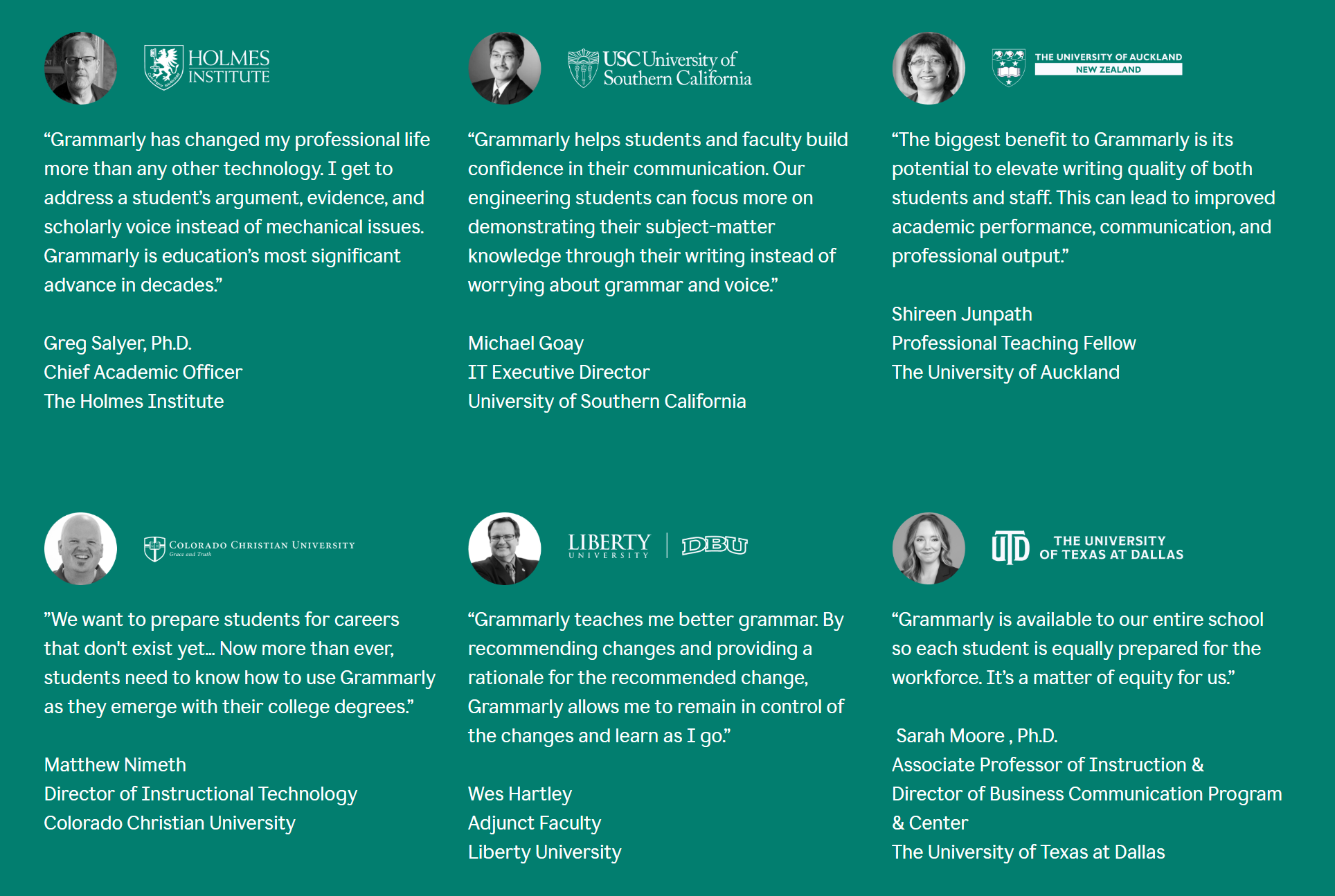
Reading these testimonials, I suppose the best one could hope for is that they were given in ignorance of the app’s current capabilities.
You can watch Barker’s video and read his assessment of Grammarly here.
(via Daniel Groll)

Alternativeto.net is helpful – filter alternative software by platform, license (esp.open source), features, and ratings
https://alternativeto.net/software/grammarly-grammar-checker/
It’s good to draw attention to this. I think there are a few factors at play. The first being that Grammarly really did used to just be a tone, spelling and grammar checker, with a pretty useful anti-plagiarism tool built in. I personally believe the testimonies presented were given in ignorance of the app’s current features.
With the advent of ChatGPT-like technologies, I suspect Grammarly is not growing the way it used to and losing many customers to free or low cost alternatives that do much more. For example, Google Docs and Microsoft Word do a lot of what Grammarly used to do, now at no additional cost. Their recent acquisitions of Superhuman and Coda reveal a company that is trying very hard to stay relevant.
None of this is to excuse cheating or the enabling of cheating. I think it’s just interesting to look at the systemic factors at play. For every school using Grammarly, there are others paying for ChatGPT or similar services for their students.
I think those testimonials are, simply put, ancient. I think looking at the wayback machine archivals will prove my point
Yes, Grammarly has been doing this since early 2023.
https://www.grammarly.com/blog/product/grammarlygo-augmented-intelligence/
But does it really deliver? I really doubt the assertion that “Grammarly can”, which probably should be more like “Grammarly markets itself”. Of course, that won’t make the promotional statement any less dubious, but still.
If Grammarly doesn’t deliver then I guess we don’t have to worry. But since it seems like we have to worry I guess it does deliver. We can’t simultaneously deplore our growing inability to detect cheating and consistently berate AI capabilities.
Thanks for sharing this Justin. I encourage people to actually the watch video. It’s one thing to read about what Grammarly can do. It’s another to watch Kieran use it in real time to generate a paper from scratch.
Thank you Kieran and Justin for calling attention to this. If anyone wants a comparison that is provocative but nevertheless true: https://youtube.com/shorts/OIvLu54Dqpw?si=bKkgI-USVWY9jr99
Now the pearl clutching has extended to Grammarly??? I tell you what, it seems sometimes like a certain wing of the Daily Nous readership is of the view that an intellectual output is not the earned product of a given thinker unless the thinker produces the intellectual output in pure cognitive isolation, without the taint of any form of epistemic dependence. We are truth seekers, sure, but we also adapt to our surroundings to seek truth more expediently (both in inner assertion (thought) and in the exteriorization of thought (assertion) — this is why our ancestors used tools to meet their needs just as we are doing right now. These tools aren’t special. Pearl clutches are fetching a time before epistemic dependence that didn’t exist.
Conceivably some people here make a living (at least in part) teaching students, and conceivably some of those people care about whether their students learn anything. It is good to know Grammarly poses an obstacle to learning, if for instance one was previously inclined to allow students to use Grammarly.
Three things:
(1) Correct me if I’m mistaken, but no one on DN has seriously put forward “pure cognitive isolation” as either a necessary or sufficient condition for one’s taking intellectual responsibility for one’s own linguistic articulation of one’s own thought. Thinking for yourself has never entailed thinking by yourself.
(2) Epistemic dependence is one thing. Epistemic surrender is another.
(3) Grammarly, e.g., won’t usurp the intellectual capacities of well-formed thinkers. But it’s the not-yet-formed thinkers whose intellectual capacities are vulnerable to usurpation.
Not all tech is the same. Mentioning previous technology of the past does exactly nothing to establish the facts about the current technology under discussion.
These are not mere tools (if “mere tool” means in the user’s control). And they are indeed special. What makes them different has been explained on these pages and in many comments people have provided references to understand further why they are different.
Nobody is saying that ideal thinking is the kind of thinking that produces output in “cognitive isolation: without a “taint” of “epistemic dependence”. Not a nary.
“Now the pearl clutching has extended to Grammarly???” Honest question: did you watch the video? If so, does it really raise no red flags for you as a teacher? If not: watch the video!
Did you star as yourself in The Ghost and Mr. Chicken? The credits are no help.
How does the tool for spotting and rewriting “passages that resemble AI-generated text” aid truth seeking?
I would say what you just said to a lot of discussions on this site about many other uses of artificial intelligence. But just because I have no objection to the use of forklifts and earth movers on construction sites doesn’t mean I think people should be using them in the gym! And similarly, just because I have no objection to the use of powerful tools to produce more carefully reasoned arguments in professional work, doesn’t mean I think people should be using them to skip the practice involved in learning to write.
Love this analogy.
Glad to know this about Grammarly. I had assumed it was relatively benign, but had never experimented with it myself or even really looked at it.
FWIW, they also advertise aggressively.
Whenever I click on anything related to higher education, my feeds start to have ads for grammarly and these tools–or some competitor.
Other companies are even more shameless. Some of these ads basically say: “Don’t be a sucker who stays up late. Use our cheating tool.”
Of course students could always cheat, but it is SO easy, and cheap now.
For those looking for solutions, some good sources recommend making students do work in steps, or connect to their own life. They can still use AI to do all of the steps, but they are less likely to. This process should also help students to see what they can learn from following the process, and separate feedback for learning from the final product that earns the grade.
I think it helps to distinguish between the utility of AI support in knowledge generation, and AI’s detrimental effects in learning environments, on learners.
I did not know this about Grammarly, thank you for raising awareness about it.
AI agents that rely on large language models are only, and can only ever be, cut and paste mechanisms.
The material sifted by an AI agent’s ‘suggestions’ are something that has already been written, and digitally archived.
There’s a reason the operators of these systems are repeatedly sued for copyright infringement- the AI agent routinely offers plausible candidates for possible answers to a query, without the capability to distinguish sources protected by copyright, or the capacity to refrain from offering confabulated nonsense. This is how every AI agent used to draft text performs when operating at their best, in the manner they were designed for. For the sake of emphasis, consider the following:
‘An automated framework for assessing how well LLMs cite relevant medical references’
Wu, K., et. al. (2025) / Nature Communications / https://pmc.ncbi.nlm.nih.gov/articles/PMC12003634/
// // // //
The question is not merely one of purported efficiency, but rather the pernicious inculcation in students, and apparently a fair number of faculty (of philosophy no less!), of norms that devalue the actual performance of the tasks of learning and production of individual reflection. The use of AI agents in academic settings also trivializes the routine practice of outright plagiarism. Promoted by this practice as well is the misrepresentation of the nature of work submitted, which is ordinarily considered simple academic fraud. It’s not evident how any of this can be defended.
Of course it is much simpler and less time-consuming to use an electronic parrot to complete assignments than to perform such work for oneself.
Perhaps we need some well-educated humans to engage in a philosophical discussion of the putative merits prioritizing methods of evading reading, composition, review, revision- let alone critical thinking- because these easily employed methods are ‘much simpler and less time-consuming’.
That’s not quite how LLMs work. They don’t sift through preexisting written bits of text, some of which are copyrighted. They were trained on large corpora, some of which include copyrighted works, but their weights are not bits of text. The statistical output anyone gets in response to a prompt is never, excerpt by accident, a bit of text that was somehow stored in memory.
In fact, how I summarized AI agents’ operation is precisely how they work-
https://www.bitlaw.com/ai/AI-training-fair-use.html
The ‘corpora’ you refer to is composed exclusively of material produced by individuals, who are neither compensated in any way by the corporations that operate AI agents, nor given the opportunity to consent for the use of their written output, including countless professionals who make their living from creating original literary, scholarly and journalistic work.
It’s not merely that AI agents may occasionally stumble upon copyrighted material, misappropriation of copyrighted material, violation of fair use requirements, and misattribution are inextricable design features:
‘Redefining boundaries in innovation and knowledge domains: Investigating the impact of generative artificial intelligence on copyright and intellectual property rights’
Al-Busaidi, A.S. (2024) / Science Direct /
https://www.sciencedirect.com/science/article/pii/S2444569X24001690
// // // //
It is at this point well-established that using an AI agent to provide content for a written work of any form will entail the likelihood (I’d say inevitability) that improperly obtained copyrighted material will be incorporated. It is only a question of how much and how often a person adds AI generated text to work they submit which determines the frequency that person’s work product will include misappropriated material.
For those apparently less concerned about the use of AI agents in academia (by students and faculty), I’d suggest we should not view the claim ‘I didn’t know I was including someone else’s research/literary output without proper attribution and citation and simply passing it off as my own’ as the standard.
Each student and faculty member who chooses to use an AI agent in the process of composition is responsible for ensuring they have not committed theft of intellectual property, plagiarism, or academic/research fraud. This is, of course, not exactly a novel expectation, it is the fundamental principle of academic ethics, and always has been- Don’t claim the work of others as yours.
We’re well past the point that any student or faculty could plausibly rely on not understanding or not knowing how AI agents actually function- have repeatedly been shown to function- and how they are routinely used, to defend submitting work that is plainly not theirs. That’s what we’re talking about. It’s not mysterious.
Casual indifference to a practice (use of AI agents in composition of work to be submitted) that inherently undermines academic and scientific integrity doesn’t strike me as a reasonable response.
You’ve described training, which I explicitly said included copyrighted works. But earlier you seemed to be asserting that queries by the user could make the model draw on such works. Not after it’s been trained. The ‘data’ you have access to has a user (or the model for that matter) after training and RL does *not* include copyrighted works. They’ve already been transformed into the model weights as it were. So if there are IP violations (which I think there were, though they’re not ‘plagiarism’ to me), they happened before users could query the model. Current uses of the model cannot constitute plagiarism
PS: I don’t think you’re using the term ‘AI agent’ properly here.
IBM describes AI agent this way:
https://www.ibm.com/think/topics/ai-agents
My use of the salient concepts and terminology is consistent with how the concepts are used in the field that designs and maintains ‘AI agents’.
Of particular note, Grammarly itself refers to its platform as an ‘AI agent’.
It’s right there on their web page (https://www.grammarly.com/ai-agents):
I’ve described what AI agents are, how they operate, correctly. I base my representations of AI agents on the characterizations of those with relevant technical expertise. Your suggestions to the contrary appear to be unfounded.
The harm caused by the ill-informed use of AI agents remains my concern.
You still misunderstand the difference between training and output generation (the copy and paste analogy reflects a profound understanding of how the technology works), and seem to assume that all models are ‘agents’ in the technical sense used in the field. Grammarly may be an agent but most everyday uses of, say, GPT are not agentic. All of this is consistent with the technology relying on massive IP violations.
In the US, at least, the problem is especially bad because in many high schools, Grammarly is just installed on students’ computers, and high school teachers treat it as just something to help with grammar. This creates two problems. First, it has become completely normalized for students. To many of them, using Grammarly to change sentence structure is like people my age using Word to catch spelling mistakes. Second, and relatedly, because the use of Grammarly has become so normalized, it has led students to lose their understanding of what grammar is. Students will sincerely say that when Grammarly rewrites a passage, it is just fixing their grammar. I’m certainly not blaming the students. The problem, at least in many cases, increasingly goes pretty deep into their educational pasts. For this reason, I think it’s super important for anyone who assigns writing assignments to be very clear with students that Grammarly constitutes impermissible AI assistance. That possibility wouldn’t have even occurred to most students.
New paper – what is better: Revisions via ChatGPT, Grammarly or a human editor?
“Overall, U-M GPT made about three times as many corrections compared to the human editor and about ten times more than Grammarly. U-M GPT was the least discriminating in terms of quality: only 61% (51/83) of its corrections were judged as improvements.”
https://journals.plos.org/plosone/article?id=10.1371/journal.pone.0342170#sec009
I’ll just add that I caught about 50 instances of AI use for writing papers last semester. There were numerous others that had an AI flavor that I wasn’t able to provide clear evidence for. The plurality of cases were a result of Grammarly usage. It was worse than the other LLMS for producing near duplicate language and writing structures. (Quillbot was also a problem.) Many students “sincerely” claimed that they had no idea that Grammarly heavily relies on AI. I think they’re taking advantage of Grammarly’s historical reputation, but I also suspect some students were unaware. If it helps – most students said they used the tools to improve grammar and structure. I don’t really grade for the former and early papers are about learning the latter, so, for those who have similar goals, addressing these with students early might help. Also, just clearly indicating tools that count as AI use beyond the major chat functions, including the tools that are increasingly embedded in our word processors or search engines.
Can I ask how you proved AI use? At my institution we aren’t allowed to put student writing into AI checkers due to intellectual property and reliability reasons. The only charge of AI I’ve seen successfully upheld was when a student submitted something with hallucinated references, and then the violation was for fabricating references (a longstanding academic code violation) and not for AI use in the writing of the essay specifically. Basically, the prof needed to show the references were made up and not that the student used AI. The fact that the fabricated references meant the entire essay was AI generated meant nothing.
I believe it is important to remember that Grammarly was originally intended to allow users to correct and check their spelling, punctuation, and overall writing assignments with mild AI recommendations for stronger writing. Now most platforms offer what Grammarly was known for. Google Docs serves as a free substitute, allowing users to fix minor spelling mistakes and even suggesting an AI generated completion of a sentence or phrase. I simply find Grammarly at a point where it must continue to appear appealing to users when operating in a space such as ChatGPT which can produce entire papers with little to no errors in its production.