
Texas A&M University (TAMU) administrators cancelled “Ethics in Public Policy,” a graduate course in the university’s Bush School of Government and Public Service, because they rejected as too vague its professor’s explanation of when and how race and gender issues may come up in the course.
First Plato, now ethics.
Is there some kind of “achievements in irony” award this university is gunning for?
Interviewed by The Texas Tribune, the course’s instructor, Professor Leonard Bright, said:
“I told them it was going to come up every day,” Bright said. “During discussions, book reviews, case studies, throughout the course. There is no one day. That’s how this class works.”
The Dean of the Bush School, John Sherman (like TAMU’s president Tommy Williams, not an academic), announced the cancelled class in an email to faculty, and the students were notified in an email from Lori L. Taylor, Head of the the Department of Public Service and Administration in which she blames Professor Bright for the cancellation, saying he declined “the opportunity to clarify the syllabus”:
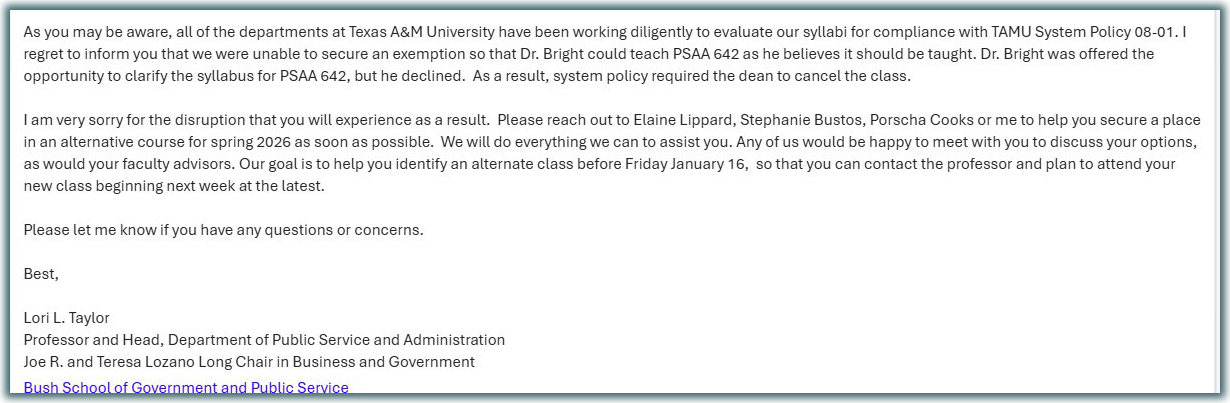
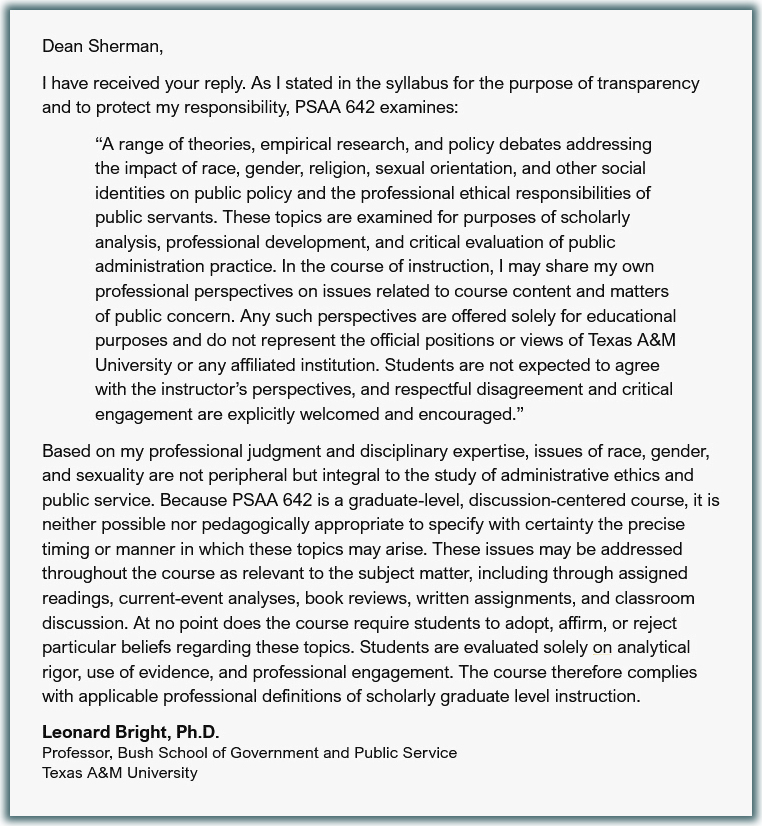
According to Bright, what Sherman said is false. Rather, it seems, Sherman did not accept that the clarification of when and how gender and race would be discussed was something like the very normal and honest: regularly, in a variety of ways, throughout the course.
Bright posted the following email he had sent to Sherman about the course:
In an email to all Bush School faculty, Dean Sherman wrote that he had sent the university’s Vice Provost for Academic Affairs, Michael Johnson, several syllabi to see if they would require special approval (an “exemption”), given their content. Professor Bright’s was among them, and came back flagged as needing that approval. Here is an excerpt from Sherman’s email:
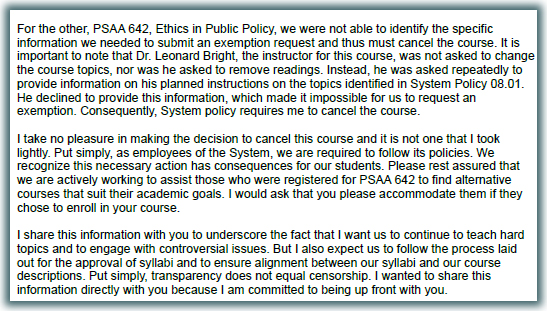
Sherman writes that “transparency does not equal censorship.” That is true. But censorship is not the only form that violations of academic freedom can take. In a context in which transparency has recently resulted in censorship, it is not unreasonable to treat requests for transparency—requests which demand ridiculously, perhaps disingenuously, precise answers about recently censored topics—as violations of academic freedom.
Bright’s course was reportedly the only ethics course on offer at the entire school of public policy this term.
* Yes, this is a long headline. I hope it satisfies my critics.
Correction: the first email was mistakenly attributed to John Sherman; the post has now been corrected to indicate that the email to students was sent by Lori Taylor.
Related: “Texas A&M Bans Plato“, “A Dishonest Response from TAMU President Tommy Williams“, “Legalize Plato: The Shirt“, “A Mess at Texas A&M”
So the options seem to be: (1) hollow out the course, leaving little of substance that would make it worthwhile running, or (2) have it cancelled by administration because the substance of it broaches topics that the administration wishes to censor in compliance with political pressure.
Interestingly, a version of Prof Bright’s position generalises to any course, even in the sciences. Professors cannot rule out a priori the possibility that questions about race/gender (in connection, even loosely, with the subject matter) might come up naturally and organically at some point in the semester, a point that cannot be predicted or predeterined at the time of submitting a syllabus. If every professor at Texas A and M copy and pasted a bland version of that observation and included it in their syllabus, then by the logic of these Texas A&M administrators, *all* courses in the University would have to be cancelled on the kind of vagueness grounds that Bright’s class was cancelled. But, if Texas A&M cancelled all their classes so long as syllabi included the above bland, true statement, they’d run out of money very soon and would have to cave. They’d realize that being a university that teaches zero classes is worse than being a university that teaches many classes, some of which upset the Trumpists.
I’d guess that these policies are not meant to be applied as written – just as the legislative acts that are often cited to justify such policies are not meant to be applied as written. They are meant to prohibit “wokeness” – and the activities of “woke” professors – and to inflict punishment on “woke” individuals.
Textualism for me, but not for thee.
One of the avenues open to us as faculty- especially at institutions that have been stripped of faculty senates- is to report and encourage our colleagues to report threats to and infringements of academic freedom to AAUP and FIRE. When we are unsure if administrators will allow us to apply for grants, teach content in a course, or provide other educational opportunities, instead of self censoring, please tell your administrator you do not understand the requirements and ask for written clarification. This documentation is crucial for joint action of faculty through grassroots orgs and orgs like AAUP in Texas. Please spread the word!
https://aaup-texas.org/blog/f/2025-a-year-of-resistance-solidarity-and-resolve
Lol, yes, can confirm no objections to this headline. <3
Several very good points have been made here, in the OP and in the comments. I’d like to add to them by adding a bit of context and noting some troubling implications.
Here is how the Texas Tribune summarized relevant policy changes in response to the firing of Prof. McCoul from A&M a few months ago:
The cancelation of Prof. Bright’s course seems to have occurred in connection with the first policy, about course reviews. It seems that the university will not approve a course that cannot specify in terms of particular class meetings when race/gender/sexuality will be discussed. Prof. Bright said these topics could come up every day the class met, and that didn’t pass muster.
Now, notice what this implies in connection with the second policy, which prohibits teaching off-syllabus. Suppose one does specify certain class meetings during which the topics of race/gender/sexuality were to be discussed and then a student recorded discussion of those topics on other days than those specified ahead of time. This would seem to be prohibited. Perhaps it occurred, as often happens, because the class got behind schedule. Perhaps the class got ahead of schedule. Perhaps a student made a connection between material discussed on one day and material discussed on another, where that connection involved race/gender/sexuality. It seems that the instructor, by policy, would be required to shut down any such discussion and do whatever it takes to stay on schedule. These demands strike me as inappropriate and unrealistic.
All this is to say that the implications of these policies and how they are being enforced really does appear to be designed to make it nigh impossible to really teach any course that touches on race/gender/sexuality. If one does as Prof. Bright did, and honestly communicates the reality that these topics may come up at any time, then one’s course will be disallowed. If one goes ahead and gives the administration what it wants and specifies particular days on which these topics are to be discussed, then one opens oneself up to the possibility of violating another policy that prohibits deviating from this, even though there may be very good reasons to do so. Damned if you do, damned if you don’t.
Correction: The text says “Email from Dean John Sherman to the students in Professor Bright’s Ethics and Public Policy course” but according to the screenshot, it’s an email from Lori Taylor, Head of the Department of Public Service and Administration.
Thanks, Garret. I’ve made that correction.
So… The Symposium might not be okay in non-core classes, either.
Dean Sherman: “Put simply, as employees of the System, we are obliged to follow its policies.”
This would, I think, also make a swell t-shirt.
Texas A+M students are being treated like fragile little cowards.
“Administrators also announced courses would be audited every semester using artificial intelligence.” That seems to be the only form of intelligence available to administrators in Texas universities these days.
Sick burn! But I don’t know that I’d give them even that much credit. Artificial intelligence is available to them, I guess, but it’s clear they have no intention of accessing or utilizing any sort of intelligence in a manner consistent with the fiduciary obligations of a public, non-profit educational organization.