
A Dishonest Response from TAMU President Tommy Williams
The interim president of Texas A&M, Tommy Williams, has publicly replied to last week’s reports of his university telling a philosophy professor to remove readings by Plato and others from the syllabus of his moral problems course.
In a message to faculty posted on the Texas A&M website, President Williams writes:
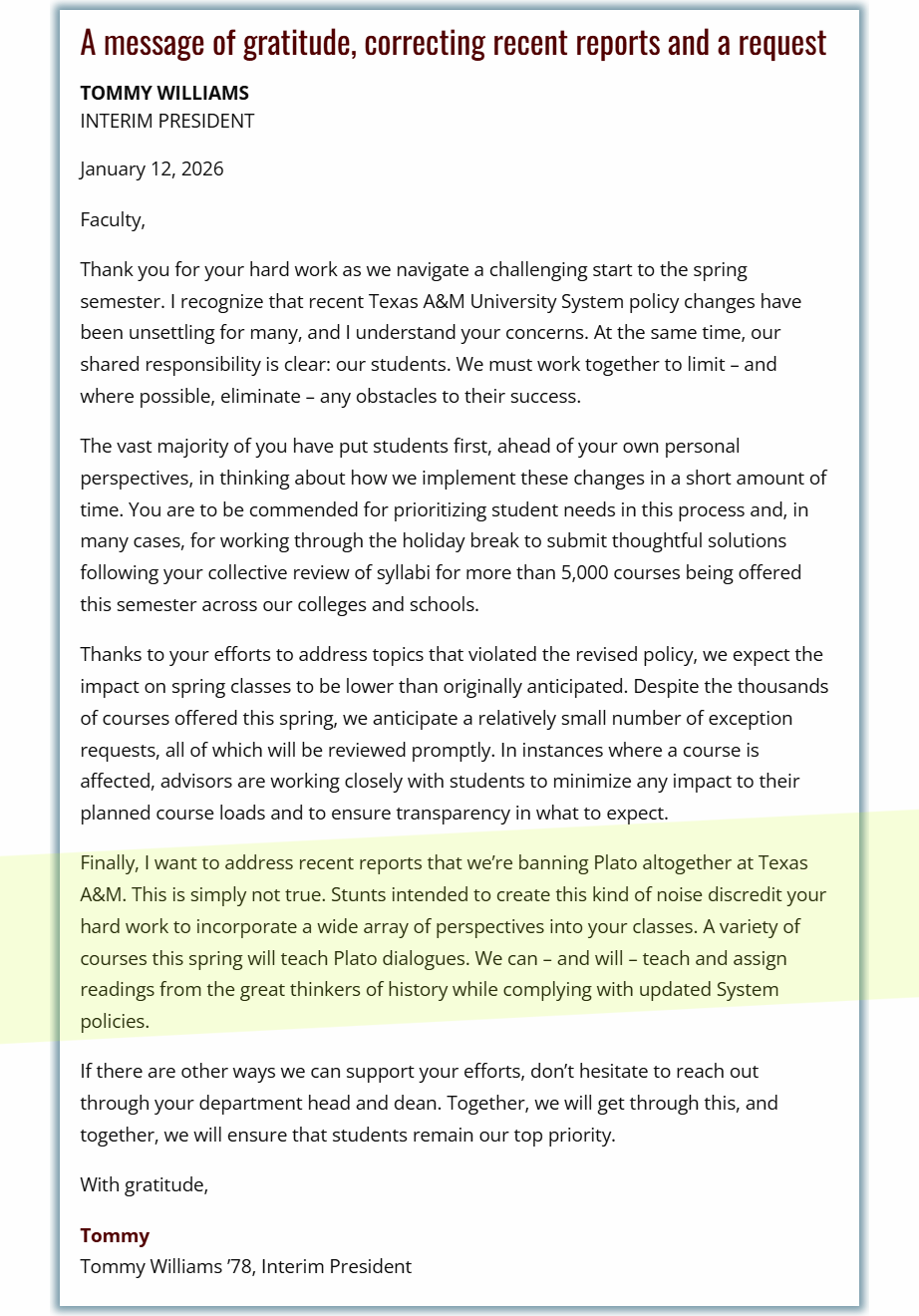
I want to address recent reports that we’re banning Plato altogether at Texas A&M. This is simply not true. Stunts intended to create this kind of noise discredit your hard work to incorporate a wide array of perspectives into your classes. A variety of courses this spring will teach Plato dialogues. We can – and will – teach and assign readings from the great thinkers of history while complying with updated System policies.
This is a dishonest and cowardly reply. It is dishonest because it misrepresents the “recent reports” it purportedly addresses, and it is cowardly because in it Williams does not himself describe and defend what his university did, but instead changes the topic.
Perhaps some random person said that Texas A&M is “banning Plato altogether,” but the post here about these events (which was viewed around 200,000 times in a single day and shared widely across the web), and every other news story about it, has been quite clear about what happened, namely that the university told philosophy professor Martin Peterson that he could only teach his moral problems course if he removed the Plato readings (and some other material) from it. See the emails here.
If Mr. Williams’ reply was honest, it would have instead said, “I want to address recent reports that a professor has been told by the administration to remove a reading of Plato’s dialogues from his course. This is true.”
If Mr. Williams’ reply was not cowardly, it would have then defended the ordered removal of Plato from Dr. Peterson’s course, and not insulted Dr. Peterson’s quite reasonable construction of his course and his expressions of concern about his academic freedom as a “stunt”, nor changed the topic to other courses.

It’s like a burglar defending himself against accusations he stole a pie cooling on the window sill by saying, “I want to address recent reports that I took everything they had. This is simply not true. And it’s their fault that they put that pie on the windowsill. And besides, look at all the people I didn’t steal from!”
Instead of responding like an evasive politician, Mr. Williams should have owned up to what his university has done. Perhaps he now thinks it was a mistake to tell Dr. Peterson to remove Plato from his course, in which case he could have said that, and probably argued for a change to the rule that was applied to Dr. Peterson’s course. After all, as Dr. Peterson notes in a recent op-ed:
The real problem is the absurd policy imposed by the Board of Regents. There is no state law that requires us to censor Plato. The policy could be dropped tomorrow if they chose to do so.
Mr. Williams’ message was addressed to his faculty. He could have spoken to the concerns most of them have about these recent violations of academic freedom, of political micromanagement of pedagogy, and the quality and reputation of their university. Yet he does not do this in any substantive way. The words “academic freedom” are amazingly absent from his statement. Perhaps his message was really addressed to the Board of Regents: don’t worry, I’ve got you covered.
His full statement to the faculty is below:
If partial censorship is okay, I propose this response.
Not that it matters but I doubt that the response was driven by cowardice. It is just politics as usual by people without a spine. In other words, populism as we know it these days.
Sounds like cowardice.
Lack of integrity is the same as (or amounts to or implies) cowardice? Maybe. It is not obvious to me. Often, to cheat and lie and obfuscate takes a lot of courage. One can also do this with integrity (at least on certain accounts of integrity), but even if one does it without integrity, it is not clear to me that this amounts to lacking courage and being a coward. I don’t want to defend this guy, it just matters exactly what we can call him.
You used the phrase “people without a spine.” A synonym of “cowardice” is “spinelessness.” I assume that this is what, to Jessie, sounds like cowardice (and I agree).
Yes, I see this e.g. in Merriam-Webster (I am not a native speaker). I still don’t think the two are the same, since one can act without a spine from any number of motives, one of them is cowardice or fear, but this does not equate the two. To me cowardice, as is clear from this, is one of many possible motives that can drive people to act without integrity. But then perhaps this is not a conceptual analysis, just the way I see the psychology of the agent.
Going back to Williams, the original claim was that his statement “is cowardly because in it Williams does not himself describe and defend what his university did, but instead changes the topic”. In other words, Williams does not own, as it were, his own policy, openly and explicitly. But again, there could any number of motives for his doing so, cowardice is one, lack of integrity (perhaps driven by cowardice, perhaps not), is another. But it is is also possible that he simply has an agenda and he uses such statements as a way of manipulating people and covering the truth, all in service of this hidden agenda (for example, to maintain power, to win elections, whatever). Populists often do this. It is not clear to me that this must be driven by cowardice. A Machiavellian (with apologies to poor Machiavelli) lies and cheats and manipulates their way to power, denying their word if needed, changing topics and so on, but none of this must be driven by cowardice at all.
But I rest my case: the original post is not about this question, really. It just made me thinking.
Thanks for tracking these and other events, Justin – appreciated!
As I noted in my comment in response to the post ‘The APA Board’s Open Letter to Trans Philosophers’:
When fascists have commandeered the government, the institutions of academia become instruments of the fascist regime.
If there remains any confusion about what is happening in colleges and universities across the country, history offers some instructive reference points:
(from: https://heritage.umich.edu/stories/in-the-face-of-fascists/)
// // //
Here’s the reality in the US in 2026:
(from https://www.journals.uchicago.edu/doi/full/10.1086/736480?cookieSet=1)
Fascists view scholars and scientists as inherently suspect, threats to be eliminated. The effort to purge universities and colleges of professors who don’t echo fascist dogma and and comply with fascist doctrine is accelerating.
I’ll revisit questions I posed in my prior comment about the ApA Board’s ‘Open Letter’:
Think this ends simply with denial of tenure and censoring some syllabi?
Think this ends after the LGBTQ community have been ‘dealt with’?
Who knows where it will end? The US is not (yet) an electoral autocracy, hence even an end to Trump is on the cards. Of course, the country won’t emerge from these years unscathed even so.
What is paid less attention to, at least on these pages, is the evident tendency to empire-building by Trump. The resurrected Monroe-doctrine and its specific application by Trump might actually be popular among (enough) Americans. Here is an evident superpower that at last has ditched its protegees and allies and uses its power to claim what rightfully belongs to it: the Western hemisphere. This is an interesting experiment also because its consequences will be at least as decisive as the consequences of its domestic counterpart.
The US used to look at itself as being the leader of the free world. Given these two trajectories – domestic and international – it might soon be nothing else but an autocratically governed illiberal empire. Perhaps its citizens will like this; after all, the British empire enriched itself enormously (at what price, that’s another matter) and many Brits are still nostalgic about it. (Importantly, though, in many respects, the British empire was not illiberal or anti-liberal.)
My sense — though admittedly I don’t have polling data at hand at the moment — is that the portion of the U.S. electorate that actively supports or is excited by actions like the removal of Maduro, the blowing up and killing of alleged drug traffickers in small boats, the detention of Venezuelan oil tankers, the noises re Greenland, the (so-called) 12-day war vs. Iran, and the bombing in N.E. Nigeria is fairly small. It’s a truism that most voters don’t pay close attention to most foreign-policy issues and don’t vote on that basis, which is why Trump’s spending time on these things is unlikely to help Republicans at the ballot box. (More could be said here, but I’ll leave it at that.)
Yes, I suppose as far as the immediate ballot box is concerned, you’re right. But I was writing on the assumption that his becomes a longer-term tendency in the US’s relation to the world. It seems possible that by using its military power, the US could significantly enrich itself in the mid/long-term. Is this sustainable? Will it happen? I don’t know, but it would be good to see indeed how Americans think about this. Why not build an empire of sorts if you have the means to do it? The more liberal version of this was soft power (the dollar as world currency, the exporting of American culture etc), but perhaps as the world is entering a phase of tougher competition, for resources and influence, maybe this is the way to go, or so could many Americans think.
I think you’re right, but would argue that this shouldn’t be viewed as a hypothetical, but more something that has long ago come to pass and which we’re only now coming to fully recognize. That is, the US has already built an empire of sorts, and much of that building happened with actions that were far from “soft” in their exercises of power.
What differs now is that the pretence of justification is no longer felt to be necessary—or, to the extent that it is felt necessary, even the faintest, most feeble attempt at justification will do. There is no need to construct an elaborate edifice of reasons for why the US is doing such and such for fear that a critical press will overwhelm the decision with negative coverage and tank the governing party’s approval. The governing party, much like the US it now governs, feels itself beyond the reach of such scrutiny and the consequences that might follow it. They’ve learned that there are no consequences, not even for insurrection; that the institutions meant to hold them to account have eroded to a point where they can no longer effectively resist their corruption; that they can proceed as they wish and call any and all resistance terrorism.
Will Americans support this? Some evidently do, enthusiastically. Others are perhaps indifferent. Others still oppose it. In any case, it’s clear that the regime can get by on a self-serving narrative that it has the approval of Real Americans, the patriots, the ones who matter. Damn the rest; if they resist, they’ll be dealt with.
> It seems possible that by using its military power, the US could significantly enrich itself in the mid/long-term. Is this sustainable? Will it happen?
This seems possible, but extremely unlikely to me. Military power can change geopolitics, but it doesn’t tend to produce wealth the way that peace and free trade do.
And if you think you can avoid incurring these brutes’ ire through any sort of partial accommodation of their ideological preferences, you’re sorely mistaken. Heidegger learned this the hard way. As odious as his flirtation with Nazism was, his unwillingness to embrace the full letter of the party line in all instances was enough to taint his rectorship, from the perspective of the Third Reich. There is no riding the tiger, people. There is no “working within the confines”.
Well, the Legalize Plato T-shirt, on which you reported with a suitable disclaimer, did deserve a response.
Yes but according to the rules that response must also be in the form of a novelty t-shirt.
The previous Daily Nous post you referenced and linked to is titled “Texas A&M Bans Plato.”
Headline writers, amirite?
You are rite!
We very often leave quantifiers implicit in English. This is why B is appropriately puzzled by A’s weird response to the news that Steve read Plato during his two-day vacation.
Imagine: A: “What did Steve do on his two-day vacation?” B: “Among other things, he read Plato.” A: “What?!! All of Plato?!! Even the Lysis?” B: [wtf?] “No. Only some Plato. Not the Lysis. I said he read Plato. I didn’t say he read *all* of Plato’s works.”
If a university banned hate speech, would it be appropriate to report it as “university bans speech”? Probably not, even though they do ban *some* speech. Yes, reading some Plato is reading Plato, but banning some Plato isn’t banning Plato. Maybe because banning is an all-or-nothing kind of thing whereas reading is not.
I’m not sure what’s dishonest about this. Plato wasn’t banned at Texas A&M. The Daily Nous headline to the contrary (“Texas A&M Bans Plato”) was false.
What actually happened is that certain passages from the “Symposium” were restricted from being taught because they hadn’t received prior approval by some committee. It’s not clear that the instructor even sought approval from said committee. It’s further not clear that, had he asked, his request wouldn’t have been approved. Not sure we know one way or the other.
Why do we want to go around saying Texas A&M “banned Plato”, when it didn’t? It feels to me there like *we* are being dishonest, not them. Because they *didn’t* actually do what we’re saying they did, and we know it.
Why not just say “Texas A&M has some stupid committee, with unnecessary oversight”? I think almost all of us (including me) would agree with that.
But look, we’re philosophers and we’re supposed to be good with words. And critical thinking. There’s plenty to worry about here, but let’s not make false and distortional claims about what’s actually happened. In my opinion, respectfully submitted.
“Texas A&M Bans Meatballs” does not imply that all kinds of meatballs have been banned from everywhere on campus. It would be a perfectly good headline for an article at Daily Ground Beef about how rumors of contamination have led the university to stop serving meatballs made from beef in undergraduate cafeterias.
It is perfectly normal for headlines to be brief and for specifics to be in the article itself. (In the case of my article about TAMU, the clarification was in the first three sentences of the article, which were followed by the email Peterson was sent.) Further, the headline “Texas A&M Bans Plato” is compatible with multiple reasonable specifications, and leaves entirely open what specifically Plato has been banned from and the extent to which Plato has been banned.
“Actually…”
No, that headline makes it sound like Plato was not allowed to be taught in philosophy classes at that campus. I saw it repeated on Twitter over and over by people who didn’t bother to read the article who took it that way. Your article was clear, but the most obvious way to take the headline, which many people did, was precisely what he was responding to. He did dodge the real questions, but it’s not as if no one out there was saying the thing he was responding to. I saw lots of people taking your headline that way, and I had to correct them.
I don’t have to have read every word Shakespeare wrote to have read Shakespeare. I don’t have to have eaten every pizza to have eaten pizza. TAMU doesn’t have to have banned every dialogue to have banned Plato. At worst the headline is ambiguous between universal and existential readings. If you want to explain ambiguity, news headlines always provide the best examples. Just from today’s New York Times: “Republicans Block Efforts to Check Trump’s Power in Venezuela,” “Au Pair Testifies of Lurid Plot in Virginia Double-Murder Trial,” “Newsom Says California Will Not Extradite Abortion Provider to Louisiana.”
To repurpose something I’ve asserted in a prior discussion-
When confronted with an institutional assault on academic freedom, quibbling about terminological minutiae is an abject moral failing.
University administrators in this instance are not merely acquiescing to the demands of the regime, they have made a conscious decision to act as the mechanism of censorship, and have agreed to adhere to the regime’s standards of approved course materials.
What is on display at universities and colleges across the country mirrors what we have witnessed at federal agencies over the past year: a systematic purging of individuals deemed ‘undesirables’, the imposition of state sanctioned curricula and materials, and the elimination of programs that are perceived as challenging the authority of the regime. This is a coordinated effort to dismantle public higher education, and to replace it with platforms for the dissemination of the fascist worldview.
Headlines? The concern to focus on here is headlines?
This exactly.
I imagine that in a world where academics were being rounded up and put in prison camps, there would be philosophers debating whether these places really met the definition of ‘camp.’
Yes, and then someone will come along and say “you’re paying attention to the wrong thing!” thus attending to the attention of people who are attending to the wrong thing. And none of us will be attending to the right thing. At least for a minute or two.
As is often the case, it’s possible to pay attention to two things at once: here, the issue and the headline.
Core curriculum courses if they are to remain as core classes (they could be renumbered but students wouldn’t get core curriculum credit) were not allowed to have a justification provided— either the material is removed or the course is not taught.
Martin’s class is a core curriculum class with close to 300 students in it.
This is not just a stupid committee with unnecessary oversight. This is a revision to system rules that censors materials used in class and also discussions one might have in class.
By your own comment, let’s call what they are doing exactly what it is: censoring the faculty. Period.
It would for sure have been better to say “Texas A&M requires professor to remove Plato from introductory philosophy class”.
Why does a committee need to approve what a seasoned PhD instructor–no matter his or her rank–selects for reading in a course she/he is teaching? That’s already a type of censorship by process, because instructors will then self-vet what they think a committee may or may not approve (a type of panopticism).
Suppose you were allergic to strawberries and the waiter said, don’t give this person any fruit! It would be reasonable to point out, I can eat other fruit. I’m only worried about the strawberries. But suppose someone said, we cannot permit strawberries at the table because they are a forbidden, dangerous red fruit! You would reasonably wonder what we are supposed to do with the other red fruit, or whether other fruit might be risky even if not quite red. What happens when a student comes in with a pomegranate? No idea.
They’ve done it again.
https://www.insidehighered.com/news/faculty-issues/curriculum/2026/01/15/texas-am-cancels-graduate-ethics-class-course-review?
“Administrators at Texas A&M University in College Station canceled a graduate ethics course as part of an ongoing course review that seeks to censor instruction on topics related to race, gender and sexuality.”