
He sees you when you’re sleeping. He knows when you’re awake. What else does Santa Claus know, and how does he know it?
These are the questions Derek Anderson (Boston University) examines in his timely investigative report, below.
Seasons greetings, everyone!
(A version of this post first appeared at Dr. Anderson’s newsletter, The Derektatus.)
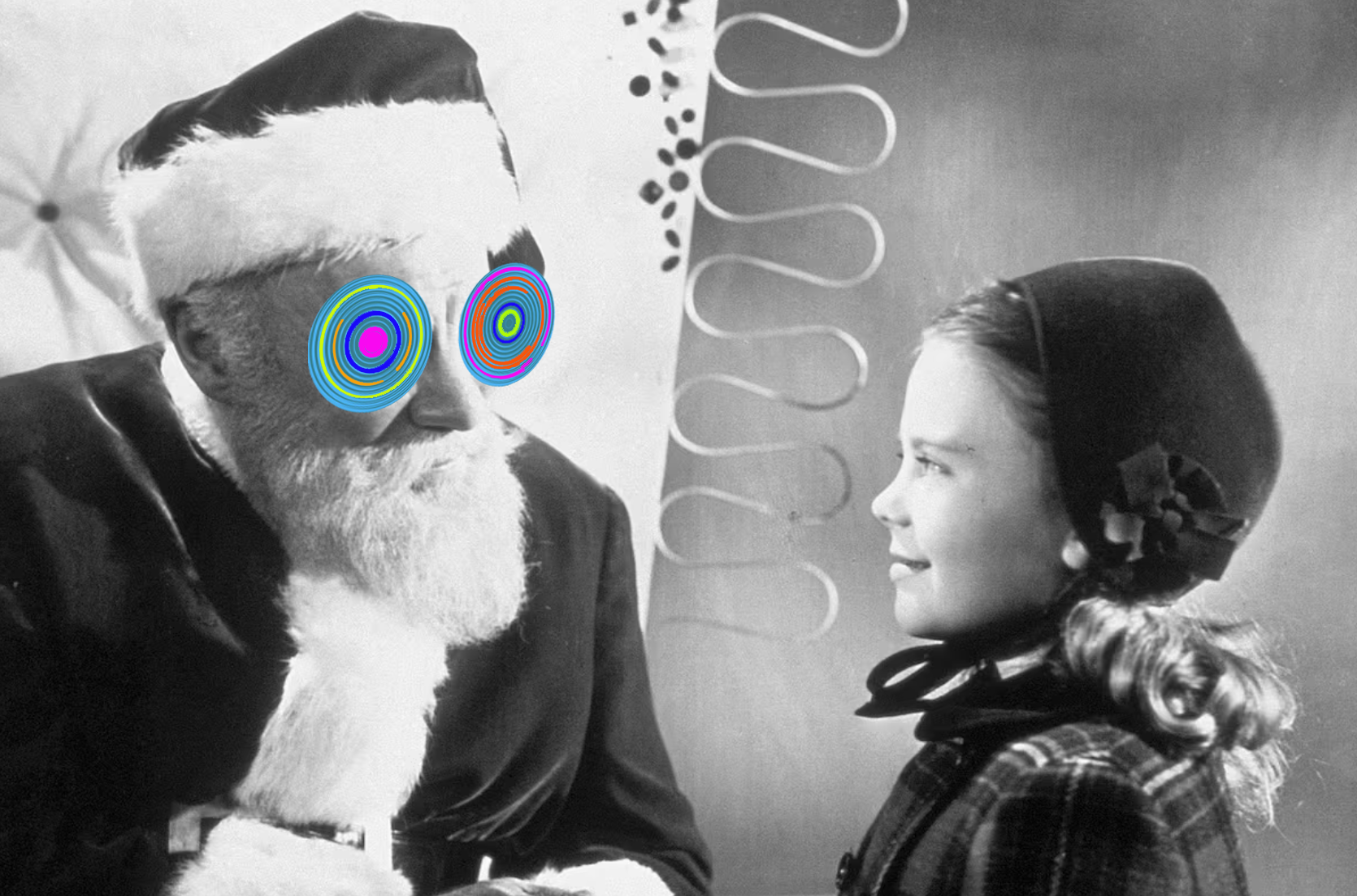
Just What Exactly Does Santa Know?
by Derek Anderson
Santa is not God. He doesn’t know absolutely everything. He can’t, for example, see the future—otherwise, why would he need Rudolph to guide his sleigh through that foggy Christmas Eve? For that matter, according to the film, he doesn’t know Rudolph has a red nose until his false one pops off. But he does have epistemic powers far beyond those of mortal humans. So just how much does he know?
You Better Not Pout
I take it the following facts are uncontroversial:
(1) He sees you when you’re sleeping.
(2) He knows when you’re awake.
(3) He knows if you’ve been bad or good.
(4) So, (you should) be good for goodness’ sake (or else he will know you’ve been bad).
From (1) we can deduce that he has a kind of clairvoyance that allows him to visually perceive things at a distance, like whether you have gone to sleep or instead secretly stayed up reading comic books against your parents’ wishes. Since it’s a kind of visual experience, the most natural interpretation of (1) is that he has a kind of remote viewing power. I picture something like an ethereal, invisible free-floating camera that can hover somewhere in your room. Also, the fact that you better not shout suggests these live streams have audio, too.
Does Santa perceive through multiple of these remote viewing perspectives at once? He must, since he is responsible for keeping tabs on hundreds of millions of children. So, he must be perceiving at least that many mystic live streams at once. But I think he probably does not have a clairvoyant point of view of everything from every angle, as I imagine God would. We should not postulate anything not absolutely warranted by the facts. So, what we can conclude is: Santa can visually perceive what everyone is doing from (let’s say) no more than five or six angles.
Is this the extent of his epistemic superpowers? The fact (2) that he knows when you are awake suggests a further kind of power. Maybe you thought he knows when you are awake simply by seeing you. But what if you were pretending to be asleep? Would that trick him? NO, because he knows when you are awake, even if you convincingly appear to be sleeping. Santa has a kind of perception that goes beyond remote viewing visual perception. And we can bet that Santa doesn’t just have a reliable intuition for when you are pretending to be asleep. He can surely also tell whether you are pretending to be nice, when you are pretending to tell the truth, etc.
What kind of knowing is this? Perhaps it is a kind of reliably formed intuition—a perceptual seeming. He can just infallibly tell when you’re faking because it seems to him like you are faking. Does Santa know how this reliable intuition works? We have no evidence that he’s that kind of knowledgeable—I doubt Santa knows all of neuroscience, much less how his magical powers influence his brain. In that case, he simply has an infallible reliable intuition regarding whether you are faking or sincerely doing what you appear to be doing.
Does that make Santa a kind of Truetemp for wakefulness?
Truetemp is a famous thought experiment character, a man who has a device in his brain that causes him to reliably guess the temperature with complete accuracy, but he has no idea how he does it. Some philosophers (not me) think Truetemp does not really know the temperature, since he has no justification for thinking his guesses are right. If those (wrong) philosophers are right, then Santa does not know when you’re awake—he’s just lucky. I would be content to think Santa’s intuition counts as knowledge. But there is a further reason to think he doesn’t need to rely on that kind of seeming to know whether you are asleep, whether you are lying and so on.
He’s Gonna Find Out
Consider now facts (3) and (4). He knows if you’ve been bad or good, so therefore you must be good for goodness’ sake. Being good for the sake of getting presents on Christmas morning is one thing, but if you do that, Santa will know you are not being good for the sake of being good, and thus judge you to be bad. Santa is no consequentialist. The motives matter. You must be good for the very reason that it is good to be that way. If you are being good for presents: naughty. In fact, if you are being good to your sibling for their sake, but not for the sake of goodness itself, then you are still coming up short. This is actually so demanding that it’s kind of surprising anyone is getting presents. But let’s set aside Santa’s exacting standards and focus on how he knows whether you are being good for goodness’ sake.
Clearly one can’t tell someone’s motives from merely remote viewing them visually. Whether the person’s actions are being done for goodness’ sake is a fact about their intentions. The natural inference is that Santa can perceive our motives. Santa has a form of telepathy. He can hear our thoughts, maybe, or feel the feelings behind the actions, or maybe he can simply sense (in the Truetemp way) whether our actions are being done for the sake of goodness. So not only is Santa capable of remote viewing us visually, but in one way or another he sees inside our minds.
This seems especially plausible for lying. Unless Santa knows all the facts, he must be able to tell that you are lying by knowing something about your motives. So even if he is not concerned with making sure you act for goodness’ sake, he must have some kind of telepathy—assuming he doesn’t have God-like omniscience about absolutely all the facts someone could possibly lie about.
But there is perhaps a deeper level. Kant claims that none of us knows for sure whether we are motivated by the reasons we consciously think we are motivated by. The shopkeeper might sell a candy bar to a child for a fair price for the sake of their reputation, and not for the sake of duty, even if they themselves consciously believe they are doing it for the sake of duty. The shopkeeper might be deceiving himself about his real reason for doing business honestly. Psychologists like Freud and Jung took this possibility to a whole other level. You don’t necessarily know your motives, just by reflecting on your conscious attitudes. But Santa knows. So not only can Santa see your conscious thoughts, but he can perceive your unconscious mind.
This is the extent of Santa’s epistemic powers in my view. We don’t have any reason to speculate he knows more than what he can gather by remote viewing and deep telepathy.
But some of you have probably been dying to object: what about the list? The magic list with the children’s names on it, showing who has been naughty and who nice?
Some people, and I think some films and books, represent Santa as knowing only in virtue of checking his list to find out if the children have been naughty or nice. He doesn’t know until he checks the list and apparently must occasionally check it twice to make sure that he didn’t read it wrong. This list, then, would be the source of his knowledge—a kind of scrying device. But this seems to undersell Santa’s powers in at least two ways. First, it doesn’t make any sense of the fact that he knows when you’re sleeping and when awake. The list theory totally obscures his remote viewing powers. Second, canonically Santa makes the list. He is the source of its information.
But why does he make the list? Why is he checking it twice? The obvious answer is that he does not have perfect memory. He is very old after all, and he is not God. He is also keeping track of SO MUCH. Not only the moral status of every child but also the elves, the toy factory, the reindeer, and his wife. It’s really not surprising that he would need to write down a list of who is naughty and who is nice. So, let’s not buy into the theory that the list itself is the source of his information. Santa’s knowledge is far more expansive.

He knows both that P is true and that he doesn’t know P. Don’t ask how, it’s Christmas magic 🙂
There are at least two alternative interpretations of (4) that strike me as more plausible than “you must be good for the sake of being good”, in the sense of “no ulterior motive”:
A) “be good for goodness’ sake” used as idiom, synonymous with “be good, by golly!”
B) “be good for goodness’ sake” used as synecdoche, where the whole of the good is standing in for the part that is the joy of receiving/opening presents. In this case, the claim expresses “be good, to receive such a constitutively good thing as the joy of opening presents”
I’m willing to abandon (A) if we are assuming some sort of textual originalism for the song lyrics AND there’s evidence that the idiomatic usage is newer. But I’m not sure why originalism is the right interpretative framework to use here for myth kept alive by culture. (And I don’t know about the history of the idiom.)
(B) strikes me as most plausible, since the lyrics are directed at a child, whose most intimate relationship with the Good at this stage in their life is presumably the phenomenology of Christmas/gift unwrapping, anticipated for months each year. So the song is most charitably attempting to meet them on their level, offering one last piece of evidence to compel the central argument.
(Disclaimer: I did not grow up celebrating Christmas. But I did grow up inundated with this song)
I concur on “for goodness sake” bit being the idiomatic expression, so it should be taken as something like “just be good already” rather than “for the sake of Goodness”.
Maybe too simplistic, but I’ve always thought that these claims about what Santa knows are more about what Santa could know, if Santa wanted to know. So, at any moment, Santa could know that I’m faking being asleep or whatever. The very possibility of Santa knowing these things is sufficient to motivate kids to behave appropriately. The other important Santa knowledge claim — what each kid wants as a gift — is dealt with by naturalized means (Santa’s “helpers” at the local mall, letters from kids, etc.).
I didn’t grow up believing in Santa, though, so maybe my intuitions about Santa are not appropriately formed.
There’s a tension with the claim that Santa knows whether you have been bad or good, and that he’s forgotten it and so has to check the list. The song does not say “he’s in a position to know whether you’ve been bad or good.” It says he already knows it.
The best resolution I can think of is to endorse an extended mind thesis, on which the list is in fact a part of Santa’s mind, and so partially constitutes Santa’s memory. This can be taken either as evidence for the external mind thesis or evidence against the existence of Santa Claus.
(1)“he has a kind of remote viewing power. I picture something like an ethereal, invisible free-floating camera that can hover somewhere in your room. Also, the fact that you better not shout suggests these live streams have audio, too.”
(2)“You don’t necessarily know your motives, just by reflecting on your conscious attitudes. But Santa knows.” Perhaps in virtue of the patterns he has learned through accessing the data you’ve left on all your devices the last many decades, together with principles of persuasion he learned in an advanced Psychological Principles for Marketing class.
Clearly, Santa is an AI.
I was trying to check the lyrics just by memory, and that made me realize I’m actually quite fuzzy on the non-Springsteen version of the melody.
Anyway, the song says (1) “he knows if you’ve been bad or good” but also (2) “he’s gonna find out who’s naughty or nice.” That suggests to me that he knows only at the end of a finding-out process. And perhaps that’s where the list comes in: he sees when you’re sleeping, etc.; he writes all that down; then he thinks it through, at which point he knows if you’ve been bad or good.
If this is right, then the list isn’t a list of who is bad or good, but just a list of facts like “Derek was reading a comic book at 11:30 pm, against parental orders.”
I’m honestly surprised that this passed editorial checks. The post is poorly argued, displays a striking unfamiliarity with the literature, and is downright unethical.
The arguments are at roughly the level of a high school essay, but I won’t belabour that point. What is genuinely troubling is the apparent unawareness of decades of work in Reindeer Studies. The author’s suggestion that Santa’s powers originate in his own brain (Godlike or not) has been extensively debated and decisively rejected. Rehearsing those arguments here would only invite a fruitless swarm of comments from others who, like the author, are unlikely ever to have opened an issue of North Pole Epistemology.
I’m sure I’ll be chastised by the DN commentariat for saying this, but it’s hard to ignore that the author is a cis grey wolf, and grey wolves have historically predated on reindeer. It is no coincidence that reindeer are mentioned only once, and then merely as another thing the poor old man must keep track of. Nowhere does the author acknowledge that reindeer possess magical epistemic abilities, or that Santa’s success depends on their ongoing exploitation. The Santa-centrism drips off the page to such an extent that it is nauseating.
I’m sorry, this comment appears to stem from a bad case of lupophobia – the last thing I’d expect from a contributor to North Pole Epistemology. I’m not sure where the obsession with reindeer comes from, but worrying about inclusivity with regards to naming all the bad actors involved in setting up Santa’s surveillance system is distracting attention away from more germane ethical matters before us.
just say you’re a scrooge.
I was following the reasoning for the most part but stumbled a bit on
which feels like smuggling in a bunch of premises on a sleigh.
First: what kind of “you better not” is this? Is it
a) a moral heuristic (e.g., “shouting is naughty-ish”),
b) a prudential prohibition (shouting likely scares Santa/Rudolph/nearby elves), or
c) a surveillance threat (shouting will not only be detected but also punished)?
It seems only (c) really speaks to Santa’s sensory channels.
Second: Even if Santa cares about shouting (and disfavors it for whatever reason), why assume that he‘s the one who must perceive/know it? Maybe it’s Rudolf who has super-hearing and can let Santa know who’s shouting (it turns out that reindeers do have excellent hearing and are sensitive to high-pitched sounds).
Third: Even if it is Santa who must somehow detect shouting, why think audio is necessary? Of course one can pretend to be shouting without actuall making a sound, but given that our Santa already seems to have “awake-detection” (by telepathy) ordinary livestream is no longer the only means by which Santa “knows”, then microphones feel like a hat on a hat.
“Santa has a list of good children and bad children. The good children will get lots of presents. And so will the bad children. In fact, the only ones who won’t get much are the poor children. That’s because Santa judges a child’s goodness based largely on parental income.” — Cunk