
Barbara Vetter, professor of theoretical philosophy at the Free University of Berlin, has been awarded a Gottfried Wilhelm Leibniz Prize from the German Research Foundation (DFG).
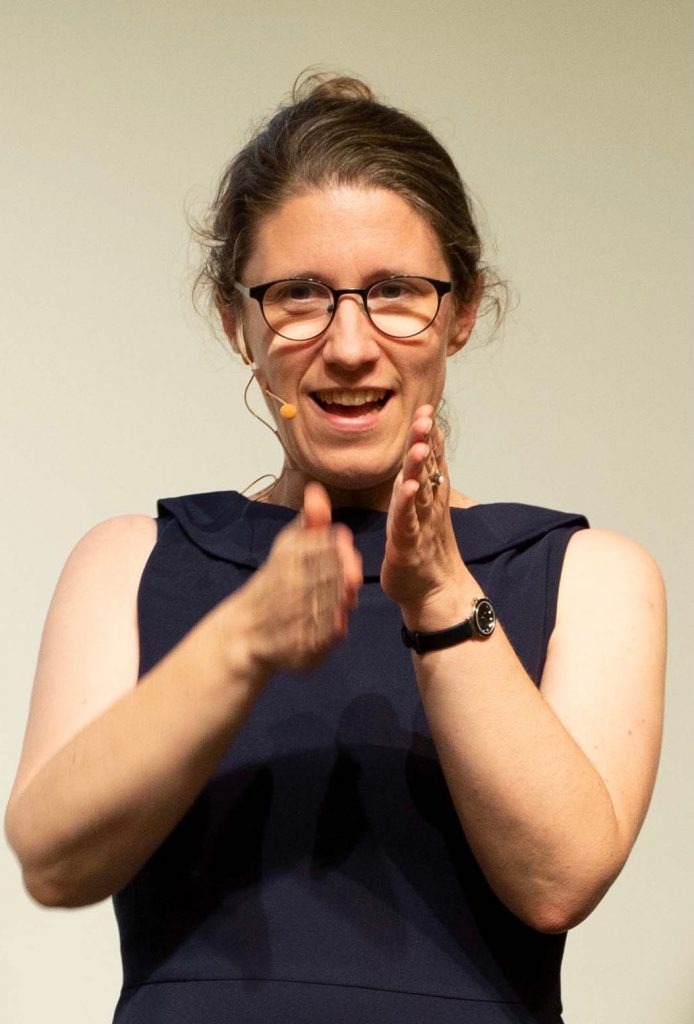
The Leibniz Prize is Germany’s most prestigious research award. The prize includes 2.5 million euros ($2.9 million) in research funding.
Up to ten Leibniz Prizes are awarded each year. Of this year’s winners, Professor Vetter is the only philosopher, and only one of three winners not in a science or engineering discipline.
The DFG says:
Professor Dr. Barbara Vetter from the FU Berlin receives the Leibniz Prize for her work in the field of modality theory, which includes the question of how possibilities can be conceived.
The question of how to conceive of possibilities has preoccupied philosophy since its beginnings. In contemporary analytic philosophy, the model of a plurality of possible worlds dominates. Barbara Vetter has subjected this model to fundamental critique and developed an alternative concept—that of potentiality—which presents possibilities as a driving force and capacity in the actual world. Her work has been praised in the academic community for its technical virtuosity and has significantly influenced the discussion. Vetter is currently working on further developing this approach from the perspectives of action theory and epistemology: How do abilities differ from other possibilities, such as predispositions? What is the relationship between cognitive and practical abilities? How do we learn about our own abilities? Her thesis is that knowledge of one’s own abilities and options for action forms the basis of an agent’s understanding of possibilities. With her work, Vetter contributes to making Germany an internationally important center for contemporary analytic metaphysics, epistemology, and action theory.
You can learn more about the prize and its other recipients here.
(via Manon Garcia)

Philosophy rewarded! That’s good news indeed.
Congratulations, Barbara. This so well-deserved!
Am I the only one who thinks this sounds like a rediscovery of Aristotle’s metaphysical views?
I think Barbara would agree to some version of this claim! Here’s a quote from early in her Potentiality book: “It goes without saying that the notion of potentiality is of Aristotelian pedigree,
and I believe Aristotle’s Metaphysics, book [Theta]
, to be one of the most illuminating
treatments of it”. I got to talk with her a bit about Aristotle in Berlin last year, and my sense is that her views developed in part from her engagement with his views (she got to sit on some of the famous Charles-Frede reading groups at Oxford, I think).