
What Philosophical Idea Or Position Do You Find The Scariest?
It’s Halloween, and philosophers everywhere are dressing up as obscure ideas and concepts that they’ll have to spend too much time explaining. Costumes are fun, but let’s not forget the horror, shall we?
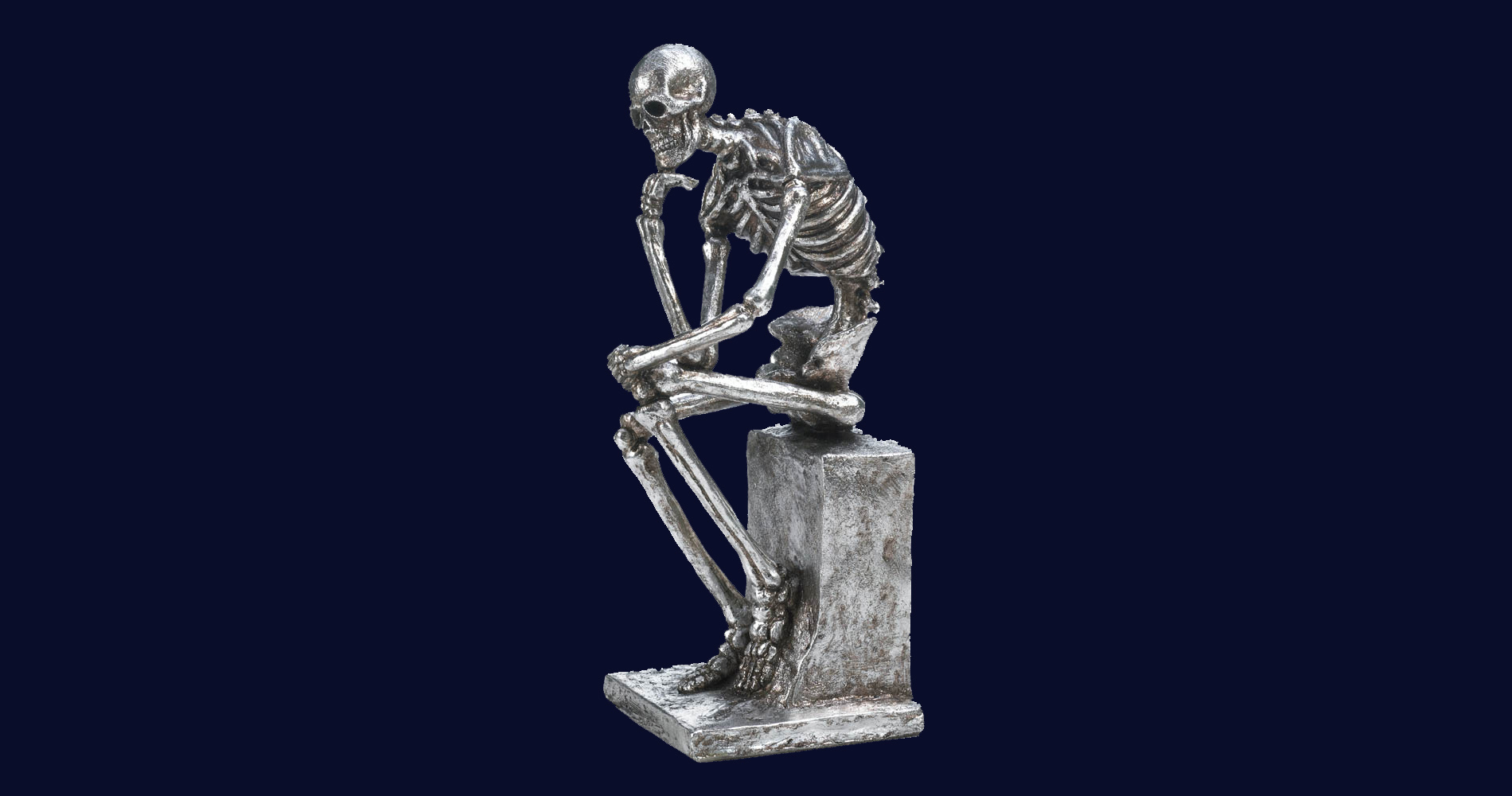
Philosophy has the power to strike fear into people’s hearts. Even the professionals. So let’s ask:
Which philosophical idea’s truth do you most fear?
(Yes, this question does not specify whether you’re supposed to take the probability of an idea’s truth into account when identifying it as the one you most fear. Such unsettling ambiguities you’ll just have to cope with this Halloween.)
[Originally published on October 31st, 2016]

The answer is clear:
“What, if some day or night a demon were to steal after you into your loneliest loneliness and say to you: “This life as you now live it and have lived it, you will have to live once more and innumerable times more; and there will be nothing new in it, but every pain and every joy and every thought and sigh and everything unutterably small or great in your life will have to return to you, all in the same succession and sequence – even this spider and this moonlight between the trees, and even this moment and I myself. The eternal hourglass of existence is turned upside down again and again, and you with it, speck of dust!”
Would you not throw yourself down and gnash your teeth and curse the demon who spoke thus?… Or how well disposed would you have to become to yourself and to life to crave nothing more fervently than this ultimate eternal confirmation and seal?” (Nietzsche, The Gay Science)
Certain strains of speculative theistic satanism can be scary, if you consider the broader gnostic and Neoplatonic background–from the Ricoeurian point of view about the symbolic power of the sacred. Christianity and atheism can be far scarier of course, but you have to start with theistic satanism to point out just how scary the reality if the sacral dimension of life can be. And finally, proceeding ever out of Halloween, scariness is just a stand in for the emotional registration of the power of reality in its true home of ultimate nothingness or divine beyond-of-being supernacy. The transnatural is always there in our metaphysics, even our self-hating metaphysics where “realism” lacks a transcendental foundation. Ghosts, living and incarnate ghosts, and the great chain of beings proceeding from the sacred, and everything in the wild imagination participates in reality in different ways, and our job as philosophers is to know the ways and how they connect to the way of being.
The thesis of David Lewis’ “How Many Lives has Schrödinger’s Cat?”
Don’t worry about this: even wildly-implausible scenarios where freak medical science saves you are much more likely than struldbrug branches.
Antinatalism
Pro-natalism (i.e., natalism) is scarier and far more dangerous to the planet.
The antithesis of antinatalism simply denies that most lives aren’t worth living. It doesn’t tell you how many good lives there should be.
A: ‘How many good lives should there be, Natalist?’
N: ‘Most.’
this is wrong. antinatatlism is the view that procreation is wrong. you can hold this view for any number of reasons besides the view that most lives aren’t worth living.
I’m pretty sure that most of the ‘antinatalism’ submissions imply David Benatar’s argument for antinatalism. If you are not familiar with Benatar’s argument, check it out. The reason antinatalism has been mentioned several times, I suspect, is because, on Benatar’s view, it would have been better for us not to have been, and that’s scary if true.
Maybe I’m wrong to assume Benatar’s view is what’s implied but I’m also pretty sure I’m not wrong about what Benatar argued.
Aren’t most anti-natalists about humans also anti-natalists about animals?
Fideism
Philosophical zombies — they do and say everything we do, but without the “what it feels like” part. Sounds dangerous to me. And, by definition, we can’t tell who they are among us.
personal identity doesn’t matter
Eliminative Materialism.
On the other hand, if it’s true, then it’s not scary, since “fear” is only folk-psychological concept to be replaced by neuroscience!
I think modal realism is scary once you consider what would be included in the realm of all possible worlds. It would mean that there are universes inhabited by people/beings suffering the worst fates possible.
There are people in this universe suffering the worse fates imaginable.
Surely you lack imagination.
I find semiotic/symbolic/expressive arguments for policies and institutions scary. (For example, “We should ban organ sales because organ sales express disrespect for the human body,” or “We should have democracy because democracy expresses respect for people.”)
Hands down, the most terrifying philosophical idea, at least in the modern era, has got to be Utilitarianism. A random assortment of “important” people deciding who and what has “utility” relative to their own arbitrary will (more or less), is responsible for more suffering death and destruction just in the 20th century alone, than in all of the rest of human history. If I could erase one bad idea from history, it would be that one.
Really? I’m not entirely sure that Hitler, Stalin, Mao etc. were utilitarians exactly. Maybe I just missed the references to Bentham in the Little Red Book.
Is the idea that we should do good things even worse? Good has been used as an excuse to do everything bad done in the name of utilitarianism and more besides. And what about social justice? Is that a terrible idea? All the communist atrocities were done in the name of social justice, after all. And what about the idea that we should strive to be healthy? That’s been an excuse for eugenic killing. Alternatively, maybe an idea isn’t shown to be an awful idea by awful things being done in its name, since any idea can have awful things done in its name, and the better the idea, the better the idea, the better an excuse it makes to hide behind.
> A random assortment of “important” people deciding who and what has “utility” relative to their own arbitrary will (more or less)
It’s just as well no utilitarian calls for that.
It will always come back. Any discussion of AI involvement in policy will be inherently utilitarian, as is effective altruism.
If it turned out that at no level, object, meta, meta-meta, meta-meta-meta, etc. in no part of the “world” however world is defined, was classical logic the correct logics, I…do not know what I would do.
Whatever you’d do, you’d do it and not do it.
Or you wouldn’t do it nor wouldn’t not do it.
I’m afraid of Parfit’s “repugnant conclusion” being true.
One student in my MA was an outright egotist. She honestly claimed ‘if it is good for me, it is good.’ Her position scared me (and others in the program) then. I think she became a lawyer…
I think that’s just how entailment works. Did she say that what is good for her is best? Because that would be weird.
Worth it for the punchline
As a lawyer, I have to agree.
Sosa’s distinction between animal and reflective knowledge. Thinking about what animals might know, and what they could do with their their knowledge is downright horrifying.
Eternal damnation
The absence of eternal damnation (for those who deserve it)
Whatever theory of the nature of moral desert leads otherwise cognitively functional people to believe ^this sort of thing.
Nice!
Can’t really top this.
much less scary, but still scary… that professional philosophy is basically a grossly self-centered, self-indulgent, immoral profession.
Wait, it’s scary that it’s true? Or it’s scary that people know that?
…and that’s why I now drive an ambulance.
Your move, academia
I’m so exhausted by the self-loathing of philosophers. It’s the most self-centered aspect of the profession.
Perhaps tttttttt isn’t a philosopher?
More seriously, I’m (sincerely) curious to hear more about why you think this, if you don’t mind. I often feel moderate pangs of guilt for being in academic philosophy (even though I’m by no means well-established), and I also often feel like this is appropriate given its–for lack of a better term and not in the technical sense–bourgeois flavor (getting paid to think/write/talk/teach/indulge pure curiosity about very abstract things). My self-loathing, or at least sarcastic self-loathing, often comes from that thought process, but I’d be very happy to hear why this might be self-centered and/or incorrect. Anyway, sorry for venting, no pressure to reply.
I fear Another Philosopher’s reply is more of a gotcha — or just an expression of annoyance — than anything. People generally understand the thrust of your/ttttt’s concern, and to reply ‘no THAT’s self-centered!’ is maybe clever or gets appreciative nods from other academic philosophers who much prefer not to be bothered. But it is not actually responsive to the concern.
If you are the kind of person who cares a fair bit about making a positive difference in the world, and making (more or less) as large a positive difference as you can — meaning you don’t want too much of your potential to do good to go to waste — then there is plenty of room for skepticism about academic philosophy as a career choice. That doesn’t make you self-centered. It is the opposite.
It is a bit of a gotcha, but I am genuinely fed up with hearing about this so much.
Philosophers are not more self-centered than the average person, actually a lot less so, because most people don’t constantly worry about being self-centered. sapha makes this point in a different way.
I happen to think that philosophy is a noble thing, and hence that having it as a profession is not self-indulgent.
Philosophy is also important for society in my view, and even if I would be hard-pressed to find examples of particular philosophers I think are important in that respect, we all play a role in maintaining a tradition that would be very regrettable if got lost. Philosophy ought to continue, and for that we need philosophers.
Could some philosophers improve society more by doing something different? Maybe, and it wouldn’t be bad if they did so, but it doesn’t follow that those who don’t are thereby self-indulgent.
In my own case, I fail to see where else my powers would be better spent. A mediocre journalist, maybe? Or do we really need more computer programmers?
Philosophers are also often accused by philosophers of creating a harsh working environment for marginalised groups and newcomers. I don’t want to minimise that—that’s probably true.
But I’m also fairly certain that most other subcultures/professions are worse (certainly in my experience) and not really as self-reflective about it as philosophers are. For example, the culture around Q&A has gotten better because of such debate.
Overall, I think philosophers are pretty decent people (I would go so far as to say that they are some of my favourite people) but they are people. People are often bad.
That’s an interesting and helpful perspective, thanks. I guess I still have some questions, but as this is probably not the best place for them, I’ll leave off there. Still, just wanted to say that I appreciate the reply.
For me, the scariest idea is that suicide can be found rational if one believes life is meaningless.
Scary? – Materialism (though I am starting to think it’s true)
Repugnant? Ethical Egoism or Randian Objectivism (though I hardly consider her a philosopher so….)
What frightens you about materialism? (Genuine, not rhetorical question).
The idea that nobody knows much of anything.
Word.
Unfortunately, this one is true as far as I can tell!
As a meat eater I find the prospect that animals might have a significant moral status pretty scary. I’m not convinced that they do (hence being a meat eater). But the stakes for being wrong are pretty high.
As a vegan I find the prospect that animals might organise themselves into revolt against the species which for longer than they can remember farmed them to extremes of misery with no exception for non-meat eaters, scary.
Sounds like a job for Precautionary Principled Man!
Homunculi.
Trivialism, and relatedly, anything that implies trivialism is true: Curry paradoxes, tonk being a genuine connective, classical logic being true.
The block view of time: any and all of the most horrific sufferings never really cease (though the fact that any and all of the most wonderful goods also never cease doesn’t strike me as a consolation for some reason).
The Fermi paradox.
Alethic absolutism. What if the context-insensitive truth sucks?
Any version of the correspondence theory of truth being false (incoherent?). I’m not sure what kind of meaningful epistemology or standards of evidence or reasoning we could have if there were no external check on our assertions.
*All versions, not any version
No free will.
Skepticism. I can see no good reason to believe my senses, nor my cognitive faculties. Brr!
I find the denial of Mark Johnston’s thesis in Surviving Death the scariest.
Everything is water. (I have an irrational fear of drowning. On the other hand, if I’m water too …)
Anything that ends is -ism.
Emotivism!!
I feel sure this post is just an elaborate attempt on Justin’s part to get someone to write “BOO!!thius, mwhahhahahaha!”
You got me.
robust realism about teletubbies
Obviosly Stirner. I don’t think I could handle that many spooks! (or being the creative nothing with the prerogative to control all things which are my property, or the idea that someone else migut think that they have that prerogative themselves)
natural slavery
The survival lottery.
Arch-pessimist that I am, I can think of only a few things more terrifying than some of what our own world actually has on offer, but certainly one of them would be that life has an *intrinsic* meaning imparted by a cosmic arbiter. I would rather live unsupervised in an indifferent and largely deterministic thresher (as in fact I believe I do) than in a world whose familiar structure and content–every horror and form of suffering in every human life–is coextensive with the preventable but intended design of some more powerful agent.
Physicalism
Crude hedonism, where well-being is defined solely as pleasurable mental states. (I.e., that we shold aim to end art, culture, and science once we have become technologically advanced enough to put ourselves into a perpetual drug-induced stupor until our sun dies.)
Also, the near-universal prevalence of hedonism as an answer to the Fermi paradox.
I think that most people have stopped answering the actual, very interesting question in the OP, which is “Which philosophical idea’s truth do you most fear?” and are instead just telling us what philosophical ideas they hate, which is not nearly so interesting.
No Free Will, Anti-Natalism.
I’ll prefix this by saying I really don’t know what I’m talking about these days, but here’s my two cents.
Functionalism, especially of a computational bent, has some pretty scary implications, when you factor in the substrate neutrality of computation.
There’s the obvious worries about my reality being some sort of simulation (whether that just applies to my own POV or a ‘wider’ reality with other captive agents in it too). Matrix-style stuff. But at least those scenarios have a reasonable chance of enduring, even if for a malign or dubious purpose.
My real worry is that, if my reality just supervenes on some suitably-arranged functional structure, there’s no guarantee it will continue at all. A fleetingly-instantiated configuration of sand grains on a beach might by sheer chance be “just so” allowing a few frames of the simulation to occur in sequence, and then the whole thing might collapse instantaneously. From the inside, you’d never know a damn thing.
That the universe is not in some way organized to promote our flourishing.
I dunno–I think it would be scarier if the universe is organized to promote our flourishing, and this is still what we’ve got.
There are many that are easy to hate for the damage they do but none that I fear.
The only philosophy paper I’ve read that has actually scared me while I was reading it is William James, “The Will to Believe”. It’s scary to look out into the abyss and wonder – what if the theists are right, and there really is *evidence* for religious belief, but you’re only able to get it by taking a leap of faith down into that abyss? This seems to have radically skeptical implications
Hi Kenny. Why be scared? According to the reports everybody who looks comes back with good news, although not entirely good for theists. Indiana Jones found there was a magic bridge.
before reading I wagered the answers’d be filled w/ ‘moral relativism’ but then it seems not to even have been mentioned once *chuckle*
Antinatalism is super-dark and spooky.
1. The idea that the truth is terrible (Nietzsche)
2. The idea that comments on philosophy blogs can still be read (haunt you) seven years later.
The view that time has an infinite future. Also the view that time has a finite future.
Sometimes I can get myself pretty scared by thinking about the noumenon.
Given Skepticism and others were already mentioned I’ll go with Pointiliste Spacetime Substantivalism. One may be frightened by the possibility of having no free will or by the fact that nothing can be known, but to be nothing over and above some appropriate arrangement of spacetime points is disturbing: all that reality presents to me and myself are no more than the universe, as if the universe sustained a great delusion.
Solipsism. That is the philosophical twilight zone.
Some combination of philosophical pessimism, meaning nihilism, panpsychism, and limitless reincarnation. What a horrible universe if truly everything that exists suffers deeply, meaninglessly, over and over again, forever.
I agree with Eric on modal realism but I don’t think he’s sketched out how terrifying it is. Not only are there infinitely many real worlds where various beings are suffering the worst fates imaginable there are infinitely many where analogs of you and analogs of the people you care most about are suffering the worst fates imaginable. There are also infinitely many worlds where there is someone exactly like you except that s/he has done something utterly horrible. As someone with a touch of OCD I can’t describe how terrifying I find it the thought that for every single invasive thought I’ve ever had there is world where my analog gave in to it.
(Mind you this isn’t the most dangerous philosophical idea. That’s almost certainly utilitarianism or something flavored by it. But of course scary and dangerous aren’t the same thing. Tarantulas are terrifying. Bears are scary. But mosquitos and dogs kill a lot more people).
“Not only are there infinitely many real worlds where various beings are suffering the worst fates imaginable there are infinitely many where analogs of you and analogs of the people you care most about are suffering the worst fates imaginable.”
That assumes there’s an upper limit on badness of fates. Plausibly there isn’t (one can always be tormented more cruelly, or for longer), in which case no-one is suffering the worst fate imaginable, since there’s always someone suffering an even worse fate.
….I accept this doesn’t reduce the scariness of the idea!
I think the idea that morality can sometimes require that we do things that make things worse for everyone, and not just because it is part of a policy that makes things better for people, seems more dangerous!
Realism about personites, those things coincident with you that are very like persons but not quite persons; in fact they’re so very like you that you ought to take their interests into account.
Real answer: modal realism, as has been suggested by others. Somewhat less serious answer but still professionally spooks me: that evolutionary debunking arguments against non-skeptical moral realism work.
The idea that there is no truth would be very scary if true.
Not to mention contradictory. But I know a Priest who could receive confession.
8 years ago I said emotivism. Given its incorporation into MAGA politics–everything is driven by aligning the right emotional attitudes and truth be damned–I think it’s by far turned out to be the scariest thing to happen in the history of this country.
What’s funny, albeit not scary, is that people are now using this thread to basically say ‘boo Trump!’
Emotivism has won.
If you’re suggesting there is no objective evidence that Trump is completely unqualified for office and that there is no objective evidence that Harris is so qualified, well, then something has certainly replaced rational thinking here.
How is this even remotely what I suggested? And what does this have to do with emotivism?
I said “if”. But what I’m saying is that MAGA arises essentially from radical unconcern with truth if not philosophical denial of it. And clearly the central place of emotions and emotional alignment is behind the MAGA cult. And that word “cult” is clearly deserved, since no disqualifying fact about or abhorrent behavior of Trump’s makes one whit of difference to them.
Well obviously that’s not what I was suggesting but it’s irrelevant. I’m not sure how you understand emotivism but it’s a metaethical thesis about the nature of moral judgments. It may be that it helps us understand political tribalism, irrationality, and polarization — ostensibly evaluative judgments and political disagreements are disguised expressions of emotional states. But for one thing I don’t understand what it would mean for MAGA to incorporate emotivism (do they think moral claims are disguised expressions of emotional states?). For another, if emotivism is true and makes sense of MAGA, it is no less true of democrats, and that’s precisely what I was noting: ‘Trump is scary’ is a perfect example of a barely disguised emotional state under the pretense of rational moral condemnation. If anything, this proves that emotivism may not be defunct after all. I’ll also note that it’s odd to associate emotivism with the rejection of truth given that many of the early emotivists were logical positivists. But yeah I guess boo, Trump.
Performance of a position does not require acknowledgement/endorsement of it. One may do any number of things–utilitarian/deontological/virtue, etc–without knowing what one’s doing. Describing it as such is a labelling, no more. It’s a question of who trusts facts/truth more, and clearly MAGAs don’t. So do you want RFK in charge of health care? That’s not an emotional question–but a question of facts about the efficacy of scientific medicine.
You and MAGAs disagree about values, not just facts. Emotivism says those disagreements are in fact disagreements not about facts but disagreement between incompatible emotive states. I don’t think this is a fully adequate metaethical theory but it’s quite perceptive and it describes fairly well what I often read in the comment sections of DN. You are correct that MAGA substitutes emotions for factual disagreements. But that’s because a lot of politics does that. Thinking only the other side does it is failing to see exactly what emotivism says we’re doing.
Of course emotions are involved in any side of politics. But the question is what drives the main narrative of any side. Truth has some central standing in matters of Jan 6, Trump’s payoffs to Daniels, his stealing classified documents, his obvious denigration of people, his incessant lies about his 2020 loss, etc. etc. If anyone cares about truth, they should reject Trump’s claim to be qualified for office, and that’s that.
Kakistocracy, government by the worst, least qualified, or most unscrupulous, something we might have to live through again if Trump wins or usurps power.
Honestly the scariest thing to me is that many of these commenters are professional philosophers who probably teach the views they are talking about. The disingenuousness with which y’all are talking about theories is horrifying.
Multiple people suggesting that emotivism has consequences for first-order moral assertions. One person says utilitarianism is scary because people might misinterpret it or wield it as justification for evil. One person says that views that deny the correspondence theory of truth means that one has to reject any “external checks on our assertions”.
I have to contort myself in the gnarliest of pretzels to see how someone could possibly see these consequences. Don’t we know that reasonable people hold these views?
I highly doubt that one’s blog comments about a topic, often posted anonymously, are indicative of how one would teach the topic to one’s students.
ah, yes, much better to secretly have severe personal misunderstandings of a view, but then to teach it fairly and objectively when in the classroom.
I’ll just say that when I think about what *scares* me about a view, I tend to think about what’s scariest about it, and that’s usually the extreme versions a minority of its proponents come up with.
When I teach a view, though, I get into a different mindset, one where I’m trying to be detached from the view so that I can present it as objectively as possible.
This is both clearly right and quite un-pretzel-like, if I may say so.
I mean, I guess I can see that perspective. At least only kind of—it seems silly to say, privately to oneself, “Deontology scares me because Eichmann claimed he was following the categorical imperative.”
But more to the point, I think something has gotten lost. What scares one about a view is decidedly not the prompt Justin started us with. Instead, he said, “Which philosophical idea’s truth do you most fear?” And the reasons people gave for being afraid of the truth of particular theories were in fact not entailments of those theories. The suggestion that you might fear the truth of utilitarianism because some individuals might use the theory to justify extreme position is nonsense.
I am scared of hedonistic consequentialism (i.e., classical utilitarianism) because (a) I think it would to all the romance and mystery out of life and (b) because I can see a way I could end up being a classical utilitarian.
So, I fear its truth both because I feel it would flatten my life (and everyone else’s) and because I think it’s not as implausible as most people seem to think.
I don’t think Eichmann is an apt example, because he’s not a philosopher. I think that most philosophers who find the extreme version of a view scary are thinking of a philosopher who has defended it, not just your garden-variety sociopath.
Finally, I think fearing X because some philosopher has advocated an extreme version of X makes sense because if a philosopher thinking carefully about it could arrive at it, then it seems like a lot of people could end up arriving at it. I realize that may seem like a non-sequitur, but I could defend it. But I’ll only do that if you think there’s not a good defense for that view.
Utilitarianism is extremely scary. There are utilitarians who want to exterminate the vast majority of life on earth because predation causes pain. There are utilitarians who want to exterminate all life on earth because life involves suffering.
Just because there are individuals who hold a position and have unseemly views that they justify using that position, this does not mean that the position itself entails these views. This seems obvious. Deontologists can justify all sorts of “scary” views. That’s not a mark against deontology, but against those deontologists who espouse those views.
Yes. The only utilitarians who are committed to such implications are negative utilitarians. This by itself does not make utilitarianism in general scary. Absolute deontology is pretty extreme to me, but that doesn’t make all forms of deontology extreme.
The failure of entailment seems obvious because it is obvious: so obvious, in fact, that Eric is obviously not rejecting it. I won’t put words in his mouth, but there’s a few alternative readings that are… a bit more charitable—even if they still turn out to be false.
(I get spooked by violations of the principle of charity.)
The question was about what views I find scary. I find those views scary.
Not quite. The question is what views you would find scariest if they were true. Would you still find utilitarianism scary if it were true? The answer cannot be that you find it scary because it entails all those false conclusions. Those conclusions wouldn’t be false if it were true! If it were, then you’d be wrong to think maximizing welfare of sentient creatures is not the fundamental normative end. Maybe it’s not true. But what if it is? Scary?
We are reaching heights of pedantry once thought impossible…
Go back and see if Eric ever said that utilitarianism entails those other views. Then see if there’s a good paraphrase of his claim that answers the question. Here’s one option:
“I think that certain kinds of utilitarianism/the beliefs of some utilitarians/what some think utilitarianism requires would be scary if true. For instance, …”.
Maybe lighthearted blog post questions and philosophy just don’t mix.
“We are reaching heights of pedantry once thought impossible…”
Clearly there are corners of this world you haven’t seen.
If utilitarianism doesn’t entail these views and Eric doesn’t think it does and he doesn’t answer the question but is spooked by a scarecrow (pun intended), then you’re right, no one is doing philosophy here.
“Clearly there are corners of this world you haven’t seen.”
I guess I shouldn’t be surprised that the hyperbole was missed.
What makes you think it was missed?
I claimed that we’re reaching heights of pedantry once thought impossible. You replied that I’ve clearly not seen some corners of the world, implying (I assume) that had I seen those corners, I would know that they contain pedantry far greater than yours, and thus far greater than what I implied was even possible. But this is only relevant if my original claim is read literally. And it’s clearly not meant to be read literally. Rather, it’s a hyperbolic way of saying “your reply to Eric is too pedantic for this thread.” Since your reply wouldn’t work without the literal reading of my claim, you’ve missed the hyperbole of the latter.
That said, I will admit that you’ve now successfully tricked me into commenting with exactly the pedantry I wanted to criticize. So, in that sense: well-played.
Exactly.
Not quite—I was once again being hyperbolic. It’s hyperbole all the way down!
Keep climbing!
Oops, yes: it’s hyperbole all the way *up*!
No, look back.
Excuse me, I’m *trying* to have the last word here!
I’m with you, utilitarianism. Once you start equating ethical value woth happiness and quantifying it all sorts of nasty conclusions can be reached, but more fundamentally the whole idea is redolent of contempt for value itself – the ultimate nihilism.
If it’s even coherent, the idea that only I exist is an idea that terrifies me.
Were that idea to be true, I’d at least find some small comfort in knowing it doesn’t terrify anyone else.
When I was having panic attacks several years ago, I genuinely had some that centered around the idea that there was no way to refute radical skepticism, and especially around the idea that you can’t really know that solipsism is false and that everyone around you is a simulacrum or something with no mental states. It still strikes me as rational to be terrified at that thought, though fortunately I am no longer in an emotional place where it induces actual panic.
I had a very similar experience once, albeit under the influence of too much THC. It’s the one time that the angst of Cartesian doubt viscerally struck me and I completely spiraled for a few hours. I even tried to “Moore” myself out of it: “here is one hand, and here is another.” It did NOT help.
Anyway, different etiologies, but I have some idea what you may have been experiencing! Glad to hear that the thought no longer leads to panic.
Oh, that’s really interesting – a kind of THC-induced paranoia that had never occurred to me. I think it would be really cool to make a iist of philosophical freak-out inducing moments and put them in a book for stoners. It could be a short philosophical horror book. Somebody should do this.
Interestingly, my panic attacks were also triggered by a THC overdose, although they persisted for many months after the initial incident.
While we’re cataloguing terrifying versions of skepticism, I’ll add inductive skepticism as one that’s been capable of striking horror into me. The thought being that you ultimately have no rational justification for thinking that the next time x occurs, y won’t occur, for arbitrary x and scary y (e.g. the next time I open that door, the room will be filled with the dead bodies of loved ones).
For anyone with similar inclinations to find radical forms of skepticism both plausible (or at least, hard to refute in an emotionally satisfying way) and terrifying, I think there’s no better advice than that given by the great skeptic Hume himself (THN 1.4.7.8 – 1.4.7.9):
Al-Ghazali (d. 1111) describes a similar sort of crisis when he was at his peak as a lecturer in Baghdad (in his Deliverance from Error). What cured him was a “light from God” cast into his heart.
Anti-natalism
The termination thesis in the philosophy of death; it’s just a blank at the end of this life.
sounds alright to me.
I actually think eternal damnation is the scariest. But that was mentioned above, so I went with originality (I think).
This is the best of all possible worlds. If that is true, that’s really scary.
Scaryism, the view that all things, including things we don’t know exist and things we don’t find scary at all, are maximally scary. (In all possible worlds, etc.)
That’s too scary, delete this.
Dead people have interests and desires, and will be harmed if you do not do what they want you to do. Therefore, we need legal institutions erected to enforce their wills.
“Simplism” – the idea that the world is really as straightforward as the descriptions you’d get in a kids TV show, that all the philosophy is epicycles running away with themselves.
Narrator: “A caused B”
Me: “whaddya mean, B was counterfactually dependent on A, A nomologically entailed B? Tell me!!”
Narrator: “A made B happen”
Me: “ok.. well, why?”
Narrator: “Because it did”
S-risks
To be distinguished from sn-risks.
Indeed! Though those are terrifying too….
Reincarnation, especially so since I think it might be true. Not quite as bad as Hellfire and damnation, but still a strong chance of being re-born into great suffering.
That we’re living in a simulation.
https://www.youtube.com/watch?v=tlTKTTt47WE
Incommensurability