Begin typing your search above and press return to search. Press Esc to cancel.

  • image/svg+xml Ello Ello

Daily Nous

Daily Nous

Primary Navigation

  • About
  • Comments Policy
  • Open, Live, Online Philosophy Events
  • Philosophy Comics
  • Value of Philosophy
  • Calls for Papers / Grants / Etc.
  • Non-Academic Hires
  • Supporters
  • Heap of Links
Mind Chunks
Home
Daily Nous Features

Mind Chunks


By
Justin Weinberg
.
September 1, 2020 at 9:27 am 0

Mind Chunks
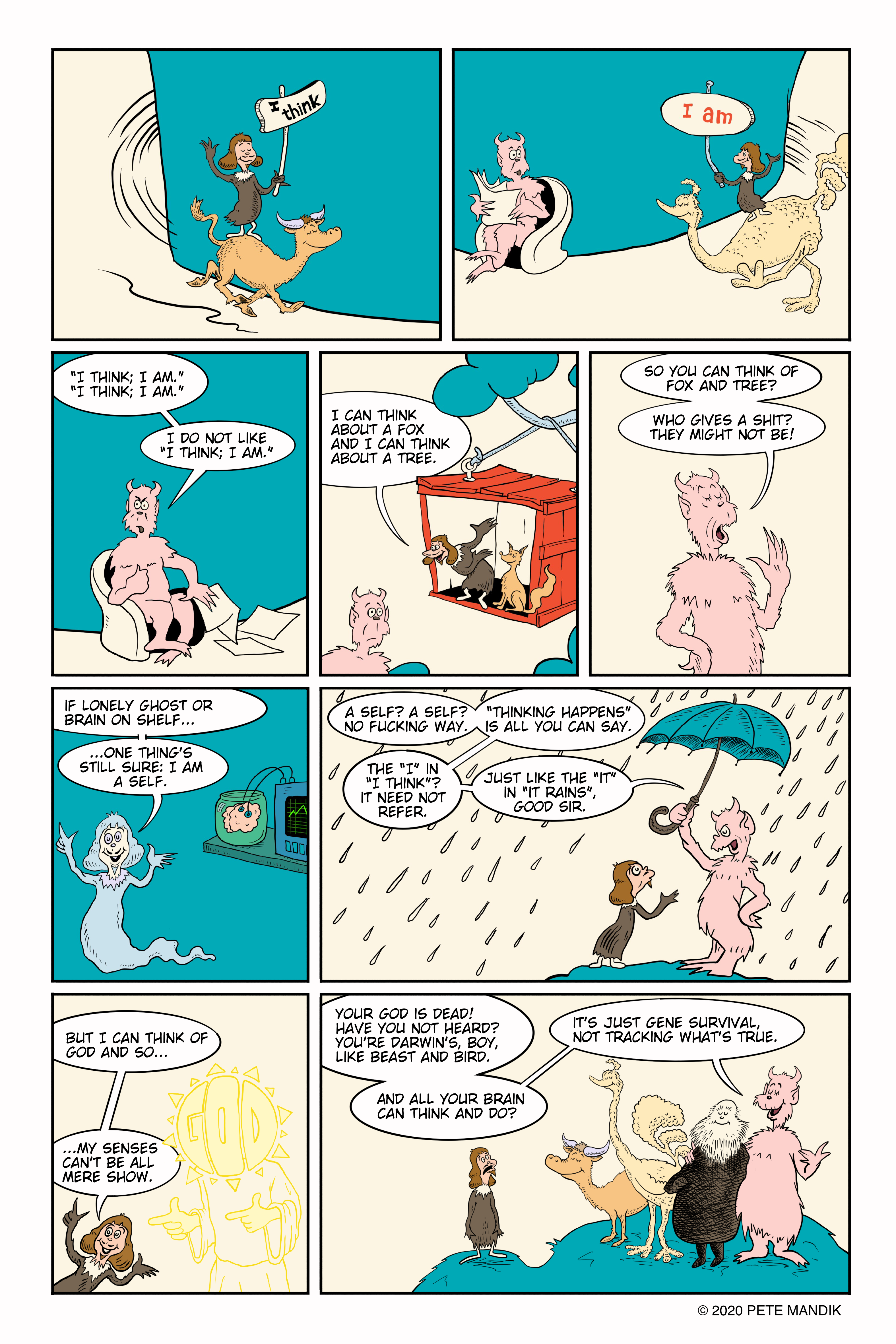
by Pete Mandik

Other Daily Nous Philosophy Comics / More Info About DN Comics
Pete Mandik on Twitter

Categories Daily Nous Features
Tags Daily Nous Philosophy ComicsDescartesMind ChunksPete Mandik

29 likes
Login
guest
guest
0 Comments
Inline Feedbacks
View all comments
Paid Advertisements

Recent Comments

Deborah Z. Altschuler on Citations and the Ethics of Credit

We at the National Pediculosis Association coined the term “Nitwashing” (akin to "greenwashing") which refers to the use of deceptive lice product marketing language — […]

Paul on Citations and the Ethics of Credit

Yes, but one shouldn't speak ill of the dead.

Kaila Draper on Citations and the Ethics of Credit

You do realize that "Socrates" was Plato's sock puppet.

Mike Gadomski on Calls for Papers / Grants / Etc.

UPDATED CFA--LOCATION CHANGE. 2nd edition of Philosophy in the Wild: a 3-day, outdoor, technology-free workshop on environmental philosophy. Ridley Creek State Park, Media, PA. June

Prospective Applicant on Advice for Applying to PhD Programs in Philosophy (guest post)

Thank you, Prof. Guerrero. I was wondering what admissions committees think about the following issue. I studied engineering as an undergrad with a minor in […]

Nicolas Delon on Citations and the Ethics of Credit

Brilliant. <pop corn gif>

curiouser and curiouser on Citations and the Ethics of Credit

Who is this? That is, who is this Harvard professor?

Justin Kalef on Citations and the Ethics of Credit

What silly melodrama. You are not going to 'die'. You are not in any 'trouble' that you need to 'escape from'. Your health will stay exactly […]

Paul Wilson on Citations and the Ethics of Credit

Farewell, but don't forget your supposed last words: “Crito, we owe a cock to Aesculapius. Pay it and do not neglect it.” “That,” said Crito, “shall

Kaila Draper on Citations and the Ethics of Credit

I hope you return

Conrad on Citations and the Ethics of Credit

No sock-puppeting, "Kaila"!

David Bourget on Comparing Three (No, Four) Top 20 Lists in Philosophy (guest post)

About the PhilPeople/Papers list, keep in mind that PhilPeople's "find a philosopher" feature (what you link to) only retrieves philosophers that have PhilPeople profiles, which […]

Subscribe

Archives

  • December 2021
  • November 2021
  • October 2021
  • September 2021
  • August 2021
  • July 2021
  • June 2021
  • May 2021
  • April 2021
  • March 2021
  • February 2021
  • January 2021
  • December 2020
  • November 2020
  • October 2020
  • September 2020
  • August 2020
  • July 2020
  • June 2020
  • May 2020
  • April 2020
  • March 2020
  • February 2020
  • January 2020
  • December 2019
  • November 2019
  • October 2019
  • September 2019
  • August 2019
  • July 2019
  • June 2019
  • May 2019
  • April 2019
  • March 2019
  • February 2019
  • January 2019
  • December 2018
  • November 2018
  • October 2018
  • September 2018
  • August 2018
  • July 2018
  • June 2018
  • May 2018
  • April 2018
  • March 2018
  • February 2018
  • January 2018
  • December 2017
  • November 2017
  • October 2017
  • September 2017
  • August 2017
  • July 2017
  • June 2017
  • May 2017
  • April 2017
  • March 2017
  • February 2017
  • January 2017
  • December 2016
  • November 2016
  • October 2016
  • September 2016
  • August 2016
  • July 2016
  • June 2016
  • May 2016
  • April 2016
  • March 2016
  • February 2016
  • January 2016
  • December 2015
  • November 2015
  • October 2015
  • September 2015
  • August 2015
  • July 2015
  • June 2015
  • May 2015
  • April 2015
  • March 2015
  • February 2015
  • January 2015
  • December 2014
  • November 2014
  • October 2014
  • September 2014
  • August 2014
  • July 2014
  • June 2014
  • May 2014
  • April 2014
  • March 2014
Paid Advertisements
Paid Advertisements

Heap of Links

  • “They did a lot to break the grip of an orthodoxy that makes important things unsayable” -- Ben Lipscomb (Houghton) interviewed about his recent work on Anscombe, Foot, Midgley, and Murdoch
  • “Those of us concerned with identifying and combating systemic racism would do well to avoid over-simplified formulations that privilege one explanatory factor at the exclusion of another” -- Benjamin Mitchell-Yellin (Sam Houston State Univ.) takes up some confusions regarding racism
  • At the University of Groningen, philosophy majors are required to take philosophy “outside the walls” -- this involves a creative project rather than an academic paper, and interviewing people outside of academia
  • How “aesthetic ideals have carried over to contemporary experiments in science” -- Milena Ivanova (Cambridge) takes up the question, "what does it mean for an experiment to be beautiful?"
  • “The homogenizing of language won’t homogenize thought… but we may [have] reasons to worry that it will limit intellectual diversity” -- Neil Levy (Oxford) on the ethics of the linguistic "affordances" of Grammarly and other AI-based writing tools
  • “I want to show students a new way into philosophy – through doing ridiculous things” -- that's why Meg Wallace (Kentucky) teaches "Circus and Philosophy"
  • Want to help your students “steel-man” rather than “straw-man” other people’s arguments? -- ThinkerAnalytix & Harvard are offering free workshops for philosophy instructors on how to teach students argument mapping as a way of exercising intellectual charity
  • How to get something from “nothing” -- Aaron Wendland (KCL/Massey) on Heidegger, Carnap, and the analytic-Continental split
  • “My utterly personal and speculative overall take-away from our data is that women’s emancipation had a paradoxical effect in philosophy” -- Katharina Nieswandt (Concordia) interviewed by Adriel Trott (Wabash)
  • “The broadening of personhood to include some nonhuman entities is not so much a recent adaptation of an old legal concept as it is a return to an even older one” -- Justin E.H. Smith (Université Paris Diderot) on the personalization of nature
  • Making discussions of cosmopolitanism more cosmopolitan -- short reflections from nine philosophers initiate a project to draw upon Chinese philosophical traditions in order to explore alternative understandings of the nature and future of cosmopolitanism
  • Part of his legacy is the motivating of “a history of political philosophy that does not cleave to exclusionary conceptions of the discipline” -- an appreciation of Charles Mills by Sophie Smith (Oxford)
  • “Almost every person has reason to avoid subjection to digital recording whenever possible” -- Elizabeth O'Neill (Eindhoven) on the "spectacular set of new threats" we face owing to the combination of digital recording, the internet, and artificial intelligence
  • “Living in the now does not entail a refusal to care about the future, only a refusal to condition happiness and meaning on it” -- John Martin Fischer (UCR) on a common insight of Stoicism and Buddhism
  • “Just as we would be loath to dictate what art people must engage with, we should be wary of social pressures that decree what they can’t” -- Erich Hatala Matthes (Wellesley) on consuming the art of immoral artists
  • “Ten Propositions of Baruch Spinoza for Tenor and Piano” by British composer Michael Zev Gordon has been shortlisted for an Ivors award -- you can listen to the 21-minute song cycle sets of texts from Spinoza’s Ethics at the link
  • “That various things are simultaneously imaginable and unimaginable is essential to love, our sense of self, and our sense of what is real” -- Oded Na’aman (Hebrew U.) on evils, attachment, ambivalence, and the problems with Stoicism
  • “Human beings are ‘general-purpose culture machines’ capable of creating cultural and moral innovations that permit them to live better and more harmoniously together” -- Dan Little (UM-Dearborn) on existentialism for individuals and historicism for human nature
  • “Stock is quick to point out that she does not believe all trans women are bad” yet “at nearly every instance in the book when trans women are mentioned as agents… they are deceivers, rapists, and violent offenders” -- Adam Briggle (North Texas) agrees with Kathleen Stock on "many of her conceptual points," but, he says, its her "foreboding mood" that drives her arguments
  • “Like everyone else, Benatar finds his views disturbing” -- a profile of David Benatar by Joshua Rothman in The New Yorker
  • “Every time I sit down to write an article or do some other research-related task… I have to ask myself: should I be doing this or should I be spending the time with my children?” -- John Danaher (NUI) on the "academic parent's dilemma"
  • “Philosophical insight arises only from the struggle to cancel this situation of unfreedom and to make the world one’s own in one’s ideas and thought” -- Richard Marshall interviews G.W.F. Hegel at 3:16AM
  • “We need the burgeoning philosophical field of space ethics to help us tackle the thorny moral questions and complicated debates that growing interest in space exploration raises” -- so argues Chelsea Haramia (Spring Hill) at Noema (via Nathan Nobis)
  • “If the analysis that I have provided is correct, then Americans cannot solve the race problem. The most that they can do is choose which race problem they are willing to live with” -- Joseph Heath (Toronto) on how, when it comes to race in the U.S., "different parties define both the problem itself and its solution differently"
  • “When everything that can be explained has been explained, when we know the truths of physics and brains and psychology and social interactions and so on and so forth, will there still be anything worth wondering about?” -- Charlie Huenemann (Utah State) on "the biggest question"
  • “It would have been easy to demand freedom and protection for both Stock and for the trans and non-binary students or allies, since both sides claim to be being intimidated and silenced by the other. But the letter did not do this” -- a nonbinary philosopher on "how I experienced the unfolding of events leading up to and around the recent UK philosophers’ open letter regarding Kathleen Stock"
  • “An insider’s take on three different directions it seems to me the left wing of the applied turn is taking in philosophy” -- Liam Kofi Bright (LSE) offers three "ideal types"
  • A philosophy professor’s account of the “perilous” and “unrelenting” trajectory of his university -- David Benatar's new book is "The Fall of the University of Cape Town"
  • Kant’s Critique of Pure Reason -- condensed into 100 tweets, by Helen de Cruz (SLU)
  • “I conjecture that, in retrospect, historians will come to view Anglophone philosophy from the 1960s to 1990s one of the great golden ages” -- why Eric Schwitzgebel (UC Riverside) thinks "Back in the 1990s, when I was a graduate student, giants strode the Earth! Now, Earth is rather more populated with human-sized people."

∙   2021 ©Daily Nous   ∙

wpDiscuz
0
0
Discussion welcome. Click to comment.x
()
x
| Reply