
The Korean version of a college admissions exam, the CSAT, administered last month, had several questions about Immanuel Kant.

One of the questions (number 17) was about Kant’s theory of personal identity and ended up generating some controversy.
Philosopher Lee Chung-hyung (Pohang University of Science and Technology), according to another Chosun Daily article, posted a message to a student discussion board saying, “I attempted the Kant-related question from the CSAT Korean language exam and found that Question 17 appeared to have no correct answer.”
Question 17 was among several questions based on a passage summarizing the views of Kant and other philosophers.
Here is the passage and questions 14, 15, and 16, with a translation of uncertain quality by Google (it can’t seem to translate some names). You should be able to click to enlarge the image, though even enlarged, the quality is not great. A better translation, by ChatGPT 5.1, follows the image.
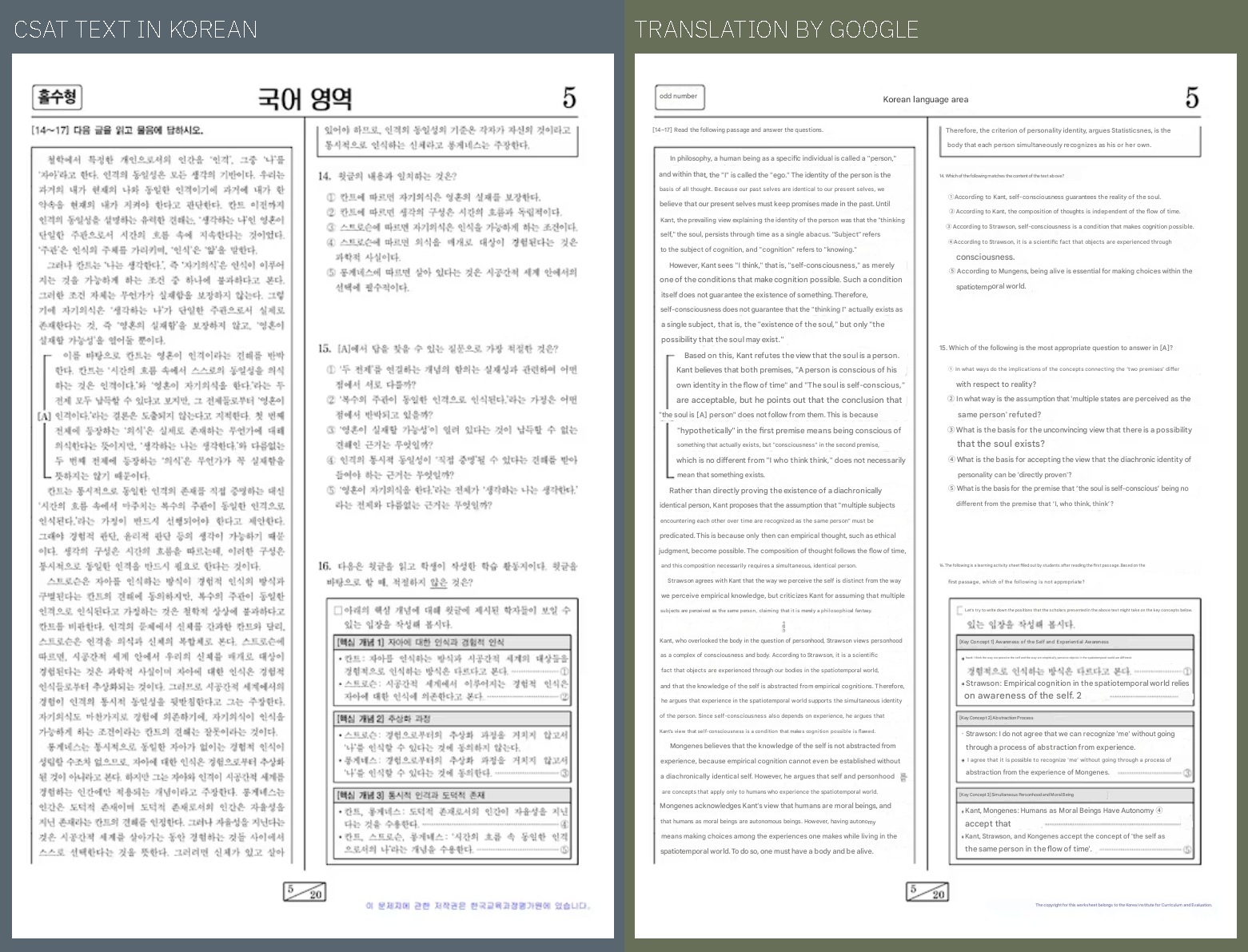
Here’s ChatGPT’s translation. I’ll note that I’m not sure it correctly identified the philosophers discussed (informed comments on that welcome):
[14~17] Read the following passage and answer the questions.
Philosophers commonly describe humans as “self-reflective” or “creatures who think about themselves.” This idea of human distinctiveness is grounded in the fact that humans possess a capacity for self-awareness distinct from that of other animals. We typically believe that only humans can think about themselves “as themselves”—that I perceive myself as “me,” distinct from others. This ability for self-awareness has long been regarded as a defining feature of human beings. When a person thinks about themselves from a first-person standpoint—“I am doing X,” “I am such-and-such kind of person”—that stance is thought to arise from an inner, mental perspective.
However, we do not say “I think” merely because a subjective awareness arises. If that alone were sufficient, there would be no need for the self as a separate entity. In fact, what enables self-awareness is not simply an internal mental scene but the structure that allows the representation of oneself. In that sense, what explains self-thinking is not an independent inner realm but a system that allows the subject to be distinguished from the world.
This view rejects the claim that self-awareness is grounded in some mysterious inner realm. According to this view, “I think” can be explained by the general cognitive capacities we all possess. It may appear that I can step back and reflect on myself, but such reflection can be fully explained through ordinary cognitive operations. Proponents of representational views argue that what makes self-awareness possible is not a special inner entity but the conceptual structure that enables one to represent oneself as oneself.
[A]
Some philosophers criticize this view, arguing that it merely explains the representation of the self but not the experience of being oneself. According to them, the representational account treats self-awareness as merely the result of a cognitive mechanism, thus overlooking the felt, experiential aspect of self-awareness. They argue that although representationalism can explain how a subject distinguishes itself from the world, it cannot explain the immediate sense of “mineness” present in experience.
Because representationalists focus on explaining the subject’s ability to distinguish itself from the world, they treat self-awareness as arising from the structural conditions for representation. But experientialists claim that this misses something crucial: that the sense of self is not something constructed by a representational mechanism but rather present directly in experience. For experientialists, the “I” is not something constructed; rather, one encounters oneself directly in experience.
Sartre accepts part of the representationalist argument—that the subject distinguishes itself from the world—but he rejects the claim that the sense of self must therefore be constructed by representation. Instead, Sartre claims that the sense of self is given immediately in experience. Therefore, representationalist explanations cannot account for the pre-reflective aspect of self-awareness. However, Sartre does not claim that the self is a metaphysical entity. Rather, he claims that the sense of self “emerges” from conscious experience itself. According to Sartre, self-awareness occurs even before one intentionally reflects on oneself. Because of this, representational mechanisms are unnecessary for explaining the origin of the sense of self.
Heidegger also argues that the human being is not fundamentally a subject who represents the world. Instead, the human being is an entity who always already exists in a meaningful situation, acting and responding within that world. In this perspective, self-awareness is not something that arises from inner mental representation. Rather, humans experience themselves through their everyday activities and relations. We encounter ourselves not as independent subjects but as beings immersed in meaningful contexts. For that reason, the experiential self is not a detached observer but an agent situated within the world. According to Heidegger, to understand self-awareness, we must not begin by separating a subjective self from the world but must instead examine how the human being already operates meaningfully within its situation.
Thus, experientialists reject the representationalist claim that self-awareness arises from representational structures. Instead, they argue that the sense of self emerges directly in experience, prior to reflection. Although they agree that humans can reflect on themselves, they claim that the foundation for such reflection lies in this pre-reflective experiential awareness.
14. Which statement is NOT supported by the passage?
-
-
Representationalism explains self-awareness through the structure of self-representation.
-
Experientialists focus on subjective experience prior to representation.
-
Sartre asserts that representational structures necessarily precede self-awareness.
-
According to Sartre, the sense of self appears prior to reflective awareness.
-
Heidegger claims that living in meaningful contexts precedes theoretical self-explanation.
-
15. Which of the following is the most appropriate question that the author of passage [A] would ask?
-
-
From what perspective should one examine the phenomenon of connecting two experiences?
-
Does the subject necessarily need representational structures to recognize itself?
-
What philosophical grounds prevent someone from stepping outside their own experiences?
-
Is self-awareness something that one must construct through reflective thinking?
-
Which part of the representationalist explanation contradicts the statement “I think before I think”?
-
16. The following learning activity report is completed by students after reading the passage.
Which part is NOT appropriate based on the content of the passage?
[Core Concept 1] Experience of the Self
-
-
I learned that humans encounter themselves directly in experience.
-
Representationalists argue that the experiential sense of self precedes cognition. (①)
-
Experientialists claim that representational structures distort direct experience. (②)
-
[Core Concept 2] Structure of Representation
-
-
It is important to understand the mechanisms that allow us to distinguish the self from the world.
-
According to the representational view, reflection follows immediately from representational structures. (③)
-
Because self-awareness relies on representation, the self must be treated as a separate inner entity. (④)
-
[Core Concept 3] Unity of Experience and the Human Being
-
-
Experientialists and Heidegger both argue that humans exist in meaningful contexts prior to theoretical explanation.
-
Thus, I learned that Heidegger claims the reflective subject is the starting point of all self-awareness. (⑤)
-
Even before getting to the controversial question 17, one might pause to note just how sophisticated a text this is to ask high school students aboiut. It is, reportedly, one of the “high-difficulty items” on the exam. I could not imagine anything like this being on the US version of the SAT.
Here’s question 17, again first with a translation by Google, followed by a translation by ChatGPT:
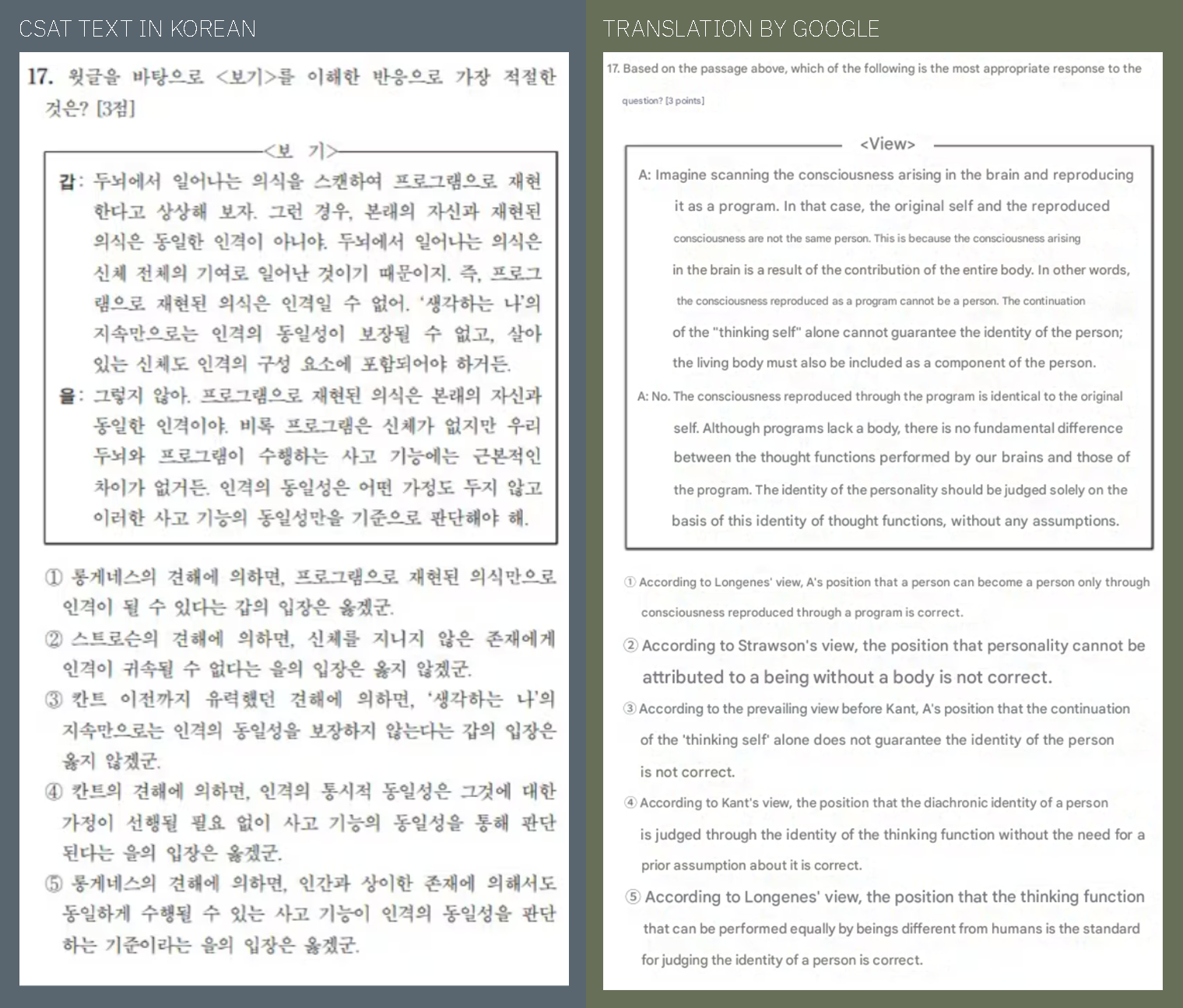
Here’s ChatGPT’s translation of question 17:
17. Based on the passage, which of the following is the most appropriate interpretation of [View]? [3 points]
〈View〉
(Speaker A)
Let us imagine scanning the consciousness occurring in the brain and reproducing it as a program. In that case, the original self and the reproduced consciousness would not be the same person. This is because the consciousness occurring in the brain arises from the entire living body of the organism. In other words, consciousness reproduced as a program cannot be considered a person. A mere “thinking me” inside a program cannot guarantee the continuity of personal identity, and the living body must be included among the constitutive elements of a person.
(Speaker B)
I disagree. The consciousness reproduced as a program is the same person as the original. It is simply that the program does not have a biological body, but the cognitive functions carried out by the brain and by the program do not differ in any essential way. The continuity of personal identity does not depend on the nature of the body but should be judged on the basis of the sameness of cognitive functions.
Answer Choices
① According to Locke’s theory, Speaker A’s claim—that the consciousness reproduced as a program could become a person—would be acceptable.
② According to Strawson’s theory, Speaker B’s claim—that an existence lacking a body cannot be considered a person—would not be acceptable.
③ According to Kant’s theory as it has been traditionally understood, Speaker A’s claim—that “the thinking ‘I’ alone” does not guarantee the continuity of personal identity—would not be acceptable.
④ According to Kant’s theory, the continuity of personal identity can be determined by the sameness of cognitive functions, without needing to posit any underlying substance, so Speaker B’s view would be acceptable.
⑤ According to Locke’s theory, because cognitive functions that can be performed identically even in a non-human existence constitute the criterion for personal identity, Speaker B’s view would be acceptable.
Chosun Daily reports on Professor Lee’s critique, however some of its force may have been lost in translation:
The question presented the argument of “Person A,” who claimed that if consciousness occurring in the brain is scanned and reproduced via a program, the original self and the reproduced consciousness are not the same person. Test-takers were then asked to select the most appropriate response demonstrating an understanding of this argument.
The Korea Institute for Curriculum and Evaluation designated option 3 as the correct answer: “According to the prominent view before Kant, Person A’s stance that the persistence of the ‘thinking self’ alone does not guarantee personal identity would be incorrect.”
However, Professor Lee argued in his post that option 3 cannot be the correct answer. The passage states, “Before Kant, the prominent view explaining personal identity was that the soul, as the ‘thinking self,’ persists as a single subject over time.” Professor Lee asserted that since the reproduced consciousness via a scan program does not meet the condition of being a “single subject,” Person A’s argument—that the persistence of the “thinking self” alone does not guarantee personal identity—is valid.
Additionally, Professor Lee stated, “While one might think the question can be solved using the logical structure ‘if a = b and a has property C, then b also has C,’ this approach is actually flawed.” He explained, “Person A discusses the ‘thinking self’ but not the soul, so a connection between the two is necessary. The only link provided in the passage is the phrase ‘the thinking self, the soul,’ but this expression does not appear anywhere in the passage or the answer choices.” He emphasized that the argument cannot be simplified in this way.
It was reported that Lee “explained his reasoning over eight A4 pages” and shared them with other philosophers, one of whom (unnamed) responded: “The passage and question contain logical leaps… Nonetheless, those who understood Kant’s pre-existing views and the answer choices in the passage could likely solve it.”
Discussion, especially from Kant scholars and Korean-speaking philosophers, welcome.
