
A few weeks ago, I was contacted by a reporter working on a story about the extent to which AI, as a topic of research and an area of specialization demanded by employers, was becoming dominant in philosophy.
Here’s one thing I said to her:
People should be cautious when inferring how much philosophy of AI work is actually happening from how much philosophy of AI work they’re hearing about. AI is relatively new and highly socially significant, and so work on philosophy of AI is bound to get attention, and its novelty means it is likely to be more memorable when thinking about the state of philosophy more generally. Since AI and philosophy is establishing itself as a subdisciplinary field, there is a fair amount of hiring in it, forming research groups of scholars studying it, creating specialist journals for writing about it, establishing prizes to recognize good work in it, and so on. People will hear about these developments, as they’re newsworthy in the profession, but a lot of this activity is just “catch-up,” as AI and philosophy comes to be on a par with other areas of applied philosophy, such as bioethics.
[UPDATE: Here’s the article: “Someone Finally Wants to Hire Philosophers” by Lila Shroff. (She noted that she doesn’t write the headlines.)]
Those were my general impressions.
But what would be more useful were hard numbers related to how AI is shaping the academic job market.
For that, I turned to Charles Lassiter, professor of philosophy at Gonzaga University. Over the years, Professor Lassiter has generously produced many data-based analyses of the philosophy job market published here at Daily Nous, and so I asked if he could look at the growth of AI in philosophy. Once again, he has come through. His analysis is below. Thanks, Charlie!
(A version of this post is also at Professor Lassiter’s site.)
AI in the Philosophy Job Market
by Charles Lassiter
Reactions to AI in academia, the humanities, and philosophy, have been mixed. Anecdotally, some of my friends and colleagues think this is the beginning of the end. It’s not that AI is going to take our jobs as philosophers or humanists; rather, inquiry into the history and values of humanity will slowly be edged out because AI can get us those answers faster and more reliably. But some other of my friends and colleagues argue this is a new day for the humanities. Previously, digital humanists were restricted by what they could build or what some nerds in a lab had already built. With AI, the sky’s the limit. Others still aren’t quite sure what to think except that there are obvious moral issues surrounding AI use and we’re probably better off morally without it.
Pope Leo XIV recently released his encyclical Magnifica Humanitas. He discusses the power and potential of the tool to do both good and ill in the world. We could intensify and centralize the power of the war machine, as the Trump administration attempts with Project Maven. Or, you know, we could make discoveries that support enormous leaps forward in the physical and social sciences and make lives better.
For now, it’s slightly comforting to know that Anthropic and the Vatican are attempting to collaborate on AI and ethics, as reported by National Catholic Reporter. Also, it’s some comfort that AI companies are hiring philosophers to think through difficult moral, metaphysical, and epistemological questions. It’s not all peaches and cream, but I’ll take hope wherever I can find it these days.
Academia and professional philosophy have endured and experienced the ubiquity of AI in many ways. Faculty worry that students are using AIs to write papers, complete discussion board questions, or take quizzes. I’m not sure whether to laugh or cry upon learning that some students use AI to complete reflection assignments. Journal editors are getting AI slop for submissions. But how has it shaped the academic job market thus far?
Using Claude’s Sonnet 4.6, I looked for mentions of AI and a suite of related terms—machine learning, neural networks, NLP, robotics, language model, etc—on PhilJobs between 2013 and 2026. If you’ve had a hunch that AI-related jobs have been taking up more room in PhilJobs, you’re right.
AI jobs in philosophy: the numbers
Table 1 gives the numbers, illustrated in plots 1A and 1B. In terms of percentage of all jobs posted, AI-related positions have increased from roughly 1% in 2013 to 16% in 2025. Put otherwise, roughly 1-in-6 jobs last year mentioned AI in some capacity as part of the specializations.
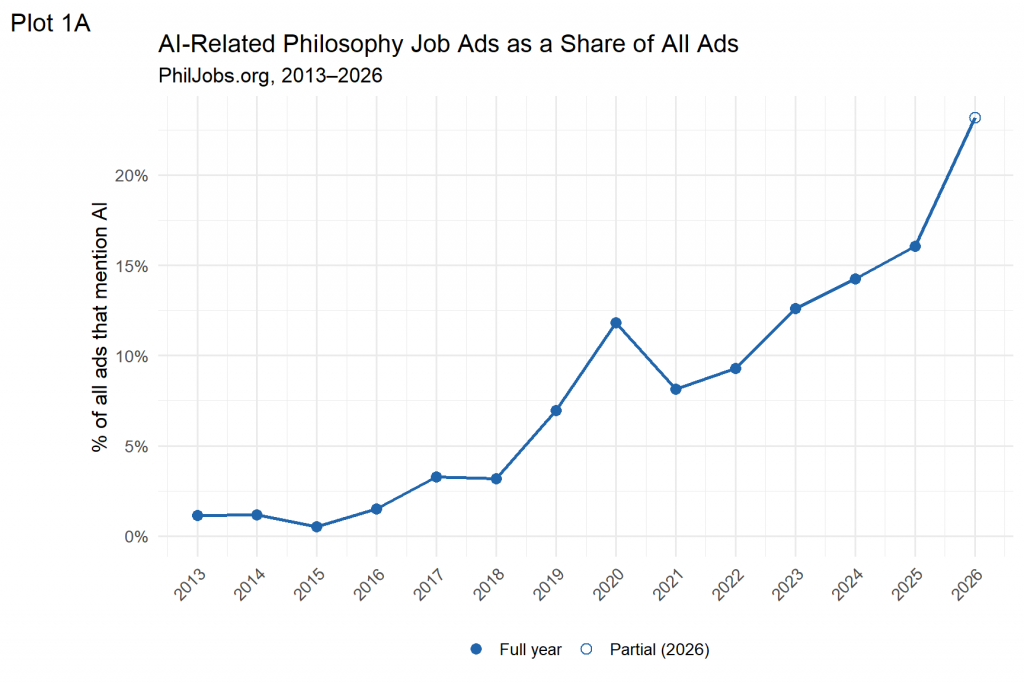
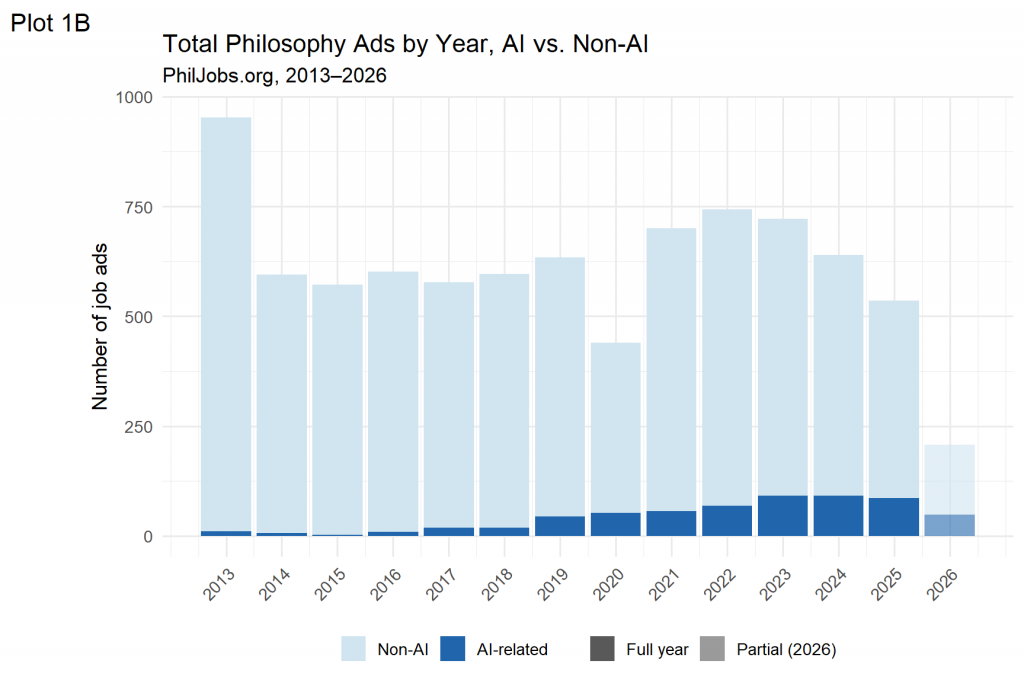
There was a peak in 2020, which then declined and didn’t recover until 2023. The best explanation for this is two factors. First, OpenAI launched GPT-3 that year, which received quite a bit of attention from popular media in, among other places, The Guardian and in academia, e.g. DailyNous. Second, COVID. In absolute numbers, AI hires remained the same, but 2021 and 2022 had more jobs posted as part of the COVID bounce-back.
Kinds of jobs being advertised
In addition to the number of jobs for AI specializations increasing, they are increasing at the junior level.
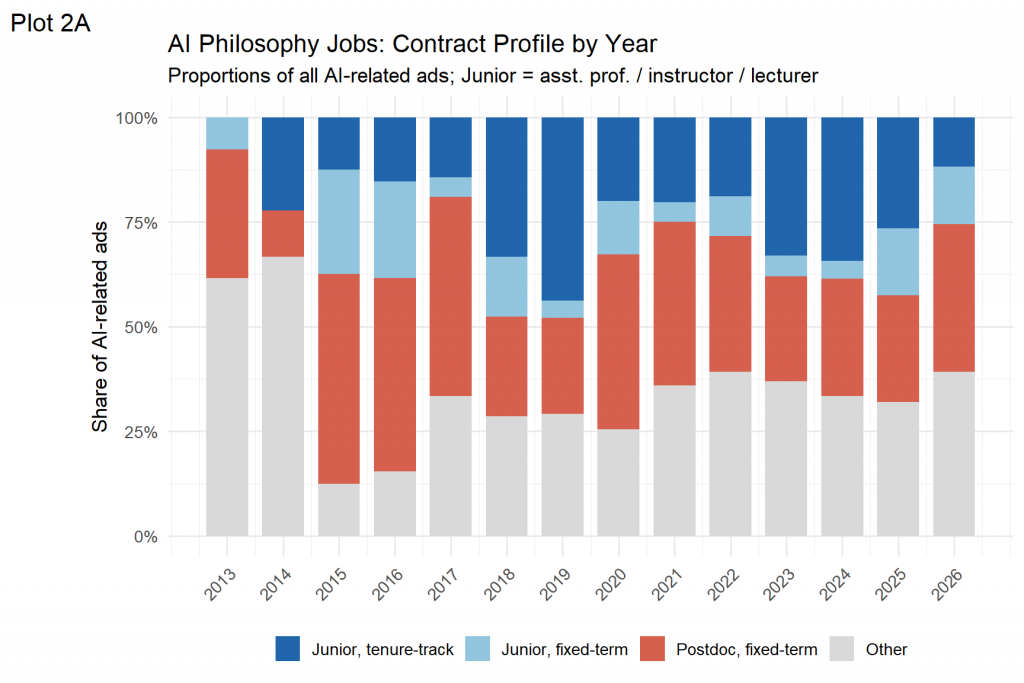
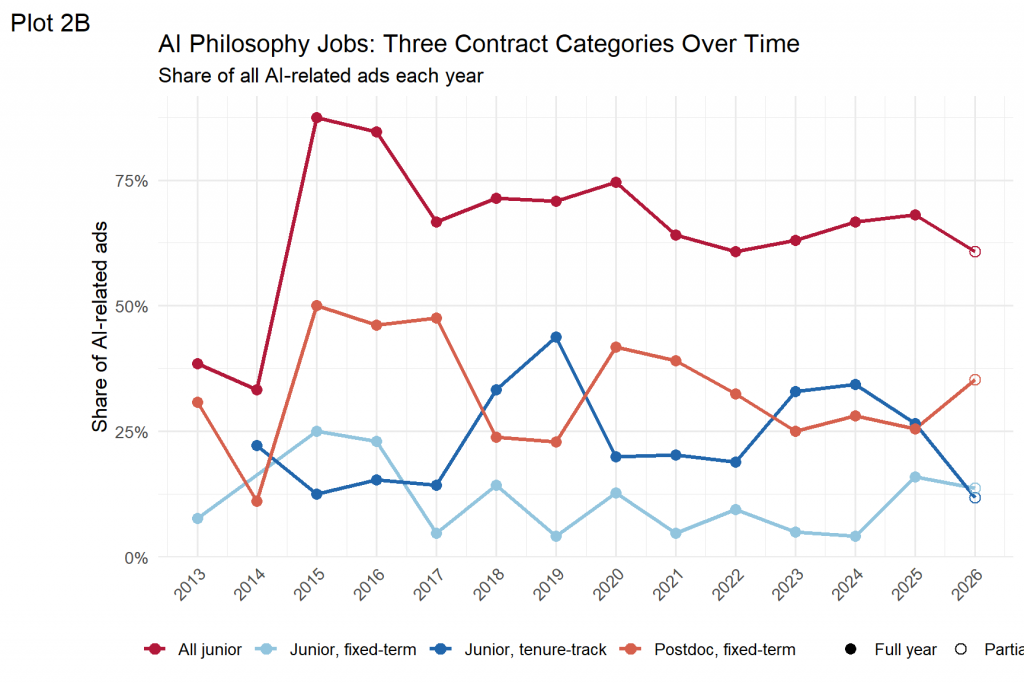
Plot 2A shows that, beginning in 2015, junior positions (including tenure-track, fixed-term, and postdoc) make up over half of all positions advertised. 2B shows the same, along with the total for all junior posiitons. This strongly suggests that departments are thinking about AI specializations in philosophy as a long-term investment, training postdocs and hiring tenure-track faculty. Remarkably, given wider trends in hiring, 2016 is the last complete year in which the share of fixed-term positions was higher than that of tenure-track.
Universities leading the hiring
Pivoting from kinds of jobs to departments, which universities are doing the most hiring in AI?
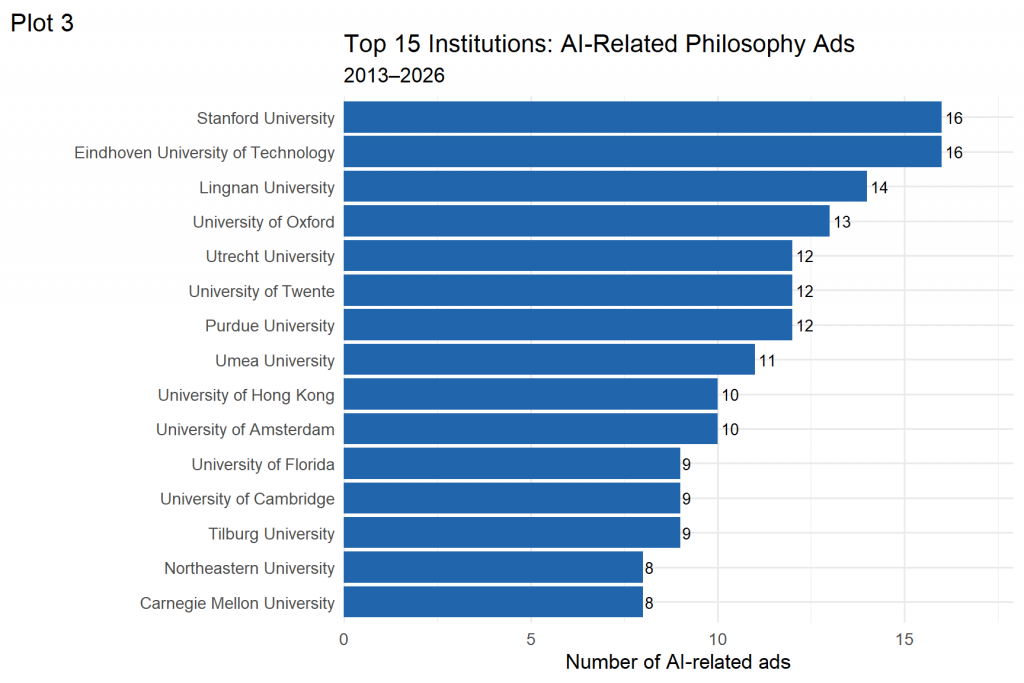
Plot 3 gives the rankings, but hiring has varied substantially pre- and post-2020, as seen in Tables 4 and 4B:
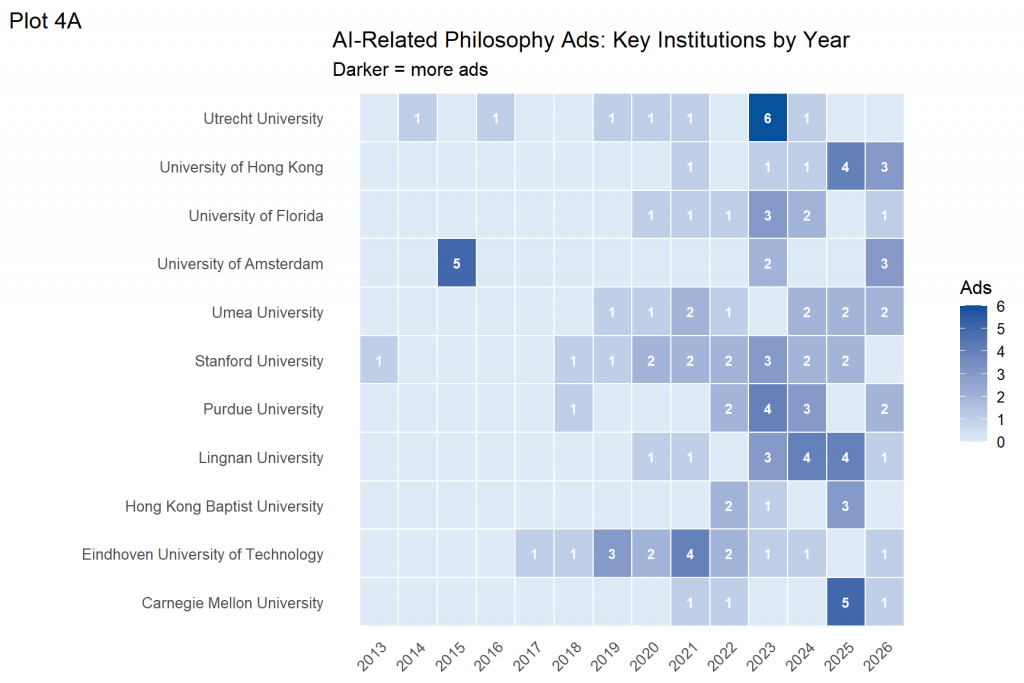
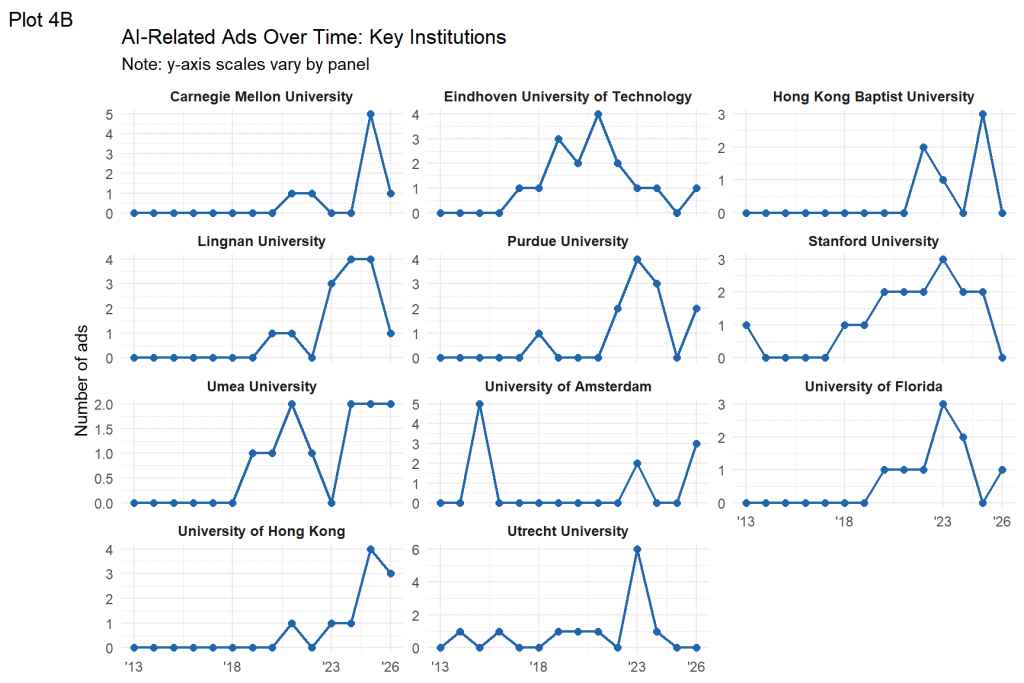
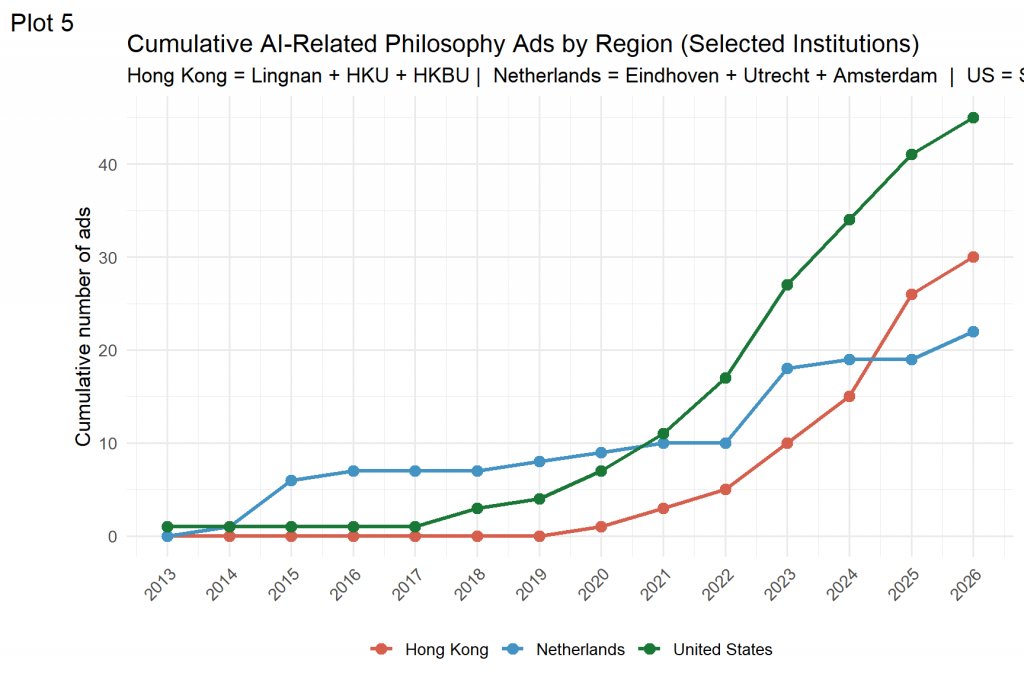
The data suggest three major regions for AI-related specializations in philosophy: the US, the Netherlands, and Hong Kong, seen in Plot 5.
One major limitation with respect to the international analyis: PhilJobs is the major source for jobs in academic philosophy in the English-speaking world. Universities outside the English-speaking world sometimes advertise in Philjobs, but I don’t have any data about the non-English advertising base rates.
Hiring in other areas of the world tend to go through government systems or academic post aggregation systems, such as Education Sub Saharan Africa, the pan-European Jobs in Philosophy, and India’s CU. I did not search or analyze these sites (or others like them) because of (i) language barriers and (ii) lacking the relevant specializations for each region to know if my search would be exhaustive. If you have that expertise and are interested in collaborating, please reach out.
Philosophy of technology and AI hiring
Technology isn’t a new topic of discussion in philosophy. Phenomenologists, post-phenomenologists, and feminist philosophers of science focusing on philosophy of technology (and allied areas in STS) have looked at the ways in which technology shapes our understanding of the world and ourselves. How often do we find philosophy of technology and AI ads appearing together?
This turns out to be a difficult question to ask at scale. AI is, of course, a kind of technology. But philosophy of technology and STS are deep traditions in modern and contemporary philosophy, drawing on hermeneutics, critical theory, existentialism, phenomenology, post-phenomenology, and post-colonial studies, and developed by thinkers like Heidegger, Arendt, Hans Jonas, Sandra Harding, Helen Longino, Don Ihde, and Peter-Paul Verbeek. (This, in the Stanford Encyclopedia of Philosophy, is referred to as “humanities philosophy of technology.”) Because of this uncertainty, it is worthwhile to make a small detour to discuss it here and in the rest of this report.
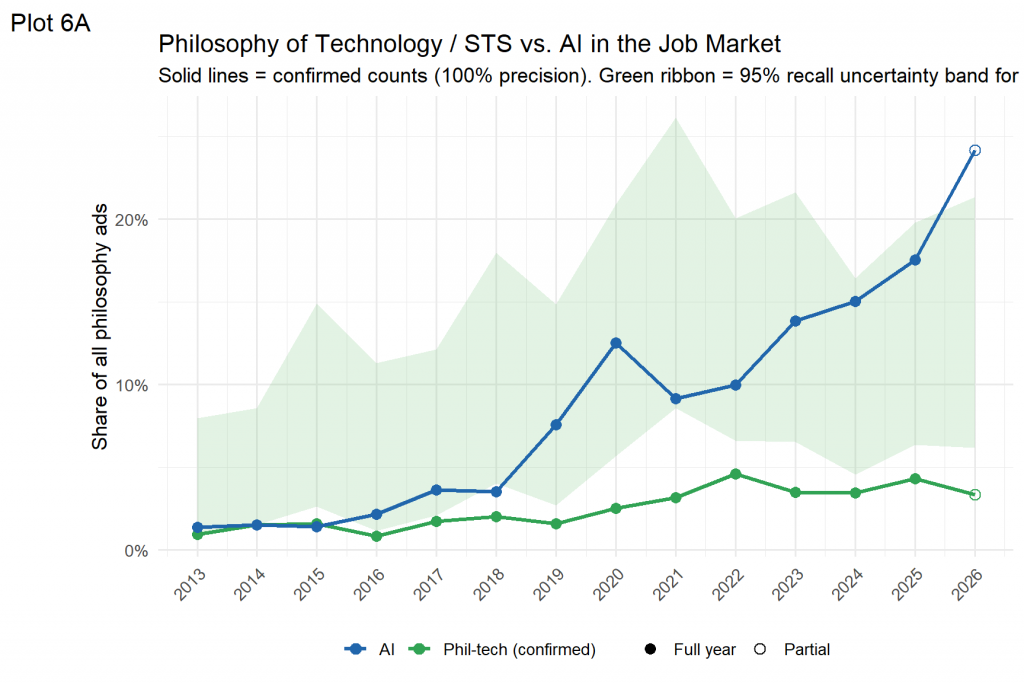
Two distinct sources of measurement uncertainty appear in these plots, and they work differently.
AI job counts (all previous plots)
The AI job counts carry two kinds of residual error after the false-positive and false-negative audits:
Residual false positives (~11%, 95% CI 6–19%). Some ads in the AI set are not genuinely AI-related. The audit identified and removed 27 confirmed false positives (15 Wake Forest, 3 Minerva, 9 individual cases), but the sampled audit estimated roughly 11% of the remaining set may still be spurious — concentrated in earlier years (2013–2018) when keyword matching was less precise. This means the AI counts are likely slightly inflated, particularly before 2019.
Residual false negatives (~2%, 95% CI 1–4%). A small number of genuine AI ads were not caught by the scraper — primarily ads using terms like algorithmic fairness, explainability, or trustworthy AI that were not in the original keyword list. The supplementary scrape recovered 32 confirmed cases, but roughly 100–280 additional AI ads likely exist across the full study period. This means the counts are also slightly conservative as a second-order effect.
These two errors partially offset each other. The net effect is that the AI trend line should be treated as carrying approximately ±10–15% uncertainty in any given year, with the directional trend being robust across the full period.
Phil-tech / STS job counts (Plot 6A)
The phil-tech counts carry a different and larger source of uncertainty, represented by the green ribbon in Plot 6A.
The scraper identifies phil-tech jobs using explicit keyword matching. The confirmed count (solid green line) includes only jobs whose full page text matched a phil-tech term — this is a 100%-precision lower bound, meaning every job on that line is genuinely a phil-tech position, but the line undercounts the true total.
To estimate how many jobs were missed, a random sample of 50 non-flagged jobs per year was fetched and checked manually. The fraction of that sample that turned out to be phil-tech (the sample hit rate) was used to project how many jobs across all non-flagged ads were also likely phil-tech. A 95% Wilson confidence interval on that sample hit rate was then propagated through the projection to produce lower and upper bounds on the estimated true count.
The green ribbon spans those bounds, expressed as a share of all philosophy ads. Its width reflects two things: the sample size used to estimate the miss rate (50 jobs per year, which is small), and the underlying variability in the hit rate from year to year. In years where the sample hit rate was 0% (e.g., 2013–2014), the lower bound collapses to the confirmed count while the upper bound remains wide — this is the Wilson interval’s correct behavior when a small sample turns up zero hits, since zero hits does not mean zero true positives.
How to read the comparison between phil-tech and AI in Plot 6A: If the AI line lies above the top of the green band, AI hiring is unambiguously higher than phil-tech. If the AI line lies within the band, the true phil-tech count could plausibly match or exceed AI in that year. If the AI line lies below the solid green line, phil-tech is definitively larger even before accounting for missed ads.
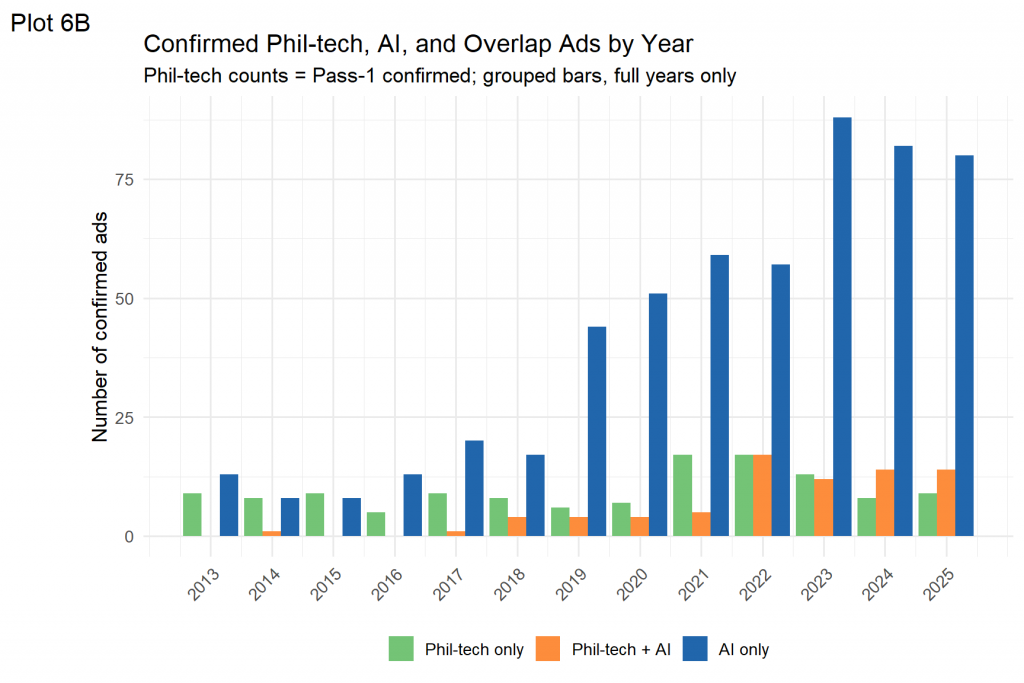
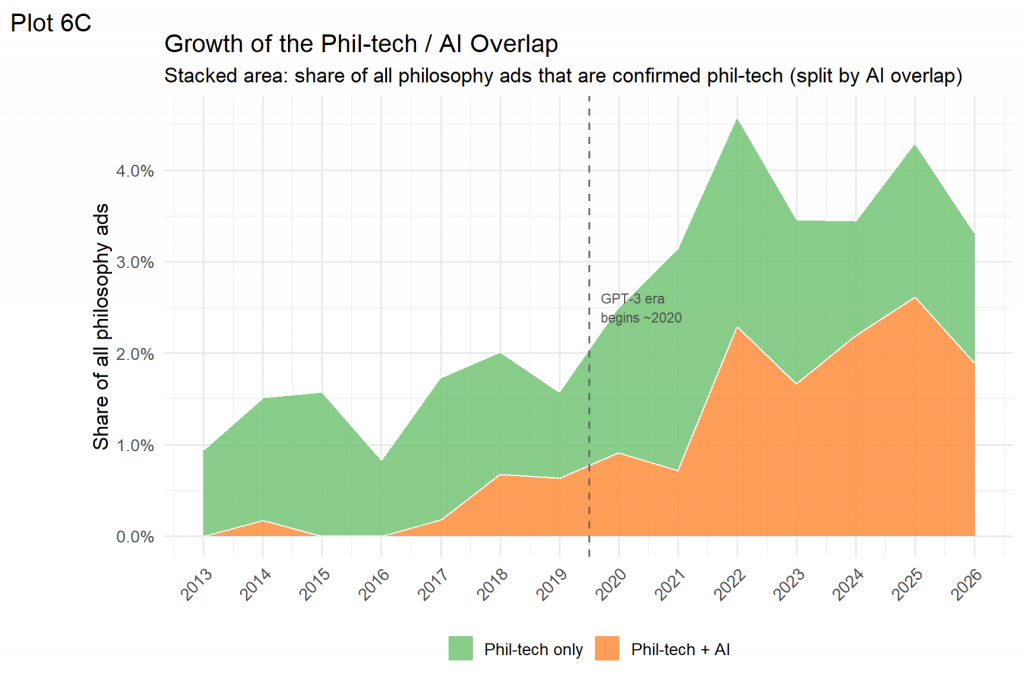
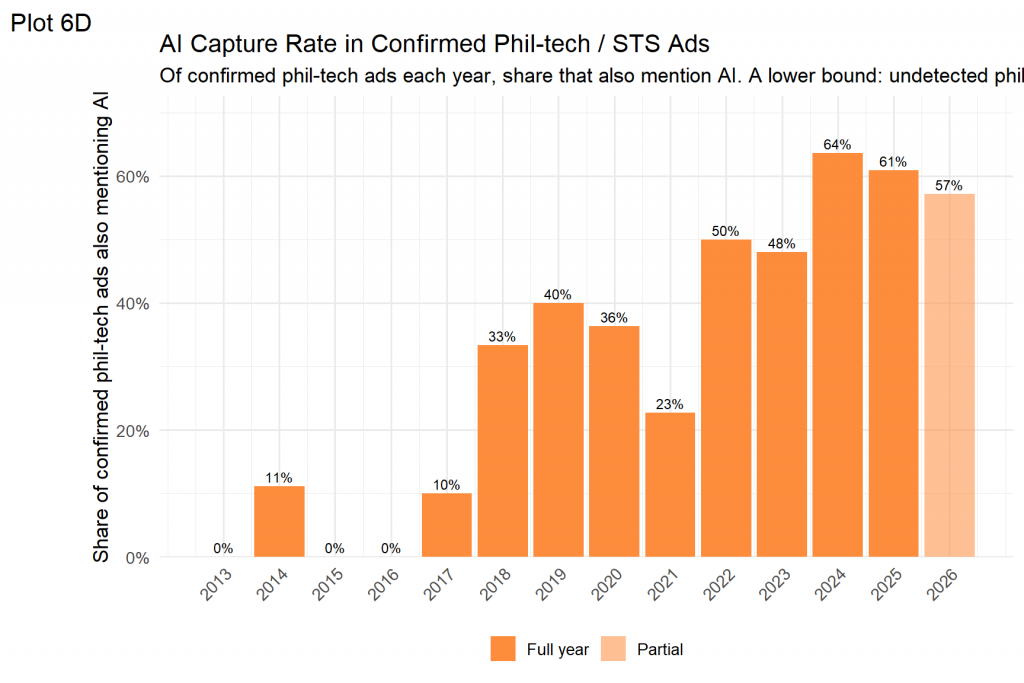
Two different conditional values are relevant in looking at AI and phil tech ads: the likelihood of an ad mentioning phil tech given that it mentions AI and the likelihood of an ad mentioning AI given that it mentions phil tech. The former is interpreted to indicate how often AI-focused positions are looking for philosophers of technology. Table A (below, appendix) indicates that this value is roughly 14% over all years. The latter is interpreted to indicated how often phil tech positions are looking to engage AI. Plot 6D shows that these values are consistently higher than 14% beginning in 2018. Table 7 shows the (non-conditional) overlap values across two periods: 2013-2019 and 2020-2026, the cutoff (as mentioned previously) defined by when LLMs, and specifically GPT-3, came to be highly visible.
Conclusions
What are the takeaways? The least controversial and most obvious is that the relevance for AI as an area of research in contemporary philosophy has grown significantly in the last 13 years and doesn’t indicate any slow-downs.
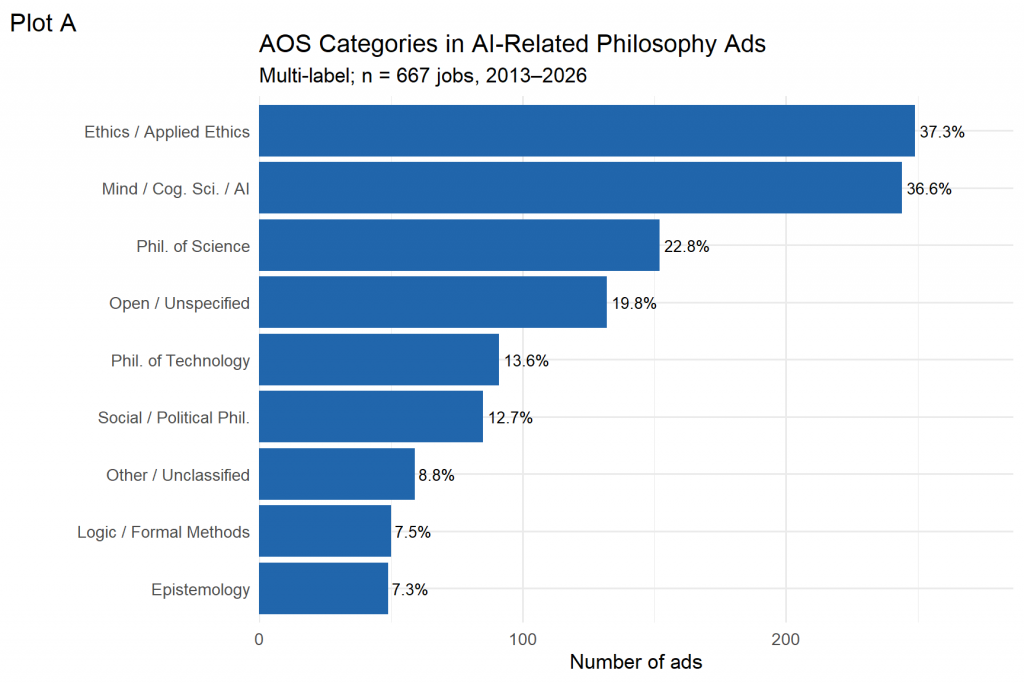
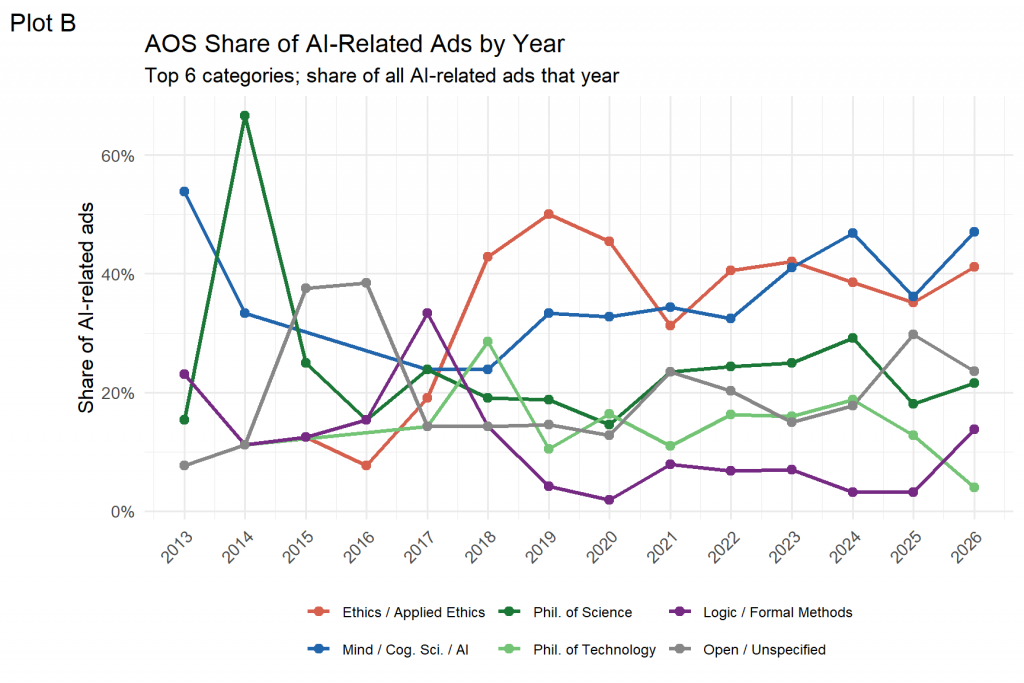
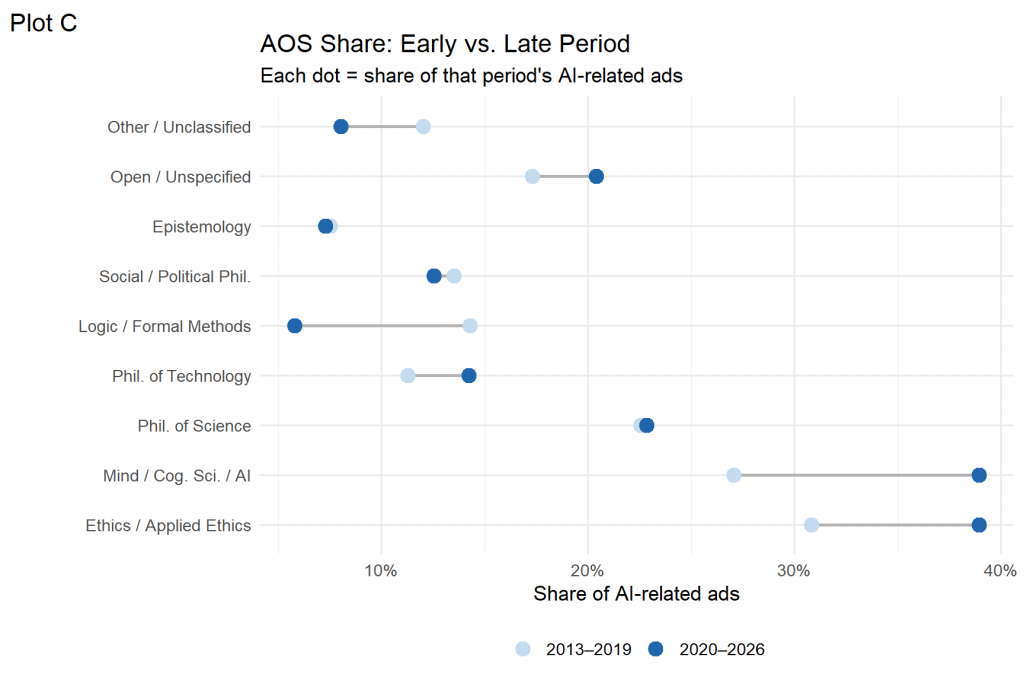
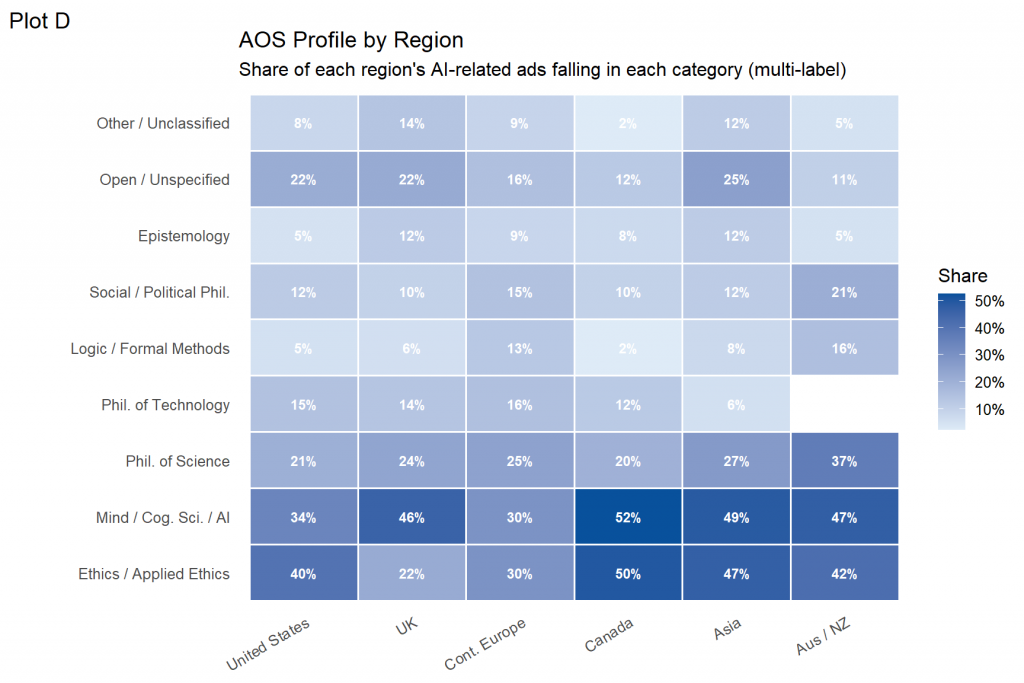
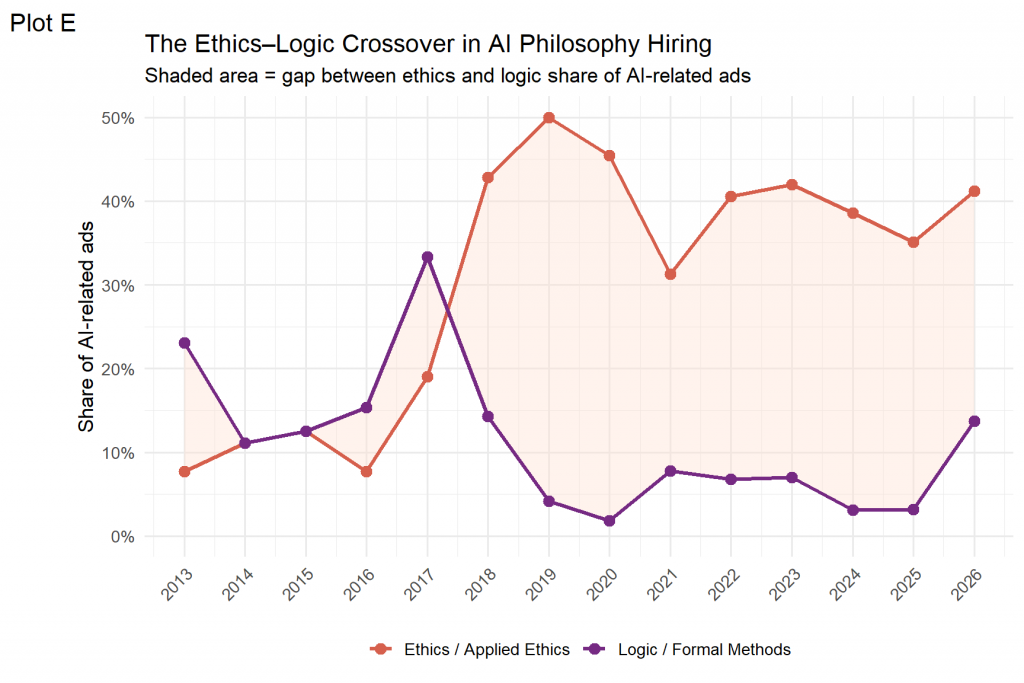
Less obviously, hiring to date doesn’t seem to engage with historical and non-analytic traditions in philosophy, as indicated in the analyses of STS and philosophy of technology in AI ads. This is further substantiated by the data in the appendix on AOS. This, I think, hamstrings future work. Global and historical philosophical traditions are abundant with conceptual resources for thinking about our future with AI which we ignore at our professional and social peril. At a time when the costs of AI become hourly clearer, philosophers’ collective contributions are vital–or at least they stand to be.
Finally, the data are about philosophers investigating AI. There is little, if any, data on philosophers using AI in their work. Digital humanists as a whole are capitalizing on the upswell of AI, but how many among these are philosophers? I mentioned at the start that I used Claude’s Sonnet 4.6, but even that has been for data collection and analysis, not necessarily for doing philosophy in some more traditional sense. But the history of philosophy is chock-full with examples of new technologies (material and conceptual) changing how philosophy is done: writing, the printing press, probability theory, modal calculi, personal computers, the Internet, email. One might reasonably wonder if AI’s impact will not be only on what philosophers talk about but also how they do philosophy.
Appendix: AI and AOS

“For now, it’s slightly comforting to know that Anthropic and the Vatican are attempting to collaborate on AI and ethics, as reported by National Catholic Reporter.”
Yeah, the Vatican has an amazing moral track record: they have always been committed to facts, champion diversity, have no grain of Euro-centrism, always pay taxes, don’t own much more than they need, only fight holy wars, and, of course, love children!
How is whether one “champions diversity” relevant to their moral track record?
The Vatican is a male-dominated institution that still does not allow women to be ordained. Women are thus excluded from positions of authority within the Catholic church. This is an institutionalized degradation of women–and only the tip of the iceberg. If you believe that the Catholic church’s sexism is morally irrelevant, you should try to look beyond your anti-woke bubble. We should agree that diversity is a value when it comes to having access to public office–no matter what you think about affirmative action! No woman can become a Catholic priest, a bishop, a cardinal, or Pope per virtue of their gender. Do you believe that such an institution is a just ethical guide for a global technology like AI? I do not think so. It seems to reproduce many of the Silicon Valley’s power structures. So, good luck with being saved by the Pope. That he is back in the public eye, is, at best, a sign of the time–and not a good one!
I reject non-cognitivism in ethics, but when I read comments such as these two from EuroAmerican, I can understand why non-cognitivism in ethics is taken so seriously. Pope Leo requests that the world be morally careful with AI, especially in relation to worker displacement and unemployment. EuroAmerican responds by bringing up Catholic pedophilia scandals, holy wars, and women’s ordination.
People listen to the Pope because they attribute moral authority to him. I question the justification of this authority by pointing to the churches problematic moral track record. The Pope is neither an expert on AI nor on economy nor on worker’s rights (questionable record too!). If you believe that such criticism is irrelevant, how should we assess the moral authority of a figure like the Pope? Put differently, blind trust is not very philosophical…
Geez. Can you be a bit more open minded?
Not all people who listen to what the pope and crew say about AI listen to it because of the pope’s moral authority. In fact they might be atheists who, thank heavens to mercy, had never been habituated to listening to any monotheistic religious authorities in their entire lives. They nevertheless might be profoundly grateful that the pope and his crew address these issues.
But as far as pope encyclicals on AI go, I recommend you first read the previous pope’s encyclical produced a few weeks before he died. It’s less hedged.
Can’t you just assess what he says about AI without worrying about the further question of whether he is a moral authority and without discussing Catholic pedophilia scandals, holy wars, and women’s ordination?
Why should we think there’s a moral obligation to “champion diversity”?
The Catholic church is an institution that does not give all of its members equality opportunity– an the Vatican is a state that enforces its doctrine. An egalitarian can argue that members of the disadvantaged group have a claim against inferiority. From a utilitarian perspective, it seems irrational to exclude many people from certain avenues to happiness–this doesn’t semester to be a good attempt at maximizing happiness. I could go on. My point is you can justify affirmation of diversity by many standard ethical views. It’s also not a dogma but a critical response to an actual social injustice.
But you treated this as dogma, not a contentious moral claim. I’m glad you can at least see that now.
But as for your arguments, and let me emphasize that I’m about as far from Catholicism as can be: the egalitarian one is completely unconvincing. The utilitarian one is unconvincing due to general skeptical worries about consequences (e.g. Lenman). Additionally, the number of people who are popes or priests are extremely small, so it’s just a handful of people.
Point being: these arguments wouldn’t get a good grade in a freshman philosophy class. This is just your personal dogma. And what’s worse (maybe: damning) is that you don’t realize it’s contentious. At least the pope has more humility.
You don’t seem to get irony, since you treated one aspect of my initial comment differently than all others–as my personal dogma. So, no, you haven’t taught me anything. All of your comments are dismissive snippets–none of them engages with the arguments I make. Why is the egalitarian justification unconvincing? You think it wouldn’t get a good grade as freshman? Please write a review of Kolodny’s The Pecking Order and publish it with a decent journal. But trolling is much more fun.
Moreover, you, again, misread what I say. I could go on should point out that diversity can be justified be most ethical theories. Finally, it shows that you are far away from being a Catholic. Your colloquial use of the term dogma (as conviction) is far away from its technical use in the relevant context.
Whether or not the institution fails at giving equal opportunities, or fails to maximize happiness or has any other moral failures is
completely and utterly
irrelevant to the question whether or not the content of the encyclical is true, well argued, sound, well researched, supported by expert inquiry, informative, insightful, innovative, topical, apt, thought provoking, etc.
… Well on second thought, maybe some potential moral failings are relevant.
Did you say the Pope used AI to write his encyclical?
Are you intentionally misreading my argument? The Pope makes a standard argument against AI. That people refer to him and not any other journalist who has advanced such a critique is rooted in his standing as moral authority (for Catholics and non-Catholics alike). I question this standing. He shouldn’t be seen as a moral authority when the institution he rules fails in so many other areas. Context matters.
Well, one might think that goals like improving equality of opportunity and equality of outcomes are morally worthy, for one thing, so that someone who doesn’t have those goals, or whose actions stymie them, is morally deficient in that respect. Perhaps you disagree, but it’s not difficult to see why others might think such considerations bear on someone’s moral “track record.”
Sorry, my above comment was overly brief and opaque. The point was that one might reasonably think championing diversity serves, or is a part of what it is to even have, some goals taken to be morally worthy. I should have made that clearer.
Let’s suppose those goals are good (I’m skeptical they’re morally obligated, but that’s consistent with them being good). That doesn’t entail that “championing diversity” is morally obligatory (or even morally good all things considered).
And it’s even more strange to *pretend* there’s an argument here that is so uncontentious that it can be used as a strike against someone who doesn’t assent to this dogma. Ironically, it looks like the diversity apologist is more dogmatic than the pope!
EuroAmerican is not claiming that the Pope has a moral obligation to champion diversity (although of course he does). Their posts have clearly been making the point that the Pope does not have moral authority. This is consistent with him never failing in his moral obligations: for, if someone fulfils their obligations and never performs supererogatory acts, one might question whether they should have any special moral authority.
it might be worth searching the philos-l archive in addition to philjobs.
This is all so troubling. May I please be allowed a moment to hearken (sp?) back to a previous post here at DN for some guidance: I think that, just as it’s, albeit somewhat controversially apparently, appropriate and right to grieve the role that AI has played in undermining the thrill of learning in our students, it is likewise appropriate to step back for a moment and grieve the role that AI has played begun swallowing, as it were, the real estate in the wider philosophy job market. By analogy, in the older days, freshly minted PhDs might ‘shop’ at a job market in a way akin to a small town with mom-and-pop style offerings that represented a wide array of subdisdiplines. Some people would apply for the ancient philosophy jobs, some working in metaphysics would apply for those jobs, the ethicists would cast their hat in the ring for the ethics jobs, language for language, epistemology for epistemology, etc. But just as, let’s say, when a Wal-Mart moves to town it begins to swallow up these mom and pop shops, likewise, AI seems to be doing a similar kind of swallowing in terms of the market: rather than to inherit a simple and efficient ‘mapping’ job market wise that takes us from our specialisation to a job in that specialistion, the mapping now (thanks to Walmart-style AI) takes us from our specialism to a job that includes AI in the title. As the great Crantor of Soli once spoke against the Stoics, there is a time for the coolness of reason but also a kind of measured grief is admirable as a form of philosophical consolation as we lose what was good about the past.
I’m afraid this grieving is not very solution oriented, Crantor of Soli. We can all grant that grieving and weeping and turning inwards is appropriate sometimes. But we also need to buckle down, put on our hard hats, grit our teeth and learn to adapt strategically in the environment that (for good luck or bad) we find ourselves. I’m afraid that this means, in this case, learning to ‘throw a bone’ to AI in one’s thematic publication choices, at least sometimes, enough to be able to put AOS or AOC on the application and point to evidence of publications. Then of course one can always move back to whatever they want after they get the job, when it comes to their own research preferences (modulo whatever , say, AI teaching based constraints are in a contract – in some cases, there are none).
This is, of course, the advice we have long given grad students – they should have a teaching competence in logic, ethics, or history, since basically every department teaches those, and not rely only on their primary research interest to get them a job.
“Buckle down, put on our hard hats, grit our teeth, and learn to adapt.”
Please immediately say this to someone working a blue collar job, I’m begging you. Make it clear you’re a philosopher too.
The fact well over a quarter of philosophy job ads this year so far are in philosophy of AI and technology is mad. Surely plenty of external funding for these posts explains a lot of it, but I have also heard from a senior philosopher in the UK that his department is looking for a hire in these fields because of the demand from the students to take a “Philosophy and AI” course. Is this something that others can relate to?
The demand from students to take a Philosophy of AI course doesnt explain why almost all the ads are looking for research specialization in it. You dont need research specialization in a specific topic at the intersection of three or four different philosophical fields (philosophy of tech, mind, ethics, and aesthetics, arguably), for people to be able to teach a course on it.
It’s likely how a program with flat or declining enrollment gets a line from the provost. If they just need someone to teach an AI class, one of their current profs can certainly do it. If they want a line, they need a specialist, and so it goes.
I don’t care for this trend, but generally students wanting to take classes in a topic seems like a perfectly good reason to hire in an area.
Sadly, this trend of “hiring in areas of high student demand” doesn’t generally translate to departmental hires. There’s high student demand for philosophy of religion and philosophical literature courses, but precious few hires in such areas (to the point where people are often warned away from publishing in those fields until one is well-established!). So, it’s natural to ask why it’s happening in the case of A.I. and to be frustrated!
I don’t see huge evidence that students want to take courses in philosophy of AI, but I know Deans and VCs/presidents want to be jumping on this bandwagon in both research and teaching. (AI is highly salient to them of course, having rendered themselves incapable of doing their own ‘jobs’ through reliance on these tools.)
‘Global and historical philosophical traditions are abundant with conceptual resources for thinking about our future with AI which we ignore at our professional and social peril. At a time when the costs of AI become hourly clearer, philosophers’ collective contributions are vital–or at least they stand to be.’
Well said. I think AI is one of those areas that benefits from every branch of philosophy. It’s easy to bludgeon things like philosophy of mind, language, metaphysics, ethics, mathematics, philosophy of science, political philosophy, etc. under one Philosophy of AI label, but the work being done still relies on these deeper traditions and I expect will require all of these AI x Philosophy Sub-discipline specialists (who don’t *only* work on AI).
Right now the missing piece (in my view), is just getting more of these traditions to do the interdisciplinary work / training needed to bridge this. Technical specialists are not really doing it (though there have been a handful of attempts).
Philosophy ethicists are all over this topic, but outside of ethics there is still a fledgling amount of Philosophy of AI work compared to what is needed.
I think it would behoove us to see this less as AI is taking over Philosophy and more like AI is one of the most pressing sociotechnical issues of our time and it’s going to require experts from every subfield to direct it’s future. We (philosophers) ignore it at our peril.
The people putting together Philosophy of AI ads only vaguely know what they want (which in my experience, is true of *any* job ad, it’s best to treat job ads as aspirational wishes, not checklists).
If someone thinks Philosophy of AI needs a legal philosopher, metaphysician or a Kant scholar, go be that person (if you’re willing). The need is there, the hiring committee just might not realize it until they meet you.
Hear! Hear!
Indeed; my former academic work was in (partially) the metaphysics of computation. My current work in cyber security benefits from me having done that, I think, but I need help from continued work in matters like mereology, persistence, boundaries/topology, my old subject of events, etc. The ethics and philosophy of mind stuff is important, but I often regard it as secondary. Of course, all of this is a difficult sell to my computing colleagues, but leave that to me. 🙂
It’s neat to think about what a course in the metaphysics of computation could cover.
At a glance, there are more AI jobs this year than aesthetics jobs in the last ten years combined. Which I think is really too bad.
The boom is going to shape not just the jobs landscape, but the research landscape, too. All these people will need to publish on the subject, and will be training students and grad students, etc. And they, in turn, will all be pushing their new AOS, too. Which means that even if it’s all just a fad, a couple of boom years will have transformed the research landscape for a long time to come. Which, again, I think is really too bad.
Even though I’ve been working in AI and robot ethics for about 20 years now, I’m also concerned that the job market is so top-heavy with this focus on technology, esp. AI. Seems that diversity would still be a very good thing, so to not have so many eggs in one proverbial basket.
But if there’s a silver lining here, it may be that just about all other interests in philosophy could fit under a “philosophy of AI” umbrella—you can smuggle it in. E.g., if you really just want to work in aesthetics, you can use AI-generated “art” to motivate that work.
And all the money being thrown now at AI also benefits these other sub-disciplines of philosophy, if you can get funders (incl. university administrators et al.) to see the AI angle or connection in that work.
So, we could view AI not only as the object of philosophical focus, but also the platform to support classical philosophy…
Aesthetics is already operating on a smuggled-in basis. My sense is that if you claim x and aesthetics, you don’t count as a real x.
More importantly, though, I just don’t think there’s enough room or interest in aesthetics for a ton more AI-related work; there’s some, to be sure, but it seems already well-served by the people doing it.
(To be clear, I’m not claiming this is a unique situation–quite the contrary.)
Right, the AI umbrella probably can’t shelter all the philosophers who want to sneak in via aesthetics. But perhaps that’s still a lot more potential jobs for aesthetics than how it was before AI?
I don’t know, and this is probably answerable as an empirical question. But it doesn’t seem absurd to think there might be more opportunities in aesthetics than in preceding years or even decades.
Also, I wouldn’t assume “if you claim x and aesthetics, you don’t count as a real x.” (Let x = philosophy of AI here.)
It likely depends on what the hiring department’s specific interests are in AI, if they have any. And it depends on how well you can make the case that your work aligns with those interests, which may require stretching the imagination.
Generally, I would look at this as “a rising tide lifts all boats.” Since it’s so multi-faceted, philosophy of AI needs the help of all the major areas of philosophy: value theory (incl. aesthetics), epistemology, metaphysics, and logic.
Even an AOS in Asian philosophy or African philosophy, etc. would be relevant, since AI is a global phenomenon and can be received differently by different cultures. Gender and disability studies are also relevant.
So, philosophy departments can make a real case to deans and provosts that they need to hire more, say, epistemologists and political philosophers in order to cover more areas in philosophy of AI. Unless they’re philosophers, administrators can’t connect those dots themselves—you will need to be inventive and maybe shameless to make a compelling argument…
See above – I think you might even be able to smuggle in some version of good old fashion ontological topics into “AI” if you think that you can teach it to a robot – or even if you think you can argue why we can’t or shouldn’t. My colleagues (some of them) are always incredulous that there actually is a field that deals with parts and wholes – something I find very important when talking about software releases, etc.
Not sure if the journalist who contacted Justin is the one who wrote this just-published Atlantic article, but the article doesn’t sufficiently distinguish between AI companies’ interest in philosophers and academic jobs in philosophy of AI. Shroff seems to assume that academic work in philosophy of AI will impact AI companies, but that assumption seems far from obvious to me. To be fair, at the end she quotes Daniel Fogal noting that good philosophy happens slowly and AI companies want to move quickly.
Here are the last 2 paragraphs of the article (over the paywall here), with Daniel Fogal’s excellent quotes:
Two minutes ago: “neuro”-everything. Cha-ching $.
A minute ago: race-everything. Cha-ching $.
Now: AI-everything. Cha-ching $.
Next up? Not sure, but the cha-ching$ seem to matter a lot…
Not sure i understand this. Are you imply that neuro-prefix-philosophy was in vogue because it was a money-spinner for somebody?
Thanks for all the work!
With regards to the data, they seem to rely on an overly generous notion of ‘AI-related’ in some cases.
I work at Umeå University, and we by no means had 11 jobs advertised that required an AI connection. We certainly had some in the stretch of time plotted here (one TT job and 3 postdocs), but most of our job openings were quite open (typically with an orientation to either ‘theoretical’ or ‘practical’ philosophy).
One possible explanation is that the ads typically list some of the areas of research exercised in Umeå, but going by that would be misleading. By that reasoning we also had 11 openings that were ‘philosophy of mind-related’, ‘applied ethics-related’, ‘metaethics-related’, and so on.
This could be worth checking on.
(another explanation is that some of the non-philosophy jobs in AI at Umeå university mentioned the word philosophy in the ad. In this case they would not have been advertised by the philosophy unit, nor would they have been visible on PhilJobs, I think.)
Thanks for this. I was skeptical about a few of the results from Claude’s scraping and analyses, so I reran it twice more with instructions to be alert for false positives and negatives.
It searched ads using the following terms, using regular expressions for pattern matching: “artificial intelligence”, “machine learning”, “deep learning”, “neural network”, “large language model”, “language model”, (catches broader LLM reference), “natural language processing”, “algorithmic bias”, “machine ethics”, “computational intelligence”, “robotics philosophy”, “ethics artificial intelligence”, “ethics of AI” (without stop words), “autonomous systems”, “foundation model”, “generative model”. If the ad only contained the word “philosophy”, then the search wouldn’t have grabbed it.
One issue might be standardizing the name of the university. Claude might have been too liberal in what counted as a token of “Umeå.” It’s possible that the mark over the “a” didn’t render properly.
I’ve added a methods section to the original post, in case you’re curious in the details of the data gathering and auditing.
Another philosopher from Umeå here: our ads include information about current research interests at the philosophy unit, even if the position advertised has no connection to AI or is open. So the text for nearly all our ads includes ‘philosophy of AI’, as well as ‘philosophy of mind’, ‘applied ethics’, and so on.
In other words, the presence of that expression in the ads does not indicate that the job is AI-related. I wonder to what extent this is also true for ads from other institutions.
I quickly tried a similar exercise using Copilot, and the results were closer to the truth: it identified 4 AI-related ads from us.
One possible source of misunderstanding is how double counting was handled. The numbers struck me as high and I wondered if an ad put up with a slight change for the same position would count twice. For example, one in December saying there are two months to apply for February deadline and then in January saying one month. Or one on a department site and the same one on the university careers page, for example.
One shouldn’t overread this. Faculties turn over slowly, so if there is a new or newly-salient subfield that many departments want someone in, that subfield will suddenly have massively disproportionate hiring. But there’s no reason to expect that to continue indefinitely.
Anecdotally, there was a huge surge in hirings in philosophy of race and gender a few years ago, which has now faded. Partly that’s a shift in political vibes but to a substantial degree it’s just that many of the departments who didn’t have anyone in that field but wanted someone now have someone, so it stops being a priority the next time a line becomes available.