
A study by The Economist looked at how the employment prospects of college graduates have changed over the past few years as AI use by potential employers has increased.
The concern is that firms will hire fewer people if they can use AI to complete the tasks that otherwise would have been handled by entry-level workers.
Data about this has been mixed, so The Economist conducted its own study based on surveys of recent college graduates from the National Association of Colleges and Employers. The surveys ask new alumni whether they are working, unemployed or continuing in school. “Using their responses, we compared labour-market outcomes in fields with differing levels of exposure to AI before and after the arrival of large language models.”
Their main finding is that “graduates in fields more exposed to AI have suffered markedly worse outcomes.”
Philosophy, according to their study, involves relatively little exposure to AI, and the percentage change in employment during 2022-2024 for college graduates with degrees in philosophy was actually positive—around +4%.
Fields like computer science, communications, electrical engineering, and information sciences, saw changes from -7% to -14%.
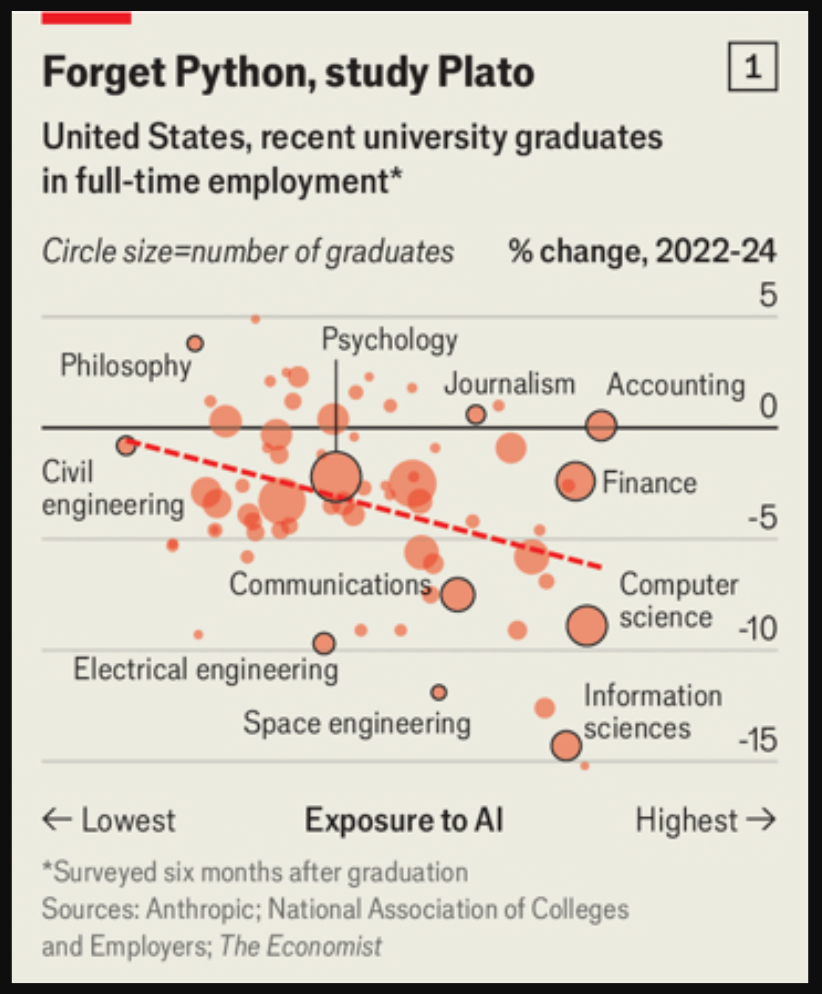
The full article is here.

Yet another indicator that soft skills – critical thinking, analytical writing, and active listening – remain in demand and philosophy majors are valued by employers for just such.
I am betting on it, and so are others: https://certifiedaifreeskillsandknowledge.org/
This is just one persons option but: Plugging your personal project here and there seems fine but I see you posting this link on so many threads that it feels like spammimg at this point. If everyone who thought they had an important website or project did this, the comment section wouldn’t work, so in my view it’s kind of free riding on the restraint of other people. I know you don’t mean any harm and I’m sorry if I’m making this out to be a bigger deal than it is
How does conceptually disintegrated nihilism teach reasoning?
I’m not surprised to learn that when AI programs develop the capacity to perform a certain function, fewer people are able to make a living by performing that function. This confirms my intuition that AI encroachment is bad for the philosophical profession, though I’m very glad to see that the effects for us so far have been minor compared to other areas of academia. Let’s do our best to keep it that way.
I agree that AI will likely be bad for the majority of specific professions. However, I do think that philosophy teaches the kind of skills that are applicable to many professions. So that leads me to believe that it is still a good choice if you are looking to be adaptable to many different possible futures. The one caveat though is that you must actually learn the skills that philosophy teaches. A philosophy degree that someone got by using AI to do all of their writing is not worth nearly as much as a philosophy degree where someone did all of the work themselves. The students who are the most successful with their degrees will always be the ones who forced themselves to learn “the old fashioned way.”
Well put. I just think we should do our best to promote the set of academic conditions most conducive to “the old fashioned way.”
These are all points I agree with. But I wonder if there’s a way to help spread this message because students and parents need to recognize these points so that there is more chance for studying and valuing philosophy in college. It just pains me that of the 1000 psychology majors at my university, many of them (certainly at least 100) would benefit more with a philosophy degree.
While I think flipped classrooms, in-class cursive writing in blue books, and live oral in-class discussion – with sides randomly switched – can go a long way, I have no answers for enforcing a substantively AI-free research paper, often a capstone exercise and evaluative criteria for grading, yet too often lazily executed to little educational benefit.
Any ideas or practices?
This is not a full solution, but Google docs has actually incorporated a “track changes” feature that allows one to easily identify the most flagrant instances of AI-based cheating. You can see what they typed, when they typed it, how long it took them to do so, and whether they copy/pasted anything. Simply requiring students to turn in their projects as a docs file (docs is completely free to use) with the track changes function activated will allow you some insight into whether they used the right methods or not. There are also some very nice proctoring softwares that you could require them to download which keep track of everything happening on their device while they’re working.
Soft skills are hard to learn and habitually apply.
Creating and enforcing the conditions to enable such learning and practice – flipped classrooms, in-class writing in blue books, live oral in-class discussion, with sides randomly switched – are just a few possibilities.
Developing critical thinking, analytical writing, and active listening skills and habits is a big challenge for philosophy professors and TAs, as much as for their students.