
Alex Guerrero, professor of philosophy at Rutgers University, received an unusual email the other day.
It was from the American Advanced Educational Association (AAEA), and it concerned an “opportunity to collaborate… in Ph.D. recruitment.”
They write:
Here is how our process typically works:
-
- We pre-screen prospective students based on your specified criteria.
- We send you the candidate’s CV for your consideration. If you’re interested, we’ll arrange an interview between you and the student. Please be kindly advised that the candidates we recommend are expected to meet the admission standards of both your institution and your department.
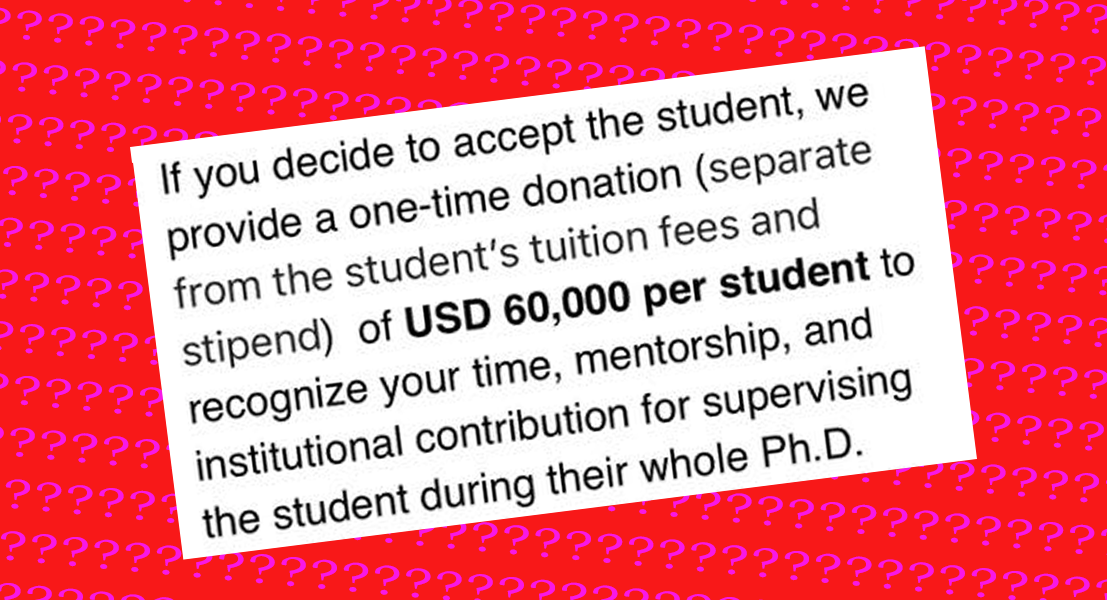
- If you decide to accept the student, we provide a one-time donation (separate from the student’s tuition fees and stipend) of USD 60,000 per student to recognize your time, mentorship, and institutional contribution for supervising the student during their whole Ph.D. time. The donation will be gifted in full once the student receives a formal admission offer, and is intended for you, and you will have full discretion on how to allocate it—whether for your lab, your research group, or any particular student.
The full email is at the bottom of this post.
Professor Guerrero is curious to learn whether other people in philosophy and other disciplines have received this proposal or something like it and whether there are academic fields in which it has gotten uptake.
Some initial discussion on social media raised concerns about whether this should be considered bribery, whether it poses a conflict of interest, about the proposal being a scam, and about the legitimacy of the organization.
If you’ve had experience with this organization (or ones offering similar arrangements), let us know about it. Discussion welcome.
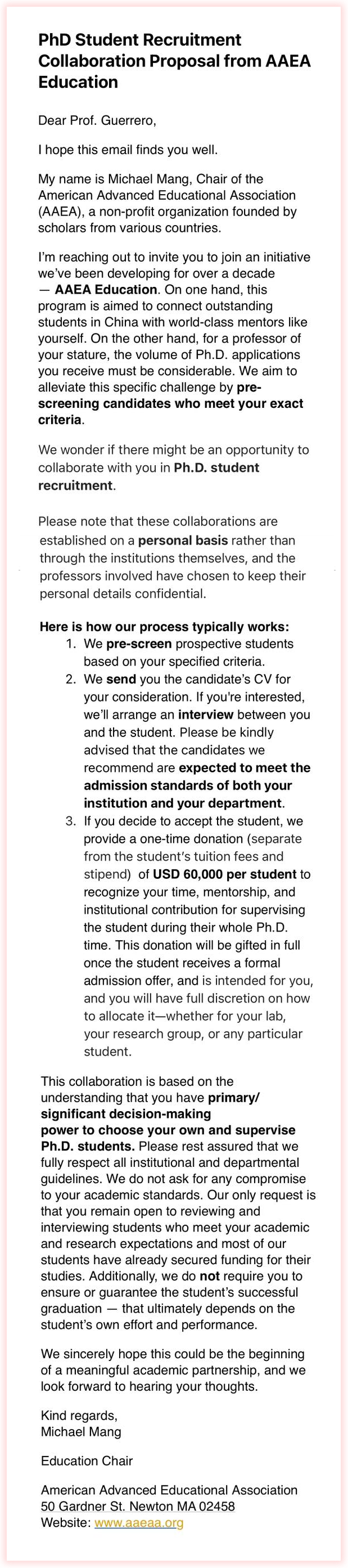

I received such an email in August 2025. Below is the text of the email I received as, from a quick skim, there is at least one interesting difference (claims about ongoing partnerships).
***
I hope this email finds you well.
My name is Michael Mang, Chair of the American Advanced Educational Association (AAEA), a non-profit organization founded by scholars from various countries. You can find more details about AAEA at the end of this message. Currently, we collaborate with a number of prestigious universities around the world, including MIT, Harvard, UIUC, UCLA, ICL, UCL, Oxford, HKU, CUHK, NUS, NTU, and others.
I’m reaching out to invite you to join an international initiative we’ve been developing for over a decade — AAEA Education. This program is designed to connect outstanding students in China with world-class mentors like yourself, especially those who may otherwise have limited access to global PhD opportunities.
We wonder if there might be an opportunity to collaborate in PhD student recruitment next year or in the future. For example, we have an ongoing partnership with the IMPRS at the Max Planck Institute, Technical University of Munich in Germany, King’s College London and University of Sheffield in the UK, where we assist with candidate screening and interview coordination. Over the past five years, this collaboration has successfully supported the recruitment of several highly qualified students.
We would be honored to explore a similar collaboration with you. Here is how our process typically works:
This collaboration is based on the understanding that you have the authority—or at least primary decision-making power—to choose your own and supervise PhD students. Please rest assured that we fully respect all institutional and departmental guidelines. We do not ask for any compromise to your academic standards. Our only request is that you remain open to reviewing and interviewing students who meet your academic and research expectations. Additionally, we do not require you to ensure or guarantee the student’s successful graduation — that ultimately depends on the student’s own effort and performance.
We sincerely hope this could be the beginning of a meaningful academic partnership, and we look forward to hearing your thoughts.
***
If the compensation continues to rise at this rate, it’s going to be quite lucrative a few years from now!
This email mentions Sheffield – but just to clarify, as someone who has some involvement in evaluating some (not all) of the PhD applications in Philosophy – I have not ever had any interaction with this person or their institution, and I don’t know of any colleagues who have either.
presumably they would call it a partnership if they had found just one person from Any department in those mentioned institutions
Based on a quick internet search, this AAEA thing seems to be some sorts of shell organization for one of those Chinese study abroad agency companies (for those of you who don’t know this, helping Chinese students apply/get into Western colleges and grad programs is a business in China). The company in question is called gongjiangpu, whose founder Meng Yue seems to be precisely that Michael Mang who wrote the email in OP (at least, their photos match). Their business model seems to be charging students money for getting students opportunities to do summer research and academic exchange in the US, which helps one get into US PhD program. They boast on their websites about all the partnerships they have with all kinds of labs and institutions, though I have no idea if they are legit or not. In any case, I suspect that the $60000 they are offering is most likely paid directly by the students themselves. I also suspect that accepting this might get one into a Charles Lieber-like situation.
Really helpful information. And for anyone unfamiliar with the story of Charles Lieber: https://en.wikipedia.org/wiki/Charles_M._Lieber
Charles M Lieber, multi time winner of Massachusetts and Rhode Island largest pumpkin contests, and current Massachusetts record holder? That Charles Lieber!?
I assume the bags of cash he was bringing in undeclared from China mostly went to pumpkin feed.
I’ve been offered money, but sadly never quite as much. On a more serious note, and I’ve become more aware of and worried about this only recently, there is a solid layer of businesses, recruiters, and agents acting as intermediaries between prestigious universities and international students worldwide. This must be a huge lucrative business, and many of these agencies take a cut from the universities (UK universities spent £500 million in 2023) and students (or both). Some are of these recruiters are, unfortunately, closer to organised crime and human trafficking, whereas others probably are more legitimate businesses. There was a really nice article on this problem in the Guardian recently:
https://www.theguardian.com/education/ng-interactive/2026/apr/07/brutal-reality-of-life-as-a-foreign-student-in-the-uk
Of course, such agencies will not be able to place many students to do a PhD in philosophy at Rutgers or Edinburgh, but they probably don’t know that or care. I assume that these are mass mailings sent to everyone in most universities.
The story set out in the Guardian article applies almost compeletely to Australia, too. (The sitution has become very bad as AI allows people to “write” nominally custumized applications to work with particular people very easily.)
This part certainly applies to Australia, including the fact that neither Labor nor conservative parties seem to have any plan about what to do in this area, other than short-term moves that mostly make things worse.
To solve the university funding crisis, the government either needs to substantially raise tuition fees or reinstate direct state grants. Neither option is politically palatable, so instead, Conservative and Labour governments have oscillated between encouraging universities to attract international students and making Britain a less appealing place for them.
This is so fucking rancid. If any of you ever accept this kind of offer, if any institution capitulates and allows this to become standard, or even a tolerated practice, we are talking about the death of our discipline and the further corruption of an already hyper-oppressive, systemically gatekept, and racist field.
And the thing is, we already have a massive problem in PhD programs with people who frankly have no original ideas at all. People whose entire identity is being a student. The “look at me, I am so young and in a PhD program” kind of hot air. People who came straight out of elite institutions with all the right connections, all the right recommendation letters, all the right institutional pedigree, but who have never actually lived outside academia for a second. They got good grades their whole lives, never worked real jobs, never struggled materially, never touched grass, and now drift directly into PhDs because school is the only thing they know how to do.
We already realize this, as professors, after admissions, all the time. We admit students and later recognize we made mistakes. That some of these PhDs are intellectually empty, professionally unprepared, and fundamentally incurious outside the narrow performance of academic success. The fact that this is already such a visible issue shows how broken the system already is.
Now imagine what happens if organizations like this become normalized, lucrative, and backed by serious money. We will get an even bigger flood of talentless applicants doing PhDs because they are “finding themselves,” because they “just like school, “because they just love to read,” or because they come from privileged institutional pipelines (and backgrounds) that can bankroll this kind of thing. And who will be able to afford services like this? The same already privileged people who can casually throw tens or hundreds of thousands of dollars at manufacturing academic prestige.
So now these people, people with no originality, no intellectual risk, no lived experience, and no genuine commitment to thought itself, get artificially polished into becoming our contemporaries.
Absolutely pathetic.
Splendidly put, PhNS. I suspect that exactly the types of people you’re referring to will soon be arriving to inadvertently self-report in the replies to your comment.
Personally I think it would be wrong to accept money to admit students even if the students were intellectually curious original thinkers with non-academic work histories and poor grades.
I think this is far too quick… I’m goign to try to defend it, at least if the money is put to good use (say, Oxfam). Okay let’s get down to business..
Consider the following package of four jointly performed acts, which for ease of presntatino l call the Action: (i) I accept AAEA’s sixty thousand dollars; (ii) I decide the candidate’s admission solely on the merit criteria I would apply to any applicant, so the candidate is admitted if and only if she would have been admitted absent the offer; (iii) I publicly disclose the offer, my acceptance, the independence of the admissions decision, and the destination of the funds, (… so am explicitly repudiating the intended quid pro quo); and (iv) I donate the full sum to Oxfam.
Righty ho, I think there’s a case for defending The Action as in the clear!!! Let’s start with a simple only if condition on wrongness of a given action:
Premise 1. An act is wrong, all things considered, only if it possesses at least one wrong-making feature that is not outweighed by its right-making features.
You aren’t going to deny me P1 are you? Good. Okay:
Premise 2. The only candidate wrong-making features the Action could possess are these three: (a) it constitutes bribery, (b) it signals the success of AAEA’s scheme to AAEA and to other faculty, or (c) it involves deception or betrayal of institutional role.
These are the ones everyone is yapping about. Now..
Premise 3. An act constitutes bribery, in the morally objectionable sense, only if it corrupts an institutional decision procedure.. that is, only if it causes decisions to track money rather than the criteria the institution exists to apply.
Premise 4. If the admissions decision is made solely on the antecedent merit criteria, then the admissions decision procedure is not corrupted.
Premise 5. Component (ii) of the Action guarantees that the admissions decision is made solely on the antecedent merit criteria.
Premise 6. An act signals the success of a scheme only if it leaves the scheme’s mechanism intact and undisclosed.
Premise 7. If an act publicly discloses and explicitly repudiates a scheme’s mechanism, then it DOES NOT leave that mechanism intact and undisclosed.
Premise 8. Component (iii) of the Action guarantees that AAEA’s scheme is publicly disclosed and explicitly repudiated.
Premise 9. An act involves deception only if it involves concealment, and involves betrayal of institutional role only if institutional duties are discharged contrary to their constitutive aims.
Premise 10. Component (iii) of the Action RULES OUT concealment, and component (ii) GUARANTEES that the admissions duty is discharged exactly as its constitutive aims require.
Premise 11. A donation of sixty thousand dollars to Oxfam produces a quantity of expected welfare of substantial magnitude (obviously) on the order of a dozen statistical lives saved or the equivalent suffering averted (something like that).
Premise 12. Component (iv) of the Action guarantees that such a donation occurs.
Premise 13. If an act produces expected welfare of substantial magnitude, then it possesses a right-making feature of substantial magnitude.
Premise 14. If an act lacks every wrong-making feature it could possess and possesses a right-making feature of substantial magnitude, then it has no wrong-making feature that is not outweighed by its right-making features.
Okay.. Now the derivation proceeds as follows.
Lemma 1 (from 4 and 5). The admissions decision procedure is not corrupted.
Lemma 2 (from 3 and Lemma 1). The Action does not constitute bribery in the morally objectionable sense.. i.e., wrong-making feature (a) is absent.
Lemma 3 (from 7 and 8). AAEA’s scheme is not left intact and undisclosed.
Lemma 4 (from 6 and Lemma 3). The Action does not signal the success of AAEA’s scheme , , i.e., wrong-making feature (b) is absent.
Lemma 5 (from 9 and 10). The Action involves neither deception nor betrayal of institutional role , i.e., wrong-making feature (c) is absent.
Lemma 6 (from 2, Lemma 2, Lemma 4, and Lemma 5). The Action lacks every wrong-making feature it could possess (boom)
Lemma 7 (from 11, 12, and 13). The Action possesses a right-making feature of substantial magnitude.
Lemma 8 (from 14, Lemma 6, and Lemma 7). The Action has no wrong-making feature that is not outweighed by its right-making features.
Conclusion (from 1 and Lemma 8). The Action is not wrong, all things considered.
This is very well thought out I’ll grant you that, though I am not sure about Premise 2 – might there not be another variant here (given the unethical things about the Chinese government (eg., treatment of Ughyurs) has done which mean accepting this money has a kind of moral equivlaence with ‘sportswashing’?
I considered that but the kind of transparaecy that’s part of The Action is enough to counteract the kind of implicature that the badness of sportswashing is predicated upon. Consider, for example, that you are not longer ‘sportswashing’ if you (for example) play in a competition where prize money is funded by the Saudis, but where you make explicit that you are ONLY doing that so you can donate winnings to the Jamal Khashoogi trust. Such an action would fail to be sportswashing given its transparency ‘rebuts’ the kind of implicature (that you are legitimizing the source) that sportswashing depends on – and by parity of reasoning, if you tweak the transparency mutatis mutandis in clause (iii) of The Action, then there isn’t going to be any kind of plausible moral equivalence to sportswashing that is going to get off the ground. Hence, I stand by Premise 2.
I agree the sports washing line doesn’t work against p2
If you think this isn’t bribery then you also probably think campaign contributions aren’t bribery either.
🙄
If not an outright bribe, a quid pro quo “donation” is either a gift or a grant. Either way, your university likely has a conflict-of-interest policy for gifts and a process for accepting and administering grants. Ignoring either is what’s call a career-limiting move.
I’d expect that any suckers who fall for or are tempted by this will get what they deserve…
(Posting this anonymously because of all the obvious reasons.)
I agree with one commenter that this particular example looks “fucking rancid.” On the other hand, it’s worth saying out loud how close universities come to something like this already. In the fall of 1991, I applied from a school in the CUNY system for graduate programs. I was accepted at some and denied at others. Then in spring of 1992, while I was still trying to work through my options, I received news that I had been awarded a multi-year Mellon fellowship. The next morning, I received several overnight FedEx envelopes and phone calls, some from universities that had rejected me and some from universities that I hadn’t even applied to. Congratulations, they all said: me (and my Mellon fellowship were accepted) and they very much wanted me to visit and pick them.
Why? I assume there were multiple reasons. Here are some guesses: (1) having lots of students with Mellon fellowships gave a university bragging rights, (2) in theory the Mellon fellowships were some indication of academic excellence, and (3) money. My analogy here is between (3) and the (absolutely fucking rancid) organization in this post. Because the Mellon foundation gave money, that relieved universities of financial obligations for some students. Universities want to spend less of their own money. Therefore, I guess, they are more likely to want such students—even when they have previously rejected those students or the students haven’t even applied.
I don’t know if external fellowships still work this way (where you can take them wherever you go), but if they do, it’s also a problem.
Just to be clear, I think this ‘offer’ is a seriously objectionable kind of quid pro quo deal, and that taking AAEA up on it would constitute serious ethical misconduct and would also (I expect) constitute grounds for termination at most reputable institutions.
I do wonder whether that is somehow not a universally shared view; otherwise I don’t see the point of the emails to faculty, as that doesn’t seem required if they are just looking to fleece wealthy families.
I would think someone motivated enough could open an investigation at one of the alleged “partner” schools, i.e., UCLA, Oxford, KCL, TU Munich, NUS, et al.
US, UK, Germany, and many other countries (but not Singapore, e.g.) have freedom-of-information laws, which would apply to at least public institutions.
If involved persons at those schools can be identified, we can perhaps hear their rationale for taking the money…and see whether that holds up in ethical misconduct hearings…
I work at TUM and I’ve contacted people in the administration about this. They didn’t immediately recognize the institution, but they’re going to see whether there’s anything to the claim that AAEA and TUM cooperate in any way.
Good luck, Philipp, and please let us know what you find out!
I can also imagine that this would be deeply embarrassing for a university, so they could obstruct you? Let’s hope they’re smart enough to not double-down here and create a second scandal around a cover-up…
Sadly, I think standards in China are low enough that this sort of deal makes sense from their side. At the very least, they don’t seem to appreciate the risks that doing something like this entails for one’s international reputation. (As A Chinese grad student says above, there are similar services in China.) Personally, this is a very frustrating situation for those of us who are trying to do things legitimately with the legitimately brilliant students that we have.
In light of some of the comments I’ve been seeing on this thread, I would like to direct a question to those better informed than I:
I am wondering sincerely what to make of the quality of the Chinese university education system. I recall a while back seeing a ranked list of the top global universities, in which several Chinese institutions appeared near the top of the pile. I’m sure there is a great deal of variation in the PRC from university to university, as one would expect of any country. But this incident, along with the information shared by A Chinese Grad Student, below, leads me to wonder what in the world is going on, and whether there is some kind of broad-strokes cultural disconnect between the academic communities of the west and those of the PRC. I can’t imagine this sort of gambit working at a western graduate program, and our instinctive reaction is generally to find the very notion deeply unscrupulous. At any rate, I would very much appreciate it if anyone with knowledge of these things could illuminate the subject for me, particularly in the context of our discipline. Does this all have to do with a highly competitive professional market favoring elite western universities? Does the PRC have a similarly tiny set of institutions in which most of the resources and prestige are concentrated, and is that what’s driving this aggressive push for placements abroad?
To make this abundantly clear, I am in no way questioning or impugning the abilities of Chinese nationals. That would be racist and reprehensible. This is a genuine question about institutional ethos from someone painfully ignorant of such affairs.
I am far from an expert, so I hope someone else better informed steps in and corrects me. But in the meantime let me say just a little bit based on my own experience.
First, there is a lot of excellent scholarship going on in China. Even limiting ourselves to the narrow category of articles published in well-known English-language journals, the faculty at those several Chinese institutions near the top of the pile regularly publish in Mind, Nous, PPR, JPhil, and so on. I mention this to reinforce what you said, about the importance of separating the abilities and quality of scholarship from broader social structures.
Second, there is a lot of opportunity for rancid shit. At least once a week some service or other contacts me to let me know that they can “guarantee” publication in an A&HCI/SSCI-indexed journal. More recently, some businesses have been advertising that they can teach you how to use AI to substantially increase your publication rate. Of course you can find analogous services in other countries. But what strikes my American sensibilities as a genuine difference in China is how shameless people are when advertising these things and how tolerant people are when being advertised to. I genuinely do not know why people do not react more like the people in this Daily Nous thread are reacting. I suspect it has something to do with broader cultural norms against personally confronting norm-violators. But that is speculative.
Third, and perhaps relatedly, international institutions are still held in very high esteem compared to equivalent Chinese institutions. When discussing with my students which philosophy programs to consider when applying abroad, one factor among many is the university’s general reputation. Why? Because if they decide to not pursue academic philosophy as a career then having a graduate degree from a “top” international university significantly improves their ability to get a job back in China. It doesn’t really matter what subject the degree is in and what skills they learned. This sort of bias is somewhat institutionalized: many companies have explicit policies about recruiting people with these sorts of degrees. For that matter, so do some universities.
The most succinct way of describing it is thus: Chinese students and Chinese profiteers are acting within the social context that they are familiar with and not the social context that you are familiar with. I think it is fair to say that there is “some kind of broad-strokes cultural disconnect”. But it is not a disconnect about what constitutes good scholarship and legitimate career advancement; it is a disconnect about what to do about those who try to game the system. For better or for worse, Americans are much more eager to grab their pitchforks.
To add to Peter Finocchiaro’s (in my view) spot-on analysis, one additional (and complementary to what Peter says) factor is that there is now both (1) quite a lot of wealth in China and (2) an ongoing eagerness for Chinese nationals to pursue education overseas, particularly in Anglo-countries. When you combine (1) and (2) with the significance Chinese parents (and, by extension, their children) place on education as such, along with a market created partly by information asymmetries/knowledge gaps (in terms, e.g., of language barriers, differing educational systems and admission processes), something like AAEA becomes almost a capitalistic inevitability.
Why is a donation of, say, 2 million dollars for an ivy college admission acceptable? In china, that would not be acceptable. You can only buy into the lower tier colleges that have no credibility anyhow.
This is a good point that others have also brought up. Legacy admissions do seem to function in an analogous way here in the US, and I think we ought to look askance at them, too, if we were to be consistent in our views.
I think we DO look at them askance. That’s why (in part) we don’t have them at the graduate level that I know of. (Universities can at least claim that having a few dumb as bricks wealthy undergrads floating around toasting the university isn’t that harmful to the other students or the academic process, but having the same in grad school really would be.)
I also think Peter’s analysis is spot on. There are a lot of ways to analyze what is wrong with the Chinese academia (despite, as many have mentioned, all the excellent scholarship produced by many absolutely brilliant and hardworking Chinese scholars), but at least two things can be said. First, the Chinese higher-ed institutions in general get a lot more administrative/bureaucratic interference than Western ones. Standards for hiring/recruitment/promotion/tenure/grants are often determined by some kind of administrative bureaucrats for the purpose of better ranking and better stats, rather than by academic staff. That creates the incentives for a lot of rancid stuff in general. One example: all doctors in China that work for a state-owned hospital, in order to get promotion and pay raise, will need to publish papers. Most of them do not do research and have no time to do that anyway, so they pay-to-publish in some fashion. Second, for whatever reason, the kind of academic norms common in the West (honestly, no plagiarism, pay to publish, etc.) has not really formed in Chinese academia in general, but are more often personal moral principles of individual researchers. Maybe that is going to change (and I certainly hope so), but for now, we see weird things like very renowned Chinese philosophers buying fake “fellow of the Royal Society” title from fraudulent organizations.
I must admit that I am a little bit amused by the pearl-clutching reaction. Legacy admissions are still a thing in the US, and they benefit the wealthiest students. I know this works mostly at the undergrad level, but a good undergrad degree can take you very far in the US. Which leads me to my second point. Recommendation letters for US programs from US scholars are valued more than those from scholars from other countries, especially non-European.
I am not happy with the email that Alex received. I would never accept any money from anyone to admit a grad student. But, as someone working in the US, I would also not react as if the phenomena were unheard of.
Children of big donors get preferential treatment as well even when the parents don’t have prior ties to the colleges of interest: https://www.highereddive.com/news/through-the-back-door-how-much-influence-do-donations-have-on-admissions/551528/
It is true that donations are generally made without *assurance* that the donor’s child will get in while Alex was promised money only if the applicant of interest got an offer letter, but otherwise, the cases are similar.
Received this one from Michael Mang in February:
Dear […],
I hope this email finds you well. We are AAEA (American Advanced Educational Association), a non-profit organization initiated by scholars from various countries (you can find more details regarding AAEA at the end of this email). Your exceptional expertise has demonstrated remarkable potential, making a significant impact not only in the academic sphere but also in industry. As the associate chair of AAEA, I’m reaching out to invite you to apply for the funding granted by one of our cooperators — Zhejiang Talent Matrix Fund of China. About Zhejiang Talent Matrix Fund: Zhejiang Talent Matrix Fund holds the vision to help the human race moving forward. They are committed to support innovative, cutting-edge and forward-looking research projects with the aim to promote scientific and technological progress and industrial development. AAEA is now working with Zhejiang Talent Matrix Fund who will provide financial support to outstanding academics to help them turn their ideas into reality and to achieve their greater potential. This funding is provided by Zhejiang Province, China, but it is not intended for governmental or administrative purposes. Rather, it serves as a general financial support mechanism aimed at advancing cutting-edge scientific and technological research worldwide, with the goal of contributing to innovation and the broader development of human knowledge and capabilities.As such, the funding is purely academic and research-oriented, and it should not raise concerns regarding administrative, institutional, or political conflicts.We can provide you with: · Funding for project research, equipment purchase, personnel expenses, etc.;
· Assistance in applying for relevant talent policies, scientific research projects, etc.;
· The opportunities to collaborate with enterprises and scientific research institutions in China;
· Once nominated, applicants will receive grants ranging from $20,000 to $500,000 USD depending on their research fields, current funding needs and other relevant factors.
The academic fields we are interested in supporting :
· Artificial intelligence, Intelligent manufacturing;
· Biomedicine, Life health;
· New materials, New energy;
· Mechanical / Electrical engineering;
· Economics / Finance.
Criteria the applicants should meet:
· hold a PhD/MD degree;
· have at least three years of research or working experience.
More information for your consideration:
1. The application can be submitted by the academic as an individual, without going through their affiliated institution. However, whether external funding needs to be reported or subject to other procedures will depend on the policies of the applicants’ institution.
2. Once nominated, the applicants enjoy the full right of allocating the granted funds to their research. Confidentiality is fully guaranteed. Any sensitive data or information related to your ongoing work will not be involved.
3. Beyond the stated eligibility criteria, there are no other requirements for the applicants. Applicants are not required to relocate, but they’re welcome to visit China for work or research in the future if they choose to.
4. Please do not directly fill and submit the application form from AAEA Website, as currently we come across some issues which prevent us from receiving your application. We sincerely apologize for any inconvenience this may have caused. We will ask you to fill out the application form later if you are interested.
Application deadline:
· First round – January 15th, 2026;
· Second round – February 15th, 2026
Applications submitted in the first round will have a higher likelihood of being nominated. The final nomination results are expected to be announced by the end of 2026.
Once you pass our pre-screening process, even if you are not selected for this funding cycle, AAEA will provide an additional USD 1,000 as an encouragement stipend to support continued engagement with us, as this funding opportunity is available on an annual basis and may be applied for again in subsequent years.
Last year, three scholars and scientists successfully collaborated with us, received a stipend, and proceeded to the next stage of the screening process.
If you are interested, please reply to this email for further information and discussion. We look forward to hearing from you.
Kind regards,
Michael Mang
Education Chair
American Advanced Educational Association
50 Gardner St. Newton MA 02458
http://www.aaeaa.org
AAEA, located in Boston, on the East Coast of the United States. We are a non-profit organization initiated by scholars from various countries. Among them, Professor Steve Bollinger from the CMU, Academician of the European Academy of Sciences, and Academician of the German Academy of Sciences Roland Eils are all mentors of AAEA organization. Our core purpose is to coordinate the resources of higher education institutions and scientific research from various countries, and assist in the construction and development of university laboratories worldwide, providing more scholars with opportunities to improve their research conditions and have broader development prospects in their respective fields.