
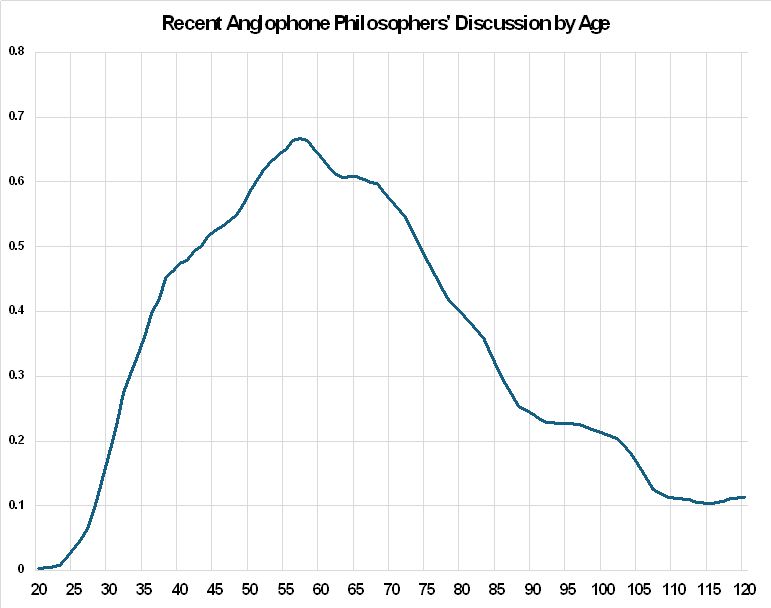
Philosophers of the past 100 years or so have tended to reach “peak influence” between their early 50s and late 60s, according to a new analysis from Eric Schwitzgebel (UC Riverside).
To determine this, Professor Schwitzgebel looked at how frequently the authors are mentioned in philosophy journal abstracts, titles, and keywords over time—that is, their “discussion arcs,” discussed previously here.
He analyzed the discussion arcs of 25 anglophone philosophers born in the 20th century who are among the most-cited in the Stanford Encyclopedia of Philosophy.
Here’s the youngest set of them, those born between 1941 and 1945:

For the charts for the other sets of philosophers, see Schwitzgebel’s post, here.
Below is the overview for all the philosophers he looked at:
As I’m sure Professor Schwitzgebel would agree, “discussion arcs” are just one way to capture the influence of philosophers, and a partial one, at that. For one thing, the influence of philosophers sometimes extends beyond the discipline’s professional ecology. For another, it is unclear how far the discussion arc approach could be extended to apply to philosophers who lived during a time in which nothing like the professional ecology of the past 150 years or so existed. And lastly, with enough time, some philosophers become so influential that their ideas come to be detached from their names, and in some cases come to be more like the lenses through which we see, or the tools with which we work. When did Aristotle’s influence peak? Has it?
We keep learning a lot from Schwitzgebel’s work in the “sports analytics” vein. Continental philosophy isn’t his thing, but I’d be curious to know whether the pattern works differently with Heidegger, Derrida, Deleuze et al. Even for those who don’t care about continental, it could shed some light on whether the pattern manifested above addresses some sort of universal mechanism, or whether it speaks more specifically to the dynamics of Anglo-American philosophy as an institution.
Sartre and Merleau-Ponty were 38 and 37 when they published their magnum opus. Husserl was 51 and Heidegger was 38. Hume was 27 apparently. I think it also has to do with how fast they could get their PhD (e.g. French people graduate relatively young).
What I was asking about is peak of influence rather than publication dates. It often takes awhile for even an important book to seep into general awareness.
This is all very helpful, however, Professor Schitzelberg’s graph seems to suggest that at least one philosopher has had non-trivial influence while at age 120 years old. Now, Jeanne Calment, the French supergenerian, is the only possible philosopher this can be, but I can’t find any of her writings online?
All models are wrong, but some models are wrong in funny ways.
I think you are misunderstanding the graph. Some philosophers are more influential 120 after their birth … though they may be deaf for some time
Well Gorm anyone may be deaf for some time, exactly the time they can’t hear
typo – dead
Why is the focus on their physical age and not their academic age?
I’m just guessing, but: straightforward to input birth year, would take a lot more work to check “start of academic career” for each one?
“Academic age” has several different plausible definitions – it could be years since undergraduate degree, years since PhD, years since first professional publication, years since first academic job, or years since most influential publication.
Most likely, each of these events triggers some part of a discussion arc, and the actual discussion arcs of any particular philosopher will be some aggregate of all of these. It’s possible that the data will be much more clear if you focus on one of these rather than the others.
But my guess is that these will all be strongly correlated – most of the people in these charts will have received an undergraduate degree about 20-25 years after they were born, received their PhD about 5-15 years after their undergraduate degree, had their first professional publication at most 2 or 3 years before or after their PhD, had their first academic job within a few years of their PhD, and had their most influential publication some time after their first academic job.
Because of this strong correlation, there’s not likely to be a *lot* more clarity by looking at one of these “academic ages” rather than biological age. There could be some, but the fact that biological birth date is easier to find for most of these people than any of the other dates (and that a non-trivial number of these philosophers will lack one or another of these dates) makes it methodologically reasonable to focus on biological age, unless you’re trying to settle a detailed empirical question of which of these events tends to be most significant in shaping a discussion arc.