
The trial of Jonathan Caravello, a lecturer in philosophy at California State University Channel Islands, begins today. The trial concerns his actions at a protest during a Federal Immigration and Customs Enforcement (ICE) raid of a cannabis farm near the university.
(See this earlier post.)

HuffPost reports:
When a tear gas canister landed near his feet, Caravello threw it away from the crowd, in a high arc over the federal agents, Angelmarie Taylor [a witness] said. He later removed a separate canister that had become stuck underneath someone using a wheelchair and tossed it away. Shortly after, Taylor said, an agent snatched him and pinned him to the ground as several other agents piled on top of him. Agents eventually placed him in a car and drove away from the facility, driving through protesters who tried to block them from leaving. Taylor jumped in a truck to try to follow Caravello, but agents threw tear gas through the vehicle’s window, she said. By the time she recovered, Caravello was gone.
Caravello, a 38-year-old philosophy lecturer at California State University Channel Islands and an active member of his faculty and tenants unions, had told friends he was at the raid. When he stopped responding to text messages, a group of colleagues, friends, and current and former students mobilized an impromptu search committee to find him. They checked nearby hospitals and jails, and eventually made the 70-mile trip to the Los Angeles Metropolitan Detention Center, where they heard immigrants detained in the raid were being held.
Caravello was detained inside and being held without access to a lawyer, but the people searching for him didn’t find out for two more days, when his name finally showed up in the federal prisoner database. Each time his supporters made the long trip to MDC, officials turned them away, refusing to provide information about Caravello.
Caravello is being charged with crimes that might result in him being sentenced to 20 years in prison:
Days after the raid, federal officials accused Caravello of throwing a tear gas canister at U.S. Customs and Border Patrol agents, and he was charged with a misdemeanor count of assaulting a federal officer. In an affidavit, Homeland Security Investigations Special Agent Virginia Pulido alleges that “the canister came within approximately several feet above law enforcements’ heads” but does not describe any officer being hit or injured by the canister.
Caravello was released after four days in detention, on a $15,000 surety bond. Prosecutors later convened a grand jury to bring a felony charge of assault on a federal officer with a deadly or dangerous weapon, which carries a maximum penalty of 20 years in prison. Caravello found out about the felony charge from friends who learned the news from a post on X by U.S. Attorney Bill Essayli.
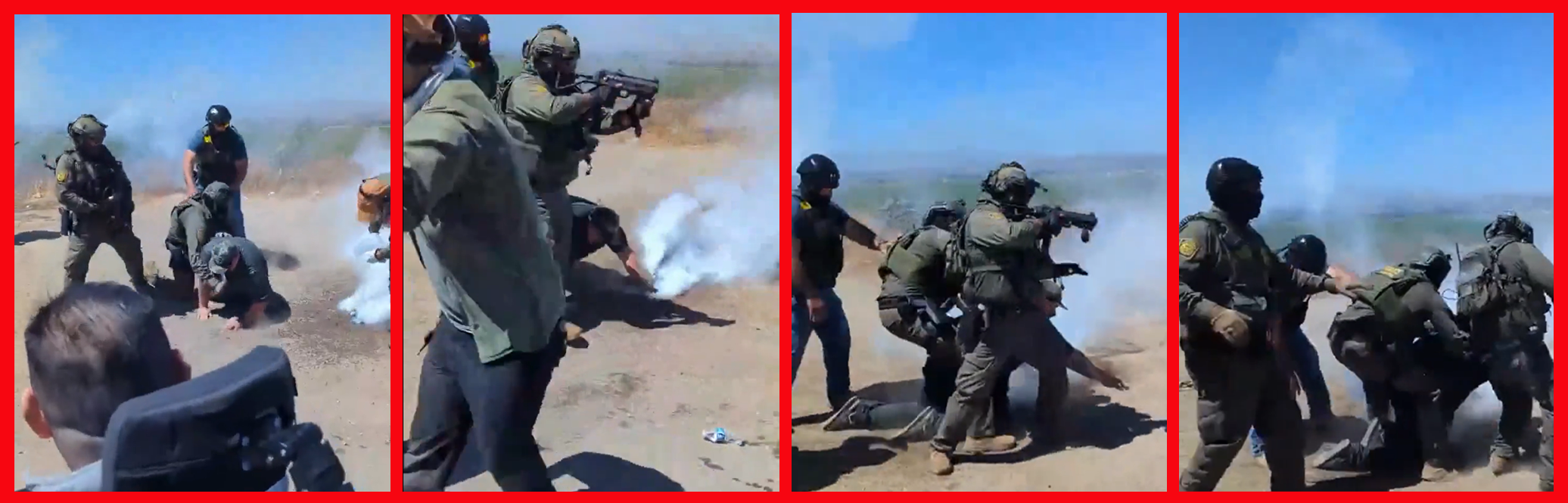
See the HuffPost article for further details.
(via Dan Korman)
UPDATE (4/10/26): Caravello was acquitted on Thursday. LAist reports: “For three days, Caravello’s colleagues, friends, family and students packed the courtroom at the U.S. District Court for the Central District of California. The jury returned a verdict within about two hours, according to Caravello’s attorney, Knut Johnson.” The California Faculty Association issued a statement about the verdict: “The jury’s decision underscores John’s right to peacefully protest and speak out against the cruelty and inhumanity this administration has shown toward immigrants and other marginalized communities across the country.”

This is very reminiscent of the actions of the Israeli Occupation Forces in the Occupied West Bank. First they attack you violently since they know they have full impunity and then prosecute you (or shoot you) if you try to defend yourself. People who pointed that the end result of the normnalization of such brutality in Palestine would be that this brutality would eventually find its way back to the US (and possibly other Western countries in the future) were ridiculed as engaging in “political actvisim” rather than “nuanced arguments”.
That being said, all the solidarity to Jonathan Caravello, whose heroic act of courage was a million times more philosophically significant than all the drivel written by the enlighetened philosophers insisting on the importance of “nuance” in the face of oppression.
I really wanted to let this comment pass, since this thread should not be about Israel. But the sentiment in the comment is disturbing enough, and (incredibly) the response to it positive enough (59 likes and counting), that it needs to be called out.
So, if I understand you, ICE arrests a philosophy professor in California, and the deep force behind that is somehow… wait for it… Israel.
Give me a break.
I’m sorry but Israel, the one tiny Jewish state, is not the deep force behind global oppression. And yes, that’s exactly what you insinuate when you say that Israel’s policy in the West Bank is somehow “find[ing] its way back” to the US and will soon, ominously, find its way to other countries.
What nonsense.
Not that it matters for my point here (i.e., calling out your Israel-as-the-source-of-global-oppression trope) but as I’ve remarked elsewhere, Israel only gained control of the West Bank in response to the immediate threat, by the surrounding states – armed to the teeth by the Soviet Union and with the full support of the Palestinians – to annihilate Israel in one fell swoop. And while I oppose some of the current policies in the WB, they did not arise in a vacuum. To the contrary, they were shaped by decades of relentless terrorism, in which Palestinian militants murdered Israelis in their homes and on their busses.
In fact, to borrow your logic, maybe that’s why ICE is arresting people. Palestinian militants terrorized Israelis for decades. And now look, those actions are finding their way back to America!
Yeah, that’s exactly how bizarre your comment sounds.
Shame on everyone who “liked” it.
Israel is not source of the oppression. The US is in this case since Israeli oppression is able to function exclusively because of American support that grants it impunity. Now, the oppression is back to its source, and Americans can’t keep ignoring it anymore.
I am not gonna bother responding to the West Bank comment. If you think decades of brutal military occupation and illegal settlement that have resulted in de facto apartheid according to the ICJ and all major human and Israeli human rights organization is justfied, then I have nothing more to say. There’s clearly a fundamental clash of values between us.
Thanks for your reply Yazan.
Your initial post appeared to insinuate that global oppression – the ICE crackdowns being your example – has its roots in Israel. That struck me as a kind of demonization of Israel that flirts with wild tropes. Hence my strident response.
I appreciate you clarifying that this is not what you meant.
We still disagree, to be sure. I do not see the US as a source of global oppression. Quite the contrary. And while I oppose some of the current policies on the WB (in particular, the tolerance for fringe settler violence), I view the main elements of Israeli policy there (the checkpoints, the WB barrier wall, etc.) as a defense against terrorism, not as racist apartheid.
But I doubt that either of us will convince the other on these issues.
‘Philosophers have hitherto only interpreted the world in various ways; the point is to change it.’
Thank you for the kind words. You are right that they are employing the very same tactics as the IOF, though of course Palestinians are tried in military courts, if not outright murdered, for far lesser perceived offenses.
This brutality isn’t exactly new. The US empire has been employing these tactics both domestically and abroad for as long as it has existed. Police brutality is as high as ever, with Black and Brown people being murdered by agents of the state almost daily. We are bombing again (not that it ever really stopped). Maybe some new tactics, but same old brutal empire, a dying empire that is gonna go down swinging.
Philosophers being punished for acting on their convictions is not new. It goes back at least to Socrates, who was executed in Athens for what he understood as a moral duty to question and examine, and to Hypatia, who was killed in Alexandria amid political and religious conflict. These cases are often treated as historical anomalies, but they point to a recurring tension: philosophy, when lived rather than merely discussed, can come into direct conflict with power.
What changed for me was the Parr Center for Ethics incident. After that, I became disillusioned with philosophy as it is often practiced institutionally. My focus shifted from studying ethics to studying power and security—less out of theoretical interest and more out of a perceived need for self-protection. I came to see a gap between ethical discourse and ethical action: in many contexts, ethics seemed to function as a professional activity oriented toward publication, status, or abstraction, rather than as a guide to conduct under real conditions of risk.
What I observed—rightly or wrongly—was that acting on one’s ethical commitments in the world is often treated as naïve or even irrational, especially when it conflicts with institutional authority or material incentives. In that sense, the problem is not simply whether someone like Jonathan Caravello is right or wrong in a particular instance, but whether philosophy as a practice equips people to bear the consequences of acting on their reasoning.
I am now returning to philosophy with a different set of questions:
• How are philosophy, power, and security structurally related?
• What conditions are required for ethical reasoning to have practical force, rather than remaining purely discursive?
• How can the gap between learning ethics and enacting it be narrowed?
One way to frame the issue is this: ethical reasoning presupposes a space in which arguments, rather than coercion, determine outcomes. But that space is not self-sustaining—it depends on social, legal, and material conditions that protect participants from retaliation. Without such conditions, those who act on principle are exposed to asymmetric risk, while those who rely on power face fewer constraints.
If that diagnosis is even partly correct, then the question is not only how individuals should act, but what kinds of institutions and norms are needed to make ethical action viable. What would it take to create conditions in which people are compelled to reason together, rather than able to default to force? And what forms of protection—legal, professional, or collective—would be necessary for philosophers, and others, to act on their convictions without facing disproportionate personal risk?
Until those questions are addressed, the distance between ethical theory and ethical practice is likely to remain—and cases like this will continue to feel less like exceptions and more like reminders of an unresolved structural problem.
A lot of this resonates, but for those of us who don’t know, what was “the Parr Center for Ethics incident”? (I tried looking it up but not sure which of the results match what’s being discussed here!)
This is a minor point, but the bail restrictions (ankle monitor, curfew, nightly wakings to log in to an app) imposed on Caravello are unbelievably horrible. Apparently the judge imposed them without any request by pretrial services or even the US government. It’s not news, but it’s just stunning what the government can do to you before you have been found guilty of any wrongdoing.
It seems to me there is some kind of pathology at work when a post like immediately–*immediately*–becomes a re(re)(re)(re)-litigation of Israel-Palestine. Is it just me?
“Like this”. Sorry!
The US is enabling a genocide, and I think it’s a good thing that this is weighing heavily on at least some of us. The moral depravity that allows us to enable a genocide abroad is predictably visible in domestic policy as well.
Excellent news, thanks for the update.